
Key Takeaways
-
Most recovery peptides like BPC-157 and TB-500 lack strong human clinical trials proving they speed workout recovery safely; animal studies and personal stories are not sufficient evidence for human effectiveness.
-
BPC-157 and TB-500 are prohibited substances on the 2026 WADA list (effective January 1, 2026) and banned for competitive athletes at all times, making them illegal for sports competitors.
-
Neither BPC-157 nor TB-500 are FDA-approved drugs; the FDA has raised concerns about immune reactions, impurities, and safety data gaps in peptide products sold online or through compounding.
-
Proven recovery foundations—7-9 hours sleep, adequate protein intake, sufficient calories, rest days, and gradual training progression—are more effective than peptides and should be your priority.
-
Legitimate peptide therapy requires licensed medical oversight with blood work, clear sourcing information, and honest discussion of what's proven; avoid one-size-fits-all dosing and pressure sales tactics.
-
Collagen peptides are a low-risk dietary supplement option that's widely available, though research on joint and tendon benefits is still developing, making them safer than experimental peptides.
You finish a great workout, and then the soreness hits. Maybe it’s a stubborn tendon, a nagging shoulder, or just that deep tired feeling that lingers for days. It’s no surprise that so many people are asking about peptides for workout recovery. Social media makes them sound like magic. But what’s actually true in 2026?
Here’s the friendly, honest answer. Some peptides are talked about a lot in the fitness world, yet the proof in humans is thin. Others are approved medicines with very specific uses. Mixing them up can waste money and even put your health at risk.
In this guide, we’ll walk through 10 peptides and related topics you’ll hear about, plus what the research really says. We’ll also cover safety, sports rules, and smarter ways to recover. If you’re a health optimizer, a biohacker, or a busy professional who wants clear answers, you’re in the right place. Let’s dive in and sort the facts from the hype together.
What Are Peptides, and Why Do Athletes Talk About Them?
Peptides are short chains of amino acids, the building blocks of proteins. Your body makes many of them naturally. They act like tiny messengers, telling cells what to do. If you want a simple primer, what are peptides is a handy starting point, and our own guide, 8 Facts That Explain What Are Peptides in 2026, goes deeper.
When people say peptides for workout recovery, they usually mean products marketed for tendon, ligament, or muscle repair. They also mean peptides that raise growth hormone. Marketing often claims these speed healing. The key word there is claims. A claim is not the same as proof.
Quick Reality Check: Marketing vs. Medical Evidence
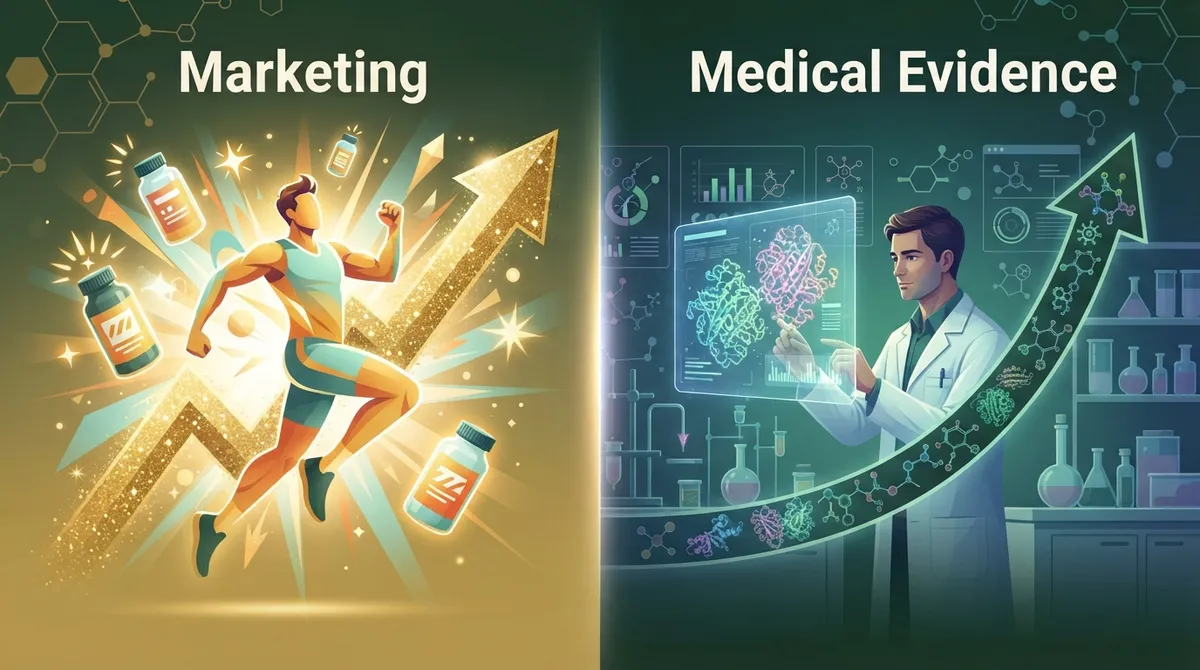
Before we get to the list, here’s the big picture. Most recovery peptides sold online are not FDA-approved drugs. Much of the excitement comes from animal studies and personal stories. Animal results are interesting, but they don’t prove a treatment works in people.
| Type of Evidence | What It Tells Us | How Strong Is It for Humans? |
|---|---|---|
| Marketing claims | What sellers want you to believe | Not evidence |
| Personal stories | What happened to one person | Very weak |
| Animal or lab studies | Early clues worth testing | Weak for people |
| Controlled human trials | Whether it truly works and is safe | Strongest |
For most recovery peptides, the top row of this table is where we are stuck. Keep that in mind as we go.
10 Peptides and Topics for Workout Recovery
1. BPC-157: The Most Talked-About Recovery Peptide
BPC-157 is the name you’ll see everywhere. It’s promoted for tendons, ligaments, muscle, and gut healing. The catch is that we don’t have strong human trials showing it speeds workout recovery safely.
BPC-157 is not an FDA-approved drug. FDA materials also say there is not enough clinical safety information to describe its safety profile. The agency has raised concerns about immune reactions, impurities, and clumping (aggregation) in peptide products. You can learn more in our post 9 BPC-157 Peptide Facts to Know Before You Start.
2. TB-500: Another Popular Name
TB-500 is a version related to thymosin beta-4. Like BPC-157, it’s marketed for muscle and soft-tissue repair. And like BPC-157, it lacks solid human proof for that purpose. It is also not an FDA-approved drug. For a closer look, read 13 Facts About TB-500 Peptide You Need in 2026.
3. Growth Hormone-Releasing Peptides
This group includes peptides like CJC-1295 and ipamorelin. They are designed to nudge your body to release more of its own growth hormone. People hope this helps recovery, sleep, and body composition.
The idea sounds smart, but results vary, and these are best handled under medical guidance with lab work. Our guide on Growth Hormone Peptides: What They Are & How They Work explains the basics.
4. Sermorelin: A Gentler Growth Hormone Approach
Sermorelin also targets your body’s own growth hormone signal. It’s often discussed for sleep and general vitality rather than as a magic fix for sore muscles. Learn more in 10 Sermorelin Peptide Therapy Facts to Know in 2026.
5. Collagen Peptides: The Everyday Food Option
Collagen peptides are a different thing. They’re a dietary supplement made from broken-down collagen. They’re easy to find and widely used, though research on their joint and tendon benefits is still developing. If you like simple, low-risk options, this one may fit your routine.
6. Approved Peptide Medicines vs. Wellness Peptides
Here’s a point many people miss. Some peptide medicines are FDA-approved for specific medical conditions. Those went through safety and effectiveness review. Peptides sold as “research chemicals” for recovery did not. Our comparison, Approved Peptides vs. Wellness Peptides: What Works?, breaks this down clearly.
7. Compounded Peptides: Not the Same as FDA-Approved
Compounding is often misunderstood. A compounded product is not the same as an FDA-approved drug. FDA has looked at BPC-157 in the context of its 503A bulk substances list, with a proposal not to include it. A nomination or advisory discussion does not make a drug safe or authorized.
Want the full picture? See FDA-Approved vs. Compounded Peptides: What Wins? and 503A vs. 503B: Which Peptide Compounding Wins?
8. Anti-Doping Rules: A Big Deal for Athletes
If you compete, pay attention. The 2026 WADA Prohibited List took effect January 1, 2026. It names BPC-157 under S0 and thymosin-beta-4 derivatives like TB-500 under S2.3. Both are prohibited at all times.
Rules can change, so always check the current list with your anti-doping organization before using anything. Our article Is BPC-157 Safe and Legal for Athletes to Use? covers this topic in more depth.
9. Safety Questions: Injections, Nasal Sprays, and Sourcing
Where a product comes from matters a lot. Products with unclear sourcing, odd formulas, or poor storage raise the risk of impurities. This is especially true for injectables and nasal products. Before you start anything, learn How to Prepare for Safe, Effective Peptide Injections and read Is Peptide Therapy Safe? What You Really Need to Know.
10. Evidence-Based Recovery Basics (Your Real Foundation)
This last one isn’t a peptide at all. It’s the habits that actually move the needle. Peptides, even if proven, would sit on top of these basics, not replace them.
- Sleep 7 to 9 hours. Most repair happens while you rest.
- Eat enough protein. Spread it across your meals.
- Fuel with enough calories. Under-eating slows recovery.
- Plan rest days. Progress needs recovery time.
- Ramp up training slowly. Sudden jumps cause injuries.
- See a clinician for pain that lingers. A proper exam beats guessing.
If you’re curious about how muscle-focused options compare, check out How to Evaluate Muscle Recovery Peptides Safely.
BPC-157 vs. TB-500 at a Glance
People often ask how these two compare. Here’s a simple side-by-side look, based on what is and isn’t known.
| Feature | BPC-157 | TB-500 |
|---|---|---|
| Common marketing claim | Tendon, ligament, muscle, and gut repair | Muscle and soft-tissue repair |
| FDA-approved drug? | No | No |
| Strong human trials for workout recovery? | Not established | Not established |
| 2026 WADA status | Prohibited at all times (S0) | Prohibited at all times (S2.3) |
| Main concern | Limited safety data, impurities, immune reactions | Limited human data, sourcing quality |
For a deeper side-by-side, see BPC-157 vs. TB-500: Which Peptide Actually Wins?
Who Should Be Extra Careful?
Some groups need to be especially thoughtful about recovery peptides:
- Competitive athletes who can be tested and face bans.
- People with health conditions or who take other medications.
- Anyone buying online from sellers with no medical oversight.
- Aging adults who may have more complex health needs.
The safest path starts with a real conversation with a licensed provider and up-to-date lab work. That’s a theme you’ll see again and again in good care. Our guide How to Get Prescription Peptides Safely in 2026 shows what a careful process looks like.
How to Spot a Legitimate Peptide Product or Provider
With so much noise out there, a simple checklist can protect you. Here is a quick tool you can use anytime.
| Green Flag | Red Flag |
|---|---|
| Licensed medical provider reviews your history | No medical review at all |
| Blood work guides your plan | One-size-fits-all dosing |
| Honest about what is and isn’t proven | Promises of fast, guaranteed healing |
| Clear sourcing and pharmacy information | Labeled “for research use only” |
| Ongoing monitoring and follow-up | Pressure to buy quickly |
You can learn how others approach this in How to Verify FDA Approval Before Peptide Therapy.
A Smarter Way to Think About Recovery
Here’s a friendly mindset shift. Instead of asking, “Which peptide will fix my soreness?” try asking, “What is my body telling me, and what does my data say?” That’s the biohacker’s approach, and it works for everyone.
Start with the basics, track your sleep and training, and get labs done. If something feels off, such as a lasting tendon ache or unusual fatigue, see a clinician. Often the real answer is a training tweak, better nutrition, or a medical check, not a trendy injection.
For busy professionals, this is where telehealth shines. You can talk to a licensed provider from home and avoid long clinic waits. Our post Local Clinic vs. Telehealth: Best Peptide Therapy Near You? compares both paths. If you want to understand how studies are done, the National Library of Medicine hosts a wide range of peer-reviewed research you can read yourself.
Where Allura Longevity Fits In
At Allura Longevity, we believe in personalized, medically supervised care. Our telehealth team starts with a $50 virtual consultation and LabCorp blood work. Then a licensed provider, led by board-certified Family Nurse Practitioner Ashley, builds a customized six-month plan based on your labs and goals.
We’re honest about the science. We’ll talk through what’s proven, what’s still being studied, and what makes sense for you. We serve clients in Florida, Georgia, Texas, Connecticut, Indiana, Maryland, New York, and California. You can also explore options like peptides for men or peptides for women, and learn How to Start Peptide Therapy Safely and See Real Results.
Final Thoughts: Recover Smart, Not Fast
The honest truth about peptides for workout recovery in 2026 is that the hype is bigger than the proof. BPC-157 and TB-500 are not FDA-approved, have limited human evidence for recovery, and are banned in competitive sport. That doesn’t mean you can’t take care of your body. It means you should lean on proven habits and qualified medical guidance first.
Ready for a personalized, evidence-minded plan? Request a consultation with Allura Longevity today, or call (813) 510-6277. New client spots are limited each month, so reach out soon. Your recovery deserves real answers, and we’re here to help you find them.
FAQs
Q: Do peptides like BPC-157 actually help workout recovery?
A: Right now, no strong human clinical trials show that BPC-157 safely speeds workout recovery. Most of the excitement comes from animal studies and personal stories, which don’t prove it works in people. It’s best to talk with a licensed provider before trying anything.
Q: Is BPC-157 FDA-approved for injury or muscle recovery?
A: No, BPC-157 is not an FDA-approved drug. FDA materials also note there isn’t enough clinical safety information to fully describe its safety profile. Being compounded or sold online doesn’t mean a product is approved.
Q: Are BPC-157 and TB-500 banned in sports?
A: Yes. The 2026 WADA Prohibited List, effective January 1, 2026, names BPC-157 under S0 and TB-500 under S2.3, both prohibited at all times. Rules can change, so always check the current list with your anti-doping organization.
Q: What are evidence-based alternatives to peptides for muscle or tendon recovery?
A: Quality sleep, enough protein and calories, planned rest days, and gradual training increases are the proven basics. If you have lingering pain, a licensed clinician can give you a proper exam and a treatment plan that fits you.
Q: How can I tell whether a peptide product is legitimate?
A: Look for licensed medical oversight, blood work guiding your plan, clear sourcing, and honest talk about what is and isn’t proven. Be cautious of products labeled “for research use only” or sellers who promise fast, guaranteed healing.





