

Key Takeaways
-
A legitimate at-home peptide program starts with a licensed clinician’s remote evaluation, lab work, and a real prescription filled by a licensed pharmacy, not vials bought online.
-
Compounded peptides are not FDA-approved, and the FDA does not review them for safety, effectiveness, or quality before they are marketed.
-
Never use or inject products labeled “research use only”; they are not made for humans and carry no guarantees of purity, strength, or sterility.
-
The FDA has flagged concerns for compounded peptides, including immunogenicity, hard-to-detect impurities, and limited human safety data, with ipamorelin and BPC-157 cited specifically.
-
Green flags include blood-work-guided plans, honest risk discussions, and scheduled follow-ups; red flags include no medical review, one-size-fits-all packages, and guaranteed fast results.
-
Before enrolling, ask which pharmacy prepares your medication, whether the peptide is FDA-approved or compounded, what human evidence supports your goal, and how you will report side effects.
You have a busy life. Between work, family, and everything else, driving to a clinic for every appointment just is not realistic. So when you hear that an at home peptide therapy program can bring care right to your door, it sounds almost too good to be true.
Here is the honest truth: convenience is great, but convenience alone does not make something safe. A box arriving on your porch does not tell you whether the medicine inside is approved, properly made, or right for your body.
The good news? A well-run program can be a smart, simple way to get care. The key is knowing what to look for. In this friendly guide, we will walk through what an at-home program really is, what the FDA says about peptides, the red flags to avoid, and how to tell the good programs from the risky ones. Let’s get started!
What Is an At-Home Peptide Therapy Program?
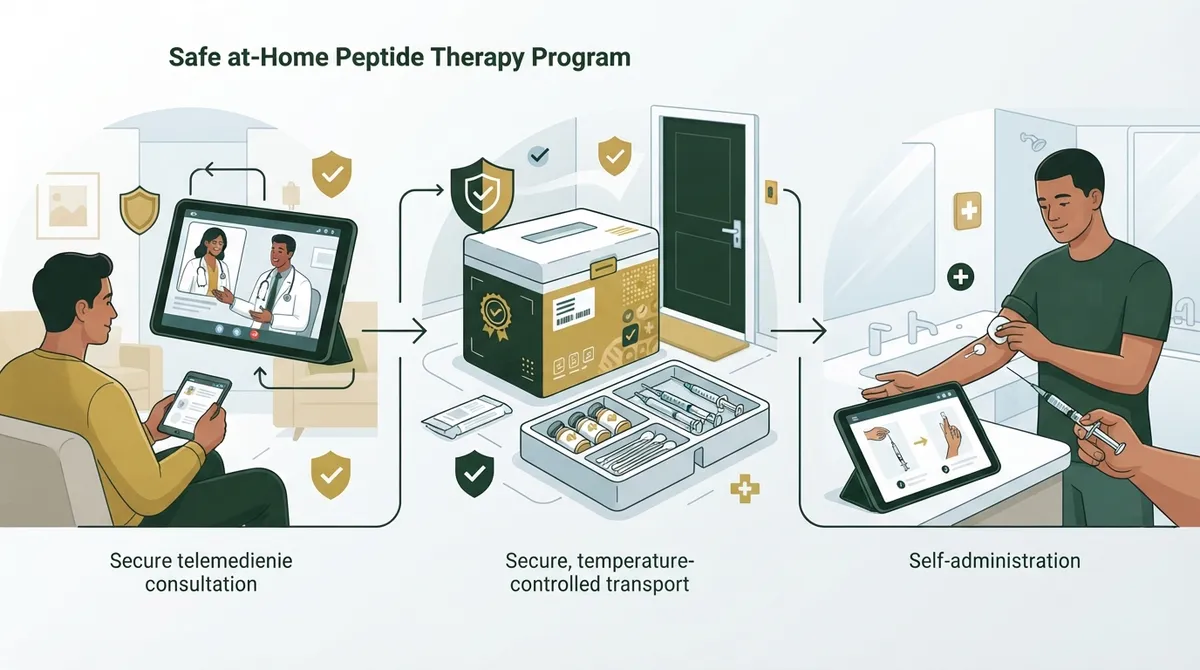
An at-home peptide therapy program is a medical care model. A licensed clinician reviews your health remotely, prescribes a medication when it is appropriate, and arranges for a pharmacy to send it to your home. You then use it at home with clear instructions and ongoing support.
Notice what that does not mean. It does not mean ordering vials online and guessing at doses. It also does not mean buying products labeled “research use only.” Those are not meant for people, and they skip the safety steps that protect you.
If you are brand new to the topic, our guide on What Makes Peptides Therapeutic? The Science Explained is a great place to start. You can also read the basics at what are peptides from WebMD.
The Basic Flow of a Good Program
- Remote evaluation: A licensed provider reviews your history, medications, and goals.
- Lab work: Blood tests show what your body actually needs.
- Prescription: If a peptide is appropriate, the provider writes a legitimate prescription.
- Pharmacy fulfillment: A properly licensed pharmacy prepares and ships it.
- Home use with guidance: You get clear storage, injection, and disposal instructions.
- Follow-up: Your provider checks in and adjusts the plan over time.
Want more detail on this process? See How to Get Prescription Peptides Safely in 2026.

Why More People Are Choosing the At-Home Route
Different people come to this for different reasons. Here is how the convenience of home care fits real lives:
- Busy professionals: Virtual visits fit between meetings, with no waiting rooms.
- Health optimizers and biohackers: Lab-guided plans let you track progress with real data.
- Aging adults: Care from the comfort of home means fewer trips and less stress.
- Wellness seekers: Personalized plans build on the supplements and habits you already follow.
If you are weighing options, our comparison of Local Clinic vs. Telehealth: Best Peptide Therapy Near You? can help you decide what fits best.
Can a Doctor Prescribe Peptides Through Telehealth?
Yes, a licensed clinician can evaluate patients and prescribe through telehealth when it is clinically appropriate and allowed under state and federal rules. Telehealth does not remove the usual medical duties. A good provider still checks your history, current medications, possible risks, and follow-up needs.
Where you live matters too. Prescribing rules vary by state, and a provider must be licensed where you receive care. Learn more in Which States Allow Telehealth Peptide Prescriptions?
Not All Peptides Are the Same: Approved vs. Unapproved
This is the part many people miss. The phrase “peptide therapy” covers very different products. Some peptide-based medicines are FDA-approved for specific conditions. Many peptides sold in the wellness world are not approved for the uses they are advertised for.
| Category | What It Means | Examples | What to Know |
|---|---|---|---|
| FDA-approved peptide medicines | Reviewed by the FDA for safety and effectiveness for specific conditions | Certain GLP-1 medicines for diabetes or weight management | Approved for defined uses, with known risks and benefits |
| Compounded peptides | Made by a pharmacy for an individual patient; not FDA-approved | Compounded versions of some medications | FDA does not review them for safety, effectiveness, or quality before they are marketed |
| Wellness-marketed peptides | Often sold for anti-aging, recovery, or muscle gain | BPC-157, CJC-1295, ipamorelin | Not FDA-approved medicines for the advertised uses |
| Research-use-only products | Labeled not for human use | Online vials sold without a prescription | Avoid; no clinical oversight or quality assurance |
For a deeper look, read FDA-Approved vs. Compounded Peptides: What Wins?
What the FDA Says About Compounded Peptides
Compounded drugs are not FDA-approved. The FDA does not review them for safety, effectiveness, or quality before they reach the market. Compounding is also limited by law. It is generally meant to meet an individual patient’s medical need when an approved drug is not suitable or available.
The FDA separates compounding into two groups. Section 503A covers state-licensed pharmacies, and section 503B covers outsourcing facilities. Each has rules about which bulk drug substances can be used. You can read the details on the FDA’s page about bulk drug substances used in compounding. We also break down the difference in 503A vs. 503B: Which Peptide Compounding Wins?
Safety Concerns the FDA Has Flagged
The FDA has identified possible safety concerns for certain compounded peptides, including:
- Immunogenicity: The body may react to the peptide as if it were foreign.
- Impurities: Peptide-related impurities can be hard to detect.
- Characterization challenges: It can be difficult to fully describe the active ingredient.
- Limited human safety data: For some peptides, there is not much information on how they affect people.
For example, the FDA notes limited safety information for BPC-157. For ipamorelin, the FDA points to route-specific uncertainty and reports of serious events, including death, in a study that used intravenous administration for gastric motility. You can see the agency’s full discussion in its page on bulk drug substances that may present significant safety risks.
None of this means you should panic. It means you should ask good questions and work with a provider who takes safety seriously. To learn more about specific compounds, see Is BPC-157 Safe? What the Research Really Shows and Ipamorelin Peptide Therapy: Benefits, Dosing & Safety.
A Real-World Reminder From GLP-1 Compounding
Even peptide-based products that have approved versions can carry risks when they are compounded or dosed incorrectly. The FDA has reported receiving multiple adverse event reports, some involving hospitalization, that may be linked to dosing errors with compounded injectable semaglutide. The FDA shares its concerns on its page about unapproved GLP-1 drugs used for weight loss.
The lesson is simple. Clear dosing instructions, a quality pharmacy, and a provider who monitors you really do matter. If you are curious about weight-related options, check out How to Understand GLP-1 Peptide Therapy in 2026.
What a Safe Home Injection Program Should Include
Injecting at home can feel intimidating at first, and that is completely normal. A responsible program makes it far less scary by giving you everything you need. Here is a checklist you can use:
- A legitimate prescription from a licensed clinician who has reviewed your health.
- A properly licensed pharmacy that prepares and ships your medication.
- Clear storage instructions so your medication stays stable (many need refrigeration).
- Step-by-step administration guidance that shows you how to inject safely.
- Sharps disposal instructions so used needles are handled safely.
- A way to report side effects quickly and get real answers.
- Scheduled follow-ups to review how you feel and adjust your plan.
New to injections? Our walkthrough on How to Prepare for Safe, Effective Peptide Injections and 12 Subcutaneous Peptide Injection Mistakes to Avoid will help you feel confident. You can also dive into How to Get Peptides Administered Safely at Home.
One Firm Rule: No Research-Use-Only Products
Please never reconstitute or inject anything labeled “research use only.” Those products are not made for human use, and there is no promise about purity, strength, or sterility. If a seller offers peptides with no prescription and no questions, that is your cue to walk away.
Red Flags vs. Green Flags
Use this quick table to size up any program you are considering.
| Green Flags (Good Signs) | Red Flags (Be Careful) |
|---|---|
| Licensed clinician reviews your history and goals | No medical review or only a short online quiz |
| Blood work guides your plan | One-size-fits-all packages |
| Medication comes from a licensed pharmacy | Products labeled “research use only” |
| Honest talk about risks and unknowns | Guarantees of fast, dramatic results |
| Scheduled follow-ups and adjustments | No check-ins after you buy |
| Clear informed consent | Vague answers about what you are receiving |
You can also browse How Do You Know Online Peptide Therapy Is Safe? and How to Find Legal Peptide Therapy You Can Trust for even more tips.
How to Judge the Big Promises
Peptide marketing loves big claims: faster healing, younger skin, more muscle, better energy. Before you believe them, ask a few simple questions:
- Is there human clinical evidence for this exact compound?
- Does the evidence match the dose and route being offered?
- Was the study done on the same condition you want to treat?
Animal and lab findings are interesting, but they do not prove a treatment is safe or effective in people. A trustworthy provider will tell you what is known, what is not, and where the evidence is thin. For an academic look at peptides in medicine, see this overview from the National Library of Medicine. AARP also offers a plain-language piece on whether peptides are safe for older adults.
Curious how timing works in real life? Read How Long for Peptide Therapy Results? A Real Timeline.
Why Lab Work Comes First
If you are a data lover, you will appreciate this part. A good program starts with your numbers, not a guess. Blood work helps your provider see your hormone levels, metabolic markers, and other signals so the plan fits you. It also gives a baseline, so you can see what changes over time.
Want to understand why this step matters? Take a look at 5 Blood Work Analysis Steps Before Peptides in 2026 and How to Use Biomarker Testing to Guide Peptide Therapy.
How Allura Longevity Approaches At-Home Care
At Allura Longevity, we believe home care should still feel like real medical care. Our model starts with a $50 virtual consultation. From there, you complete blood work through LabCorp, and a licensed provider builds a customized six-month plan around your results and goals. Your treatment is delivered to your home, and your plan is monitored and adjusted along the way.
Our care is led by Ashley, a board-certified Family Nurse Practitioner. We offer peptides for women and peptides for men, supporting goals like energy, sleep, mental clarity, immune function, skin rejuvenation, muscle recovery, metabolism, and sexual wellness. We are licensed in Florida, Georgia, Texas, Connecticut, Indiana, Maryland, New York, and California.
Not sure where to begin? Our guide on How to Start Peptide Therapy the Smart, Safe Way walks you through it.
Questions to Ask Before You Sign Up
Bring these to any consultation. A confident, honest provider will welcome them:
- Which pharmacy prepares my medication, and is it licensed?
- Is this peptide FDA-approved, or is it compounded?
- What does the human evidence say for my goal?
- What are the risks, and how will I report side effects?
- How often will we check in, and what labs will we repeat?
For more ideas, see 15 Peptide Consultation Questions to Ask in 2026.
Ready to Take the Next Step?
An at-home peptide therapy program can be a wonderful fit when it is built on real medical care: a licensed provider, quality pharmacy, honest talk about risks, and steady follow-up. You deserve care that is both convenient and careful. Remember, the smartest move is not the fastest one; it is the safest one.
If you would like personalized, medically supervised care from the comfort of your home, we would love to help. Spots for new clients are limited each month, so request a consultation today or call (813) 510-6277 to get started.
FAQs
Q: What is an at-home peptide therapy program?
A: It is a care model where a licensed clinician evaluates you remotely, prescribes a medication when appropriate, and has a pharmacy ship it to your home. You get instructions and follow-up care, so you are never left guessing. It should never mean buying research-use-only products on your own.
Q: Are at-home peptide therapy programs safe?
A: They can be safe when run by licensed providers using properly licensed pharmacies, with clear instructions and regular follow-up. Safety depends on the specific peptide, the quality of the pharmacy, and the oversight you receive. Home delivery alone does not make a product safe or FDA-approved.
Q: Are BPC-157, ipamorelin, and CJC-1295 FDA-approved?
A: No, these are not FDA-approved medicines for the uses they are often marketed for. The FDA has also noted safety concerns and limited human data for certain compounded peptides. Always talk with a licensed provider about the evidence and risks before considering them.
Q: What should I look for in a peptide therapy provider or pharmacy?
A: Look for a licensed clinician who reviews your history and labs, a properly licensed pharmacy, and honest talk about risks. You also want clear injection and storage guidance, sharps disposal tips, and scheduled follow-ups. Walk away from anyone selling research-use-only products or promising guaranteed results.
Q: What are the risks of injecting peptides at home?
A: Risks can include dosing errors, contamination, allergic or immune reactions, and side effects from the peptide itself. These risks grow with unregulated products and poor instructions. A good program lowers them with a legitimate prescription, quality pharmacy, proper training, and ongoing monitoring.





