

Key Takeaways
-
Peptides become therapeutic only when three conditions align: a defined molecular sequence with quality control, engagement with a relevant biological target, and human evidence proving effectiveness at a specific dose and route—the word 'peptide' alone guarantees neither safety nor efficacy.
-
Peptides work through precision signaling by binding to specific receptors like a key in a lock, potentially causing fewer off-target effects than broad-spectrum drugs, but this selectivity only matters if backed by human clinical data for that exact molecule.
-
Most peptide medicines require injection because digestive enzymes destroy them and they cannot cross cell membranes effectively, making delivery method, dose, and formulation critical to therapeutic success and why oral peptide supplements deserve skepticism.
-
Over 80 peptide drugs are FDA-approved worldwide with 200+ in clinical development, but compounded peptides sold online lack FDA approval and carry undisclosed risks including impurities, immune reactions, and limited safety data—they should never be equated to approved medicines.
-
Evidence is specific to each peptide's exact formulation, dose, route, and condition, so lab or animal studies do not prove human efficacy, and success with one peptide cannot be assumed for another treating the same problem.
-
Personalized medical oversight with baseline blood work and licensed provider monitoring is essential because outcomes depend on individual age, labs, goals, and health history—one-size-fits-all peptide protocols are ineffective and potentially unsafe.
You have probably heard the buzz. Peptides are showing up in medical journals, wellness podcasts, and group chats. But here is the question that really matters: what makes peptides therapeutic, and what is just marketing noise?
If you are a health optimizer, a busy professional, or someone who simply wants to feel good as the years go by, you deserve a clear answer. The good news is that the science behind peptides is genuinely fascinating. The honest news is that not every product with the word “peptide” on the label is proven to work.
In this guide, we will walk through how peptides act as tiny messengers in your body, why some become real medicines, and where the evidence is strong or thin. Think of it as a friendly chat with someone who wants you to make smart, safe choices. Let’s dive in!
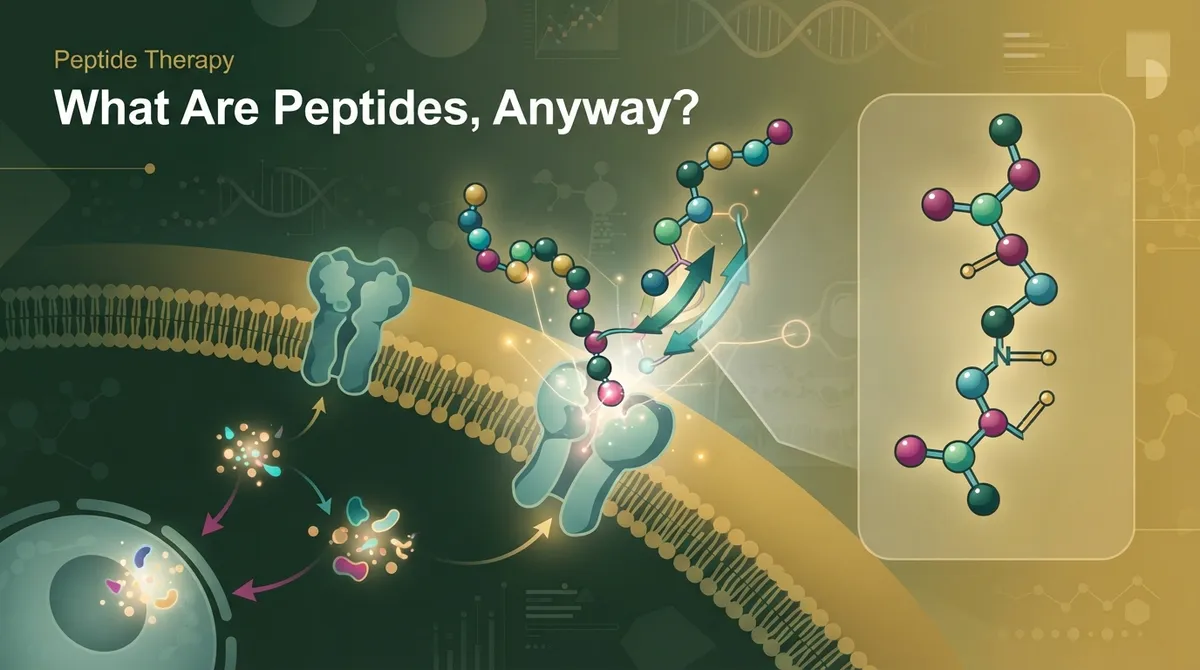
What Are Peptides, Anyway?
Peptides are short chains of amino acids. Amino acids are the building blocks of protein. When a few of them link together, you get a peptide. When many link together and fold into a complex shape, you get a protein.
Researchers often describe peptide drugs as having roughly 2 to 50 amino acids. That range is a handy rule of thumb, not a strict legal definition. If you want a plain-language primer, you can read what are peptides from WebMD, or check out our own guide, 8 Facts That Explain What Are Peptides in 2026.
Here is why peptides matter. Your body already makes many of them. Many act as signaling molecules or hormones. They carry short messages from one part of the body to another, such as “release insulin” or “slow down appetite.”

So, What Makes Peptides Therapeutic?
A peptide becomes therapeutic when three things line up:
- A defined molecule. The exact amino-acid sequence is known, made with quality control, and consistent from batch to batch.
- A relevant target. The peptide engages a receptor or pathway that actually matters for a health issue.
- Human evidence. Studies show that changing that target improves a specific condition or symptom, at a certain dose, by a certain route.
Notice what is missing from that list. The word “peptide” alone does not make something effective or safe. A peptide is a category of molecule, not a guarantee. Each one has to earn its place through evidence.
The Lock-and-Key Superpower: Precision Signaling
The biggest reason peptides can be therapeutic is precision. Many peptides work like a key that fits one specific lock, called a receptor. When the key turns, the cell gets a message and responds.
This high selectivity is a big plus. A well-designed peptide can mimic, replace, or fine-tune a natural signal in your body. Because it targets a specific receptor, it may cause fewer off-target effects than a drug that hits many pathways at once.
Peptides can influence many everyday processes, including:
- Blood sugar regulation
- Appetite and fullness signals
- Blood pressure
- Immune activity
- Tissue growth and repair
Real-World Proof: Approved Peptide Medicines
This is not just theory. Peptide medicines are already part of modern care. A 2025 review reports that, as of 2023, more than 80 peptide drugs had been approved worldwide, with more than 200 candidates in clinical development. Exact counts vary depending on how “peptide” is defined.
Here are a few well-known examples:
| Peptide Medicine | How It Works | Approved Use (General) |
|---|---|---|
| Insulin | Replaces a natural hormone that moves sugar into cells | Diabetes management |
| Semaglutide | Activates GLP-1 receptors | Type 2 diabetes and weight management (specific products have specific approvals) |
| Tirzepatide | Acts at both GIP and GLP-1 receptors | Type 2 diabetes and weight management (specific products have specific approvals) |
These medicines went through formal FDA review for defined uses. That is the gold standard. If you are curious how GLP-1 options work, our guide on How to Understand GLP-1 Peptide Therapy in 2026 breaks it down simply.
How Scientists Make Peptides Work Better as Medicines
Here is a little challenge. Natural peptides are often fragile. Enzymes in your body can break them down fast, so their half-life is short. They also struggle to cross cell membranes.
To fix this, scientists can engineer peptides. They may change the sequence or structure so the peptide resists breakdown or lasts longer in the body. These tweaks can make a peptide more useful as a medicine.
But here is an important point. These design changes need product-specific testing. A clever design does not prove clinical benefit on its own. The proof comes from human studies of that exact product.
Why Delivery, Dose, and Formulation Matter
Because peptides break down easily and cross membranes poorly, how you take them matters a lot. Many are given by injection so they reach the bloodstream intact. Others need specialized delivery methods.
Dose and formulation matter too. The same peptide can act very differently depending on how much you take, how it is made, and how it is delivered. That is one reason you cannot assume results from one product will carry over to another. For a practical look at technique, see How to Prepare for Safe, Effective Peptide Injections.
Why Injections Are Common
Think of your stomach like a busy recycling plant. Peptides taken by mouth often get chopped up by digestive enzymes before they can do their job. Injections bypass that step. That is why many approved peptide medicines are injected, and why claims about oral peptide supplements deserve a careful look. Our article 8 Facts: Peptide Injections vs Oral Peptides (2026) explores this in more detail.
Peptide vs. Protein vs. Small-Molecule Drug
It helps to see how peptides compare with other medicine types. They sit in a sweet spot between the two.
| Feature | Small-Molecule Drug | Peptide | Protein (Biologic) |
|---|---|---|---|
| Size | Very small | Medium (about 2 to 50 amino acids) | Large |
| Target selectivity | Varies | Often high | High |
| Common delivery | Often by mouth | Often injection | Usually injection |
| Breakdown in the body | Varies | Often rapid unless engineered | Varies |
The Big Caveat: Evidence Is Specific
Now for the honest part. Evidence belongs to a specific molecule, dose, route, formulation, and condition. Results from a lab dish or an animal study do not prove a peptide works in people. And success with one peptide does not mean another one will treat the same problem.
This is where many wellness claims go too far. Some peptides promoted online are sold as “research” products with little human data behind them. They should not be presented as established therapy.
Safety Questions to Take Seriously
The FDA has raised concerns about certain compounded peptides, including possible immune reactions, impurities, and limited human safety and effectiveness data. FDA materials note that route, formulation, aggregation, and impurities can all affect immune-response risk. Injected routes generally raise more concern than oral ones.
In rare, serious cases, unwanted immune responses can be life-threatening, such as anaphylaxis. Compounded products are not FDA-approved, and they should not be treated as equivalent to approved medicines. For a deeper comparison, read FDA-Approved vs. Compounded Peptides: What Wins? You can also explore research summaries through the National Library of Medicine.
How to Judge Whether a Peptide Is Truly Therapeutic
Want a simple checklist? Here is how to size up any peptide before you consider it:
- Name the exact peptide. Vague “peptide blends” make evidence hard to check.
- Ask about the condition. What specific issue is it meant to address?
- Look for human studies. Lab and animal data are a starting point, not proof.
- Check the approval status. Is it FDA-approved for a defined use, or is it compounded?
- Confirm the source. Quality, purity, and licensed oversight matter.
- Get baseline labs. Blood work helps show whether a plan fits your body.
That last step is a favorite among our biohackers and data-driven readers. Learning your numbers first lets you track real change over time. See 5 Blood Work Analysis Steps Before Peptides in 2026 for a helpful walkthrough.
Why Personalization and Medical Oversight Matter
Because outcomes depend on the specific peptide, dose, and person, one-size-fits-all rarely works. Your age, labs, goals, and health history all shape what makes sense. A licensed provider can weigh benefits and risks, adjust your plan, and monitor how you respond.
This is where telehealth shines for busy people. You can get expert guidance without sitting in a waiting room. If you are weighing your options, Local Clinic vs. Telehealth: Best Peptide Therapy Near You? is a useful read, and How to Start Peptide Therapy Safely and See Real Results covers the first steps.
How Allura Longevity Approaches Peptide Therapy
At Allura Longevity, we believe the best peptide care is personalized and medically supervised. Clients begin with a $50 virtual consultation and complete blood work through LabCorp. Then a licensed provider designs a customized six-month plan, led by Ashley, a board-certified Family Nurse Practitioner. Your treatment is delivered to your door, with ongoing monitoring and adjustments along the way.
Our programs can support goals like energy, sleep, mental clarity, immune function, skin rejuvenation, muscle recovery, metabolism, and sexual wellness. We also offer GLP-1 medications for weight loss, BPC-157 for injury recovery, and testosterone replacement. Whether you are exploring peptides for women or peptides for men, care is tailored to you. We are licensed in Florida, Georgia, Texas, Connecticut, Indiana, Maryland, New York, and California.
Putting It All Together
So, what makes peptides therapeutic? It comes down to precise biology plus real proof. A peptide earns the label “therapeutic” when a defined molecule hits a meaningful target, and good human evidence shows it helps a specific condition at a specific dose and route.
Peptides are exciting, and they already power some of the most important medicines of our time. But the word alone is not a promise. Stay curious, ask smart questions, and lean on licensed professionals who put your safety first.
Ready to see if a personalized plan fits your goals? Spots for new clients are limited each month, so request a consultation with Allura Longevity today, or call (813) 510-6277. We would love to help you feel your best.
FAQs
Q: What are therapeutic peptides, and how do they work?
A: Therapeutic peptides are short chains of amino acids used to mimic, replace, or fine-tune natural signals in the body. They usually work by binding to specific receptors, like a key in a lock, which triggers a targeted response. Their value depends on evidence for the exact peptide, dose, and condition.
Q: Are compounded peptides FDA-approved or proven to work?
A: No. Compounded peptides are not FDA-approved, and they should not be considered equivalent to approved medicines. The FDA has raised concerns about some of them, including possible impurities, immune reactions, and limited human safety and effectiveness data.
Q: Why are many peptide medicines given by injection?
A: Peptides are often broken down by digestive enzymes and struggle to cross cell membranes. Injection helps them reach the bloodstream intact so they can do their job. Dose and formulation matter too, which is why delivery is such a big part of how peptides perform.
Q: Are peptide therapies safe, and what side effects can they cause?
A: Safety depends on the specific peptide, dose, source, and your health history, so no single answer fits every product. Possible concerns include injection-site reactions, immune responses, and quality issues with unregulated products. Working with a licensed provider and getting baseline blood work helps lower risk.
Q: What evidence should I look for before considering a peptide treatment?
A: Look for human studies on the exact peptide for your specific condition, not just lab or animal research. Check whether it is FDA-approved for a defined use or compounded, and confirm the source and quality. A licensed medical provider can help you weigh the benefits and risks.





