
Key Takeaways
-
Oral collagen peptides have the most human research and may modestly improve skin hydration, elasticity, and wrinkles, typically measured after about 8 to 12 weeks.
-
Many promising collagen-peptide results come from industry-funded trials; a 2025 meta-analysis found no significant effect in studies without pharmaceutical-company funding.
-
'Peptide therapy' covers very different products (oral collagen, topical signal peptides, injectables), and evidence from one type does not transfer to another.
-
Injectable peptides like BPC-157 and TB-500 are not established as collagen boosters in people, and FDA material notes limited clinical safety information.
-
Compounded peptides are not FDA-approved for safety, effectiveness, or quality before sale, so working with a licensed clinician and verified products matters.
-
Daily habits like sunscreen use, adequate protein and vitamin C, good sleep, not smoking, and limiting sugar support collagen regardless of any peptide plan.
You have probably seen the buzz. Peptides are everywhere, and many people hope they can bring back firmer, smoother skin. It is a fair hope. Collagen is the protein that gives skin its bounce, and levels slowly drop as we age. So how does peptide therapy boost collagen, and what is actually proven?
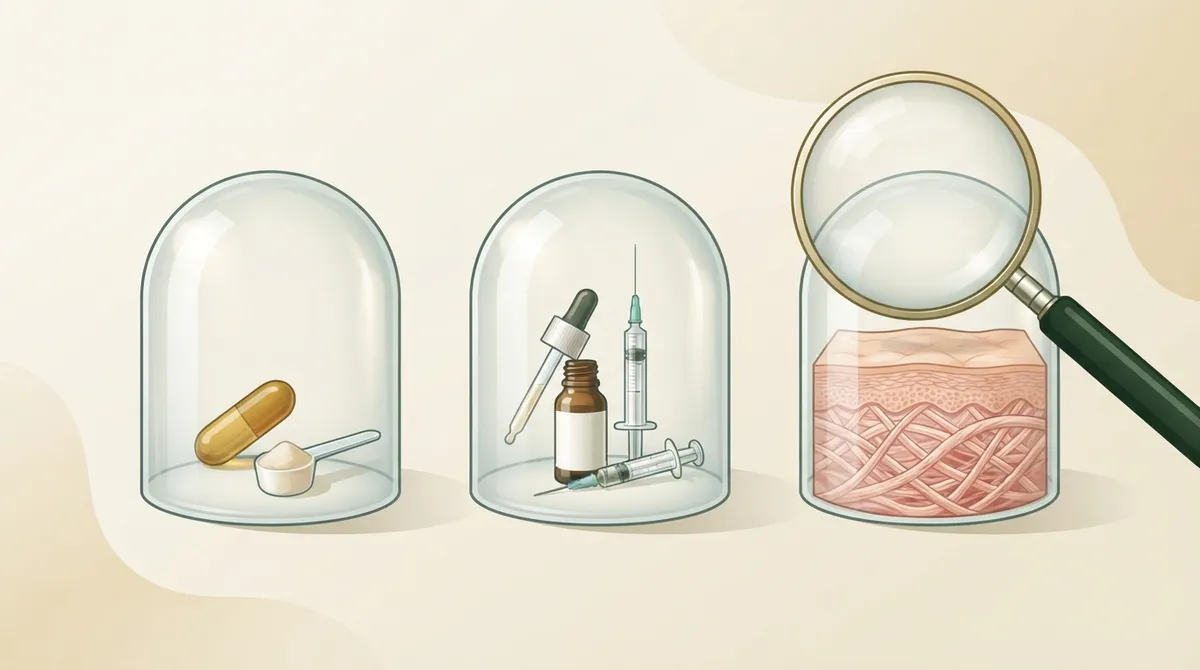
Here is the honest answer. “Peptide therapy” can mean very different things. It might mean oral collagen peptides, skin creams with signal peptides, or prescription injections. Each works in a different way, and each has a different level of evidence.
In this guide, we will keep things simple and friendly. You will learn how each type may support collagen, what 2024 and 2025 research really found, where the science is still thin, and how to talk to a licensed provider about a safe plan. If you are a busy professional, a health optimizer, or just curious about aging well, this is for you.

What Collagen Does and Why It Declines
Collagen is the main structural protein in your skin, joints, tendons, and bones. In skin, it sits in the dermis, the layer under the surface. It acts like a scaffold that keeps skin firm and springy.
As we age, fibroblasts (the cells that make collagen) slow down. Sun exposure, stress, poor sleep, smoking, and sugar-heavy diets can speed up the loss. Hormone shifts in midlife can also play a role, especially for women.
Common signs of lower collagen include:
- Fine lines and deeper wrinkles
- Skin that feels thinner or less elastic
- Dryness and dullness
- Slower recovery from small skin injuries
Knowing this helps you see why peptides get so much attention. They are tied to the signals and building blocks that collagen needs.

What Are Peptides, Exactly?
Peptides are short chains of amino acids. Proteins are just much longer chains. Your body makes many peptides on its own, and they act as messengers between cells. For a simple overview, see this guide on what are peptides.
Here is the key point for this topic. The word “peptide” covers a huge range of products. Evidence for one type does not carry over to another. Let us look at the three main types.
| Type | How It’s Used | Proposed Collagen Link | Evidence Level |
|---|---|---|---|
| Oral collagen peptides | Powder, capsule, or drink | Supplies amino acids; may signal fibroblasts | Human trials, mixed quality |
| Topical signal peptides | Creams and serums | May influence fibroblast activity | Varies by peptide and formula |
| Injectable or compounded peptides | Prescribed injections | Not established for collagen | Limited human data for this goal |
How Oral Collagen Peptides May Support Collagen
This is the form with the most human research. Hydrolyzed collagen peptides are collagen proteins broken into tiny pieces. Your gut digests and absorbs them as amino acids and small peptides.
Researchers have proposed two main ways this may help:
- Building blocks: The amino acids, such as glycine and proline, are used to make new collagen.
- Signaling: Some small peptides may nudge dermal fibroblasts to support collagen and other parts of the skin’s structure.
Scientists are still sorting out how much each path matters in real people. So it is best to say these are proposed mechanisms, not settled facts. For a deeper read, a review on oral collagen peptides and skin rejuvenation from the National Institutes of Health library covers the current thinking.
What the Research Shows So Far
Several human trials have reported better skin hydration, elasticity, or wrinkle measures. These results often show up after about 8 to 12 weeks. Let us look at a few examples, with a note of caution on each.
| Study | What They Reported | Important Caveat |
|---|---|---|
| 2025 meta-analysis (23 trials, 1,474 people) | Overall gains in hydration, elasticity, and wrinkles | No significant effect in studies without pharmaceutical-company funding |
| 2024 collagen plus vitamin C trial | At 12 weeks vs. placebo: 13.8% higher hydration, 22.7% higher elasticity index, 19.6% lower Rz roughness index | Specific to that product |
| 2024 multi-ingredient supplement study (116 completers) | Wrinkle score fell from 5.9 to 5.0 at month 3; 83.6% improved | Several ingredients, so results can’t be pinned on collagen peptides alone |
| 2024 trial in 114 women aged 45 to 65 | 2.5 g daily for 8 weeks tied to up to 49.9% less eye-wrinkle volume | Formulation-specific; do not generalize to all products |
The big picture is promising but uncertain. A 2024 summary of 19 placebo-controlled trials with 1,125 people (95% women) also pointed to better wrinkles, elasticity, and hydration after about 90 days. Still, the studies and products varied a lot.
That variety matters. Funding source, dose, product type, and how results were measured all change the story. So think of oral collagen peptides as a possible, modest helper, not a guaranteed fix.
Topical Peptides: A Different Path
Many serums use “signal peptides.” The idea is that they tell skin cells to boost matrix production, including collagen. The results depend on the exact peptide, the formula, how deep it gets into skin, and the study design.
Skin is a tough barrier. Not every peptide in a cream reaches the dermis where collagen is made. And a good result for one cosmetic product does not prove that an injection will do the same thing. If you want to explore skin options, our team has covered topical vs. injectable skin peptides in more detail.
What About Injectable Peptides Like BPC-157 and TB-500?
This is where many people get confused, so let us be clear. Peptides such as BPC-157 and TB-500 are popular in wellness circles. But they are not established collagen-boosting treatments in people.
Here is what the available information says:
- Clinical evidence is not enough to confirm they work for collagen or skin.
- Animal and lab findings cannot prove a benefit in humans.
- FDA briefing material states BPC-157 is not a component of an FDA-approved drug and that there is insufficient clinical safety information to describe its safety profile.
Regulatory status can change, so always check current FDA information. If you are curious about this peptide for other goals, read our explainers on whether BPC-157 is safe and how BPC-157 is administered safely.
Compounded Peptides and Safety
In the United States, compounded drugs are not FDA-approved for safety, effectiveness, or quality before they are sold. That does not make every compounded product unsafe. It does mean quality can vary, and oversight matters a lot.
This is why working with a qualified clinician is so important. Self-injecting products from unknown sources is risky. Our guide on how to weigh the risks of peptide therapy and this overview of peptide therapy side effects can help you prepare good questions.
How to Judge a Peptide Product’s Evidence
With so much marketing noise, a quick checklist helps. Before you try anything, ask these questions:
- Which exact ingredient is it? “Peptides” is too vague.
- What is the route? Oral, topical, and injected products are not interchangeable.
- Are there human trials? Animal or lab results are not enough.
- Who paid for the studies? Funding can shape results.
- Is the product quality verified? Look for licensed prescribers and reputable pharmacies.
- Does the claim sound too big? Be wary of promises to “regenerate” collagen or treat disease.
For more on this, see common collagen peptide wrinkle mistakes and our look at how to tell if peptides help with wrinkles.
How Long Might It Take to See Changes?
Be patient. In oral collagen studies, changes were often measured around 8 to 12 weeks. Skin renews slowly, and collagen remodeling takes time. Results also differ from person to person.
If you are planning ahead, our guide on how long until peptides improve skin sets realistic expectations. You may also like what a realistic peptide therapy timeline looks like.
Habits That Support Collagen Alongside Any Plan
No peptide works in a vacuum. Daily habits matter a lot, and they are free. Try these friendly basics:
- Wear sunscreen daily. UV light breaks down collagen faster than almost anything.
- Eat enough protein and vitamin C. Both support your body’s collagen production.
- Sleep well. Skin repairs itself overnight.
- Skip smoking and limit sugar. Both can damage collagen over time.
- Keep your hormones in check. Midlife shifts can affect skin, so labs can be useful.
If you want more ideas, read how to boost collagen naturally after 30. And if you are comparing supplement types, collagen peptides vs. peptide therapy breaks down the difference clearly.
Where Personalized Care Fits In
Here is where a clinic can help. Skin changes are rarely about just one thing. Hormones, nutrition, sleep, and stress all play a part. A good provider looks at the full picture before suggesting anything.
Allura Longevity is a telehealth clinic that offers personalized, medically supervised peptide therapy. Clients start with a virtual consultation, complete blood work through LabCorp, and receive a customized plan from licensed providers, led by a board-certified Family Nurse Practitioner. Care is delivered to your home and monitored over time. Allura is licensed in Florida, Georgia, Texas, Connecticut, Indiana, Maryland, New York, and California.
To be clear, no clinic can honestly promise collagen regeneration. What a good provider can do is review your goals, check your labs, explain the evidence for each option, and flag the risks. That honest approach is what protects you. You can learn more in our guide on how to choose collagen stimulating peptides that work and how to trigger collagen stimulation with peptides.
Who May Want to Explore This
Peptide conversations tend to resonate with a few groups. Health optimizers want data and clear steps. Aging adults want to keep a healthy, vibrant look. Biohackers like tracking labs and results. Busy professionals value easy telehealth. Wellness seekers want to go beyond basic supplements.
If you see yourself here, a good first step is a simple chat with a licensed provider. Our list of peptide consultation questions to ask makes it easy to walk in prepared.
The Bottom Line
So, how does peptide therapy boost collagen? The honest answer depends on the type. Oral collagen peptides may supply building blocks and signal skin cells, and some human trials show modest skin gains. Topical peptides may help, depending on the formula. Injectable peptides like BPC-157 and TB-500 are not proven to boost collagen in people, and safety data are limited.
The research is promising but uncertain, especially since the strongest results often came from industry-funded studies. Go in with realistic hopes, healthy daily habits, and a trusted clinician by your side.
Ready to talk through your options? Request a consultation with Allura Longevity to see whether a personalized, lab-guided plan fits your goals. Spots for new clients are limited each month, and you can also reach the team at (813) 510-6277.
FAQs
Q: How do collagen peptides stimulate collagen production in the skin?
A: Oral collagen peptides are digested into amino acids and small peptides. Researchers think these may supply collagen’s building blocks and also nudge skin fibroblasts to support collagen and other structural parts of skin. How much each effect matters in real people is still being studied.
Q: Are oral collagen peptides the same as peptide therapy injections?
A: Nope, and that is a big point to remember. Oral collagen peptides are a nutritional supplement, while injectable peptides are prescription or compounded medicines. Evidence for one type does not apply to the other, so always ask about the exact product.
Q: Do injectable peptides like BPC-157 or TB-500 increase collagen?
A: Right now, that has not been established in people. Available information shows there is not enough clinical evidence to confirm they boost collagen, and animal or lab results cannot prove human benefit. A licensed clinician can help you weigh the risks before you consider anything.
Q: How long does it take for collagen peptides to affect skin?
A: In many studies, changes in hydration, elasticity, or wrinkles were measured after about 8 to 12 weeks. Results vary by product, dose, and person, so patience and realistic expectations are key.
Q: Are compounded peptide injections FDA-approved or proven safe?
A: Compounded drugs are not FDA-approved for safety, effectiveness, or quality before they are marketed. FDA material also notes that BPC-157 is not part of an FDA-approved drug and that safety information is limited. Working with a qualified, licensed provider is the safest path.





