

Key Takeaways
-
Collagen peptides are oral supplements that break down into amino acids during digestion and don't travel intact to target tissues, unlike injectable peptide therapy which is a personalized medical treatment prescribed by licensed providers.
-
A 2025 study showed collagen with calcium and vitamin D increased skin hydration by 23% and elasticity by 8.52% in menopausal women, but results vary significantly by product, dose, and individual.
-
A 12-month clinical trial found collagen peptides improved bone mineral density in postmenopausal women's spine and femoral neck, though this doesn't prove it treats osteoporosis or prevents fractures.
-
Collagen supplements are dietary supplements, not FDA-approved drugs, so verify third-party testing, check the protein source for allergies, and avoid products making disease cure claims.
-
Don't replace prescribed treatments like hormone therapy or osteoporosis medication with collagen supplements; discuss any additions with your clinician first, especially if pregnant, breastfeeding, or taking medications.
-
Medical peptide therapy offers personalized plans based on blood work and provider guidance, targeting energy, sleep, recovery, and metabolism—a different approach than generic collagen powder for nutrition support.
If you’ve been scrolling through wellness feeds lately, you’ve probably seen a lot of talk about collagen peptides for women. Powders, gummies, capsules, even coffee creamers! It’s easy to feel curious, and a little confused. Are these the same thing as the peptide therapy you hear about from medical providers? Short answer: no. And that difference really matters.
In this friendly guide, we’ll walk through what collagen peptides are, what the research says about them for women, and how they differ from personalized, provider-guided peptide therapy. Whether you’re a busy professional, a data-loving biohacker, or simply someone who wants to feel and look their best as the years go by, you’ll leave with clear, honest answers. No hype, no pressure. Just helpful info from one curious human to another.

What Are Collagen Peptides, Really?
Collagen peptides are small pieces of collagen protein. Manufacturers take collagen from sources like cows, fish, pigs, or chickens and break it down (this is called hydrolyzing) so it dissolves easily in drinks and food. That’s why you may also see the term collagen hydrolysate on labels.
Here’s something many people don’t know. When you swallow collagen peptides, your body digests them like any other protein. They break down into amino acids and small peptides. They don’t travel in one piece to your face, knees, or bones and plug in like puzzle pieces. Your body uses those building blocks wherever it needs them.
That doesn’t mean collagen supplements are useless. Researchers have studied them for skin, joints, and bones. But it does mean we should talk about them with a realistic lens. If you’d like a deeper primer on how peptides work in general, our guide on 8 facts that explain what are peptides in 2026 is a great place to start. You can also read this simple overview of what are peptides from WebMD.
Quick Definitions
- Collagen: A structural protein found in skin, bones, tendons, and cartilage.
- Collagen peptides (hydrolysate): Collagen broken into smaller pieces so it’s easier to digest and mix.
- Peptide therapy: A medical approach where a licensed provider prescribes specific peptides based on your labs and goals.
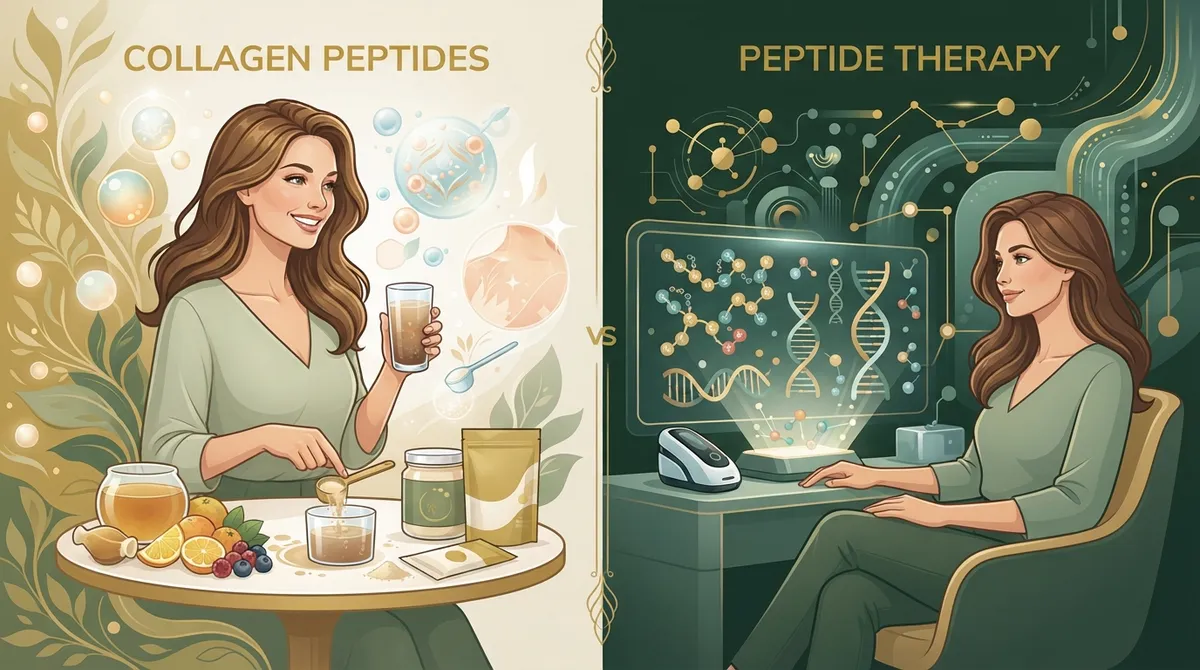
Collagen Peptides vs. Peptide Therapy: The Big Differences
This is the part that clears up most of the confusion. Both involve the word “peptide,” but they are very different tools. Think of collagen powder as a food-style supplement and peptide therapy as a personalized medical plan.
| Feature | Collagen Peptides (Supplement) | Medical Peptide Therapy |
|---|---|---|
| What it is | Hydrolyzed collagen protein, usually a powder or capsule | Specific signaling peptides prescribed by a licensed provider |
| How it’s taken | Swallowed (oral) | Often injected at home under provider guidance |
| Personalization | Same product for everyone | Plan based on blood work, symptoms, and goals |
| Oversight | Sold as a dietary supplement | Provider monitoring and follow-up |
| Main focus | Skin, joint, and bone support through nutrition | Energy, recovery, sleep, metabolism, and more, depending on the plan |
| Evidence base | Product-specific studies, mostly small and short | Varies by peptide; guided by clinical judgment |
One important point: studies on oral collagen supplements should never be treated as proof for injectable or prescription peptides. They are different products with different goals. Mixing them up is one of the most common mistakes people make when researching this topic.
What Does the Research Say About Collagen Peptides for Women?
Let’s look at the science with open eyes. Studies on collagen peptides for women have focused mainly on skin and bones, especially after menopause. Results are interesting, but they come with limits.
Skin Hydration and Elasticity
A 2025 randomized study in menopausal women tested 5 g per day of fish-derived collagen, along with calcium and vitamin D, for six months. The group that took the combined collagen, calcium, and vitamin D reported skin hydration up 23% and elasticity up 8.52% from their own starting point. The same study did not find significant changes in body composition or the bone markers it measured.
That’s encouraging for skin, but it’s one study of one product in one group of women. It doesn’t prove every collagen powder will do the same thing. If skin is your main goal, you may also like our deeper look at what peptides do for skin and how collagen stimulation with peptides works differently from eating collagen.
Bone Health After Menopause
Two studies often come up here:
- The 12-month trial (published 2018): This randomized, double-blind, placebo-controlled study enrolled 131 postmenopausal women. They took 5 g per day of a specific collagen peptide product. Researchers reported higher bone mineral density in the lumbar spine and femoral neck compared with placebo.
- The 2020 osteopenia study: In 51 postmenopausal women with osteopenia, researchers compared calcium plus vitamin D with or without 5 g per day of collagen peptides for three months. In the collagen group, a bone formation marker called P1NP dropped 13.1% from baseline (p<0.001).
These are real findings worth knowing. But please keep the fine print in mind. These were product-specific and population-specific results. The second study was only three months long and tracked a lab marker, not fractures. Neither one shows that collagen treats osteoporosis or prevents broken bones, and neither replaces standard osteoporosis care.
Joints and Overall Evidence
Some research has also looked at joint comfort and mobility. A 2023 review summarized clinical studies of oral collagen for skin and orthopedic outcomes. The big takeaway? The studies varied a lot in collagen type, dose, length, and who was studied. That means we can’t squeeze them into one neat, definitive result.
For a broader look at the science of connective tissue and nutrition, the National Library of Medicine offers free access to peer-reviewed research.
Honest Pros and Cons of Collagen Supplements
Let’s keep things balanced. Here’s a friendly snapshot of what collagen peptides can and can’t do.
| Possible Upsides | Real Limits |
|---|---|
| Easy to add to coffee, smoothies, or oatmeal | Results vary by product, dose, and person |
| Some studies show small gains in skin hydration and elasticity | Many studies are small or short |
| Studied at modest daily doses (often 5 g in the trials above) | Findings for one branded product can’t be applied to all |
| Generally available without a prescription | Not an FDA-approved treatment for any disease |
| May fit nicely into a balanced nutrition routine | Not a substitute for prescribed care |
Safety Tips Every Woman Should Know
Collagen supplements are sold as foods or dietary supplements, not as drugs that treat disease. So a little label-reading goes a long way. Keep these points in mind:
- Check the source. Collagen can come from fish, cows, pigs, or poultry. If you have a food allergy, match the source to your needs.
- Look for quality. Choose products that share third-party testing so you know what’s actually inside.
- Be wary of big claims. Any product that promises to cure arthritis or reverse osteoporosis is overselling.
- Talk to a clinician first if you’re pregnant, breastfeeding, have a chronic condition, or take prescription medicines.
- Don’t swap it for treatment. Collagen should never replace hormone therapy, osteoporosis medication, or anything your provider prescribed.
Where Personalized Peptide Therapy Fits In
So if collagen powder is a nutrition add-on, where does medical peptide therapy come in? Think of it as the more tailored path. Instead of one scoop for everyone, a licensed provider looks at your blood work, your symptoms, and your goals, then builds a plan around you.
That plan might focus on things like energy, sleep, recovery, metabolism, or skin rejuvenation, depending on what your labs and history show. Curious about the options? Take a peek at our guides on peptide skin rejuvenation, hormone therapy peptides for women, and how to build a women’s wellness peptide plan.
If you want to see how collagen powders stack up against another popular recovery peptide, we’ve also compared collagen peptides vs. BPC-157 in plain language.
A Simple Way to Decide
- Start with your goal. Is it smoother-feeling skin, joint comfort, energy, sleep, or something else?
- Get your baseline. Blood work gives you real data instead of guesses, which biohackers and busy professionals both love.
- Match the tool to the goal. Collagen powder may suit a nutrition-first routine. Medical peptide therapy suits people who want a provider-guided plan.
- Ask questions. A good provider will explain risks, timelines, and what’s still unknown.
- Reassess. Check in on how you feel and adjust as needed.
Why Many Women Choose Telehealth for Peptide Care
Life is busy. Between work, family, and everything else, driving to a clinic can feel like one more thing on the to-do list. That’s one reason many women love telehealth. You can chat with a licensed provider from your couch, complete lab work locally, and have treatments delivered to your door. If you’re weighing your options, our comparison of local clinics vs. telehealth breaks it all down, and our guide on how to start peptide therapy safely walks you through the first steps.
At Allura Longevity, care starts with a $50 virtual consultation. From there, you complete blood work through LabCorp and receive a customized six-month plan, with ongoing monitoring and adjustments from licensed providers. The team is led by Ashley, a board-certified Family Nurse Practitioner. Telehealth is available in Florida, Georgia, Texas, Connecticut, Indiana, Maryland, New York, and California. And hey, it’s perfectly okay to keep your collagen coffee while exploring medical options. Just run everything by your provider so your plan works together.
Putting It All Together
Here’s the bottom line on collagen peptides for women. Oral collagen is a popular supplement with some encouraging, but limited, research on skin and bone markers in postmenopausal and menopausal women. It’s not a drug, not a treatment for osteoporosis or arthritis, and not the same as prescription peptide therapy. If it fits your routine and your clinician is on board, it can be a fine part of a balanced lifestyle. If you want something more personalized and data-driven, medical peptide therapy is a different path worth exploring.
Ready to see what a plan built around your own labs and goals could look like? Request a consultation with Allura Longevity today, or call (813) 510-6277. Spots for new clients are limited each month, so don’t wait too long. Your future self will thank you!
FAQs
Q: Are collagen peptides the same as peptide therapy or injectable peptides?
A: Nope, they’re different! Collagen peptides are usually oral supplements made from broken-down collagen protein, while peptide therapy is a medical approach where a licensed provider prescribes specific peptides based on your labs and goals. Research on collagen powders shouldn’t be used to judge injectable peptides.
Q: Do collagen peptides improve skin hydration and elasticity in women?
A: Some studies say yes, in certain groups. A 2025 six-month study in menopausal women found skin hydration up 23% and elasticity up 8.52% with collagen, calcium, and vitamin D together. Results depend on the product, dose, and person, so it’s best to keep expectations realistic.
Q: Can collagen peptides improve bone density after menopause?
A: One 12-month trial in 131 postmenopausal women reported higher bone density in the spine and femoral neck with 5 g per day of a specific collagen product. That’s promising, but it doesn’t prove collagen treats osteoporosis or prevents fractures, and it shouldn’t replace standard care.
Q: Are collagen peptides safe during pregnancy or breastfeeding?
A: It’s always smart to check with your clinician first. If you’re pregnant, breastfeeding, managing a chronic condition, or taking medicine, a quick chat can help you decide what’s right. Also check the source (fish, bovine, porcine, or poultry) if you have allergies.
Q: Can collagen peptides replace hormone therapy or osteoporosis medication?
A: No. Collagen supplements are sold as foods or dietary supplements, not as approved treatments for disease. Please keep taking anything your provider prescribes, and talk with them before making changes.





