

Key Takeaways
-
Oral collagen peptides have the most research support, showing modest improvements in skin hydration and elasticity in meta-analyses of 26-31 studies, but effects vary significantly by product, dose, and individual.
-
The term 'collagen stimulating peptides' is a marketing umbrella covering three distinct types—oral supplements, topical serums, and injectables—each with different evidence levels and should not be used interchangeably.
-
Injectable peptides like BPC-157 and GHK-Cu lack robust human clinical data for collagen treatment and carry FDA safety concerns; BPC-157 is not FDA-approved and poses potential risks from impurities.
-
Topical peptide serums and creams have less established efficacy than marketing suggests; results depend heavily on formula quality and skin absorption, requiring realistic expectations and several weeks of consistent use.
-
Daily habits like sunscreen, adequate protein and vitamin C, quality sleep, and regular movement often produce better skin results than any peptide product and should be the foundation of any anti-aging plan.
-
Always verify regulatory status, seek third-party testing, check for human studies before purchasing, and consult a licensed clinician before starting any collagen peptide treatment to avoid impurities and unproven claims.
If you have ever stood in front of your bathroom mirror and wondered where your glow went, you are not alone. Skin changes with age, and many of us start looking for ways to give it a little help. That search often leads to collagen stimulating peptides, a phrase you will see on supplement tubs, skincare labels, and wellness clinic menus.
Here is the catch: that one phrase can mean three very different things. It can mean an oral collagen powder, a topical serum, or an injectable compound promoted for tissue repair. They are not the same, and the proof behind each one is not the same either.
In this friendly guide, we will sort it all out. You will learn what each type is, what the research actually shows, how to spot hype, and how to build a smart plan with a licensed provider. Whether you are a busy professional, a data-loving biohacker, or simply someone who wants to age well, you will leave with clear steps you can use today.

What Are Collagen Stimulating Peptides, Really?
Collagen is the main structural protein in your skin, joints, and connective tissue. Peptides are short chains of amino acids, the building blocks of protein. If you want a refresher on the basics, our guide on 8 Facts That Explain What Are Peptides in 2026 is a great place to start. You can also read this overview of what are peptides from WebMD.
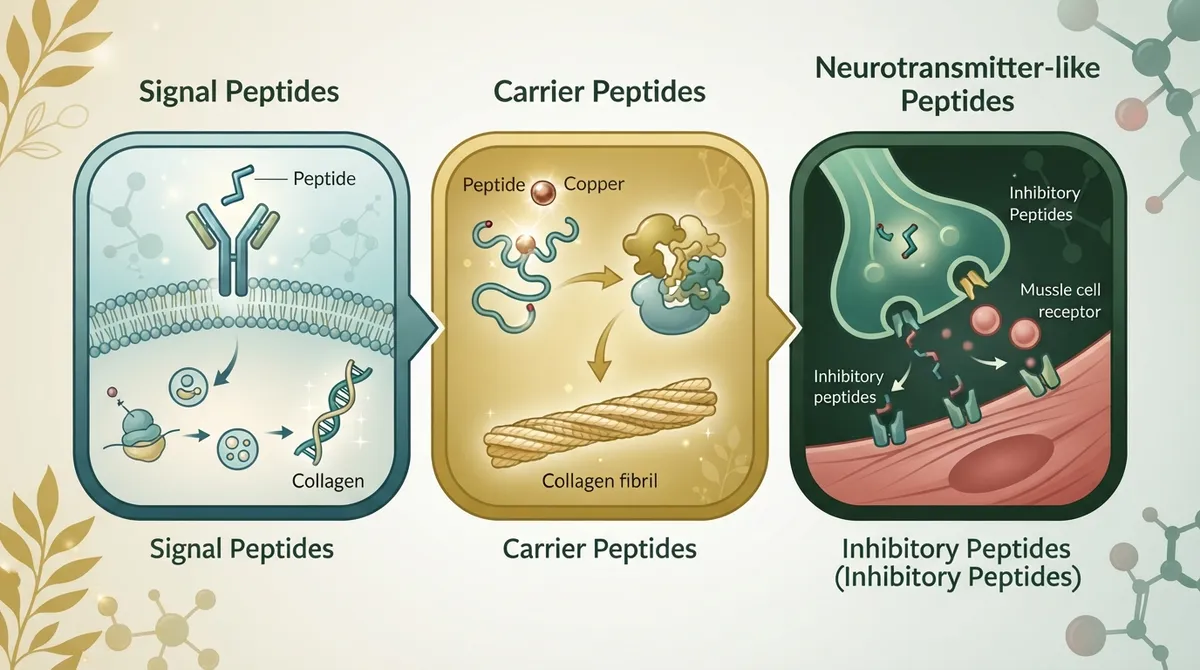
“Collagen stimulating peptides” is not one standardized medical treatment. It is a marketing umbrella. Most products fall into one of three groups:
- Oral collagen peptides: Powders, capsules, or drinks made from hydrolyzed collagen.
- Topical peptides: Serums and creams with signal peptides or copper peptides.
- Injectable compounds: Peptides such as GHK-Cu or BPC-157 that wellness providers sometimes promote for tissue repair.
Knowing which group a product belongs to is the first and most important step. It tells you how it works, what the evidence looks like, and what questions to ask.
How to Tell the Three Types Apart
Think of this like choosing a tool for a job. A hammer and a screwdriver are both tools, but you would not swap them. The same goes here.
| Type | How You Use It | Evidence Level | Regulatory Notes |
|---|---|---|---|
| Oral collagen peptides | Swallowed daily as powder, capsule, or drink | Most developed; modest skin benefits suggested | Sold as supplements, not drugs |
| Topical peptides | Applied to skin as serum or cream | Less established than marketing implies | Cosmetic products |
| Injectable peptides (GHK-Cu, BPC-157) | Injected under a provider’s guidance | No robust human data as collagen treatments | BPC-157 is not FDA-approved |
Notice that a peptide being sold, or even compounded by a pharmacy, does not mean it is FDA-approved or proven to boost collagen. Approval is specific to a drug, its form, its use, and its route. That is why honest labeling matters so much.
What the Research Says About Oral Collagen Peptides
Oral collagen peptides are the best-studied option. When you swallow them, your body breaks them into amino acids and small peptides. Researchers are still working out exactly how those pieces influence skin, but human trials have given us some useful clues.
- A 2023 meta-analysis of 26 randomized controlled trials with 1,721 participants reported improvements in skin hydration and elasticity with hydrolyzed collagen supplements.
- A 2024 review of 31 publications looked at hydrolyzed collagen, collagen tripeptides, and low-molecular-weight collagen peptides. It also noted limits in the evidence.
- A 2026 systematic review of 19 randomized trials and 1,341 participants found gains in some skin outcomes, but effects on elasticity and density were inconsistent, with a lot of variation between studies.
So what is the honest takeaway? Oral collagen peptides may offer modest benefits for some people. Results vary by product, dose, and who is taking them. They are a supplement, not a prescription peptide drug, and they should not be sold as a guaranteed fix.
What About Topical Peptides and Copper Peptides?
Topical signal peptides and copper peptides show up in many skincare products. The idea is that they send “messages” to skin cells to support the extracellular matrix, the scaffold around your cells.
The reality is a bit more modest than the labels suggest. Results depend heavily on the formula and on how well the ingredient gets into the skin. A pretty jar with a long ingredient list does not guarantee a visible change.
Topicals can still be a pleasant, low-risk part of a routine. Just keep your expectations realistic, and give any new product at least several weeks before judging it. For a deeper look, see What Peptides Do for Skin: A Real-World Guide for 2026.
The Truth About Injectable Collagen Stimulating Peptides
This is where things get tricky, and where we want to be extra clear. Some wellness providers promote injectable GHK-Cu or BPC-157 for collagen production or tissue repair. But the available research does not show strong human evidence that these injectables work as collagen treatments.
Here is what is worth knowing:
- BPC-157 is not a component of an FDA-approved drug.
- FDA briefing materials say the information available is not enough to describe its safety.
- FDA has also raised concerns about possible immune reactions tied to impurities or clumping in injectable peptide products.
- Evidence for injectable GHK-Cu as a collagen treatment is not on par with what exists for oral supplements.
That does not mean you should panic. It means you should ask good questions. If you are curious, you can read more in Is BPC-157 Safe? What the Research Really Shows and How to Evaluate GHK-Cu Peptide Safely in 2026. The National Library of Medicine also hosts research on peptide therapeutics that can help you understand the wider science.
7 Steps to Choose Collagen Stimulating Peptides Wisely
Ready to put this into action? Follow these steps, and you will avoid most of the common traps.
- Name your goal. Are you after smoother skin, better joint comfort, or overall vitality? A clear goal keeps you from chasing every trend.
- Identify the product type. Is it oral, topical, or injectable? Write it down. Each one has its own evidence and rules.
- Check the label and source. Look for third-party testing, clear dosing, and a transparent ingredient list. Skip products with vague claims.
- Look for human studies. Animal or lab results are interesting, but they do not prove the same effect in people.
- Verify regulatory status. Ask whether the product is an approved drug, a supplement, or a compounded preparation. Our guide FDA-Approved vs. Compounded Peptides: What Wins? breaks this down.
- Talk to a licensed clinician. A provider can review your history, medications, and goals before you start anything new.
- Track and adjust. Take photos, note changes, and review results after a set period so you are not guessing.
Smart Habits That Support Your Natural Collagen
No peptide can replace the basics. Your daily habits often move the needle more than any single product. If you want a food-and-lifestyle starting point, check out How Can You Boost Collagen Naturally After 30?
- Daily sunscreen: UV light breaks down collagen faster than almost anything else.
- Protein and vitamin C: Your body needs both to build collagen.
- Good sleep: Skin repairs itself while you rest.
- No smoking and less sugar: Both can speed up visible aging.
- Regular movement: Exercise supports circulation and overall tissue health.
These habits are free, safe, and they make every other step work better.
Red Flags to Watch For
The peptide space is exciting, but it is also crowded with big promises. Be cautious if you see any of these:
- Claims that a product “rebuilds collagen” with no human studies to back it up
- Injectable peptides sold online without a prescription or clinician review
- No information about where or how the product was made
- Pressure to buy large bundles right away
- Providers who skip lab work or a health history
Unverified online products can carry real risks, including impurities and unclear dosing. A licensed clinician and a reputable pharmacy are your best safety net. To learn how to do this the right way, read How to Get Prescription Peptides Safely in 2026.
How Personalized Care Fits In
Skin is only one piece of the puzzle. Hormones, sleep, stress, metabolism, and nutrition all shape how you look and feel. That is why a personalized approach tends to work better than guessing in the supplement aisle.
At Allura Longevity, care starts with a $50 virtual consultation and blood work through LabCorp. Licensed providers, led by Ashley, a board-certified Family Nurse Practitioner, then build a customized six-month plan based on your labs and goals. Any treatment is delivered to your home, with ongoing monitoring and adjustments along the way. Telehealth care is available in Florida, Georgia, Texas, Connecticut, Indiana, Maryland, New York, and California.
A provider can also help you decide whether a collagen supplement, a skincare routine, or a broader wellness plan makes the most sense for you. You can learn how this process works in How to Start Peptide Therapy Safely and See Real Results, or explore options like peptides for women and peptides for men.
What Results Should You Expect?
Patience is your friend here. Skin renews itself slowly, so most studies of oral collagen last several weeks to a few months. A realistic timeline looks like this:
| Timeframe | What You Might Notice |
|---|---|
| Weeks 1 to 4 | Little visible change; focus on consistency and habits |
| Weeks 4 to 12 | Some people notice slightly better hydration or texture |
| Months 3 to 6 | Subtle improvements may show if the product and dose suit you |
Results differ from person to person, and some people see no change at all. That is normal, and it is okay. Staying honest about progress helps you decide whether to continue, adjust, or try a different approach. For more on pacing, see How Long for Peptide Therapy Results? A Real Timeline.
Your Next Step
Collagen stimulating peptides can be a helpful part of a wellness plan, but only when you know what you are buying. Oral collagen has the strongest evidence, though benefits look modest. Topicals can support a routine. Injectables deserve extra caution until stronger human data exists.
The best path is a simple one: know the type, check the evidence, protect your skin daily, and work with a licensed provider who puts your safety first. You deserve clear answers, not hype.
If you want personalized guidance, request a consultation with Allura Longevity or call (813) 510-6277. Spots for new clients are limited each month, so reach out while there is room on the calendar. Your glow is worth a plan built just for you.
FAQs
Q: Do collagen peptides actually increase collagen production?
A: Research on oral collagen peptides suggests modest improvements in skin hydration and elasticity for some people, though results vary by product, dose, and study. Scientists are still learning exactly how they work, so think of them as a possible helper, not a guaranteed fix.
Q: Are collagen peptides the same as peptide therapy?
A: Nope, they are different. Collagen peptides are usually oral supplements, while peptide therapy involves provider-guided treatments designed around your labs and goals. A licensed clinician can help you understand which option fits your needs.
Q: Are injectable collagen stimulating peptides FDA-approved?
A: Not for collagen stimulation. BPC-157, for example, is not part of an FDA-approved drug, and the FDA has said there is not enough information to describe its safety. Always ask your provider about a product’s regulatory status before you start.
Q: What is the evidence for GHK-Cu injections for skin or collagen?
A: Strong human clinical evidence for injectable GHK-Cu as a collagen treatment has not been established. Topical copper peptides are common in skincare, but results depend on the formula and how well it absorbs into skin.
Q: How do oral collagen peptides compare with topical peptides?
A: Oral collagen peptides have more human research behind them, with some trials showing modest skin benefits. Topical peptides can be a nice addition to a routine, but their clinical benefit is less certain and depends heavily on the product.





