

Key Takeaways
-
Collagen peptide therapy for skin usually means taking oral hydrolyzed collagen as a dietary supplement, not a prescription or injectable treatment.
-
Meta-analyses suggest modest improvements in skin hydration and elasticity versus placebo, typically studied at about 4 to 12 weeks of daily use at roughly 1 to 10 grams per day.
-
Supplements are not FDA-approved to treat skin aging, so product quality varies; check labels for collagen source (fish, bovine, porcine, poultry) and third-party testing.
-
Collagen peptides work best as an add-on to daily broad-spectrum sunscreen, retinoids, and healthy habits rather than a replacement for them.
If you have ever stood in front of the mirror and wondered where your glow went, you are in good company. Skin changes with age, and plenty of us are curious about what might help. That curiosity is why collagen peptide therapy for skin has become such a popular search in 2026.
Here is the friendly truth. In most cases, this phrase means taking oral hydrolyzed collagen peptides, a type of dietary supplement. It does not mean prescription peptide medicine or an injectable skin treatment. That difference matters, especially if you are a health optimizer, a biohacker, or a busy professional who wants straight answers before spending money.
In this guide, we will walk through what collagen peptides are, what the research says about hydration, elasticity, and wrinkles, and where the limits are. We will also cover safety, allergies, and how supplements compare with medical peptide therapy. Grab a cup of tea and let’s dig in.

What Does Collagen Peptide Therapy for Skin Actually Mean?
The phrase can be confusing because the word “peptide” shows up in so many places. Peptides are simply short chains of amino acids, the building blocks of protein. You can learn the basics from this overview of what peptides are.
Collagen is the main structural protein in the dermis, the layer of skin that gives it firmness and bounce. Collagen peptides are small fragments made by breaking down collagen into pieces your body can absorb more easily. This process is called hydrolysis, which is why you will see the label “hydrolyzed collagen.”
So, collagen peptide therapy for skin usually looks like this: you mix a scoop of powder into coffee or a smoothie, or you take capsules, every day for several weeks. That is it. No needles, no prescription.
How It Differs From Medical Peptide Therapy
Medical peptide therapy is a different world. It involves prescription peptides chosen by a licensed provider after reviewing your health history and lab work. If you want to understand that side, our guide on collagen peptides vs. peptide therapy breaks it down nicely.
| Feature | Oral Collagen Peptides | Medical Peptide Therapy |
|---|---|---|
| What it is | Dietary supplement | Prescription treatment plan |
| How you take it | Powder or capsules by mouth | Often injectable, as prescribed |
| Who guides it | You (self-selected) | Licensed medical provider |
| Based on labs | No | Yes, personalized |
| FDA status | Not an approved drug for skin aging | Varies by peptide and use |
How Might Collagen Peptides Work in the Skin?
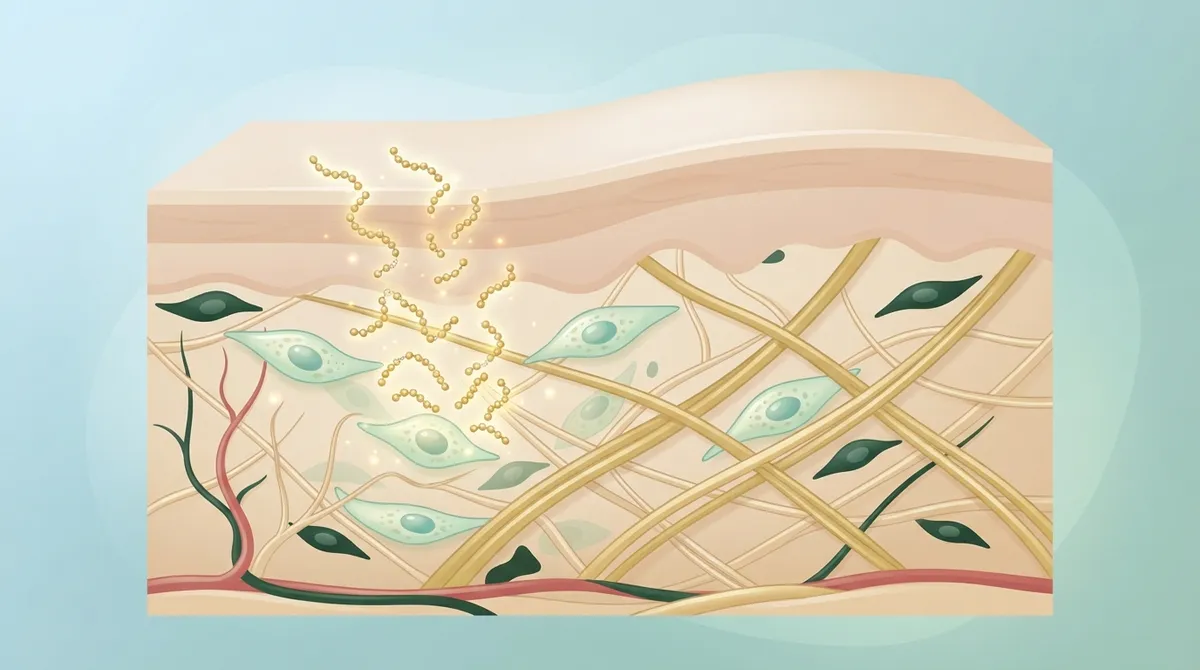
When you swallow collagen peptides, your digestive system breaks them into amino acids and small peptides. The leading idea is that these pieces give your body building blocks and may nudge skin cells that make collagen and other support molecules.
Here is the honest part. Researchers are still studying the exact mechanisms, and it is not fully clear how important each one is in real life. So think of it as a promising area of research, not a settled science.
What Does the Research Say?
Let’s look at the numbers, because this is where the story gets interesting. Several reviews have looked at randomized controlled trials, which are the gold standard for testing supplements against a placebo.
| Review | Size | What It Reported |
|---|---|---|
| 2023 meta-analysis (Pu et al.) | 26 trials, 1,721 participants | Statistically significant gains in skin hydration and elasticity versus placebo |
| 2024 systematic review (Reilly et al.) | 11 trials, 805 participants | Promising results for elasticity, hydration, and dermal collagen density |
| 2023 review of hydrolyzed collagen | 14 trials, 967 participants | Improvements in hydration, elasticity, and some wrinkle measures over 4 to 12 weeks |
| Separate meta-analysis | 10 trials, 646 participants | Pooled effect sizes of 1.25 for hydration and 0.61 for elasticity |
You can explore the underlying science through the National Library of Medicine, which hosts many of these studies.
The Big Picture Takeaway
Overall, the evidence points toward possible modest improvements in hydration and elasticity, with some data on wrinkle-related measures. That is encouraging!
But there are important caveats:
- Study designs, products, and doses differed a lot from trial to trial.
- Some reviews noted moderate heterogeneity and unclear risk of bias.
- Pooled results do not tell us the single best product or routine.
- Results vary from person to person, so nothing is guaranteed.
In short, collagen peptides are not a facelift in a scoop. They may be a gentle, supportive habit for some people.
What Dose and How Long Have Studies Used?
Many readers ask this first, especially data-driven biohackers. Here is what the research has looked at, with a reminder that these are study ranges, not medical recommendations.
| Detail | What Studies Commonly Used |
|---|---|
| Daily dose range | About 1 to 10 grams |
| Common dose | Around 4 grams per day |
| Median dose in one review | 3.5 grams per day |
| Duration | Often 4 to 12 weeks of daily use |
Notice that no one has pinned down an optimal dose or a long-term effect yet. If a product promises dramatic results in a week, take it with a grain of salt.
Is It Safe? Allergies, Sources, and Side Effects
Short-term trials generally report good tolerability, which is reassuring. Still, a few things are worth knowing before you start.
- Digestive upset: Some people notice bloating or mild stomach discomfort.
- Taste: Certain powders have an unpleasant flavor.
- Allergies: Collagen can come from fish, cows, pigs, or poultry. If you have a food allergy, check the label carefully.
Source matters here. A person with a fish allergy should skip marine collagen, for example. When in doubt, ask your healthcare provider.
Supplements Are Not FDA-Approved Skin Treatments
This is a point worth saying clearly. In the United States, dietary supplements are regulated differently from drugs. They are not approved by the FDA for safety and effectiveness before they hit the shelves, and collagen supplements are not approved to treat skin aging or any skin disease.
That means product quality can vary. Here is a simple checklist to help you shop smarter:
- Look for a clear ingredient list with the collagen source named.
- Choose products with third-party testing when possible.
- Check for allergens like fish or shellfish on the label.
- Be wary of big claims such as “reverses aging” or “cures wrinkles.”
- Talk with a provider if you take medications or have health conditions.
How Collagen Peptides Fit With Proven Skin Care
Think of collagen peptides as a possible bonus, not the foundation. The basics still do the heavy lifting for most skin goals:
- Daily broad-spectrum sunscreen, which protects the collagen you already have
- Retinoids, which have a long track record in skin research
- Good sleep, balanced nutrition, and not smoking
- Gentle cleansing and moisturizing
If you are curious about the bigger picture, you may enjoy our look at common collagen peptide wrinkle mistakes and our guide on boosting collagen naturally after 30.
A Realistic Timeline for Skin Changes
Patience helps here. Since studies often run 4 to 12 weeks, many people give a supplement at least a couple of months before judging it. Skin renews slowly, so quick fixes are rare.
If you want to see how timelines work for other approaches, take a peek at how long peptides take to improve skin. Setting honest expectations is one of the kindest things you can do for yourself.
When Medical Peptide Therapy Might Be a Better Fit
Maybe you have tried collagen powder and want something more tailored. Or maybe your goals go beyond skin, like energy, sleep, recovery, or overall vitality. That is where personalized, medically supervised care comes in.
Providers can review your history and order lab work before suggesting any plan. This approach is explained well in our look at peptides for skin regeneration and our overview of how to tell if peptides help with wrinkles.
At Allura Longevity, we offer personalized peptide therapy through telehealth. You begin with a virtual consultation, complete blood work through LabCorp, and receive a customized six-month plan delivered to your door, with ongoing monitoring by licensed providers. Our team is led by Ashley, a board-certified Family Nurse Practitioner, and we serve clients in Florida, Georgia, Texas, Connecticut, Indiana, Maryland, New York, and California.
Putting It All Together
Collagen peptide therapy for skin, in its most common form, is an oral supplement habit with early but promising research behind it. It may modestly support hydration and elasticity, and some studies hint at wrinkle benefits. It is generally well tolerated, though allergies and product quality deserve your attention.
It is not an FDA-approved treatment, and it is not the same as prescription peptide therapy. Used wisely alongside sunscreen and sound skin care, it can be a pleasant, low-effort addition for some people.
If you would like a plan built around your own labs and goals, we would love to help. Request a consultation with Allura Longevity today. Spots for new clients are limited each month, so reach out soon, or call us at (813) 510-6277. Your skin, and your whole self, deserve thoughtful care.
FAQs
Q: What are collagen peptides, and how are they different from peptide therapy injections?
A: Collagen peptides are short protein fragments taken by mouth as a dietary supplement. Peptide therapy injections are prescription treatments guided by a licensed provider and usually based on your lab work. They are two very different things, even though both use the word peptide.
Q: How long does it take to see skin changes from collagen peptides?
A: Most studies run for about 4 to 12 weeks of daily use, so patience is key. Results vary from person to person, and there is no guarantee. Many people give a product at least a couple of months before judging it.
Q: Are collagen peptide supplements FDA-approved to treat skin aging?
A: No, they are not. In the United States, dietary supplements are not approved by the FDA for safety and effectiveness before marketing, and they cannot be presented as treatments for skin aging or disease.
Q: Does the source of collagen matter?
A: It can, especially for allergies. Collagen may come from fish, bovine, porcine, or poultry sources, so always check the label. If you have a food allergy, choose a source that is safe for you and ask your provider if unsure.
Q: How should collagen peptides fit alongside sunscreen or retinoids?
A: Think of collagen peptides as an optional extra, not a replacement. Daily sunscreen and evidence-based products like retinoids still do the heavy lifting for most skin goals, and collagen can be a gentle add-on.





