

Key Takeaways
-
Oral collagen peptides have the strongest research for skin, with meta-analyses showing improved hydration and elasticity, but wrinkle reduction evidence is less robust.
-
Expect 8 to 12 weeks of consistent daily use before judging results from oral collagen or topical peptides, since most studies run that long.
-
Topical peptide results depend on the specific named ingredient and formula; a vague 'peptide complex' label tells you little about effectiveness.
-
Research on oral collagen does not prove that injectable wellness peptides like BPC-157 or TB-500 treat skin aging; these are different products with different risks.
-
Compounded peptide drugs are not FDA-approved and are not reviewed for safety, effectiveness, or quality, so supervision by a licensed provider matters.
-
Daily sunscreen, good sleep, and prescription retinoids have stronger skin-aging evidence than peptides, so treat peptides as an add-on rather than a fix.
If you have ever stood in front of the mirror and wondered what the word “peptides” on a skin product really means, you are in good company. In 2026, peptides are everywhere. They show up in creams, powders, gummies, and even injectable wellness plans. But here is the catch: they are not all the same thing, and they do not all work the same way.
This guide breaks down anti aging skin peptides for women into three clear types. We will look at what each one is, what the research says, and where the evidence is still thin. Whether you are a health optimizer, a busy professional, or simply a wellness seeker who likes to know what you are putting in your body, this is for you.
Quick note: peptides are short chains of amino acids. That is a broad label. The benefits and risks depend on the exact peptide, how you take it, and why. So let’s sort the three types, one by one.
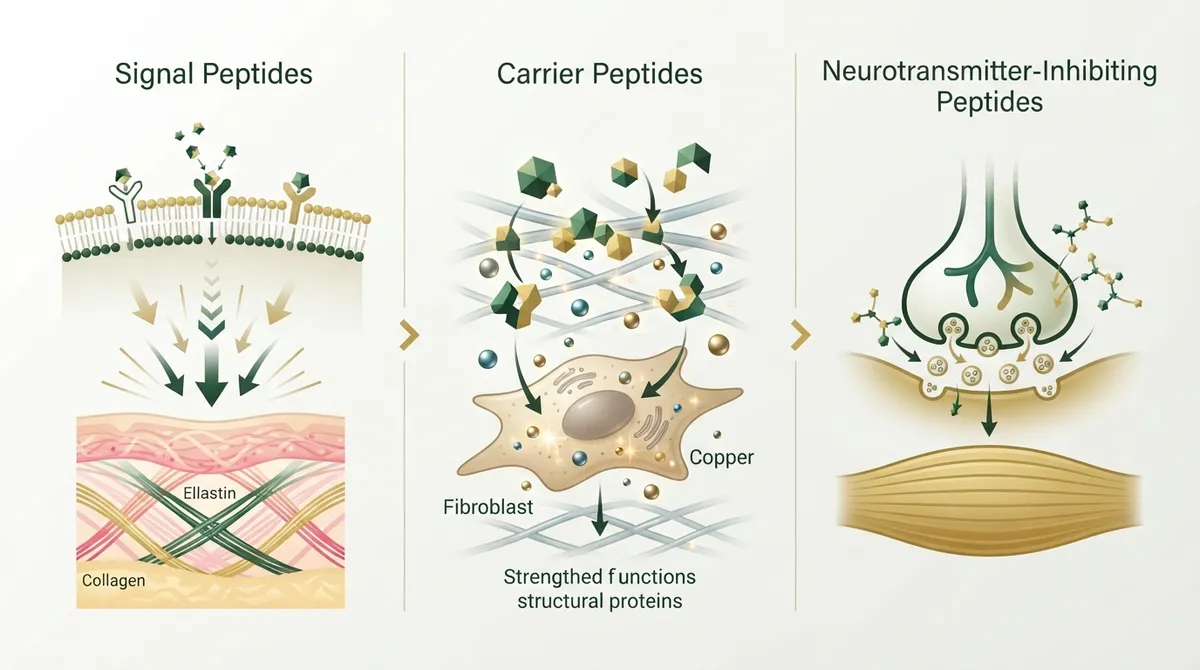
Quick Comparison: The 3 Types at a Glance
Before we dive deep, here is a simple side-by-side look. Keep this handy as you read.
| Type | How It’s Used | Evidence Level for Skin | Regulation |
|---|---|---|---|
| Oral collagen peptides | Powder, capsule, or drink | Moderate for hydration and elasticity; mixed for wrinkles | Sold as supplements |
| Topical cosmetic peptides | Serums and creams | Depends on the specific ingredient | Sold as cosmetics |
| Injectable or systemic peptide therapy | Prescribed, administered under supervision | Limited for direct skin-aging claims | Compounded drugs are not FDA-approved |

1. Oral Collagen Peptides: The Most Studied Option
Oral collagen peptides are small pieces of collagen, broken down so your body can absorb them. You mix them into coffee, smoothies, or water. They are the best-studied of the three types when it comes to skin.
What the Research Shows
A 2026 systematic review and meta-analysis looked at 35 randomized trials with 2,534 participants. It found improvements in measured skin hydration, elasticity, and transepidermal water loss. The reported effect sizes were 0.44 for hydration, 0.62 for elasticity, and −0.39 for water loss.
Here is the honest part. The same review found that results for wrinkles, roughness, and dermal density were not robust once the researchers ran sensitivity checks. So oral collagen may help your skin feel more hydrated and bouncy. Visible wrinkle reduction is less certain.
Real-World Study Snapshots
- A 2023 randomized trial enrolled 100 women aged 30 to 60. They took 1,650 mg per day of collagen dipeptides for 12 weeks. Hydration and desquamation improved, with wrinkle and elasticity gains reported at later check-ins.
- A 2024 study of 135 women aged 45 to 65 reported better expert-graded skin appearance after three months. But the product mixed collagen peptides with other ingredients, so we cannot credit the peptides alone.
- A 2023 meta-analysis of 26 trials (1,721 participants) also reported better hydration and elasticity with hydrolyzed collagen.
How Long Does It Take?
Most studies run about 8 to 12 weeks. So patience is key. Do not expect a mirror-changing glow in two weeks.
Safety and Smart Shopping
Collagen supplements are generally well tolerated, but side effects can happen. Talk with a clinician first if you are pregnant, breastfeeding, taking medicines, or managing a health condition. When you shop, look for products that list the peptide type and dose clearly. Our guide on how to choose the best collagen peptides for women walks through what to check.
2. Topical Cosmetic Peptides: Skincare You Apply
Topical peptides live in your serums and moisturizers. You might see names like signal peptides or copper peptides on the label. They are made to sit on the skin, not to change your whole body.
Why “Peptide” Does Not Mean One Thing
Here is where people get tripped up. A result from one cosmetic peptide cannot be applied to all peptides. Each ingredient has its own formula, strength, and delivery system. A great serum with one peptide tells you nothing about a different serum with another.
What to Look For
- Name the peptide. A label that just says “peptide complex” is vague.
- Check the formula. Stable packaging and a well-built base help the ingredient do its job.
- Patch test first. Even gentle products can irritate sensitive skin.
- Give it time. Plan on at least 8 to 12 weeks of steady use before judging.
Can You Pair Them With Other Actives?
Many people use peptide serums alongside vitamin C or retinoids. The right routine depends on your skin and the exact products. A clinician or dermatology professional can help you build a plan that does not overdo it. If you want to go deeper, see how peptides differ from skin creams.
3. Injectable and Systemic Peptide Therapy: What Is Proven and What Is Not
This is the type most connected to a peptide therapy clinic. It includes prescribed peptides given by injection under medical supervision. It is also the type where honesty matters most.
Separating Supplement Findings From Injection Claims
Here is a key point. Research on oral collagen or topical products does not prove that injectable peptides reverse skin aging. Those are different products, with different routes and different risks. Mixing them up is one of the most common mistakes in this space.
For commonly promoted wellness peptides such as BPC-157 or TB-500, there is no established clinical evidence that they safely or effectively treat skin aging in women. Animal and anecdotal findings do not equal proven clinical benefit. You can read more in our piece on approved peptides vs. wellness peptides.
Regulation Matters
In the United States, compounded drugs are not FDA-approved. The FDA does not review them for safety, effectiveness, or quality before they are marketed. Policies on specific substances can also change, so it pays to verify current information. Be cautious of anything sold online as a “research chemical” or “for research use only.” Those are not the same as care from a licensed provider.
Where Systemic Peptide Care Fits
Where peptide therapy can make sense is in a broader, supervised wellness plan. That means labs, a licensed provider, and realistic goals. Skin changes may be one small part of a larger picture that includes sleep, recovery, energy, and metabolism. You can learn more in our guide to whether peptide therapy can really help slow aging and our look at what anti-aging peptide therapy for skin really does.
How to Pick the Right Path for You
So which type is best? It depends on your goals, budget, and comfort level. Here is a simple way to think it through.
- Start with the basics. Daily sunscreen, good sleep, and a gentle routine do the heavy lifting for skin.
- Consider oral collagen for hydration and elasticity. This has the strongest research support of the three.
- Add a well-formulated topical. Choose a named peptide and patch test it.
- Explore supervised peptide therapy only with a licensed provider. Make sure your goals are realistic and the sourcing is clear.
Skin-Aging Options With Stronger Evidence
It would not be fair to talk about peptides without mentioning other tools. Some treatments have a longer track record for skin aging than peptides do.
- Daily broad-spectrum sunscreen: Sun damage drives much of visible aging.
- Prescription retinoids: These are among the most studied topical options.
- Professional in-office treatments: A dermatology provider can explain which fit your skin type.
- Lifestyle habits: Not smoking, balanced nutrition, and steady sleep all show up in your skin.
Peptides can be a helpful add-on, but they are not a magic fix. Think of them as one tool in a bigger toolkit.
What a Safe Peptide Plan Looks Like
If you decide to explore peptide therapy, safety comes first. A trustworthy plan usually includes these pieces:
| Step | What It Looks Like | Why It Matters |
|---|---|---|
| Consultation | A licensed provider reviews your history and goals | Rules out risks and sets realistic expectations |
| Lab work | Blood tests to see your baseline | Guides a plan built around you, not a template |
| Custom plan | Treatment matched to your needs | Avoids one-size-fits-all guesswork |
| Ongoing monitoring | Check-ins and adjustments over time | Keeps you safe and tracks real progress |
That is the model at Allura Longevity. Our licensed providers design personalized plans based on your blood work and goals, with care delivered through telehealth and medication shipped to your door. Get a clearer picture in our post on how to know online peptide therapy is safe.
Common Mistakes to Avoid
A few missteps can waste money or put your health at risk. Watch for these:
- Assuming all peptides are alike. A supplement result does not prove an injection works.
- Falling for before-and-after hype. Photos can be edited, lit differently, or cherry-picked.
- Skipping the clinician. Especially if you take medicines or have a health condition.
- Buying from unclear sources. Avoid anything labeled for research use only.
Want to avoid the top slip-ups? Read our rundown of collagen peptide wrinkle mistakes to avoid.
The Bottom Line
The big takeaway on anti aging skin peptides for women is simple. There are three different types, and each has its own evidence and risks. Oral collagen peptides have the most research behind them, mainly for hydration and elasticity. Topical peptides depend on the exact product. Injectable wellness peptides do not have established proof for treating skin aging.
That does not mean peptides are useless. It means you deserve clear, honest information so you can choose well. If you want a plan built around your own labs and goals, a supervised approach is the smartest place to start.
Ready to talk it through with a licensed provider? Request a consultation with Allura Longevity today. Spots for new clients are limited each month, and our team is licensed in Florida, Georgia, Texas, Connecticut, Indiana, Maryland, New York, and California. You can also call (813) 510-6277. For more on how research supports this field, see this overview from the National Library of Medicine.
FAQs
Q: Do peptides help reduce wrinkles or improve skin elasticity in women?
A: Oral collagen peptides have shown modest improvements in measured hydration and elasticity in many trials. Evidence for visible wrinkle reduction is less consistent, so it is smart to keep expectations realistic.
Q: How long does it take for oral collagen peptides to affect the skin?
A: Most studies run about 8 to 12 weeks, so steady daily use over a few months is the usual timeline. Results vary by product and person, so patience pays off.
Q: Are injectable peptides approved or proven for anti-aging skin treatment?
A: No. There is no established clinical evidence that commonly promoted wellness peptides like BPC-157 or TB-500 safely or effectively treat skin aging in women. Compounded drugs also are not FDA-approved, so supervision by a licensed provider matters.
Q: What is the difference between collagen peptides, topical peptides, and injectable peptide therapy?
A: Collagen peptides are taken by mouth, topical peptides are applied to the skin, and injectable peptide therapy is prescribed and given under medical supervision. Each has its own evidence and safety profile, so results from one cannot be applied to the others.
Q: Can topical peptides be used with retinoids or vitamin C?
A: Many people combine them, but the right mix depends on your skin and the exact products. A clinician or dermatology professional can help you build a routine that works without causing irritation.





