

Key Takeaways
-
No peptide is officially FDA-approved for body recomposition; it's a marketing term, not a medical diagnosis or single treatment.
-
GLP-1 medicines like semaglutide are FDA-approved for weight loss but not muscle gain, and can cause lean mass loss alongside fat loss without proper resistance training and protein intake.
-
Growth hormone secretagogues (CJC-1295, ipamorelin) lack strong clinical evidence for fat loss or muscle gain despite popularity; raising growth hormone levels doesn't prove better body composition.
-
Resistance training 2-3 times weekly, adequate protein intake, quality sleep, and slow weight loss are the primary drivers of body recomposition—peptides play only a supporting role.
-
Compounded and unapproved peptides carry significant risks including contamination, inaccurate dosing, hormonal side effects, and fluid retention; avoid products labeled 'research use only.'
-
Personalized clinician-supervised care with baseline labs, specific goal-setting, and ongoing monitoring is essential; generic peptide protocols cannot account for individual hormones, age, and fitness history.
You have probably seen the promises online. Lose fat, gain muscle, and look ten years younger, all with a few small injections. It sounds amazing, and it makes sense that you want to know if it is true.
Here is the honest answer. Body recomposition peptide therapy is a marketing phrase, not an official medical treatment. It points to a real goal, which is carrying less body fat and more lean muscle. But the science behind each peptide is very different, and some of the loudest claims are not backed by strong human research.
In this friendly guide, we will sort fact from hype. You will learn what body recomposition means, which peptides have real evidence, which ones do not, and how to stay safe. If you are a busy professional, a data-loving biohacker, or someone who just wants to feel strong as you age, this is for you.

What Does Body Recomposition Actually Mean?
Body recomposition means lowering body fat while keeping or building lean mass. Lean mass is mostly muscle, but it also includes bone and water. The scale may not move much, yet your body shape can change a lot.
It is different from simple weight loss. When you lose weight, you can lose fat, muscle, or both. Recomposition aims to protect the muscle and burn the fat.
Body recomposition is an outcome. It is not a diagnosis, and it is not a single treatment. No peptide is officially approved by the FDA to “recomp” your body. That is the most important fact in this whole article.
Why does muscle matter so much?
Muscle helps you move, balance, burn energy, and manage blood sugar. After about age 30, most adults slowly lose muscle unless they work to keep it. For aging adults, holding on to muscle supports strength, independence, and healthy longevity.
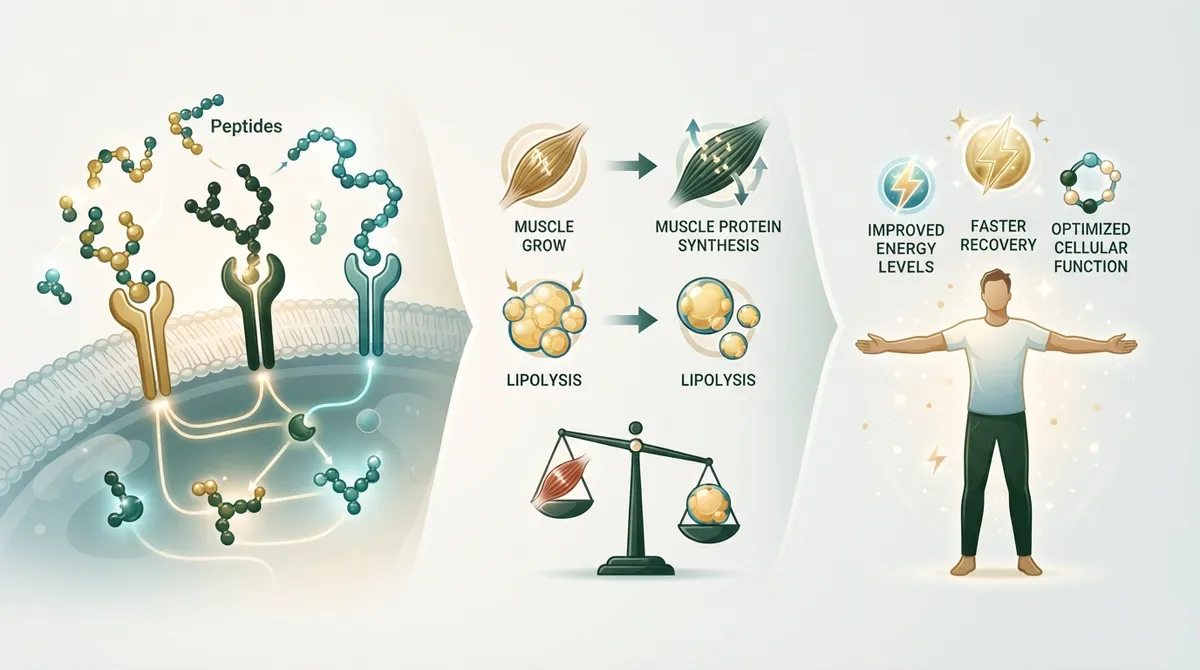
What Is Peptide Therapy, and Where Does It Fit?
Peptides are short chains of amino acids. They act like tiny messengers in your body. If you want a plain-language primer, read what are peptides, or check out our guide, 8 Facts That Explain What Are Peptides in 2026.
The term “peptide therapy” covers a very wide range of products. Some are FDA-approved medicines with solid trial data. Others are unapproved, compounded, or sold as “research use only.” Lumping them together is where most confusion starts.
That is why a good provider will always ask which peptide, for what goal, and based on what evidence. Think of it like the difference between a prescription medicine and a trendy supplement. They are not the same thing.
Which Peptides Get Linked to Body Recomposition?
Let us walk through the main groups, and what we actually know about each one. The table below gives a quick snapshot.
| Peptide Group | Examples | FDA Status for Recomposition | Evidence Level |
|---|---|---|---|
| GLP-1 based medicines | Semaglutide, tirzepatide | Approved for weight management in eligible patients, not for muscle gain | Strong for weight loss |
| Growth hormone secretagogues | CJC-1295, ipamorelin, sermorelin | Not approved for recomposition | Limited for fat loss or muscle gain |
| Repair-focused peptides | BPC-157, TB-500 | Not approved for recomposition | Mostly preclinical or small studies |
GLP-1 medicines: strong for weight loss, but not muscle builders
Semaglutide and tirzepatide are FDA-approved for chronic weight management in eligible patients. They work by calming appetite and helping you feel full. In one FDA statistical review of semaglutide in adolescents with overweight or obesity, BMI dropped by about 16.75 percentage points more than placebo at week 68. That result is for adolescent BMI, so it does not directly tell us about adult body recomposition.
Here is the key point. These medicines help you lose weight, but that weight can include some lean mass. They are not approved to build muscle. If you want to learn more, see How to Understand GLP-1 Peptide Therapy in 2026.
Growth hormone secretagogues: popular, but under-proven
CJC-1295 and ipamorelin are often sold as muscle and fat-loss helpers. They signal your body to release more growth hormone. That sounds great, but raising growth hormone or IGF-1 does not prove you will look or feel better, or be healthier.
Right now, there is not enough strong clinical evidence showing meaningful fat loss or muscle gain from these peptides for recomposition. You can learn more in Ipamorelin Peptide Therapy: Benefits, Dosing & Safety and Growth Hormone Peptides: What They Are & How They Work.
BPC-157 and TB-500: recovery buzz, not recomp proof
BPC-157 and TB-500 are popular for recovery and healing talk. They are not FDA-approved for body recomposition. Much of the research is in animals or small human studies, and long-term safety is not established.
That does not mean they are useless. It means the evidence is early, and you should be cautious. Our articles on TB-500 and BPC-157 go deeper.
Can GLP-1 Medicines Cause Muscle Loss?
This is a big question for anyone chasing a leaner, stronger look. When you eat much less, your body can pull energy from both fat and muscle. GLP-1 treatment can lead to loss of lean mass along with fat.
We do not have a single reliable percentage that applies to everyone. Results depend on the person, the medicine, the dose, diet, and exercise. So be careful with any claim that gives one neat number.
The good news is that you can fight back. Medication does not replace smart habits, but it can work much better when paired with them.
How to help protect lean mass
- Lift weights or do resistance training two to three times a week, with guidance from a trainer or clinician.
- Eat enough protein at each meal, at a level your provider recommends for you.
- Do not crash diet. Slow, steady loss tends to be kinder to muscle.
- Sleep well. Poor sleep can work against recovery and appetite control.
- Get regular check-ins and labs so your plan can be adjusted.
Want a deeper look at weight loss options? Try How to Lose Weight With Peptide Therapy in 2026 or 8 GLP-1 Weight Loss Maintenance Tips That Last.
What Really Drives Body Recomposition?
Here is the part many ads skip. The biggest levers for changing your body are not in a vial. They are in your daily routine. Peptides, when used under medical care, may play a supporting role for some people.
| Factor | Why It Matters | Peptides Replace It? |
|---|---|---|
| Resistance training | Signals your body to keep or build muscle | No |
| Protein and total nutrition | Supplies the building blocks for muscle | No |
| Sleep and stress control | Supports hormones, recovery, and appetite | No |
| Blood work and hormone review | Finds issues that may hold you back | No |
If you are curious how body composition itself is tracked, our guide 12 Body Composition Facts Peptide Users Need in 2026 is a helpful next read.
What Are the Risks You Should Know About?
We want you to feel excited, but also safe. Peptides are not all harmless just because they are small.
The FDA has raised safety concerns about certain bulk drug substances proposed for compounding. These include risks tied to impurities, how well a product is characterized, and possible immune reactions. Compounded drugs are not FDA-approved, and the FDA does not review them for safety, effectiveness, or quality before they are sold.
Here are some possible problems, which vary by product:
- Fluid retention and changes in blood sugar control with growth hormone secretagogues
- Other hormonal effects that need monitoring
- Side effects such as faster heart rate, chest tightness, headache, nausea, diarrhea, higher liver enzymes, and injection-site reactions, as noted in a 2024 FDA discussion of certain peptides
- Sterility and dose problems with unapproved injectables, including contamination and inaccurate dosing
Please avoid anything labeled “research use only.” Those products are not meant for human use, and you cannot trust what is inside. For more on this topic, see the National Library of Medicine for peer-reviewed research, and our guides on FDA-approved vs. compounded peptides and whether peptide therapy is safe.
How Do You Approach This the Smart Way?
The safest path is clinician-supervised care built around your own data. That means real labs, a real conversation about goals, and a plan that can change as you do. Here is a simple step-by-step way to think about it.
- Define your goal. Is it fat loss, muscle support, energy, or all three? Be specific.
- Get baseline labs. Blood work helps show hormones, metabolic markers, and other clues.
- Talk with a licensed provider. Ask which options have real evidence for your goal.
- Build the foundation first. Set up your training, protein, and sleep habits.
- Track and adjust. Recheck labs, body composition, and how you feel over time.
Our guides How to Start Peptide Therapy Safely and See Real Results and How to Get Prescription Peptides Safely in 2026 walk through the process in more detail.
Questions to ask a clinician
- Is this product FDA-approved, compounded, or something else?
- What human evidence supports it for my specific goal?
- What labs will you run before and during treatment?
- What side effects should I watch for?
- How will we protect my muscle while I lose fat?
Why Does Personalization Matter?
No two bodies are alike. Your age, hormones, sleep, stress, training history, and medical background all shape what is right for you. A generic stack from a website cannot account for that.
This is why a personalized plan beats a one-size-fits-all approach. If you want to see how this works, our post on why customized wellness programs beat generic peptides explains it well. You can also explore 14 Peptides for Muscle Gain Worth Knowing (2026) and 13 Peptides for Fat Loss That Really Work in 2026 for a closer look at specific options.
Telehealth also makes this easier for busy people. You can get care without sitting in a waiting room. Compare your choices in Local Clinic vs. Telehealth: Best Peptide Therapy Near You?
How Allura Longevity Can Help
At Allura Longevity, we believe in honest, personalized care. Our telehealth team offers peptide therapy designed around your goals and your blood work. We offer peptides for women and peptides for men, with licensed providers guiding each step.
You start with a $50 virtual consultation. Then you complete blood work through LabCorp and receive a customized six-month plan delivered to your home. Ongoing monitoring and adjustments are led by Ashley, a board-certified Family Nurse Practitioner. Our services include GLP-1 weight loss support, BPC-157 for injury recovery, and testosterone replacement, along with other options for energy, sleep, and vitality.
We are licensed in Florida, Georgia, Texas, Connecticut, Indiana, Maryland, New York, and California. We never promise miracle results. We promise honest guidance and a plan that fits you.
The Bottom Line on Body Recomposition Peptide Therapy
Body recomposition peptide therapy is a catchy phrase, but it is not a single proven treatment. Some peptide medicines, like semaglutide and tirzepatide, have strong evidence for weight management. They are not approved to build muscle. Many other peptides sold for recomp have limited human research.
The winning formula is simple. Pair careful medical guidance with strength training, good protein intake, and solid sleep. Peptides, when appropriate, can be one supporting piece of the puzzle.
Ready to talk through your goals with a licensed provider? Request a consultation with Allura Longevity today, or call us at (813) 510-6277. Spots for new clients are limited each month, so reach out while there is room. We would love to help you feel stronger, leaner, and more like yourself.
FAQs
Q: What is body recomposition, and how is it different from weight loss?
A: Body recomposition means lowering body fat while keeping or building muscle. Weight loss just means a lower number on the scale, which can include muscle loss too. So recomposition is really about changing what your body is made of, not only how much it weighs.
Q: Are semaglutide or tirzepatide approved for body recomposition?
A: No, they are not. They are FDA-approved for chronic weight management in eligible patients, and they can lower body weight. They are not approved to build muscle, and some of the weight lost may be lean mass, so strength training and good nutrition still matter.
Q: Do CJC-1295 or ipamorelin build muscle or reduce body fat?
A: There is not enough strong clinical evidence to say they do for recomposition. They can raise growth hormone, but a higher level does not prove better body composition or health. It is best to talk with a licensed clinician before considering them.
Q: Are BPC-157 and TB-500 FDA-approved or safe to use?
A: They are not FDA-approved for body recomposition. Most of the research is in animals or small human studies, and long-term safety is not established. Please avoid products sold as research use only, and work with a licensed provider.
Q: What should I ask a clinician before starting peptide treatment for weight management?
A: Ask whether the product is FDA-approved or compounded, what human evidence supports it for your goal, and which labs you will need. Also ask about side effects and how your muscle will be protected. A good provider will welcome these questions.





