

Key Takeaways
-
Daily broad-spectrum sunscreen is non-negotiable for preventing further elasticity loss, as UV exposure is a major driver of collagen and elastin breakdown.
-
Oral hydrolyzed collagen peptides show modest, real benefits in 26+ randomized trials but require 2-6 months of consistent use and shouldn’t replace other treatments.
-
Topical retinoids have strong clinical evidence for photoaged skin and fine wrinkles, but require clinician guidance due to potential irritation.
-
Topical peptide creams have mixed evidence with statistically non-significant elasticity improvements, making them best used as supporting players rather than primary treatments.
-
Many injectable peptides marketed for skin rejuvenation lack FDA approval for that purpose and may not be well-studied; compounded versions bypass FDA premarket review.
-
A complete elasticity plan combines daily sun protection, consistent gentle skincare, lifestyle factors (sleep, diet, no smoking), and possibly retinoids or oral collagen as add-ons.
Have you looked in the mirror lately and noticed your skin doesn’t bounce back like it used to? You’re not alone. Many of us start to see a little less firmness around the cheeks, jawline, and neck as the years go by. If you’ve ever thought, “help me improve skin elasticity,” you’re asking a great question, and you deserve a clear, honest answer.
Here’s the friendly truth: peptides are in the conversation, but they aren’t magic. Some peptide products have decent research behind them. Others are mostly marketing. In this guide, we’ll walk through what skin elasticity is, which peptide options have real evidence, and how to build a smart plan that fits your life. We’ll also cover the basics that matter just as much, like sun protection and good skin care.
Whether you’re a busy professional, a data-loving biohacker, or simply someone who wants to age well, you’ll leave with practical steps you can actually use.
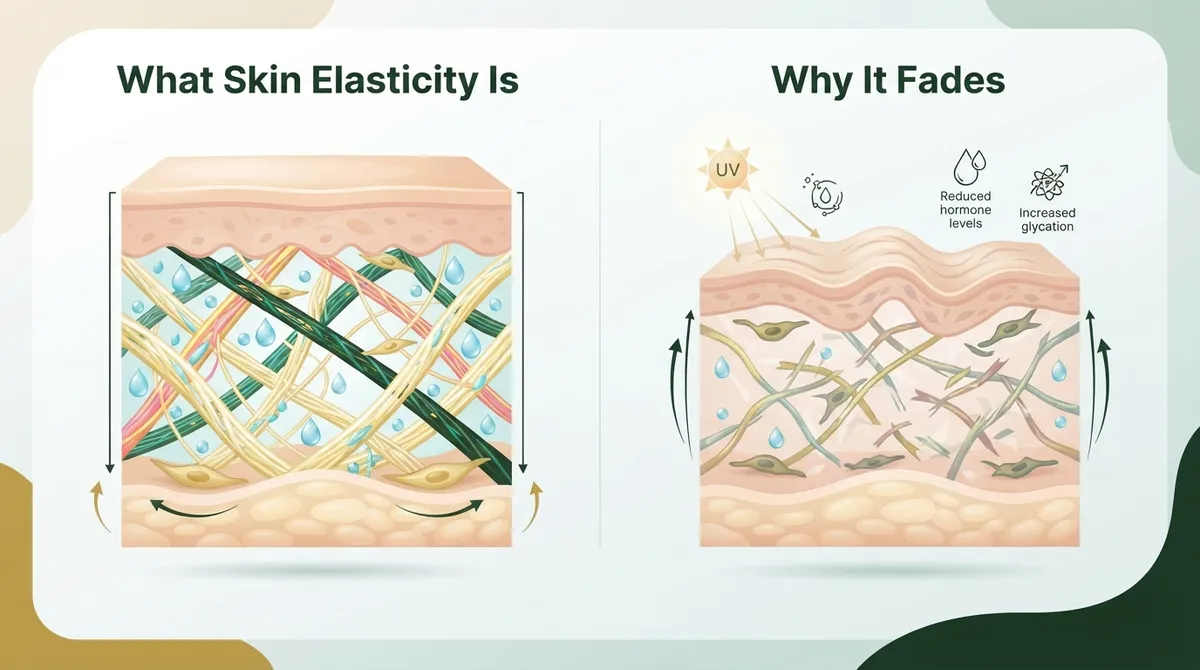
What Skin Elasticity Is and Why It Fades
Skin elasticity is your skin’s ability to stretch and snap back into place. Think of a fresh rubber band versus one that’s been left in a hot car. Young skin is the fresh one.
That bounce comes from the dermal extracellular matrix, a supportive network in the deeper layer of your skin. Collagen gives skin its strength and structure. Elastin gives it stretch and recoil. When these fibers break down or get made more slowly, skin can look looser and feel less firm.
Common Causes of Reduced Elasticity
- Natural aging: Collagen and elastin production slows over time.
- Ultraviolet (UV) exposure: Sun damage is one of the biggest drivers of visible skin aging.
- Smoking: It is linked with premature skin aging.
- Lifestyle factors: Poor sleep, high stress, and weight changes can also play a role.
It’s worth saying plainly: no peptide product can promise to fully reverse these changes. But there are meaningful steps that may help support your skin, and we’ll get to them.
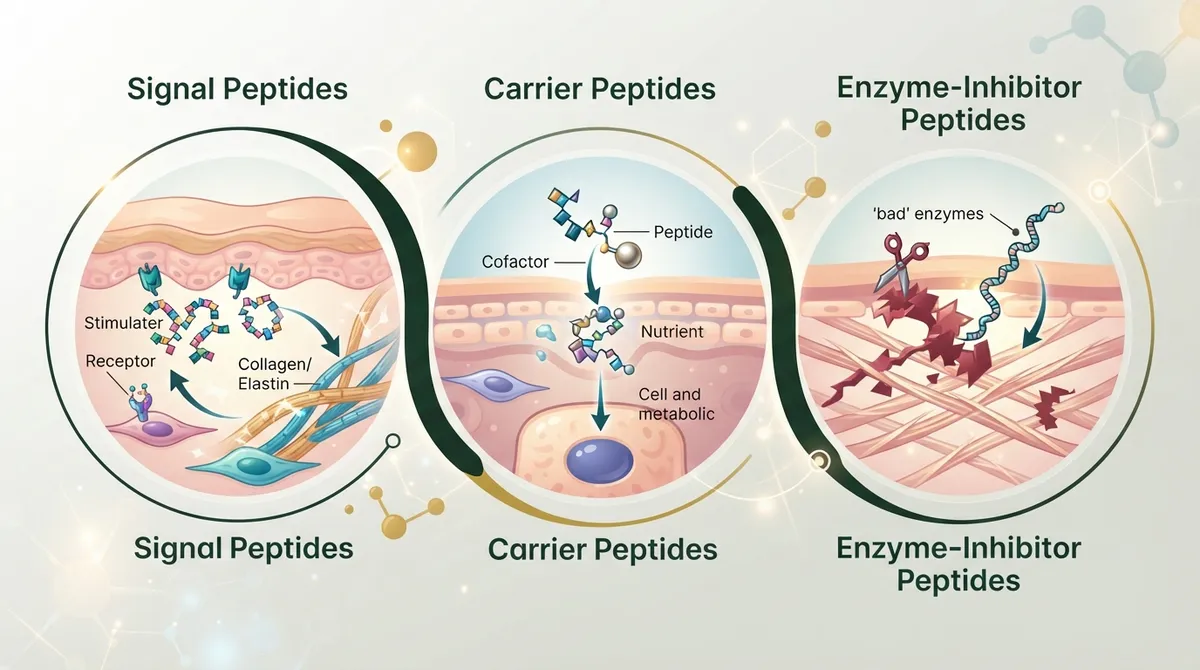
Understanding the Different Kinds of Peptide Approaches
Here’s where many people get tripped up. The word “peptide” covers very different things. A collagen powder in your smoothie, a peptide face serum, and a prescription injection are not the same, and research on one does not automatically apply to another. If you want a quick refresher, our guide on 8 facts that explain what are peptides in 2026 is a great starting point, and what are peptides is explained in plain language by WebMD.
| Peptide Approach | How It’s Used | Strength of Evidence for Elasticity | Key Notes |
|---|---|---|---|
| Oral collagen peptides | Powder or capsule, taken daily | Best-studied of the three | Benefits, when seen, tend to be modest |
| Topical cosmetic peptides | Serums and creams | Mixed; less established than marketing suggests | May help other skin measures more than elasticity |
| Prescription or injectable peptides | Provider-guided treatment | Varies widely by peptide; many lack strong skin data | Many are not FDA-approved for skin rejuvenation |
Keeping these categories separate helps you spot hype quickly. If a product claims one type of peptide proves another works, that’s a red flag.
What the Research Says About Oral Collagen Peptides
Oral hydrolyzed collagen has the most human research of any peptide-style option for skin. Hydrolyzed means the collagen has been broken into smaller pieces so your body can absorb it more easily.
A 2023 meta-analysis, as summarized in a later review, pulled together 26 randomized controlled trials with 1,721 participants. It reported improvements in skin hydration and elasticity compared with placebo. That’s encouraging.
But let’s keep our feet on the ground. Results vary by product, dose, and study design. Newer analyses also show a range of findings. One 2026 systematic review reported a pooled elasticity effect from oral collagen peptides across 35 trials and 2,534 participants, though very recent results like this should be checked against the full published paper before anyone leans on them. The honest takeaway is that benefits appear to be real for some people but generally modest. Collagen peptides are not a substitute for medical treatment.
How Long Might Collagen Peptides Take?
Many studies run for around two to six months before measuring skin changes. So patience matters. If you try an oral collagen product, give it a fair window and track how your skin looks and feels, rather than expecting overnight change.
What About Topical Peptide Creams?
Topical peptides are popular, and many feel lovely on the skin. They can support hydration and a smoother-looking surface. When it comes to firmness, though, the evidence is more mixed.
A 2026 systematic review of randomized trials reported a small, statistically non-significant overall change in elasticity for topical peptides (mean difference 0.09; p=0.15), even though some other skin measures looked better. Because this is a newer finding, it should be read alongside the full publication. You can browse the broader literature through the National Library of Medicine.
This doesn’t mean topical peptides are useless. It means they’re best seen as a nice supporting player in your routine, not the star of the show. For a deeper look, check out what peptides do for skin: a real-world guide for 2026.
The Truth About Injectable Peptides for Skin
This is the area that needs the most care. Many injectable peptides promoted online for skin rejuvenation are not FDA-approved for that purpose. Their safety and effectiveness may not be well studied, especially for skin elasticity.
Compounded medications add another layer. Compounded drugs are not FDA-approved and do not go through FDA premarket review for safety, effectiveness, and quality. That doesn’t automatically make them unsafe, but it does mean you want a licensed clinician guiding the decision and sourcing. Learn more in FDA-approved vs. compounded peptides: what wins? and how to get prescription peptides safely in 2026.
If anyone promises guaranteed skin tightening from an injection, treat that as your cue to ask more questions.
Step-by-Step: A Practical Plan to Support Skin Elasticity
Ready for action? Here’s a simple, realistic plan. Peptides can fit in, but the foundation comes first.
- Protect your skin from the sun every day. Use a broad-spectrum sunscreen daily, even when it’s cloudy. UV exposure is a major driver of lost elasticity, so this step is non-negotiable.
- Build a gentle, consistent routine. Cleanse, moisturize, and keep things simple. Skin that isn’t irritated tends to look and feel better.
- Ask a clinician about retinoids. Topical retinoids have clinical evidence for photoaged skin. In one six-month randomized, double-blind, vehicle-controlled study of 346 people, a retinoid used with sunscreen significantly improved fine wrinkles versus vehicle. They can irritate and aren’t right for everyone, so get personal guidance first.
- Consider oral collagen peptides as an add-on. If you want to try one, choose a reputable product, use it consistently, and track your progress over a few months.
- Review your lifestyle. Avoid smoking, prioritize sleep, and eat a balanced diet with enough protein.
- Talk to a licensed provider about personalized options. If you’re curious about prescription peptide therapy, a medical team can look at your health history and goals.
How Evidence Stacks Up Across Options
| Option | Best For | Evidence Level | Things to Keep in Mind |
|---|---|---|---|
| Daily broad-spectrum sunscreen | Preventing further UV damage | Strong | Works best used every day |
| Topical retinoids | Photoaged skin and fine lines | Strong clinical evidence | Can irritate; clinician guidance advised |
| Oral collagen peptides | Hydration and modest elasticity gains | Moderate | Results vary; not a replacement for care |
| Topical peptide creams | Supporting a smooth, hydrated look | Mixed | Elasticity effect may be small |
| Injectable or compounded peptides | Individualized medical plans | Varies; often limited for skin | Many not FDA-approved for skin use |
Where Personalized Peptide Therapy Fits In
Skin is just one piece of your overall health. Sleep, hormones, metabolism, stress, and recovery all show up on your face over time. That’s why a personalized approach can make sense for health optimizers and aging adults who want the full picture.
At Allura Longevity, licensed providers design customized plans based on your blood work and health goals, delivered to your home through telehealth. It’s a convenient option for busy professionals who don’t have time for extra appointments. If you’re exploring this path, our articles on how to start peptide therapy safely and see real results and how to trigger collagen stimulation with peptides can help you get oriented. We’re honest with every client: we focus on setting realistic expectations, not promising overnight transformations.
You can also read about what’s the best treatment for sagging skin in 2026 for more perspective on your options.
Questions to Ask Before Starting Any Peptide Treatment
Being a smart, informed client is a superpower. Bring these questions to any clinician visit:
- Is this peptide FDA-approved, and for what purpose?
- Is it compounded, and where is it prepared?
- What does the research show for my specific goal, and what are the limits?
- What blood work or health history do you need before starting?
- What side effects should I watch for, and how will you monitor me?
- How will we know if it’s working, and when will we adjust?
A trustworthy provider will welcome these questions. If you get vague answers or pressure to buy fast, trust your gut and pause.
Setting Realistic Expectations
Let’s end on a hopeful but honest note. Improving skin elasticity is usually a gradual process. Daily sun protection and a good routine protect what you have. Evidence-based treatments like retinoids may help skin look healthier over time. Oral collagen peptides may offer a modest boost for some people. And personalized peptide therapy, guided by a licensed team, can be part of a bigger wellness plan.
Real change takes weeks to months, and everyone’s skin responds a little differently. Be kind to yourself, track your progress, and celebrate small wins, like skin that feels more hydrated or looks a bit smoother.
Take the Next Step Toward Firmer-Looking Skin
You don’t have to figure this out alone. If you’re ready for a personalized, medically supervised approach, request a consultation with Allura Longevity. Our licensed team, led by a board-certified Family Nurse Practitioner, will review your goals, order blood work, and build a plan that makes sense for you, all through telehealth. We’re licensed in Florida, Georgia, Texas, Connecticut, Indiana, Maryland, New York, and California, and spots for new clients are limited each month. Call us at (813) 510-6277 to get started.
FAQs
Q: Can collagen peptides improve skin elasticity?
A: They might, a little. Randomized trials suggest oral hydrolyzed collagen may modestly improve skin hydration and elasticity for some people, but results vary by product, dose, and person. Think of it as a helpful extra, not a cure-all.
Q: How long does it take for collagen peptides to affect skin?
A: Many studies look at changes after roughly two to six months of daily use, so patience is key. Take photos and notes along the way so you can see whether your skin is actually responding.
Q: Are injectable peptides safe or FDA-approved for skin rejuvenation?
A: Many injectable peptides promoted online for skin are not FDA-approved for that purpose, and their safety and effectiveness may not be well studied. Compounded medications also skip FDA premarket review, so it’s wise to work with a licensed clinician and ask lots of questions.
Q: What is the difference between collagen supplements and peptide therapy?
A: Collagen supplements are oral products taken daily, while peptide therapy often means prescription treatments guided by a medical provider. The research on one doesn’t automatically apply to the other, so it helps to keep them separate in your mind.
Q: What treatments have the best evidence for improving skin elasticity?
A: Daily broad-spectrum sun protection and clinician-guided skincare, including topical retinoids for photoaged skin, have the strongest backing. Peptides can be a supportive add-on, but they work best alongside these basics.





