

Key Takeaways
-
Skin focused peptide protocol is not one standard treatment; it can mean oral collagen, topical serums, or injectable compounds, each with very different evidence and risk levels.
-
Oral hydrolyzed collagen peptides have the strongest human evidence, with a 2024 12-week placebo-controlled trial reporting 13.8% higher skin hydration versus baseline and placebo.
-
Topical peptide benefits depend on the specific ingredient and formula, so a result from one serum does not prove that other peptide serums work.
-
Injectable peptides like BPC-157 and GHK-Cu lack adequate human skin trials, and collagen supplement evidence does not validate them; they require medical supervision and caution.
-
Realistic timelines for measurable skin changes in studies were around 8 to 12 weeks, and results vary by product, dose, and person, so fast or permanent promises are a red flag.
-
Daily sunscreen, sleep, nutrition, and hormone balance are proven skin-health habits that often matter as much as any peptide, so pair any peptide plan with them.
You have probably seen the phrase “skin focused peptide protocol” on social media, in clinic ads, or in a friend’s group chat. It sounds scientific and exciting. But here is the honest truth: it is not one standard treatment. It is a broad label that can mean very different things.
For some people, it means a daily collagen supplement. For others, it means a topical serum. And for some, it means injectable compounds that are still being studied. Each path has a different level of evidence, a different level of risk, and a different place in a thoughtful wellness plan.
If you are a busy professional, a health optimizer, or someone who simply wants to age well, this guide is for you. We will break down what the research actually shows in 2026, what is still unproven, and how to build a smart, safe plan with medical guidance. No hype and no guarantees. Just clear, friendly information to help you decide your next step.

What Is a Skin Focused Peptide Protocol?
A skin focused peptide protocol is a personalized plan that uses peptides to support skin health, such as hydration, firmness, and texture. It is not a single medical term, and there is no one official regimen. That is the first thing to know.
Peptides are short chains of amino acids. They are the building blocks of proteins like collagen. If you want a quick refresher, our guide on 8 facts that explain what are peptides in 2026 covers the basics, and what are peptides is also explained well by WebMD.
In practice, a “skin protocol” usually falls into one of three buckets:
- Oral collagen peptides: Powders, capsules, or drinks you swallow.
- Topical peptides: Creams and serums applied to the skin.
- Systemic or injectable peptides: Compounds given under medical supervision, often compounded.
These three options are not interchangeable. Results from one cannot be assumed for another. Keeping them separate is the key to reading any claim wisely.
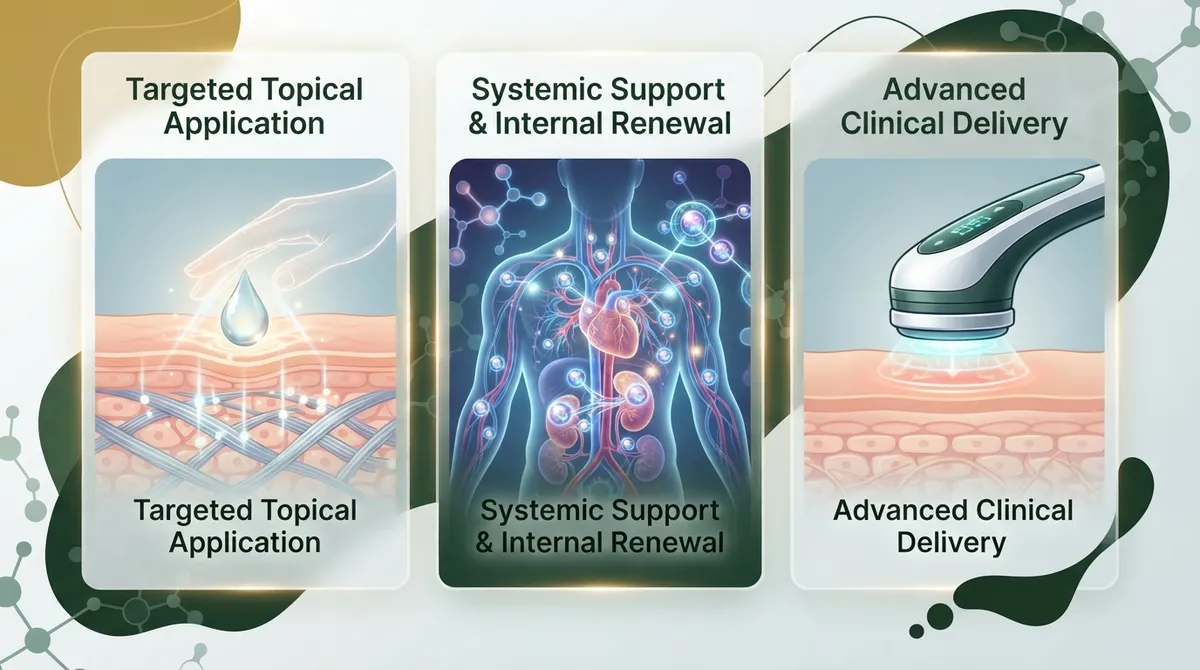
The Three Main Approaches Compared
Let us put the options side by side so you can see how they differ. This table is a simple starting point for conversations with your provider.
| Approach | How It Is Used | Level of Human Evidence | Regulatory Notes |
|---|---|---|---|
| Oral collagen peptides | Daily powder or capsule | Several randomized trials showing modest hydration and elasticity changes | Sold as dietary supplements |
| Topical peptides | Serums and creams | Varies by ingredient and formula | Regulated as cosmetics |
| Injectable or systemic peptides | Prescribed, often compounded | Limited human skin data for many compounds | Varies; some are investigational or compounded |
Notice how the evidence gets thinner as you move down the table. That does not mean a path is useless. It means we should be honest about what we know and what we do not.
What the Research Says About Oral Collagen Peptides
The strongest human data in this space comes from oral hydrolyzed collagen peptides. These are collagen proteins broken into small pieces so the body can absorb them more easily.
A 2024 randomized, double-blind, placebo-controlled trial looked at a hydrolyzed collagen supplement over 12 weeks. The study reported 13.8% higher skin hydration, a 22.7% increase in an elasticity index, and a 19.6% decrease in a roughness measure compared with baseline and placebo comparisons. Those are study-specific numbers, not promises for any one person.
Other research points the same way. A 2024 systematic review pulled together 31 publications on oral collagen and skin aging. It reported generally favorable findings for hydration and elasticity, while also noting limits in the evidence. A separate review of 14 studies found that 10 reported better skin elasticity after collagen use. That is a count of studies, not a pooled effect size.
An earlier controlled study gave 66 women aged 40 to 59 a daily 10 g dose for 8 weeks. They had greater skin moisture than the control group, though transepidermal water loss did not change. Another 12-week study of 106 women reported higher ultrasound-measured collagen density.
What These Numbers Do Not Mean
It is easy to get carried away by percentages, so let us keep it real. Many studies use instruments to measure skin, and a change on a machine may not look dramatic in the mirror. Results also vary by product, dose, and person.
Collagen supplements are best seen as a supportive, low-drama option. They are not a face-lift in a scoop.
Topical Peptides: Helpful Cosmetics With Limits
Topical peptides are ingredients in creams and serums that are meant to signal or condition the skin. Many people enjoy them, and some formulas may help with the look and feel of skin.
The catch is that evidence is specific to each ingredient and formula. A great result with one serum does not prove that all peptide serums work. It also does not tell us anything about oral or injected peptides.
If you like topicals, treat them as one piece of a bigger routine. Pair them with daily sunscreen, gentle cleansing, and good sleep. These basics often do more than any single ingredient.
Injectable and Systemic Peptides: Proceed With Care
This is where honesty matters most. You may have heard about compounds like BPC-157 or GHK-Cu being used for skin. These are popular topics online. But evidence from collagen supplements does not validate them, and a different route of delivery means a different risk and evidence picture.
Right now, claims that injectable or systemic peptides rejuvenate skin should not be treated as established clinical care without adequate human trials. Some of these products are compounded or investigational, and that changes how they are regulated. If you want to dig deeper, read our explainers on 9 BPC-157 peptide facts to know before you start and how to evaluate GHK-Cu peptide safely in 2026.
It also helps to understand the difference between approved and compounded products. Our guide on FDA-approved vs. compounded peptides walks through it in plain language.
How to Build a Smart Skin Focused Peptide Protocol
A good plan starts with you, not a trend. Here is a simple, step-by-step way to think about it.
- Define your goal. Are you after hydration, firmness, texture, or an overall healthy aging plan? Clear goals make choices easier.
- Review your health history. Share medications, allergies, chronic conditions, and pregnancy plans with a licensed provider.
- Check your baseline labs. Blood work can reveal hormone, nutrient, and metabolic factors that affect skin and energy.
- Start with the best-supported options. Oral collagen and a solid daily skin routine come first for most people.
- Add medical therapies only with guidance. If injectable or prescription options are considered, a clinician should weigh benefits and risks with you.
- Track and adjust. Take photos, note how your skin feels, and check in regularly. Adjust based on real results, not marketing.
Biohackers will love step five and six. Data beats guesswork every time, and a clinician can help you read it. For a broader look at the process, see how to start peptide therapy safely and see real results.
Skin Health Is Bigger Than Skin
Here is something many people miss. Your skin reflects what is happening inside your body. Sleep, stress, hormones, nutrition, and inflammation all play a role.
That is why a truly personalized plan looks at the whole picture. A few areas worth checking include:
- Hormone balance: Shifts in midlife can change how skin looks and feels.
- Sleep quality: Skin repairs itself overnight, so poor sleep can show up on your face.
- Sun protection: Daily SPF remains one of the most proven habits for skin health.
- Nutrition and hydration: Protein, vitamin C, and water support normal collagen processes.
If you want more on how peptides may fit into the bigger picture, our article on what peptides do for skin and the guide to how to trigger collagen stimulation with peptides are helpful next reads.
How Long Does It Take to See Changes?
This is the question everyone asks. The honest answer is: it depends. In the oral collagen studies mentioned above, changes were measured at around 8 to 12 weeks. That is a research timeline, not a guarantee.
Skin renews slowly, so patience is part of the process. Be wary of any program that promises fast, dramatic, or permanent results. A responsible provider will set realistic expectations and tell you plainly that outcomes vary.
| What to Watch | Realistic Expectation | Why It Matters |
|---|---|---|
| Hydration | May improve in 8 to 12 weeks in some studies | Often the first measurable change |
| Elasticity | Modest changes reported in some trials | Varies by product and person |
| Visible wrinkles | Not guaranteed | Lab measures may not equal visible change |
For more on timing, see how long until peptides improve skin.
Safety, Quality, and Red Flags
Safety comes first. Even products that feel “natural” can cause side effects or interact with medications. Peptide supplements and injections can bring risks like allergic reactions, injection-site irritation, or unexpected effects, especially when product quality is unclear.
Before you start anything, look for these green flags:
- A licensed medical provider reviews your history and labs.
- The plan is personalized, not copy-and-paste.
- The provider is honest about uncertainty and does not promise results.
- Products come from reputable, regulated pharmacies.
- There is ongoing monitoring and follow-up.
And here are a few red flags to avoid: miracle claims, pressure to buy fast, no medical screening, and sellers who cannot explain where a product comes from. Our guide on whether peptide therapy is safe goes deeper, and the National Library of Medicine is a great place to look up peer-reviewed research yourself.
Special care is needed if you are pregnant, nursing, managing a chronic illness, have allergies, or take other medications. Always talk with a clinician first.
Why Personalization Matters
No two people have the same skin, hormones, or lifestyle. That is why generic, one-size-fits-all packages often fall short. A tailored plan starts with a conversation and real data.
At Allura Longevity, care is built around you. It begins with a virtual consultation, followed by LabCorp blood work and a customized treatment plan reviewed by licensed providers, led by Ashley, a board-certified Family Nurse Practitioner. Your plan is monitored and adjusted over time, and any prescribed items are delivered to your door. Telehealth care is available in Florida, Georgia, Texas, Connecticut, Indiana, Maryland, New York, and California.
That kind of structure is especially useful for busy professionals who want expert guidance without sitting in a waiting room. It is also a good fit for wellness seekers who want to go further than store-bought supplements. If you are comparing options, our piece on local clinic vs. telehealth peptide therapy can help.
Final Thoughts: Start Smart, Stay Realistic
A skin focused peptide protocol can be a useful part of a healthy aging plan, as long as you keep your expectations grounded. Oral collagen peptides have the most human evidence, with modest benefits for hydration and elasticity in several studies. Topicals can be pleasant cosmetic additions. Injectable and systemic options need extra caution and medical oversight because the skin-specific evidence is still limited.
The best next step is a conversation with a licensed provider who looks at your labs, goals, and history. Spots for new clients are limited each month, so do not wait too long if you are ready to begin. You can call (813) 510-6277 or request a consultation to see what a personalized, medically supervised plan could look like for you.
Your skin tells your story. Let us help you care for it with science, honesty, and a little warmth.
FAQs
Q: What is a skin focused peptide protocol?
A: It is a personalized plan that uses peptides to support skin health, but it is not a single standardized medical regimen. It may include oral collagen peptides, topical products, or medically supervised options, and each has different evidence. A licensed provider can help you choose what fits your goals and health history.
Q: Do collagen peptides improve skin hydration or elasticity?
A: Several randomized trials suggest oral collagen peptides may modestly improve measured skin hydration and, in some studies, elasticity. One 2024 trial reported 13.8% higher hydration after 12 weeks. Results vary by product and person, so they are not guaranteed.
Q: Are injectable peptides like BPC-157 or GHK-Cu proven for skin rejuvenation?
A: Not yet. Evidence from collagen supplements does not validate these compounds, and adequate human trials for skin rejuvenation are limited. If you are curious about them, talk with a licensed clinician who can explain the risks and the regulatory status.
Q: What is the difference between oral, topical, and injectable skin peptides?
A: Oral peptides are swallowed and have the most human skin data. Topical peptides are cosmetic products applied to the skin, and evidence depends on the formula. Injectable peptides are given under medical supervision and often have the least skin-specific research.
Q: How do I know if a skin peptide treatment is safe and high quality?
A: Look for licensed providers, lab-based screening, regulated pharmacies, and honest conversations about uncertainty. Avoid anyone promising miracle results or skipping medical review. Ongoing monitoring is a good sign that a program takes your safety seriously.





