
Key Takeaways
-
The term 'facial rejuvenation peptides' is a broad marketing label covering topical creams, oral collagen, and injectables, each with different evidence and risk levels.
-
Injectable or compounded peptides sold online may be unapproved for facial use and carry risks around sterility, dosing, and product quality, so work with a licensed clinician.
-
Small human trials suggest some specific topical peptide serums may modestly improve expression lines and wrinkles over 12 weeks, but results apply only to the tested formulation.
-
GHK-Cu has extensive lab and animal research, but human evidence remains limited and fragmented, with no large randomized trials yet confirming facial benefits.
-
Oral collagen peptides may modestly improve hydration and elasticity, with effects varying by product, dose, and duration; a 2025 trial of 77 participants reported gains after 12 weeks.
-
Peptides are not a magic eraser: allow about 12 weeks before judging results, and pair them with sun protection, sleep, and nutrition for the best outcomes.
If you have ever stood in front of the mirror and wondered whether a tiny chain of amino acids could soften those fine lines, you are in good company. Facial rejuvenation peptides are everywhere right now, from serums to powders to injectable programs. But here is the catch: the term is a broad marketing label, not one standardized treatment.
It can mean a topical cream, an oral collagen scoop, or a prescribed injectable. Each one has a different level of evidence and a different risk profile. That matters a lot if you are a busy professional or a data-driven health optimizer who wants real results, not hype.
In this guide, we walk through eight peptide options and categories, what small human studies actually show, and where caution is smart. For a quick primer, you can start with 8 Facts That Explain What Are Peptides in 2026. Let’s get into it, friendly and honest.

Why Facial Rejuvenation Peptides Are Getting So Much Attention
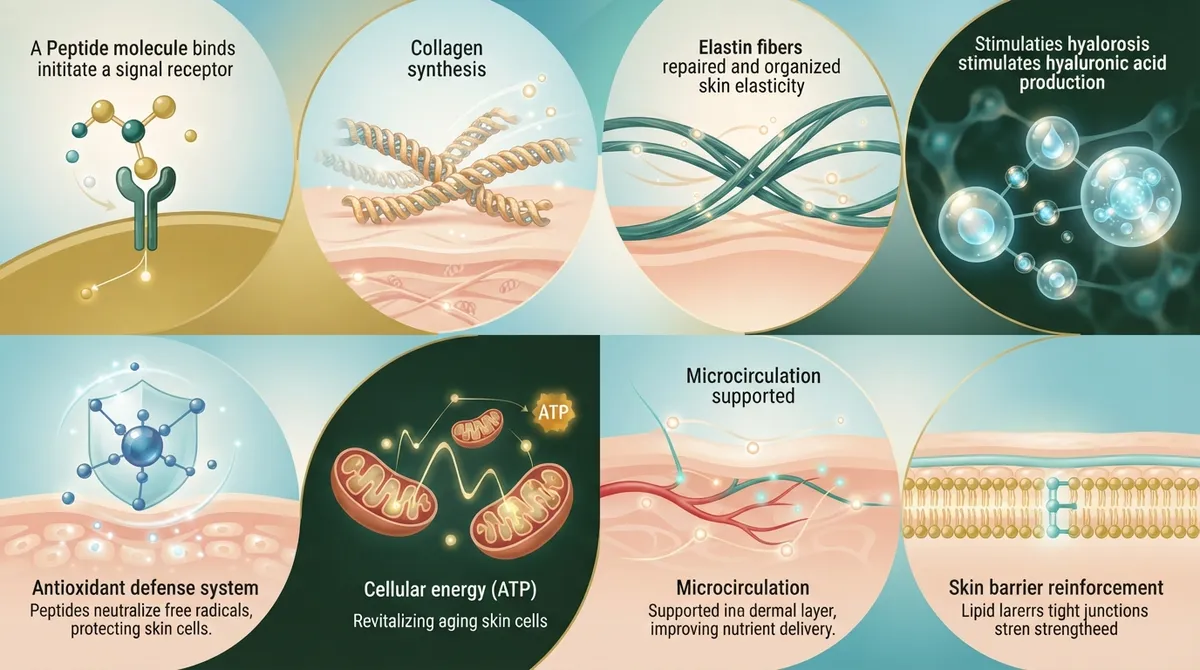
Peptides are short chains of amino acids. Some act like messengers that tell skin cells to behave more youthfully. That is the idea behind many facial rejuvenation peptides. If you want the basics, what are peptides is a helpful overview.
Skin changes with age. Collagen drops, lines deepen, and skin can feel thinner and drier. Peptides are popular because they seem gentle and targeted. Still, lab results do not always equal real-world results on your face.
Three Very Different Routes
Not all peptide products work the same way. It helps to sort them by how you use them.
| Route | Examples | Evidence Level | Main Caution |
|---|---|---|---|
| Topical (on the skin) | Palmitoyl pentapeptide, acetyl hexapeptide-8, GHK-Cu | Small studies, formulation-specific | Multi-ingredient products blur results |
| Oral collagen peptides | Hydrolyzed collagen powders and capsules | Modest effects on hydration and elasticity | Varies by dose, product, and duration |
| Injectable or compounded | Prescribed or online peptide injections | Often limited for facial claims | Quality, sterility, and approval status |
8 Facial Rejuvenation Peptides and Options to Know
1. Palmitoyl Pentapeptide (Signal Peptide)
This is one of the best-known signal peptides in skin care. The idea is that it nudges skin to support its own structure, including collagen. It shows up in many anti-aging creams and serums.
The catch is that lab ideas do not automatically prove clinical benefit. Mechanisms seen in cells do not guarantee fewer wrinkles on your face. Look for products with some human testing behind them.
2. Acetyl Hexapeptide-8 (Neurotransmitter-Modulating Peptide)
You may hear this one called a “gentle alternative” to injectables. It is designed to soften the look of expression lines, like those around the eyes and forehead.
Be careful with the comparison, though. A topical product is not the same as a medical injection, and results tend to be modest. Think subtle smoothing, not a dramatic change.
3. GHK-Cu (Copper Peptide)
GHK-Cu is popular for good reason. It has a large body of preclinical research, and it is often discussed for skin repair and texture. A review of small cosmetic studies describes a 12-week facial-cream study in 71 women and an eye-cream study in 41 women.
Here is the honest part. Human evidence is limited and fragmented, and large randomized trials are lacking. The National Library of Medicine hosts research on its regenerative actions, but cell and animal findings should not be read as proven clinical outcomes. You can learn more in How to Evaluate GHK-Cu Peptide Safely in 2026.
4. Multi-Peptide Topical Serums
Many serums blend several peptides together. Some have decent human data. A 2021 randomized, double-blind, placebo-controlled study of a topical peptide serum enrolled 55 women aged 35 to 60. Used twice daily for 12 weeks, it reported improvements in expression lines and wrinkles versus placebo.
That is encouraging, but it applies to that tested formulation only. It does not mean every peptide serum works the same. A 2019 study of a peptide complex included just 22 women aged 40 to 60, with wrinkle improvements after two weeks. Small and short studies limit what we can say.
5. Oral Collagen Peptides
Oral collagen is different from topical or injectable peptides. You swallow it, and the peptides are broken down and used by the body. Human trials and reviews report possible modest gains in hydration, elasticity, or wrinkle-related measures.
A 2025 randomized, double-blind trial of bioactive collagen peptides enrolled 77 participants and reported improvements in selected skin measures after 12 weeks. Results vary by product, dose, and duration. For more on this, see How to Choose the Best Collagen Peptides for Women in 2026.
6. Peptide Eye Creams
The skin around your eyes is thin, so it shows aging early. Peptide eye creams aim to support smoother, firmer-looking skin there. Some use GHK-Cu or signal peptides.
Results depend on the exact formula. Since these products are applied to intact skin, they are generally lower risk than injectables. Patch test first, and give any product about 8 to 12 weeks before judging it.
7. Combination Routines (Topical Plus Oral)
Some people pair a topical peptide with an oral collagen supplement. The logic is simple: support skin from the outside and the inside.
A 2026 systematic review reported 19 randomized trials with 1,341 participants across oral and topical peptides. It found modest wrinkle-related effects, but only two of the trials were topical. Because this is a very recent result, verify the publication details before citing it. For more context, read Topical vs. Oral vs. Injectable Peptides: Which Wins in 2026?
8. Prescribed Injectable Peptides (Handle With Care)
This is the category that needs the most caution. Injectable or compounded peptides marketed online may be unapproved for the claimed facial use. They can carry added risks around product quality, sterility, dosing, and limited long-term safety data.
That does not mean every injectable program is a bad idea. It means you should work with a licensed clinician and verify regulatory status. Learn how to protect yourself with FDA-Approved vs. Compounded Peptides: What Wins? and How to Get Prescription Peptides Safely in 2026.
What the Research Really Shows
Let’s keep it real. Small human studies suggest some topical formulations and oral collagen products may modestly improve selected skin measures. But the evidence is product-specific and less robust than broad marketing claims imply.
| Study or Review | Participants | What It Looked At | Takeaway |
|---|---|---|---|
| 2021 topical peptide serum trial | 55 women, ages 35 to 60 | Expression lines and wrinkles over 12 weeks | Improved vs. placebo; tested formula only |
| 2018 GHK-Cu review | 71 women (face cream), 41 women (eye cream) | Small cosmetic studies | Promising but not definitive |
| 2019 peptide complex study | 22 women, ages 40 to 60 | Wrinkle measurements after two weeks | Small and short; hard to generalize |
| 2025 collagen peptide trial | 77 participants | Skin measures over 12 weeks | Selected improvements; product-specific |
| 2026 systematic review | 1,341 participants, 19 trials | Oral and topical peptides | Modest wrinkle effects; few topical trials |
The pattern is clear. Many studies are small, short, or use multi-ingredient products. That makes it hard to credit one peptide alone. For a broader look, the National Library of Medicine is a good place to read primary research.
How to Choose a Facial Rejuvenation Peptide Approach
Picking the right path does not need to be overwhelming. Here is a simple way to think it through.
- Name your goal. Are you after fine lines, hydration, firmness, or overall skin quality?
- Start with the lowest-risk option. Topical products and oral collagen usually come first.
- Check the evidence. Look for human studies on the exact formula, not just the ingredient.
- Be patient. Many trials run 12 weeks, so give products time before judging them.
- Talk to a licensed clinician. This is a must before any injectable or prescribed peptide.
If you are comparing options, What Peptides Do for Skin: A Real-World Guide for 2026 and 12 Peptide Skin Rejuvenation Facts Worth Knowing (2026) go deeper.
Red Flags to Watch For
- Promises of dramatic, overnight results
- Injectable peptides sold online with no clinician review
- No information on sourcing, sterility, or dosing
- Claims that all peptides work the same way
- Pressure to buy large bundles right away
Why Personalization Matters
Your skin, your health history, and your goals are unique. That is where personalized care can help, especially for health optimizers and biohackers who like to track data. Blood work can show a bigger picture of your health, and a clinician can tailor a plan around it. See How to Use Biomarker Testing to Guide Peptide Therapy for more.
Allura Longevity offers personalized, medically supervised peptide therapy by telehealth. Clients start with a $50 virtual consultation, complete blood work through LabCorp, and receive a customized six-month plan delivered to their door. Care is led by Ashley, a board-certified Family Nurse Practitioner, with ongoing monitoring. Telehealth is available nationwide, and Allura Longevity is licensed in Florida, Georgia, Texas, Connecticut, Indiana, Maryland, New York, and California. Curious how that works? Read How to Start Peptide Therapy Safely and See Real Results.
Setting Realistic Expectations
Here is a friendly reality check. Peptides are not a magic eraser. At best, many topical and oral options show modest improvements in selected skin measures over weeks to months.
Think of facial rejuvenation peptides as one piece of a bigger puzzle. Sun protection, sleep, nutrition, and overall wellness all play a role. You can explore the bigger picture in Anti-Aging Peptides: What Actually Works in 2026.
Also remember that results vary. If you want to understand timing, How Long Until Peptides Improve Skin? A 2026 Timeline is a helpful read.
Ready to Take the Next Step?
Facial rejuvenation peptides can be a thoughtful part of an anti-aging plan, as long as you match the right type to the right goal and stay realistic. Start with evidence, choose reputable products, and be extra careful with anything injectable.
If you would like expert guidance built around your own labs and goals, we would love to help. Spots for new clients are limited each month. Request a consultation with Allura Longevity today, or call (813) 510-6277 to talk with our team. You can also learn more about peptides for women and peptides for men.
FAQs
Q: What are facial rejuvenation peptides?
A: Facial rejuvenation peptides is a broad marketing term, not one standardized treatment. It can mean topical cosmetic peptides, oral collagen peptides, or injectable peptides, and each has different evidence and risks.
Q: Do topical peptides actually reduce wrinkles?
A: Some small human studies show modest improvements in expression lines and wrinkles with specific formulations. Results depend on the exact product, and many studies are small or short, so it is smart to keep expectations realistic.
Q: Is GHK-Cu proven to work on the face?
A: GHK-Cu has a lot of lab and animal research, but human evidence is limited and mostly from small cosmetic studies. Large randomized trials are still missing, so it is promising but not proven.
Q: Are injectable peptides approved for facial rejuvenation?
A: Many injectable or compounded peptides sold online are not approved for facial rejuvenation claims. They can carry risks around quality, sterility, and dosing, so always work with a licensed clinician and verify regulatory status.
Q: How long do peptide skin products take to work?
A: Many studies run about 12 weeks, so that is a fair window to judge a topical or oral product. Some small studies report earlier changes, but results vary from person to person.





