
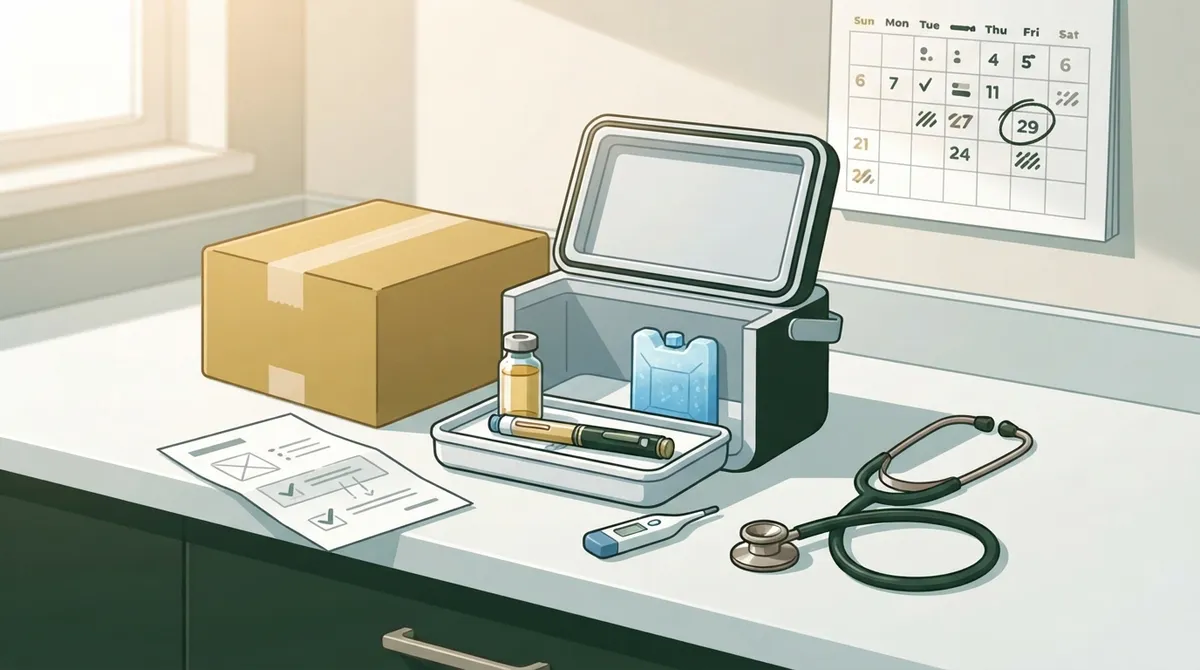
Key Takeaways
-
Home delivery is only a fulfillment method; it doesn't prove a peptide is FDA-approved, properly handled, or right for you. Verify the prescriber and licensed pharmacy first.
-
Before anything ships, expect a medical consultation, lab work, a personalized plan, and a prescription sent to a licensed pharmacy. Skipping these steps is a red flag.
-
On arrival, check the patient name, drug and strength, directions, expiration date, seal, and any temperature indicator before storing or using the medicine.
-
Do not use a product that arrives warm without cooling, leaks, is mislabeled, or looks cloudy or discolored. Call the pharmacy and prescriber for guidance first.
-
Follow the package insert for storage, and write the date you first open a multidose vial; FDA guidance generally calls for discarding it within 28 days unless labeling says otherwise.
-
Confirm your dose in the same units as your label (mg, mL, or syringe units) before injecting, since FDA reports documented serious dosing errors with compounded semaglutide.
You’ve done your homework, talked with a provider, and now a box of peptides is on its way to your front door. Exciting, right? It’s also a moment that raises a lot of questions. What will be inside? How cold should it be? Who shows you how to use it? And what if something looks off?
Here’s the good news: when it’s done right, what to expect from home delivered peptides is a smooth, calm, well-supported experience. Home delivery is just a fulfillment method. It doesn’t guarantee a product is approved, handled well, or right for you. That’s why the steps before and after the delivery matter so much.
In this guide, we’ll walk you through the whole journey in plain language. You’ll learn what happens before the box ships, what to check when it arrives, how storage works, and what safe use looks like. Whether you’re a busy professional, a data-driven biohacker, or simply someone who wants to feel and age well, this is for you. Let’s make sure your first delivery feels confident, not confusing.

What Home Delivered Peptides Actually Are
The phrase “home delivered peptides” can mean very different things. Some are legitimate prescription therapies. Others are products sold online with little oversight. Knowing the difference is your first big win.
A legitimate prescription therapy follows a simple path. A licensed clinician evaluates you, writes a prescription, and a licensed pharmacy dispenses it. The delivery is the last step, not the first. If you want a refresher on the basics, check out these 8 facts that explain what are peptides in 2026. You can also read a general overview of what are peptides from a trusted health source.
Here’s a key point many people miss. Online availability or fast shipping does not prove a product is authentic or appropriate for you. A professional care team, a real pharmacy, and clear instructions do.
FDA-Approved vs. Compounded Peptides
Not all peptide medicines are regulated the same way. FDA-approved peptide medicines have been reviewed for safety, effectiveness, and quality for their approved uses. Compounded medicines are different. They are not FDA-approved and do not go through FDA premarket review. The FDA says compounding should generally be reserved for patients whose needs can’t be met by an approved drug.
Want to go deeper? This breakdown of FDA-approved vs. compounded peptides explains how to think about the choice.
| Feature | FDA-Approved Peptide Medicine | Compounded Peptide |
|---|---|---|
| FDA premarket review | Yes, for approved uses | No |
| Who dispenses it | Licensed pharmacy | Licensed compounding pharmacy |
| Prescription needed | Yes | Yes |
| Best used when | An approved option fits your needs | An approved option can’t meet your medical needs |
| Extra care needed | Follow the package insert | Confirm dose units and storage closely |

What Happens Before Your Box Ships
A great home delivery experience starts days or weeks before the package leaves the pharmacy. Think of the delivery as the finish line of a careful process.
Here’s what a responsible journey usually looks like:
- A medical consultation. A licensed provider reviews your goals, history, and current medications.
- Lab work. Blood tests give your provider real data, so your plan isn’t a guess.
- A personalized plan. Your provider picks the therapy, dose, and schedule that fit you.
- A prescription sent to a licensed pharmacy. The pharmacy prepares and dispenses your medicine.
- Clear instructions. You learn how to store, measure, and use your medicine before it arrives.
- Shipping and tracking. You get a delivery window so you can be home to receive it.
This is how it works at Allura Longevity. Clients begin with a $50 virtual consultation, complete blood work through LabCorp, and receive a customized six-month plan. Licensed providers, led by Ashley, a board-certified Family Nurse Practitioner, monitor progress and adjust the plan along the way. Curious about the first steps? Read how to start peptide therapy safely and see real results.
Questions Your Provider Should Answer Up Front
Before anything ships, you should feel clear on the basics. If you’re not, ask. Good providers love questions.
- What is my exact dose, and how often do I take it?
- Is my medicine a prefilled pen, a syringe, or a vial?
- How should I store it, and for how long?
- What do I do if I miss a dose?
- What supplies come with it?
- Who do I call if something seems wrong?
For more ideas, this list of 15 peptide consultation questions to ask in 2026 is a handy cheat sheet.
What to Expect When the Package Arrives
Delivery day is the moment to slow down and look closely. A two-minute check can prevent a big headache. Don’t just toss the box on the counter and move on.
Most injectable peptide medicines are shipped with care. Many are packed with insulated materials and cold packs. The exact setup depends on the product and the pharmacy. Always follow the label and the shipping instructions that come with your order.
Your Arrival Checklist
Open the package soon after it arrives. Then go through this list:
- Check the patient name. It should match yours exactly.
- Confirm the drug name and strength. Compare it with what your provider told you.
- Read the directions. They should match your plan.
- Look at the expiration or beyond-use date. Make sure it hasn’t passed.
- Inspect the seal and container. Look for leaks, cracks, or tampering.
- Check any temperature indicator. Follow the shipping instructions if one is included.
- Look at the medicine itself. If it looks cloudy, discolored, or different than described, pause.
When to Stop and Call
Here’s the part that matters most. Do not use a product that is damaged, leaking, mislabeled, visibly altered, or exposed to the wrong temperature without guidance from the pharmacist or your prescriber. The FDA has warned that injectable GLP-1 products arriving warm or without enough refrigeration may have compromised quality. Contact the dispensing pharmacy and your prescriber, and wait for their advice before using it.
| What You Notice | What To Do |
|---|---|
| Package arrives warm or without cold packs | Do not use it yet. Call the pharmacy and your prescriber. |
| Leaking or cracked vial | Do not use it. Call the pharmacy. |
| Wrong name, drug, or strength on label | Do not use it. Contact the pharmacy right away. |
| Liquid looks cloudy or changed color | Hold off and ask the pharmacist. |
| Past the expiration or beyond-use date | Do not use it. Ask for a replacement. |
| Everything matches and looks normal | Store it as directed and follow your plan. |
Storage: Refrigerated or Not?
Storage rules vary by product. Some injectable peptide medicines need refrigeration. Others have different requirements. The only rule that always applies is this: follow the specific package insert or pharmacy label for your medicine.
A few friendly tips can help:
- Put your medicine away soon after you check it.
- Keep it in the original packaging unless told otherwise.
- Keep it away from direct heat and sunlight.
- Keep it out of reach of children and pets.
- Write the date you first open a vial on the label.
That last tip matters. FDA guidance generally recommends discarding multidose vials of sterile medication within 28 days after first use, unless the labeling or your pharmacy instructions say otherwise. Always follow your exact product directions, since they may differ.
How Injections Work at Home
For many people, the idea of self-injecting is the biggest worry. Take a deep breath. With good teaching and a little practice, most people find it far easier than they feared. If you’re nervous, you’re in good company.
Your first step is knowing what format you have. A prefilled pen works differently than a syringe, and both differ from a vial you draw from. Ask your clinician or pharmacist to demonstrate. Don’t guess at syringe markings or try to convert units on your own.
For a full walkthrough, see how to prepare for safe, effective peptide injections. If you want to understand the technique, this guide to avoiding subcutaneous peptide injection mistakes is a great next read. You can also learn how to get peptides administered safely at home.
Why Dosing Clarity Matters So Much
This is where extra caution pays off. The FDA documented serious dosing errors with compounded injectable semaglutide, especially when patients drew doses from multidose vials. People mixed up milligrams, milliliters, and syringe units. Some reported taking 5 to 20 times the intended dose.
Reported problems included severe nausea and vomiting, fainting, dehydration, low blood sugar, pancreatitis, gallstones, and hospital stays. Those reports are a serious reminder to confirm your dose in the same units your label uses. If you’re unsure, stop and ask before you inject.
The same caution applies to numbers you may have seen. As of April 30, 2025, the FDA had received 520 adverse-event reports involving compounded semaglutide and 480 involving compounded tirzepatide. These reports don’t measure how often problems happen, and they may be underreported. Still, they show why clear instructions and clinician support matter. To learn more about managing common issues, read what causes GLP-1 side effects and how to manage them.
Red Flags: Products to Avoid
Not everything that ships to your door deserves a place in your fridge. Stay away from products labeled “research use only” or “not for human consumption” if you plan to treat yourself. Those labels are a signal that the product isn’t meant for you.
The FDA has also warned that semaglutide sodium and semaglutide acetate are different from the active ingredient in FDA-approved semaglutide products. Their safety and effectiveness haven’t been established for human use. The American Diabetes Association’s 2025 statement also recommends against non-FDA-approved compounded GLP-1 and dual GIP/GLP-1 products, citing uncertainty about content, safety, quality, and effectiveness.
Quick red flags to watch for:
- No consultation or no prescription required
- No lab work or health review
- No named, licensed pharmacy
- Vague labels with no dose, lot, or expiration info
- Pressure to buy fast or in bulk
- “Research only” language
Not sure how to vet a provider? This guide on how you know online peptide therapy is safe can help. You can also read how to get prescription peptides safely in 2026 and how to find legal peptide therapy you can trust. For a broader look at published research, the National Library of Medicine is a solid place to explore.
What Ongoing Care Looks Like
Delivery is not the end of the story. The best peptide care keeps going after the box arrives. Expect check-ins, lab follow-ups, and plan adjustments as your body responds.
A good telehealth program usually includes:
- Scheduled follow-up visits with your provider
- Repeat lab work to track your progress
- Easy ways to ask questions between visits
- Dose adjustments based on how you feel and what your labs show
- Clear guidance on side effects and when to call
Results take time, and every person is different. Many people wonder when they’ll notice changes. This realistic look at how long for peptide therapy results can set honest expectations. If you’re comparing care models, see local clinic vs. telehealth to find your best fit.
Side Effects to Watch For
Most people do well, but it’s smart to know what to watch for. Contact your provider if you notice severe nausea or vomiting, dizziness or fainting, signs of dehydration, strong stomach pain, or a reaction at the injection site that keeps getting worse. Call emergency services for severe symptoms. Your provider can tell you what’s normal and what isn’t for your specific therapy. For a balanced view, read is peptide therapy safe? What you really need to know.
Why Convenience Fits Busy Lives
Let’s talk about the upside. For busy professionals, parents, and anyone juggling a full calendar, home delivery is a real gift. No waiting rooms. No commute. No rearranging your day around an appointment.
Biohackers and health optimizers also love the data-driven side. Labs guide the plan, and follow-ups keep it on track. Aging adults and wellness seekers often appreciate having a clinician in their corner who explains things in plain terms. You can learn more about options for peptides for women and peptides for men, depending on your goals.
Wondering about the full picture? Here are 12 things to expect from peptide therapy in 2026, plus a look at how peptide medications ship safely from telehealth clinics.
Your Friendly Delivery-Day Game Plan
Let’s pull it all together in a simple routine you can follow every time a package arrives:
- Be home or plan for safe receipt so the package doesn’t sit outside.
- Open it promptly and run through the arrival checklist.
- Store the medicine exactly as the label directs.
- Review your dosing instructions before your first use.
- Reach out to your provider with any question, big or small.
Final Thoughts
Knowing what to expect from home delivered peptides turns a possibly stressful moment into a confident one. The right experience includes a real consultation, labs, a licensed pharmacy, clear instructions, careful inspection on arrival, and a team that’s there when you have questions. If any of those pieces are missing, slow down and ask more questions.
You deserve care that is personal, safe, and easy to follow. Allura Longevity offers personalized, medically supervised peptide therapy through telehealth in Florida, Georgia, Texas, Connecticut, Indiana, Maryland, New York, and California. New client spots are limited each month, so don’t wait too long. When you’re ready, request a consultation or call (813) 510-6277, and let’s build a plan that fits your goals and your life.
FAQs
Q: Are peptides delivered to your home safe and legal?
A: They can be, when they come from a licensed pharmacy after a clinician evaluates you and writes a prescription. Fast shipping alone doesn’t make a product safe, so always check who prescribed it and who dispensed it. If a seller skips the consultation or labs, that’s your cue to walk away.
Q: Do home-delivered peptide injections need to be refrigerated?
A: It depends on the product. Some injectable peptide medicines need refrigeration and others have different rules, so follow the package insert or pharmacy label every time. If your medicine arrives warm or without enough cooling, call your pharmacy and prescriber before using it.
Q: What should I check when my peptide medication arrives?
A: Look at the patient name, drug and strength, directions, expiration or beyond-use date, seal, and any temperature indicator. If anything looks damaged, mislabeled, or off, pause and contact the pharmacist or your prescriber for guidance. A quick check takes just a couple of minutes and gives you real peace of mind.
Q: Are compounded peptides FDA-approved?
A: No, compounded medicines are not FDA-approved and don’t go through FDA premarket review. FDA says compounding should generally be reserved for patients whose needs can’t be met by an approved drug. Ask your provider why a compounded option is right for you, and make sure the dosing units are crystal clear.
Q: What should I do if I’m unsure how to measure or inject my dose?
A: Don’t guess! Ask your clinician or pharmacist to walk you through it, especially if you’re drawing from a vial. Confusing milligrams, milliliters, and syringe units has caused serious dosing errors, so a quick demonstration is always worth it.





