

Key Takeaways
-
Peptide therapy is a broad category, not one treatment, so the route, dose, and schedule depend on the specific peptide and the person taking it.
-
Most peptide products are injected because stomach acid and digestive enzymes break peptides down; a 2020 review found roughly 75% of FDA, EMA, and PMDA-approved peptide products are given by injection.
-
Subcutaneous injection, into the fat layer under the skin, is the most common route and is often self-administered at home after proper training from a clinician or pharmacist.
-
Oral peptides exist only for specific approved medicines and have strict rules, such as taking oral semaglutide (Rybelsus) on an empty stomach with no more than 4 ounces of plain water.
-
Compounded peptide products are not interchangeable with FDA-approved medicines; the FDA has warned of dosing errors with compounded injectable semaglutide, so verify concentration and get product-specific directions.
If you’ve ever wondered how peptide therapy is administered, you’re in good company. It’s one of the first questions people ask, right after “Does it work?” Some folks picture a clinic visit with big needles. Others imagine popping a simple pill. The truth sits somewhere in the middle, and it depends on the exact medicine.
Here’s the key idea: “peptide therapy” is a broad term, not one single treatment. The route, dose, and schedule all change based on the specific peptide, the goal, and the form it comes in. So the real question is not “injection or pill?” It’s “which delivery method fits this particular medicine and this particular person?”
In this friendly guide, we compare the two big options head to head: injections and oral peptides. You’ll learn why most peptides are injected, where pills still make sense, how at-home care works, and what to watch for with compounded products. Whether you’re a busy professional, a data-driven biohacker, or simply curious, let’s break it down together.
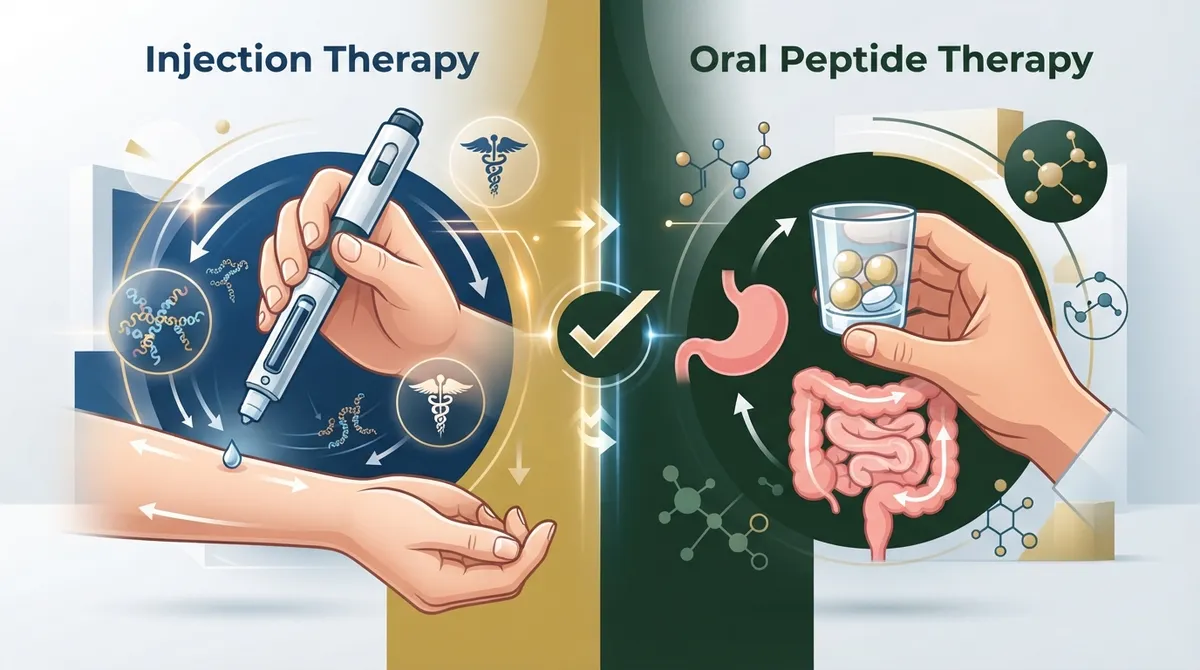
The Quick Answer: How Peptide Therapy Is Administered
Peptide therapy can be given several ways. Injections are the most common. Some peptides come as tablets, nasal sprays, or other forms. The right method depends on the product label and your clinician’s instructions.
For most people starting care, the picture looks like this:
- Subcutaneous injection: a tiny shot into the fat layer under the skin (very common)
- Intramuscular injection: a shot into muscle (used for certain medicines)
- Intravenous delivery: given through a vein, usually in a medical setting
- Oral tablets: available only for specific peptide medicines
- Other routes: nasal, inhaled, or topical forms for select products
Want a refresher on the basics first? Our guide, 8 Facts That Explain What Are Peptides in 2026, covers what peptides are and why they matter. You can also read a plain-language overview of what are peptides from WebMD.

Why Injections Are So Common
Peptides are small chains of amino acids. Your digestive system is very good at breaking down amino acid chains, because that’s how it digests protein. So when a peptide is swallowed, stomach acid and enzymes can chop it up before it ever reaches your bloodstream.
Injections skip that problem. The medicine goes straight into tissue, where it can be absorbed more predictably.
The numbers back this up. A 2020 review of approved therapeutic peptide products found that injectable forms made up roughly 78% of approved administration routes. Subcutaneous injection was the most common injection route, at nearly 36% of routes counted. The same review noted that more than 75% of peptide products approved by the FDA, EMA, and PMDA are given by injection. You can explore related research through the National Library of Medicine.
Injections vs. Oral Peptides: A Side-by-Side Look
Here’s how the two main approaches stack up for everyday life.
| Feature | Injectable Peptides | Oral Peptides |
|---|---|---|
| Absorption | Bypasses the digestive tract | Must survive stomach acid and enzymes |
| Availability | Wide range of products | Limited to specific approved medicines |
| Preparation | May involve a pen, vial, or syringe | Usually just a tablet and water |
| Timing rules | Often weekly or daily, per product | Can be strict (for example, empty stomach) |
| Training needed | Yes, a clinician or pharmacist should teach you | Minimal, but follow label rules closely |
| Best for | Most peptide protocols | Medicines designed and approved as pills |
Neither option is “better” in every case. The best route is the one your product is designed for. That’s why a personalized plan matters so much. Curious about the details? Take a look at 8 Facts: Peptide Injections vs Oral Peptides (2026).
Understanding the Three Injection Types
Not all injections are the same. Here’s a simple breakdown.
Subcutaneous Injection
This is the most familiar route for self-administered peptides. A very small needle delivers the medicine into the fatty layer just under your skin. Common spots include the abdomen, thigh, or upper arm, depending on the product.
For example, FDA-approved injectable semaglutide products such as Ozempic and Wegovy are labeled for subcutaneous use in the abdomen, thigh, or upper arm. They are not meant to go into a vein or muscle. The label also spells out the schedule and dose steps, so always follow the instructions for your specific product.
Intramuscular Injection
Here, the medicine goes deeper, into a muscle. Some medications require this route. It’s used less often for self-care peptides, and technique matters, so it’s best done with proper training.
Intravenous Delivery
This route puts the medicine directly into a vein. It’s typically done in a medical setting. Some peptide medicines require it, but it’s not the usual path for home-based care.
| Route | Where It Goes | Typical Setting |
|---|---|---|
| Subcutaneous | Fat layer under the skin | Often at home after training |
| Intramuscular | Muscle tissue | Clinic or trained administration |
| Intravenous | Vein | Medical facility |
Do Oral Peptides Exist? Yes, With Fine Print
They do. Oral peptide medicines are real, but they’re the exception rather than the rule, and their instructions can be very specific.
Take oral semaglutide (Rybelsus). Its label says to take the tablet on an empty stomach, at least 30 minutes before the first food, beverage, or other oral medicine of the day. You swallow it with no more than 4 ounces (120 mL) of plain water. That’s a lot more precise than “take with breakfast.”
The lesson? Never assume one peptide’s rules apply to another. A pill form of one medicine tells you nothing about how a different peptide should be taken. Our post on oral peptide supplements explains why “peptide supplements” and prescription peptide medicines are not the same thing.
At-Home Care: How Self-Injection Usually Works
Here’s good news for busy professionals and anyone who values convenience. Many peptide medicines that use subcutaneous injection can be administered at home once you’ve been taught how. That’s a big reason telehealth has become so popular.
When a clinician prescribes a self-injected medicine, they or a pharmacist should teach you to:
- Use the supplied pen or device correctly
- Prepare and store the medicine exactly as directed
- Choose an approved injection site
- Rotate sites so you don’t use the same spot repeatedly
- Dispose of needles safely in a sharps container
Please don’t borrow a technique or dose from another peptide. Each product has its own device, concentration, and instructions. For a friendly walkthrough, see How to Prepare for Safe, Effective Peptide Injections and 12 Subcutaneous Peptide Injection Mistakes to Avoid.
Clinic Visit vs. Home Delivery
So where does the injection happen? It depends on the medicine and your comfort level.
- In a clinic: Good for medicines that need professional administration, or if you want hands-on support at first.
- At home: Ideal for many subcutaneous products, once you’re trained. No commuting, no waiting rooms.
If you’re weighing both paths, Local Clinic vs. Telehealth: Best Peptide Therapy Near You? breaks down the tradeoffs. For the at-home side specifically, check out How to Get Peptides Administered Safely at Home.
How Often Is Peptide Therapy Given?
There’s no single schedule. Frequency depends on the medicine, the dose, and your goals.
Some medicines are weekly. Ozempic, for instance, is labeled for once-weekly dosing, with the exact dose and step-up plan depending on the condition being treated and the current product label. Others may be daily or follow a different cycle.
That’s why a personalized plan beats a one-size-fits-all chart. Your provider sets the timing, and adjusts it as your labs and progress change.
FDA-Approved vs. Compounded: Why It Matters for Administration
This is a big one, and it’s worth slowing down for.
FDA-approved peptide medicines come with a detailed label that spells out the route, dose, device, and storage. Compounded products are different. They are not interchangeable with approved medicines, and they may have different concentrations, devices, or instructions.
The FDA has warned about dosing errors with compounded injectable semaglutide, including mistakes tied to measuring doses from multidose vials. The agency has also raised broader safety questions about some compounded peptides, noting that injectable routes can carry immunogenicity risks, including potentially serious reactions, and that the evidence for some peptides may be limited.
| Question to Ask | Why It Matters |
|---|---|
| Is this product FDA-approved or compounded? | Instructions and concentrations may differ |
| What is the exact concentration? | Prevents measuring and dosing errors |
| Who is the dispensing pharmacy? | Quality and oversight vary |
| Do I get written, product-specific directions? | You should never have to guess |
Learn more in FDA-Approved vs. Compounded Peptides: What Wins? and How to Evaluate Compounded GLP-1 Medication Safely.
Storage, Handling, and What If Something Goes Wrong
Good habits make a real difference. A few simple tips:
- Store your medicine exactly as the label or pharmacy directs.
- Check the product before each use, as instructed.
- Use only the device or syringe provided for your medicine.
- Keep a simple log of dates, doses, and injection sites.
If you think you made a dosing error, don’t panic and don’t guess. Contact your prescriber or pharmacist right away, and seek urgent care if you feel seriously unwell. They know your product and can guide you.
Side effects are another thing to plan for. If you’re using GLP-1 medicines, What Causes GLP-1 Side Effects and How to Manage Them? offers calm, practical tips.
Who Benefits From Each Approach?
Let’s connect this back to real life.
- Health optimizers and wellness seekers: You’ll likely appreciate clear, step-by-step training and a plan built around your goals.
- Biohackers: You’ll want lab-guided dosing and tracking. Blood work should drive decisions, not guesswork.
- Busy professionals: At-home delivery and virtual check-ins save time.
- Aging adults: Simple devices and clear support help you feel confident from day one.
No matter your category, the best next step is a conversation with a licensed provider who can match the right product and delivery method to you. See How to Start Peptide Therapy Safely and See Real Results for a helpful roadmap. And if you want to understand whether your questions fit your care plan, 15 Peptide Consultation Questions to Ask in 2026 is a great pre-visit checklist.
How Allura Longevity Approaches Administration
At Allura Longevity, administration isn’t an afterthought. It’s built into a personalized plan from the start. Here’s how the process typically works:
- Virtual consultation: A $50 telehealth visit to talk through your goals and history.
- Blood work: Labs completed through LabCorp to guide your plan.
- Custom plan: A six-month treatment plan designed by licensed providers, led by Ashley, a board-certified Family Nurse Practitioner.
- Home delivery: Your medicine arrives at your door with clear instructions.
- Ongoing monitoring: Check-ins and adjustments as you go.
Allura Longevity is licensed in Florida, Georgia, Texas, Connecticut, Indiana, Maryland, New York, and California. Telehealth is available nationwide where eligible. You can call (813) 510-6277 with questions, and keep in mind that spots for new clients are limited each month.
The Bottom Line
So, how is peptide therapy administered? Most often by subcutaneous injection, sometimes by other injections, and occasionally by tablet or other forms, always depending on the specific medicine and its instructions. Injections lead the pack because peptides can break down in the digestive tract. Oral options exist, but they come with strict, product-specific rules.
The golden rule is simple: follow the exact label and your clinician’s directions for your product, and be extra careful with compounded options. You don’t have to figure it out alone.
Ready to see which delivery method fits your goals? Request a consultation with Allura Longevity and get a plan built around your labs, your lifestyle, and your schedule. Exploring options for peptides for women or peptides for men? Start there and take the first step today.
FAQs
Q: How is peptide therapy administered?
A: It depends on the specific medicine. Most peptide therapies are given by subcutaneous injection, while some use other injections, tablets, or nasal and inhaled forms. Always follow the label and your clinician’s instructions for your exact product.
Q: Can peptide therapy be taken orally instead of by injection?
A: Sometimes, but only for specific peptide medicines made as pills, like oral semaglutide. Since digestion can break peptides down, many are injected instead. Oral versions often have strict timing rules, so follow your product’s directions closely.
Q: Are peptide injections given at home or in a clinic?
A: Many subcutaneous peptide injections can be done at home after a clinician or pharmacist teaches you how. Other routes, like intravenous delivery, usually happen in a medical setting. Your provider will tell you which setup fits your medicine.
Q: Are compounded peptide injections the same as FDA-approved ones?
A: No. Compounded products aren’t interchangeable with FDA-approved medicines and may have different concentrations, devices, or instructions. The FDA has flagged dosing errors with some compounded injectables, so get clear, product-specific directions and use them only under clinician oversight.
Q: What should I do if I make a dosing error with a peptide injection?
A: Stay calm and contact your prescriber or pharmacist right away so they can guide you based on your product. If you feel seriously unwell, seek urgent medical care. Don’t try to guess a fix or copy advice meant for a different peptide.





