

Key Takeaways
-
FDA-approved products undergo formal safety and efficacy review with strict manufacturing standards, while compounded products are made for individual patients but aren't individually FDA-reviewed—understand which you're receiving before starting treatment.
-
The Endocrine Society found no comprehensive clinical evidence that compounded bioidentical hormones are safer or more effective than FDA-approved options, and post-market testing revealed inconsistencies in dose and purity in some compounded preparations.
-
Research-use-only peptides sold online aren't approved for human use and may have uncertain purity and sterility; always work with a licensed provider who sources properly tested products rather than purchasing unregulated compounds independently.
-
Personalized medical supervision including baseline blood work, customized dosing plans, and ongoing lab monitoring is one of the biggest quality differences you can find—not just the product itself but the care surrounding it.
-
Before starting hormone or peptide therapy, ask your provider: Is this FDA-approved for my condition? Where is it sourced? What human clinical evidence exists? How will dosing be monitored? If rushed or brushed off, that's a signal to seek another opinion.
-
Quality markers for injectable peptides include confirmed purity, accurate consistent dosing, sterility and endotoxin testing, proper storage conditions, and clear lot-number labeling for traceability—your provider should easily explain all these details.
So you’re thinking about hormone or peptide therapy, and you keep seeing different words thrown around. FDA-approved. Compounded. Bioidentical. Research-grade. It’s a lot, right? Here’s the good news: once you understand what these words actually mean, you’ll feel so much more confident making decisions about your own health. Grab a cup of tea, and let’s break this down together in plain, friendly language.
Whether you’re a busy professional squeezing in research between meetings, a biohacker who loves data, or someone just starting to explore what what are peptides even means, this guide is for you. We’ll walk through exactly what makes one product different from another, and how to ask the right questions before you start any treatment.

Why Hormone Therapy Quality Differences Actually Matter
Quality in hormone and peptide therapy isn’t just one thing. It’s actually two separate ideas that people often mix up.
First, there’s product quality. This means how consistent, pure, and accurately dosed a product is. Second, there’s evidence quality. This means how much solid research backs up whether a treatment actually works and is safe.
Here’s the important part: a well-made product doesn’t automatically mean it works for your specific goal. You could have a perfectly manufactured peptide that still has little to no human research behind it. Both pieces matter, and neither one alone tells the whole story.
The Two Dimensions of Quality
- Product consistency: Does every dose contain what the label says? Is it pure, sterile, and stored correctly?
- Clinical evidence: Has this specific treatment been studied in real people for your specific health goal?
- Regulatory status: Has the FDA reviewed and approved this product, or is it unapproved or compounded?
- Source transparency: Can the provider tell you exactly where the product came from and how it was made?
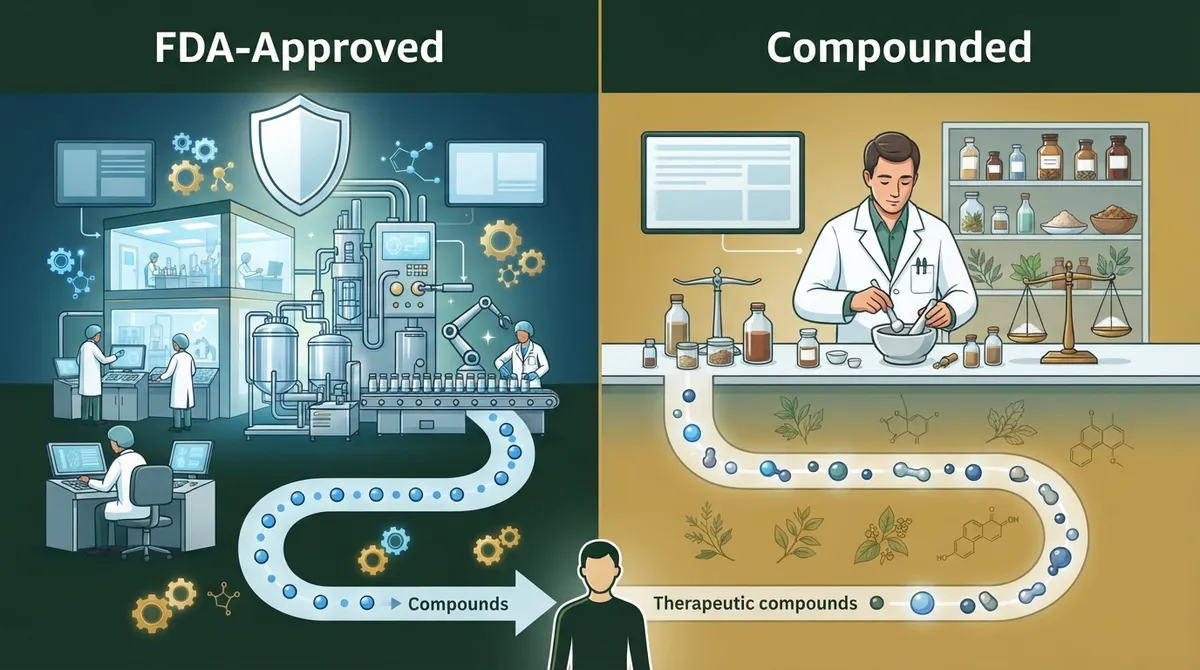
FDA-Approved vs. Compounded: What’s the Real Difference?
Let’s clear up some confusion. FDA-approved medicines go through a formal review process. The FDA checks their quality, safety, and how well they work for a specific approved use. These products are also made under strict manufacturing rules.
Compounded medicines are different. A licensed prescriber creates them for an individual patient when there’s a specific clinical need. But here’s the key thing: compounded products are not FDA-approved. The FDA does not review each compounded formula for safety or effectiveness before it reaches you.
This doesn’t mean compounding is bad. It just means it works under a different set of rules. Compounding can be the right choice in specific situations, but it’s simply not the same thing as FDA approval.
| Category | FDA-Approved Products | Compounded Products | Research-Use Peptides |
|---|---|---|---|
| Regulatory Review | Reviewed for safety and efficacy | Not individually reviewed | Not approved for human use |
| Manufacturing Standards | Strict quality controls required | Varies by pharmacy | Often unclear or unverified |
| Dose Consistency | Highly consistent | Can vary between batches | Uncertain purity and potency |
| Clinical Evidence | Established for approved use | Depends on the compound | Often limited to preclinical studies |
| Best Used With | Licensed prescriber oversight | Licensed prescriber, clear need | Not recommended for self-use |
What the Endocrine Society Says About Bioidentical Hormones
You’ve probably heard the term “bioidentical” and assumed it means safer or more natural. It’s a common misunderstanding, and totally okay if you thought that too!
Here’s the truth: bioidentical simply means a hormone molecule is structurally identical to what your body naturally makes. FDA-approved hormone products can absolutely be bioidentical. The word itself doesn’t tell you anything about quality or safety.
The Endocrine Society, a leading professional group for hormone specialists, has looked closely at compounded bioidentical hormone therapy. Their findings are worth knowing:
- No comprehensive clinical outcome trials have proven that compounded bioidentical hormones are safe or effective.
- Post-market testing has found inconsistencies in dose and purity in some compounded preparations.
- Current evidence does not support the idea that compounded bioidentical hormones are safer or work better than FDA-approved options.
- Their official guidance favors FDA-approved products whenever they’re a good clinical fit.
This isn’t meant to scare you away from compounding altogether. It’s meant to help you ask smarter questions and set realistic expectations.
Understanding Peptide-Specific Quality Concerns
Peptide therapy adds another layer to this conversation. Many peptides you’ll read about online, like certain research compounds, are sold as “research use only.” That label is a big deal.
Research-use-only products are not approved for use in humans. Their purity, sterility, and exact concentration may be uncertain. Even if a seller provides a certificate of analysis, that document alone doesn’t prove FDA approval or clinical safety.
In July 2026, an FDA advisory committee reviewed several unapproved peptides and recommended allowing compounding for six out of seven of them. This was widely covered, including by NPR’s coverage of the FDA peptide review. But here’s the catch: these recommendations were nonbinding. The FDA makes the final call, and that call can change. Always check current status before starting anything.
FDA staff reviewers also noted that evidence for several peptides under review was largely preclinical, meaning it came from lab or animal studies rather than human trials. This varies a lot by compound, so it’s worth learning about the specific peptide you’re considering. Our guide on 8 Facts That Explain What Are Peptides in 2026 is a great starting point.
Quality Checklist for Injectable Peptides
If you’re considering any injectable peptide, here’s what you and your provider should be discussing:
- Confirmed identity and purity of the active ingredient
- Accurate, consistent dosing from batch to batch
- Sterility and endotoxin testing for anything injected
- Proper stability and storage conditions (like refrigeration)
- Clear labeling with lot numbers for traceability
- A system for reporting and monitoring any side effects
If a provider can’t answer questions about any of these points, that’s a signal to pause and ask more.
Questions to Ask Before Starting Any Hormone or Peptide Therapy
You deserve to feel fully informed, not just hopeful. Here are the questions worth asking any clinic or provider:
- Is this specific product FDA-approved for my condition, or is it compounded?
- Where does the product come from, and can you share sourcing details?
- What human clinical evidence exists for this treatment and my specific goal?
- How will my dose be monitored and adjusted over time?
- What blood work will you use to personalize my plan?
- How are side effects tracked and reported?
- What happens if my labs show I need a different approach?
A trustworthy provider will welcome these questions. If you feel rushed or brushed off, that’s valuable information too. Learning how to start peptide therapy safely and see real results starts with asking good questions from day one.
Why Personalized, Medically Supervised Care Makes a Difference
Here’s where things get exciting. Quality differences aren’t just about the product itself. They’re also about the care surrounding it.
Personalized treatment starts with real lab work, not guesswork. At Allura Longevity, every client begins with a virtual consultation and complete blood work through LabCorp. This lets licensed providers see your actual hormone levels, not just assume based on symptoms.
From there, a customized six-month plan is built around your specific numbers and goals. Care doesn’t stop once your peptides arrive at your door. Ongoing monitoring means your plan can be adjusted as your body responds, led by Ashley, a board-certified Family Nurse Practitioner who oversees every treatment plan.
This kind of continuous, personalized oversight is honestly one of the biggest quality differences you can find. It’s the difference between a one-size-fits-all approach and a plan that actually fits you. If you’re deciding between local options, our comparison on local clinic vs. telehealth peptide therapy can help you weigh the options.
What Makes a Telehealth Peptide Program High Quality
| Quality Marker | Why It Matters |
|---|---|
| Licensed medical providers | Ensures proper diagnosis, prescribing, and monitoring |
| Comprehensive blood work | Confirms your actual hormone and health status before treatment |
| Personalized dosing plans | Matches treatment to your body, not a generic template |
| Ongoing check-ins | Allows adjustments as your results and labs change |
| Transparent sourcing | Gives you confidence in what you’re actually receiving |
Common Mistakes People Make When Comparing Options
Let’s be honest, this space can be confusing, and it’s easy to fall into a few traps.
- Assuming “natural” or “bioidentical” automatically means safer
- Buying research-use peptides online without medical guidance
- Skipping blood work and jumping straight to treatment
- Not asking whether a product is FDA-approved for their specific use
- Choosing a provider based on price alone, without checking oversight quality
Avoiding these mistakes isn’t about being paranoid. It’s about being an informed, empowered patient. For a deeper look at building a smart plan, check out how to start peptide therapy the smart, safe way.
How This Applies to Popular Peptides Like BPC-157 and TB-500
You’ve probably heard buzz about peptides like BPC-157 or TB-500 for recovery and healing. These are popular topics, and for good reason, people want faster recovery and less downtime.
But it’s worth knowing that evidence for these specific compounds is still developing. Much of the current research comes from lab and animal studies, according to findings summarized in the National Library of Medicine. That doesn’t mean they’re off the table. It means working with a licensed provider who can walk you through what’s known, what’s still being studied, and whether it fits your specific situation is essential. Our resource on 13 Facts About TB-500 Peptide You Need in 2026 covers this in more depth.
Your Next Step Toward Confident, Informed Care
Here’s the takeaway: quality differences in hormone and peptide therapy come down to regulatory status, manufacturing consistency, and real clinical evidence, not just marketing language. The best decisions come from asking good questions, reviewing your own labs, and working with providers who take the time to explain their process.
You deserve care that’s personalized, transparent, and backed by licensed medical oversight. That’s exactly what Allura Longevity is built around, real blood work, real licensed providers, and a treatment plan made just for you. Spots fill up each month, so if you’re ready to explore what a personalized plan could look like for your goals, request a consultation today and take the next step with confidence. You can also call (813) 510-6277 to speak with our team directly.
FAQs
Q: What is the difference between FDA-approved peptide therapy and compounded peptide therapy?
A: FDA-approved products go through a formal review for safety, quality, and effectiveness before they reach you. Compounded products are made for individual patients by a prescriber but aren’t individually reviewed by the FDA. Both can have a place in care, but they follow very different rules, so it’s worth knowing which one you’re getting.
Q: Are compounded bioidentical hormones safer or more effective than FDA-approved hormone therapy?
A: Current evidence doesn’t support the idea that compounded bioidentical hormones work better or are safer than FDA-approved options. The Endocrine Society has actually found inconsistencies in dose and purity in some compounded products. That said, compounding can still be the right choice in specific clinical situations, so it’s all about the details of your case.
Q: Are research-grade peptides safe to inject or use for treatment?
A: Research-use-only peptides aren’t approved for human use, and their purity and sterility can be uncertain. We’d always recommend working with a licensed provider who sources properly tested products rather than using research-grade compounds on your own. Your safety is worth that extra step!
Q: What should I ask a clinician or pharmacy before starting peptide therapy?
A: Ask whether the product is FDA-approved for your specific use, where it’s sourced from, and what human evidence supports it for your goal. Also ask how your dose will be monitored and adjusted over time. A good provider will happily answer all of this, no awkwardness required.
Q: What quality and sterility standards should injectable peptide products meet?
A: Injectable peptides should have confirmed purity, accurate dosing, proper sterility and endotoxin testing, and clear labeling with traceable lot numbers. Storage and stability matter too, since improper handling can affect how well a product works. These details might sound technical, but your provider should be able to explain them simply.





