

Key Takeaways
-
Collagen peptides are small protein fragments made by breaking down collagen through hydrolysis, sold as oral supplements (powder, capsules, or drinks) derived from animal sources like cows, fish, and chickens.
-
A 2023 meta-analysis of 26 randomized trials found significant improvements in skin hydration and elasticity versus placebo, though results vary by product and most studies are relatively short-term.
-
Collagen peptides are dietary supplements, not prescription medications, and should not be confused with medically supervised peptide therapy, which is personalized and delivered by licensed providers.
-
Effective dosing ranges from 2.5g to 10g daily based on research studies, and results typically require 8+ weeks of consistent use with patience needed to see measurable changes.
-
Third-party testing, clear ingredient lists with minimal additives, and verified sourcing are critical when choosing a product, as quality and formulation vary significantly between brands.
-
Collagen peptides are generally well-tolerated with mild side effects like nausea or constipation; they work best as a supplement supporting basics like protein intake, sleep, strength training, and sun protection rather than as a standalone solution.
If you have ever walked down a supplement aisle, you have probably seen a tub of collagen peptides promising smoother skin and happier joints. You might also have heard the word “peptide” tossed around in longevity circles and wondered if it all means the same thing. Good news: you are in the right place, and you are not alone in being curious.
So, what are collagen peptides, and where do they fit in the bigger world of peptide therapy? In short, they are small protein fragments made by breaking down collagen. Most people take them as a powder, capsule, or drink. They are a nutritional ingredient, not a prescription medicine.
In this friendly guide, we will walk through how collagen peptides are made, what the research really says, how they differ from prescription peptide therapy, and how to decide if they belong in your routine. Whether you are a health optimizer, a busy professional, or someone who loves a good lab report, this guide is for you. Let’s dive in!

What Are Collagen Peptides? A Simple Definition
Collagen is the main structural protein in your body. You find it in skin, bones, cartilage, tendons, and other connective tissues. Think of it as the scaffolding that holds you together.
Collagen peptides, also called hydrolyzed collagen, are short chains of amino acids. They are made by breaking down whole collagen into much smaller pieces. Because they are small, they mix easily into coffee, smoothies, or water.
Here is the key point to remember: a collagen peptide is a food or dietary-supplement ingredient. The word “peptide” alone does not mean a product is a drug or has proven medical effects. If you want a refresher on the basics, this overview of what are peptides is a handy starting point. You can also explore our deeper dive, 8 Facts That Explain What Are Peptides in 2026.
Quick Facts at a Glance
- They come from animal sources such as cows, pigs, chickens, or fish.
- They are usually taken by mouth, not by injection.
- They are sold as supplements, not as standardized medical therapies.
- Results can vary by product, dose, and person.
How Are Collagen Peptides Made?
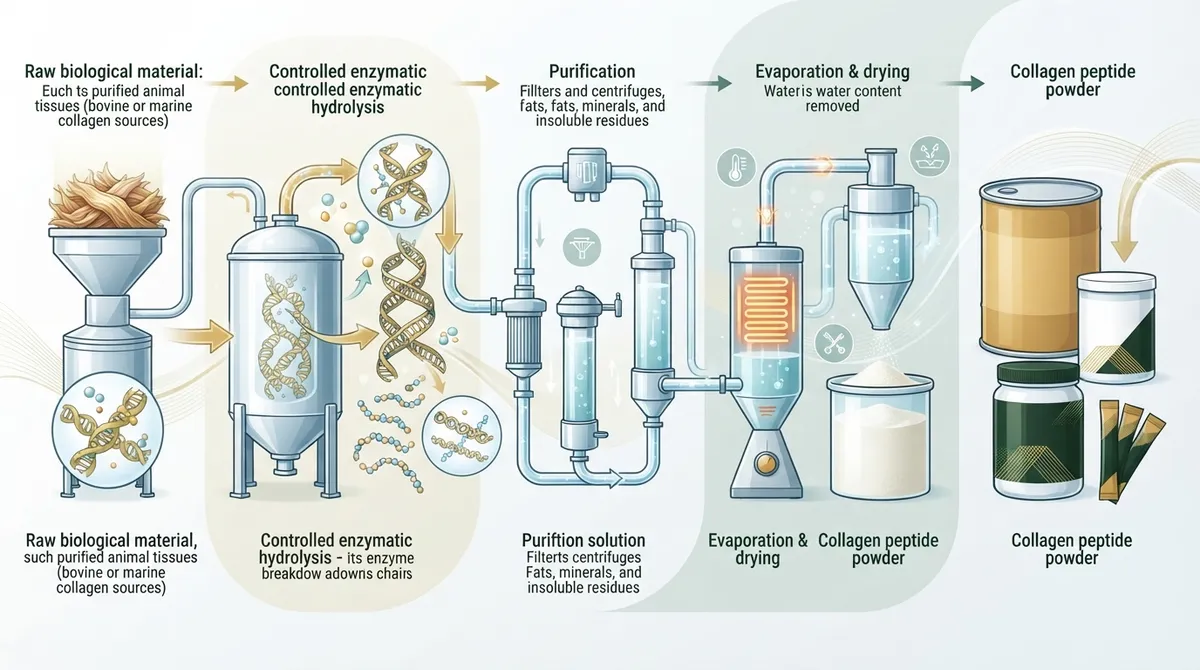
The process is called hydrolysis. It sounds fancy, but the idea is simple. Manufacturers take collagen from animal skin, bones, or scales. Then they use heat, water, and enzymes to cut the long protein chains into short pieces.
Here is how it typically works, step by step:
- Sourcing: Collagen-rich raw materials are collected and cleaned.
- Extraction: Collagen is pulled out using water, mild acids, or heat.
- Hydrolysis: Enzymes break the collagen into small peptides.
- Purification: The mixture is filtered and cleaned.
- Drying: The liquid is dried into a fine powder for packaging.
Quality matters here. Source, testing, and manufacturing controls can differ a lot from brand to brand. That is one reason two products labeled “collagen peptides” may not perform the same way.
Collagen Peptides vs. Prescription Peptide Therapy
This is where many people get tangled up, so let’s clear it up with a friendly comparison. Both use the word “peptide,” but they are very different tools.
| Feature | Collagen Peptides | Prescription Peptide Therapy |
|---|---|---|
| Type | Dietary supplement or food ingredient | Medical treatment guided by a licensed provider |
| How it is taken | Usually oral powder, capsule, or drink | Often injection or other prescribed delivery |
| Personalization | Generally one-size-fits-all | Based on labs, goals, and medical history |
| Oversight | Regulated as a supplement | Prescribed and monitored by licensed providers |
| Typical goal | General skin, joint, or nutrition support | Targeted goals like recovery, metabolism, or energy |
In other words, collagen peptides are not automatically the same as peptide therapy. Evidence for an oral supplement does not prove an injectable peptide is safe or effective, and the reverse is true too. If you are curious about the medical side, read Is Peptide Therapy Safe? What You Really Need to Know.
How Do Collagen Peptides Work in Your Body?
After you swallow collagen peptides, your body digests them. They are absorbed mostly as amino acids and small peptides. Your body can then use those building blocks wherever it needs them.
Some studies suggest that certain collagen-derived peptides may enter the bloodstream and signal connective-tissue cells. That is an exciting idea. However, it does not prove that a scoop of powder rebuilds collagen in your exact knee or cheek.
Think of it like giving a construction crew extra bricks. The crew still decides where to build. Your age, diet, sleep, sun exposure, and overall health all shape the final result.
What Does the Research Say About Collagen Peptides?
Human studies have mostly looked at skin, joints, and muscle-related outcomes. The results are promising in some trials, but they are not a magic wand. Let’s look at the key findings.
| Study | Who and How Long | What It Found |
|---|---|---|
| 2023 meta-analysis of 26 randomized trials | 1,721 participants | Significant improvements in skin hydration and elasticity versus placebo |
| 2024 randomized trial (CollaSel Pro) | 112 women, 10 g daily for 8 weeks | Improvements in measured skin parameters |
| 2015 placebo-controlled study | 105 women, 2.5 g daily for 6 months | Reduced cellulite measures in the normal-weight subgroup |
These numbers are encouraging, but a few cautions apply. Many trials are short. Products and measurement methods vary. Some studies are funded by industry. And results from one branded product cannot be assumed for all others. The authors of the 2023 review themselves called for larger trials. You can read more through the National Library of Medicine.
Skin Benefits
Skin is where the research looks strongest. Studies often measure hydration, elasticity, and the look of wrinkles. If skin health is your main goal, you may also like our guide on what peptides do for skin.
Joint and Muscle Support
Some trials have looked at joint comfort and musculoskeletal outcomes. Findings are mixed and depend on the product and the group studied. There is no solid proof that collagen peptides rebuild cartilage. For a comparison with a well-known injectable option, see Collagen Peptides vs. BPC-157: Arthritis Relief Truth.
How to Choose a Collagen Peptide Supplement
Since quality varies, a little homework pays off. Here is a simple, friendly checklist to follow.
- Check the source. Bovine, porcine, marine, and chicken collagen all exist. Pick one that fits your diet and allergies.
- Look for the dose. Studies have used amounts from about 2.5 g to 10 g per day, so check that the label lists a clear amount.
- Seek third-party testing. Independent testing can help confirm purity and label accuracy.
- Read the ingredient list. Fewer fillers, sweeteners, and additives is usually better.
- Match the product to the research. If a brand cites a study, make sure that study used the same formulation.
Who Might Want to Be Careful
- People with fish, shellfish, egg, or other food allergies should check the source.
- Anyone with a medical condition should talk to a provider first.
- People taking prescription medicines should ask before adding new supplements.
Are Collagen Peptides Safe? Side Effects to Know
In short-term studies, oral collagen peptides are generally well tolerated. Possible effects are usually mild and may include nausea, bloating, or constipation. In the 2024 trial, 43 adverse events were reported among 19 participants. Most were mild, and no serious adverse events were reported.
Allergic reactions are possible, especially with fish-derived collagen. Always read the label and know your own sensitivities.
It is also worth remembering that supplements are not reviewed like prescription drugs. That is why product quality and honest labeling matter so much.
How Long Do Collagen Peptides Take to Work?
Patience is your friend here. Most studies run for eight weeks or longer. Some skin trials lasted several months. Do not expect overnight changes.
A simple way to track your progress is to take a few photos in the same light each month. Jot down notes on how your skin or joints feel. If you love data, as many biohackers do, this makes it easy to see whether the habit is worth keeping.
Where Do Collagen Peptides Fit in a Personalized Longevity Plan?
Collagen peptides can be a nice supporting player. They are easy to add to a morning routine, and many people enjoy them. But they work best alongside the basics: protein, sleep, strength training, sun protection, and regular check-ups.
If you want a more targeted approach, medically supervised peptide therapy may be worth exploring. This is where Allura Longevity comes in. Our licensed providers design customized plans based on your blood work and goals, delivered to your home through telehealth. Learn more about peptides for women or peptides for men.
Curious how a plan is built? Check out How to Start Peptide Therapy Safely and See Real Results. And if collagen is your main focus, our article on how to trigger collagen stimulation with peptides explores other options.
Simple Ways to Add Collagen Peptides to Your Day
- Stir a scoop into your morning coffee or tea.
- Blend it into a protein smoothie.
- Mix it into oatmeal or yogurt.
- Take capsules if you prefer no taste or mixing.
Consistency matters more than perfection. Pick a time you will remember, and stick with it.
Final Thoughts: Is It Worth It?
Collagen peptides are small protein fragments with promising, but not yet perfect, evidence behind them. They may help some people with skin hydration and elasticity, and possibly joint comfort. They are not a cure-all, and they are not the same as prescription peptide therapy.
The best approach is a smart, personal one. Start with your goals, look at your labs, and choose tools that fit your life. If you are ready for a plan built around you, our team at Allura Longevity is here to help. Spots for new clients are limited each month, so don’t wait too long.
Ready to take the next step? Request a consultation today, or call us at (813) 510-6277. We offer a $50 virtual consultation, LabCorp blood work, and a customized six-month plan led by our board-certified Family Nurse Practitioner, Ashley. We are licensed in Florida, Georgia, Texas, Connecticut, Indiana, Maryland, New York, and California.
FAQs
Q: What are collagen peptides, and how are they made?
A: Collagen peptides are short chains of amino acids made by breaking down collagen from animal sources like cows, chickens, or fish. The process is called hydrolysis, and it turns collagen into a fine powder that mixes easily into drinks and foods.
Q: Are collagen peptides the same as peptide therapy?
A: Not quite! Collagen peptides are dietary supplements taken by mouth, while peptide therapy usually means personalized, prescribed treatments guided by a licensed provider. Evidence for one does not automatically apply to the other.
Q: Do collagen peptides really improve skin and joints?
A: Some studies show better skin hydration and elasticity, and a few suggest joint benefits. Results depend on the product, dose, and person, and many trials are short, so it is best to keep your expectations realistic.
Q: Are collagen peptides safe, and what side effects can they cause?
A: They are generally well tolerated in short-term studies. Mild issues like nausea or constipation can happen, and people with fish or other food allergies should check the source before trying them.
Q: How long do collagen peptides take to work?
A: Many studies run at least eight weeks, and some last several months, so patience is key. Tracking photos and notes monthly can help you see whether they are working for you.





