

Key Takeaways
-
Topical peptide evidence for skin is encouraging but limited: small studies report gains in fine lines, texture, or elasticity, yet many findings come from lab or animal research, not large human trials.
-
Sunscreen remains the most proven way to protect skin from visible aging, so peptides should be an add-on to daily sun protection, gentle cleansing, and moisturizing rather than a replacement.
-
Topical peptide products are sold as cosmetics and are not FDA-approved to treat aging or disease; injectable or compounded peptides carry separate regulatory and safety risks.
-
Introduce one new peptide product at a time, patch test first, and allow several weeks; visible changes, if any, typically take about 8-12 weeks of consistent use.
-
Share your medical history, allergies, medications, and pregnancy status with a licensed clinician, since these can change what is appropriate; retinoids should be avoided during pregnancy unless a provider advises otherwise.
-
Be wary of guaranteed results, claims that cosmetic creams treat medical conditions, pressure to buy bundles, or vague ingredient and sourcing information.
You’ve seen the serums, the before-and-after photos, and the headlines promising smoother, firmer skin. Now you’re wondering if a personalized skin peptide plan could be your next step. Good news: you’re asking the right question. Bad news: the answer isn’t one-size-fits-all.
Here’s the honest truth. Peptides are short chains of amino acids, and some early studies suggest they may help skin look better. But the evidence is still limited, and products vary a lot. A personalized plan is not a single, proven medical protocol. It’s a thoughtful way to choose what fits your skin, your health history, and your goals.
In this guide, we compare the two main paths people consider: topical peptide skincare and clinician-guided peptide therapy. We’ll cover what each one can and can’t do, what the research says in 2026, and how to build a plan that’s safe and realistic. If you’ve been curious about what peptides actually are, you’re in the right place.
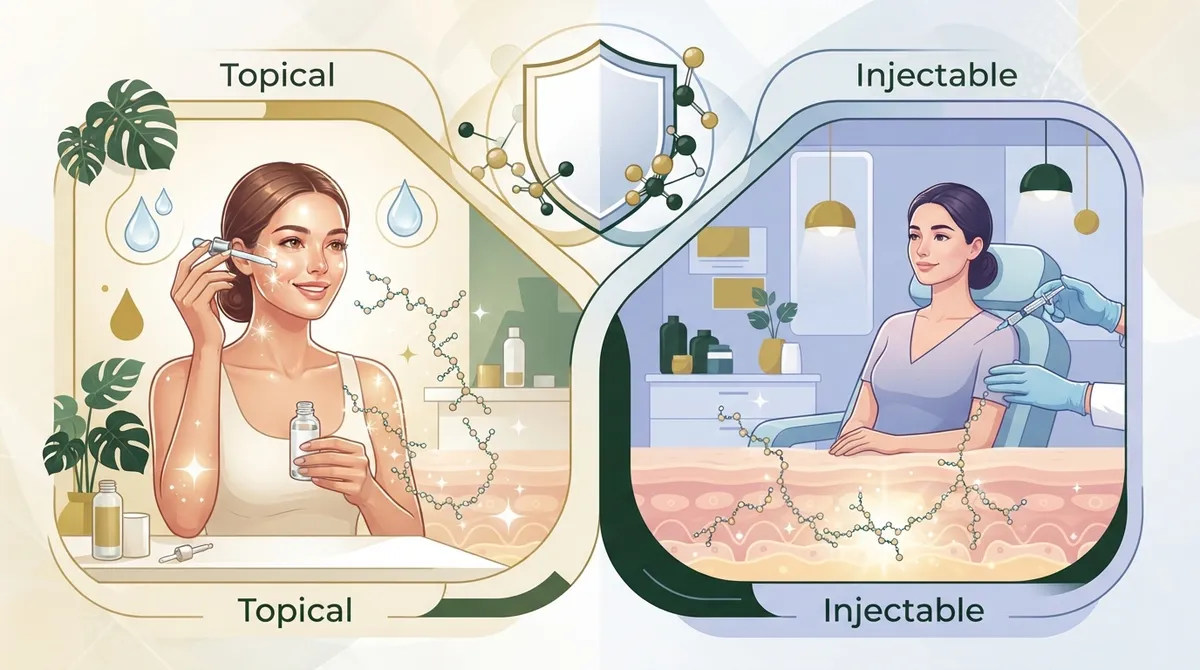
What Is a Personalized Skin Peptide Plan?
A personalized skin peptide plan is an individualized approach to picking peptide-based care for your skin. It starts with your concerns, such as fine lines, dullness, or loss of firmness. It also looks at your medical history, allergies, current products, and goals.
It is not a standardized treatment. No single protocol has been proven to work for everyone. That’s why a good plan begins with an assessment, not a shopping cart.
Think of it like a fitness plan. A trainer doesn’t hand every client the same workout. They look at your body, your history, and your goals first. Skin care works the same way.
What peptides do in skincare
Peptides are small signaling molecules. In skincare, different peptides are proposed to work in different ways:
- Signal peptides that may nudge skin cells toward making more structural proteins
- Carrier peptides that may help deliver trace minerals, like copper, to skin
- Enzyme-modulating peptides that may help slow the breakdown of skin proteins
What a peptide actually does depends on the specific ingredient, the formula, the concentration, and whether it can reach the right skin layer. That last part is a big deal, because skin is a tough barrier.
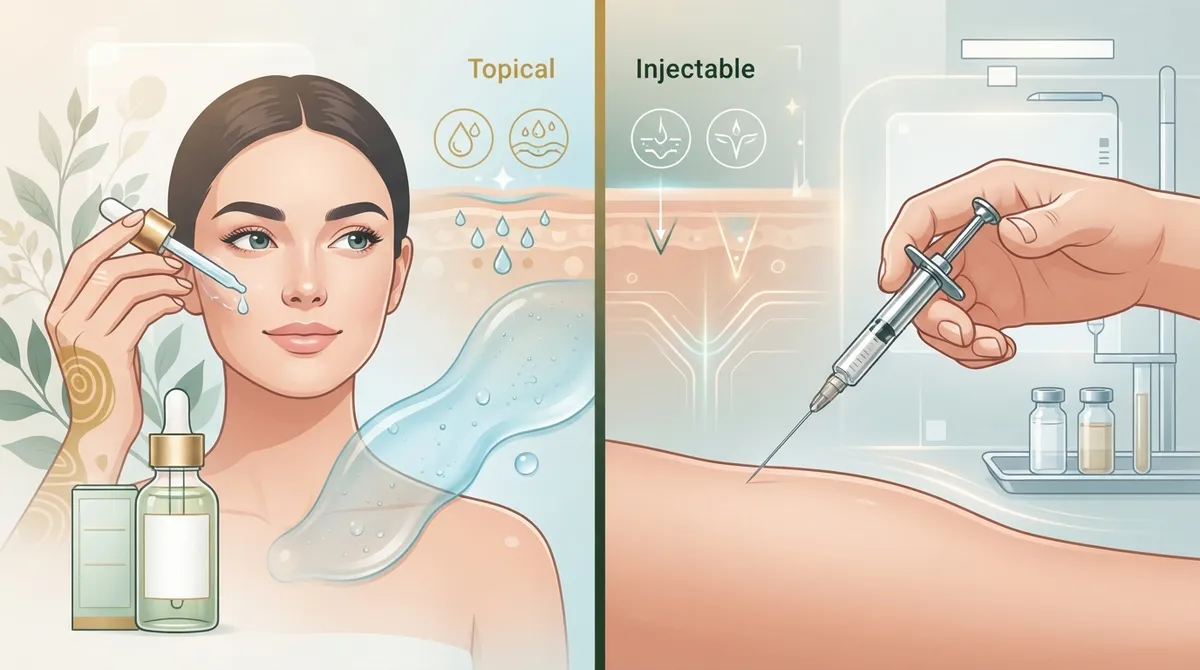
Topical vs. Injectable: The Big Comparison
Here’s where many people get tangled up. “Peptide” can mean a cream you buy at a store. It can also mean a compounded medication prescribed by a licensed provider. These are very different things with different rules, risks, and evidence.
| Feature | Topical Peptide Skincare | Clinician-Guided Peptide Therapy |
|---|---|---|
| How it’s used | Applied to the skin surface | Prescribed and administered as directed by a provider |
| Regulatory status | Sold as cosmetics; not FDA-approved to treat aging or disease | Varies by product; compounded options carry separate safety considerations |
| Evidence for skin | Promising but limited; small studies | Limited and varies widely by peptide and goal |
| Main goal | Cosmetic appearance | Broader wellness and longevity goals |
| Oversight | Mostly self-directed | Licensed provider, lab work, and monitoring |
The key point: do not assume a peptide is approved, proven, or safe for you just because it’s sold online or offered by a clinic. Every route has its own risks. Always talk it through with a licensed clinician.
What Does the Research Actually Say?
Let’s keep it real. The science on topical peptides is encouraging, but it’s not a slam dunk.
A 2024 systematic review of topical peptide and exosome studies found that several included peptide studies reported improvements in fine lines, texture, or elasticity. That’s the good part. The catch is that those studies were limited in number and size. They don’t prove that every peptide product works.
Another 2024 review of cosmeceuticals for photoaging described the evidence for topical peptides as largely based on lab and animal research. In other words, we need more well-designed human trials. You can read more through the National Library of Medicine.
So what does that mean for you? It means peptides may be a nice addition to a skin routine, but they shouldn’t replace the basics that have stronger proof behind them.
Stronger evidence for common concerns
For photoaging, dermatology guidance backs a few established steps:
- Daily sun protection. This is the single most proven way to protect skin from visible aging.
- Retinoids, when appropriate. These may help with fine lines and uneven tone, but they can irritate skin and are not appropriate during pregnancy.
- Gentle cleansing and moisturizing. A healthy skin barrier supports everything else you use.
- A dermatologist visit. Persistent or changing skin concerns deserve a professional look.
Peptides can sit on top of this foundation. They shouldn’t be treated as a replacement for it.
A Closer Look at GHK-Cu
You may have heard of GHK-Cu, also called copper peptide. It shows up in some topical cosmetic products. It’s popular, and it’s often discussed in skin circles.
Here’s the thing to keep straight. Using GHK-Cu in a cosmetic cream is not the same as using it by injection. The evidence and regulatory status for topical cosmetic use should not be mixed up with injectable use. FDA materials have raised concerns about limited safety information and possible immune reactions for certain compounded peptide products and routes.
If you’re curious about this ingredient, our guide on how to evaluate GHK-Cu peptide safely walks through the questions worth asking before you try anything.
How to Build Your Personalized Skin Peptide Plan
Ready to put a plan together? Here’s a simple, safe way to think about it.
- Name your goal. Is it fine lines, firmness, dullness, or overall skin health? A clear goal keeps you from buying things you don’t need.
- Review your history. Share your medical history, allergies, medications, and current products with a clinician. Sensitive skin, pregnancy, and other conditions can change what’s appropriate.
- Start with the basics. Lock in sunscreen, gentle cleansing, and moisturizer before adding anything new.
- Add one thing at a time. Introduce a single peptide product and give it time. If you add five at once, you won’t know what’s helping or irritating.
- Track and adjust. Take photos in the same light and note how your skin feels. Share your notes at follow-ups.
This slow, steady approach is a lot like how a good provider handles any personalized treatment plan for peptides.
Can You Mix Peptides With Other Skincare?
Many people layer peptides with vitamin C, retinoids, or other actives. Some combinations work fine for some people. Others cause redness or stinging, especially on sensitive skin.
A few friendly rules of thumb:
- Patch test any new product on a small area first
- Introduce new products one at a time, a week or two apart
- Pause and ask a clinician if you notice burning, swelling, or a rash
- Skip retinoids entirely if you’re pregnant or trying to conceive, unless your provider says otherwise
When in doubt, ask. A quick question to a licensed provider can save you weeks of irritated skin.
Where Clinician-Guided Peptide Therapy Fits In
Some people want more than a cream. They’re thinking about whole-body goals like energy, recovery, sleep, and healthy aging, with skin as one piece of the puzzle. That’s where clinician-guided care comes in.
At Allura Longevity, licensed medical providers design customized plans based on your blood work and health goals. It’s a telehealth model, so peptides are delivered to your home and you can fit care into a busy schedule. Because skin is only one part of overall wellness, a provider can look at the bigger picture.
Keep expectations grounded, though. Peptide therapy is not a guaranteed skin fix. If you want a deeper read, check out what peptides do for skin in 2026 and our look at peptide skin rejuvenation facts.
Why lab work matters
A personalized plan should start with data, not guesses. Blood work can show what’s going on inside your body, which helps a provider decide what is and isn’t appropriate. It’s the difference between a plan built for you and a generic one built for everyone.
If you’re weighing your options, you may also like our comparison of local clinic vs. telehealth peptide therapy.
Red Flags to Watch For
Because the peptide space is crowded, it pays to be a smart shopper. Be cautious if you see:
- Promises of guaranteed results or “reversing” aging
- Claims that a cosmetic cream treats a medical condition
- No mention of a licensed provider, health history, or follow-up
- Pressure to buy large bundles right away
- No clear information about ingredients or sourcing
Safety first, always. Our article on whether peptide therapy is safe covers what to ask before you start.
Realistic Expectations: What to Expect and When
Skin changes slowly. Skin cells take weeks to turn over, so any visible change from a topical product, if it happens, usually takes consistent use over a couple of months. Results vary from person to person, and some people see little change at all.
| Timeframe | What’s Reasonable to Expect |
|---|---|
| Weeks 1-2 | Skin adjusts; watch for irritation; no major change yet |
| Weeks 4-8 | Possible subtle changes in feel or texture for some people |
| Weeks 8-12+ | Time to review photos and decide with your provider whether to continue, adjust, or stop |
If you want to understand timing across peptide care more broadly, see how long until peptides improve skin.
The Bottom Line: Which Path Wins?
Neither path “wins” for everyone. Topical peptides are an easy, low-commitment way to add a possibly helpful ingredient to a routine you already trust. Clinician-guided care makes sense if you want a lab-informed, whole-body plan with ongoing monitoring.
The smartest move is to start with the basics, stay curious, and keep a licensed clinician in your corner. A good personalized skin peptide plan is honest about what’s proven and what’s still being studied.
Want help figuring out what makes sense for you? Our team at Allura Longevity offers personalized, medically supervised care through telehealth in Florida, Georgia, Texas, Connecticut, Indiana, Maryland, New York, and California. Spots for new clients are limited each month, so don’t wait too long. Request a consultation or call (813) 510-6277 to get started. You can also learn more about peptides for women and peptides for men, or read a plain-language primer on what are peptides.
FAQs
Q: What is a personalized skin peptide plan?
A: It’s an individualized approach to choosing peptide-based care for your skin, based on your concerns, health history, allergies, and goals. It isn’t a standardized medical treatment. A good plan starts with a clinician’s assessment and builds on proven basics like sun protection.
Q: Do topical peptides really improve wrinkles or skin texture?
A: Some small studies report improvements in fine lines, texture, or elasticity, which is encouraging. But the research is limited, and many findings come from lab or animal work. So peptides may help some people, but they aren’t proven to work for everyone.
Q: Are peptide skincare products FDA-approved?
A: Topical peptide products are sold as cosmetics, and the FDA has not approved them as drugs to treat skin disease or aging. That means marketing claims aren’t the same as proof of clinical results. It’s smart to look past the label and talk with a clinician.
Q: What’s the difference between topical and injectable peptides for skin?
A: Topical peptides are cosmetic products applied to the skin’s surface. Injectable or compounded peptides are prescribed by a provider and carry separate regulatory and safety considerations. Never assume one has the same evidence or risks as the other.
Q: Can I use peptides with retinoids or vitamin C?
A: Many people layer them, but some combinations can irritate sensitive skin. Patch test first, add one product at a time, and check with a clinician if you have concerns. Retinoids are not appropriate during pregnancy.





