

Key Takeaways
-
A top telehealth peptide provider is defined by licensed clinical care: a real health review, lab work guiding the plan, honest discussion of evidence, and ongoing follow-up, not the biggest catalog.
-
Always ask whether a peptide is FDA-approved or compounded; compounded products are not FDA-reviewed for safety, effectiveness, or quality before sale.
-
Avoid products labeled ‘research use only’ or ‘not for human consumption’ or sold without a prescription, since identity, purity, and potency may be uncertain.
-
Red flags include prescribing after a short questionnaire alone, guaranteed results, hidden pharmacy or pricing, and injections sent with no training or support.
-
Before starting, confirm the provider is licensed where you live, name the pharmacy that ships your medication, and get a full cost breakdown including labs, shipping, and follow-up.
-
Telehealth is a delivery method, not proof a treatment is right for you; pregnant or breastfeeding people, those on other medications, and anyone with urgent symptoms should consult a qualified clinician first.
Scrolling through peptide ads can feel like walking into a candy store. Every site promises more energy, better sleep, faster recovery, and younger-looking skin. So how do you know which one is actually worth your trust, and your money?
Here is the good news: you do not have to guess. The best telehealth peptide therapy is not the one with the longest menu or the loudest marketing. It is the one built on real clinical care. That means a licensed provider, a real health review, honest talk about evidence, and follow-up after you start.
Whether you are a busy professional, a data-loving biohacker, or someone who simply wants to feel like yourself again, this guide will walk you through what to look for. We will cover how telehealth works, how FDA-approved and compounded products differ, which red flags to avoid, and what a smart first visit looks like. Think of this as a friendly checklist you can take anywhere.

What Does ‘Best’ Really Mean in Telehealth Peptide Therapy?
Let’s clear something up first. ‘Best’ should never mean the biggest peptide catalog or the flashiest website. It should mean clinically appropriate care that is safe, legal, and tailored to you.
Telehealth is simply how you receive care. It is a delivery method, not proof that a treatment is right for you. A great telehealth provider treats a video visit with the same seriousness as an office visit.
If you are brand new to the topic, this primer on what peptides are in 2026 is a helpful place to start. You can also read the basics from what are peptides at WebMD.
The Core Traits of a Top-Tier Provider
- Licensed clinicians who review your history before prescribing anything
- Blood work that guides your plan instead of guesswork
- Clear disclosure of every medication, including whether it is FDA-approved or compounded
- Named pharmacies so you know who is making and shipping your medicine
- Ongoing follow-up with a real person you can contact
- Honest talk about benefits, risks, and what is still unknown
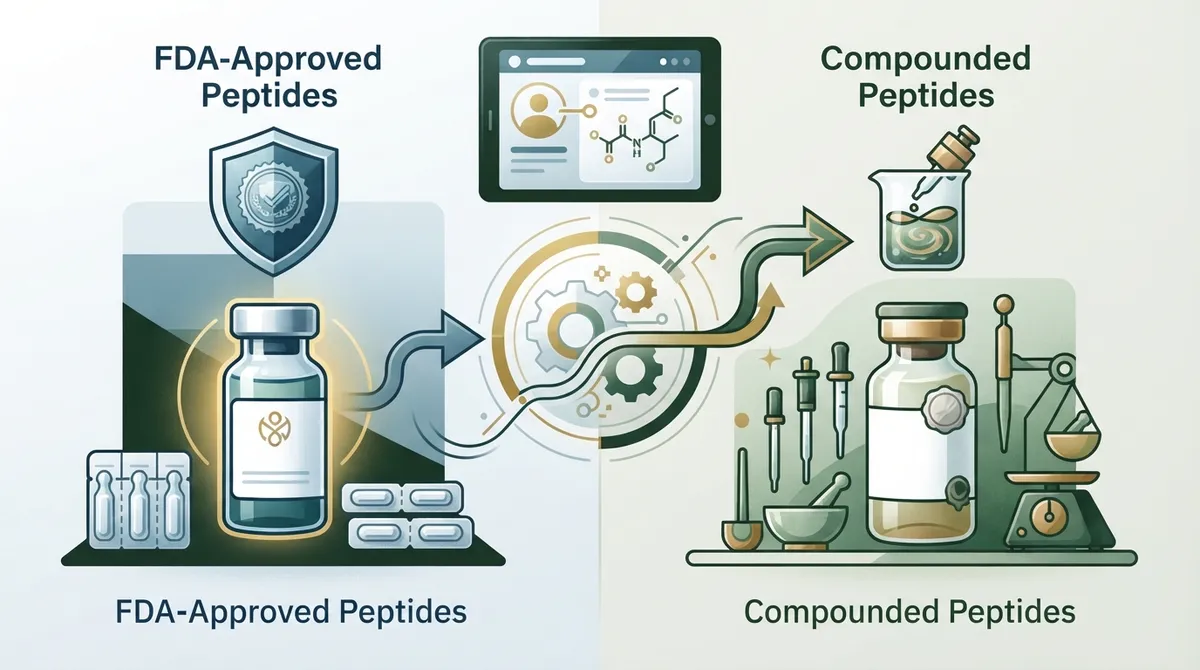
FDA-Approved vs. Compounded: Know the Difference
This is the single most important thing to understand, so let’s go slowly. Some peptide medicines are FDA-approved. Others are compounded, meaning a pharmacy prepares them for a specific patient.
Compounded drugs are not FDA-approved. The FDA does not review them for safety, effectiveness, or quality before they are sold. Compounding is generally meant for a patient-specific medical need, not just a cheaper or preferred option.
The FDA also limits which bulk substances can be used in compounding. Just because an online seller offers a peptide, or a clinician is willing to prescribe it, does not mean it is approved or legally eligible. For a deeper dive, see FDA-approved vs. compounded peptides and our guide to 503A vs. 503B compounding.
| Feature | FDA-Approved Peptide Medicine | Compounded Peptide Product |
|---|---|---|
| FDA review before marketing | Yes, for safety, effectiveness, and quality | No |
| Made for | Broad patient populations | A specific patient’s medical need |
| What to ask | Which brand and dose? | Which pharmacy and why compounded? |
| Key risk | Known side effects listed on label | Variable quality, limited human data for some peptides |
A trustworthy provider will tell you which category your medicine falls into. If they dodge the question, that is your cue to pause.
Is Telehealth Peptide Therapy Legal and Safe?
It can be, when done properly. Telehealth clinicians generally must be licensed where you are physically located. Rules for remote evaluation and prescribing vary by state, so always verify the provider’s license and coverage area.
Telehealth use is also well established. Medicare data from CMS showed about 23% of telehealth-eligible Medicare fee-for-service users used telehealth in 2025 (preliminary data). That figure covers general Medicare telehealth, not peptide therapy specifically, so it does not prove any peptide works. It simply shows that virtual care is a normal part of healthcare today.
For a closer look at safety, check out how to know if online peptide therapy is safe and which states allow telehealth peptide prescriptions.
Beware of ‘Research Use Only’ Products
Here is a big one. If a product is labeled ‘research use only’ or ‘not for human consumption,’ or if it is sold without a prescription, steer clear. Reporting from Johns Hopkins highlights concerns about gray-market peptides, including uncertain identity, purity, and potency, plus contamination and immune reactions.
Many popular wellness peptides also have limited human evidence. That does not mean every peptide is unsafe. It means you deserve a provider who explains the uncertainty plainly instead of hiding it.
Red Flags vs. Green Flags: A Quick Comparison
Use this table as a pocket guide when you compare clinics.
| Red Flag | Green Flag |
|---|---|
| Prescribes after a short questionnaire only | Reviews your history and orders labs first |
| Promises guaranteed results | Explains realistic expectations and uncertainty |
| Hides the pharmacy or pricing | Names the pharmacy and shows total costs |
| Calls compounded products ‘FDA-approved’ | Clearly labels approved vs. compounded |
| Sends injections with no training | Teaches safe at-home administration |
| No way to reach the care team | Offers follow-up and adverse effect support |
Want a longer list? Take a look at common peptide clinic mistakes to avoid.
How a Smart Telehealth Peptide Journey Works
A good process feels organized and calm, not rushed. Here is what a well-run visit path typically looks like.
- Book a virtual consultation. You share your goals, symptoms, medications, and medical history with a licensed provider.
- Complete blood work. Labs help your provider see what is going on inside your body, so your plan is based on data.
- Review results together. Your clinician explains what the numbers mean and whether peptide therapy fits you at all.
- Receive a personalized plan. You learn the exact medication, whether it is approved or compounded, the dose, and what to expect.
- Get your medication at home. Quality providers ship from a named pharmacy and teach you how to inject safely.
- Follow up and adjust. Your provider checks in, tracks progress, and tweaks the plan as needed.
Curious about the prep work? See how to prepare for safe, effective peptide injections and the blood work steps before peptides.
Questions to Ask Before You Start
Do not be shy here. A great provider welcomes your questions and loves an informed client. Bring these to your first visit:
- Is this exact medication FDA-approved or compounded?
- Which pharmacy prepares and ships it?
- What does the evidence say, and where is it limited?
- What are the risks, side effects, and alternatives?
- How will you monitor me, and how do I reach you with concerns?
- What is the total cost, including consult, labs, medication, shipping, and follow-up?
For more ideas, read 15 peptide consultation questions to ask in 2026.
Who Is Telehealth Peptide Therapy Best For?
Different people come to peptides for different reasons. Here is how telehealth care can fit a few common lifestyles.
Busy Professionals
If your calendar is packed, skipping the commute is a real perk. Virtual visits and home delivery fit around meetings, travel, and family life.
Biohackers and Health Optimizers
You love data, and so should your provider. Lab-guided plans, tracking, and regular adjustments suit the way you already think about your health.
Aging Adults and Wellness Seekers
If you want to support energy, recovery, skin, and long-term vitality, personalized care matters more than a one-size-fits-all pack. Explore how to pick the best peptides for aging and who is a candidate for peptide therapy.
One note: telehealth is not right for everyone. If you are pregnant, breastfeeding, taking other medicines, or managing a chronic condition, talk with a qualified clinician first. And urgent or severe symptoms always call for in-person or emergency care.
What Does Telehealth Peptide Therapy Cost?
Price tags can be confusing, so compare the whole picture, not just the sticker. Total cost often includes several parts.
| Cost Component | What to Ask |
|---|---|
| Consultation | Is there a flat fee? Is it credited toward treatment? |
| Lab work | Is it included, or billed separately? |
| Medication | What is the monthly price, and does it change with dose? |
| Shipping and supplies | Are syringes, alcohol swabs, and shipping included? |
| Follow-up | Are check-ins and plan changes free? |
A clear, upfront price is a green flag. Hidden fees are not. For help planning, see how to budget for peptide injections and real numbers on peptide therapy costs.
Why Allura Longevity Is a Strong Choice for Telehealth Peptide Care
Allura Longevity was built around the exact standards we just covered. It is a telehealth wellness clinic offering personalized, medically supervised peptide therapy for women and men. Care is led by Ashley, a board-certified Family Nurse Practitioner, along with a team of licensed providers.
Here is how it works. You start with a $50 virtual consultation. Next, you complete blood work through LabCorp. Then you receive a customized six-month treatment plan delivered right to your home, with ongoing monitoring and adjustments along the way.
Services focus on energy, sleep, mental clarity, immune function, skin rejuvenation, muscle recovery, metabolism, and sexual wellness. Allura also supports weight loss with GLP-1 medications, injury recovery with BPC-157, and testosterone replacement. You can browse options like peptides for women and peptides for men.
Telehealth care is available nationwide, and Allura is licensed in Florida, Georgia, Texas, Connecticut, Indiana, Maryland, New York, and California. Have questions? Call (813) 510-6277. Spots for new clients are limited each month, so it helps to reach out early.
Setting Realistic Expectations
Peptide therapy is not magic, and a good provider will say so. Results vary from person to person, and some peptides have stronger evidence than others. You can read more about timelines in how long peptide therapy results take and the broader safety picture in is peptide therapy safe.
For research context, the National Library of Medicine hosts peer-reviewed studies you can explore with your provider. Bringing your own questions to the table is a sign of a healthy partnership.
Your Next Step Toward Safer, Smarter Peptide Care
The best telehealth peptide therapy comes down to a few simple things: a licensed clinician, honest labeling, named pharmacies, lab-guided plans, and real follow-up. If a provider checks those boxes and treats your questions with respect, you are in good hands.
You deserve care that feels personal, transparent, and easy to fit into your life. Ready to see what a personalized plan could look like for you? Request a consultation with Allura Longevity and take the first step with a licensed provider who will walk you through every detail.
FAQs
Q: Is telehealth peptide therapy legitimate?
A: It can be, when a licensed clinician reviews your history, orders labs, and explains your medication clearly. Telehealth is just the way care is delivered, so the quality of the provider is what really matters. Always verify licensing and ask whether your medication is FDA-approved or compounded.
Q: Are compounded peptides FDA-approved?
A: No, compounded peptides are not FDA-approved, and the FDA does not review them for safety, effectiveness, or quality before they are marketed. They are generally meant for a patient-specific medical need. A trustworthy provider will be upfront about this and name the pharmacy making your medication.
Q: Can a telehealth provider prescribe peptides in my state?
A: Telehealth clinicians generally need to be licensed where you are physically located, and rules vary by state. Allura Longevity is licensed in Florida, Georgia, Texas, Connecticut, Indiana, Maryland, New York, and California. Always confirm a provider’s license and coverage before booking.
Q: What should I ask before starting peptide therapy?
A: Ask whether the medication is FDA-approved or compounded, which pharmacy ships it, what the risks and alternatives are, and how you will be monitored. Also ask about total costs, including labs, shipping, and follow-up. A great provider will welcome every question.
Q: How much does telehealth peptide therapy cost?
A: Costs vary based on the consultation, lab work, medication, shipping, and follow-up care. Compare the total price rather than just the monthly medication fee. At Allura Longevity, you start with a $50 virtual consultation before moving on to labs and a personalized plan.





