

Key Takeaways
-
Legitimate clinics require a real medical evaluation with a licensed prescriber reviewing your history and medications before recommending any peptide; sites that skip this are not providing real care.
-
"Peptide therapy" is a marketing term, not an approved treatment. A trustworthy clinic names the exact peptide and states whether it is FDA-approved or compounded, before you pay.
-
Never accept claims that compounding makes a peptide FDA-approved; FDA approval applies to a specific drug, formulation, and use, not to peptides as a class.
-
Verify your clinician's license through your state licensing board and ask which pharmacy fills your prescription, confirming it is state-licensed and, where applicable, a 503B facility.
-
Red flags include selling "research use only" peptides for injection, hiding the product source, and promising guaranteed results such as fast fat loss or overnight muscle gain.
-
Good clinics use baseline blood work, schedule follow-up check-ins and lab rechecks, and honestly explain evidence gaps, such as that BPC-157 is not FDA-approved for human use.
Peptide therapy is everywhere right now. Your friend mentions it at brunch, your favorite podcaster swears by it, and your social feed is packed with before-and-after posts. It is exciting, but it also raises a fair question: how do you know if a clinic is the real deal?
Here is the tricky part. “Peptide therapy” is a marketing phrase, not a single approved treatment. Some peptide medicines are FDA-approved for specific conditions. Others are compounded or still being studied. A legitimate peptide therapy clinic will tell you exactly which is which, in plain language, before you ever pay a dollar.
Whether you are a busy professional who wants easy care at home, a biohacker who loves lab data, or someone in midlife hoping to feel like yourself again, this guide is for you. Below are nine clear signs of a trustworthy clinic, plus red flags to watch for. If you are brand new to the topic, you may want to start with 8 Facts That Explain What Are Peptides in 2026 first. Let’s dive in!

Why Finding a Legitimate Peptide Therapy Clinic Matters
Not every clinic that sells peptides is practicing real medicine. Some are retail shops with a medical-sounding name. Others sell products labeled “research use only” to people who plan to inject them. That is not safe, and it is not legitimate care.
The FDA has flagged safety concerns for certain compounded peptides. Those concerns include impurities, aggregation, immunogenicity, and limited human safety data. The agency also notes that adverse event reports do not prove cause and effect, but they are still a reason to be careful.
Good news: you can protect yourself with a few smart questions. The signs below give you a simple checklist. For a broader look at safety, see Is Peptide Therapy Safe? What You Really Need to Know.
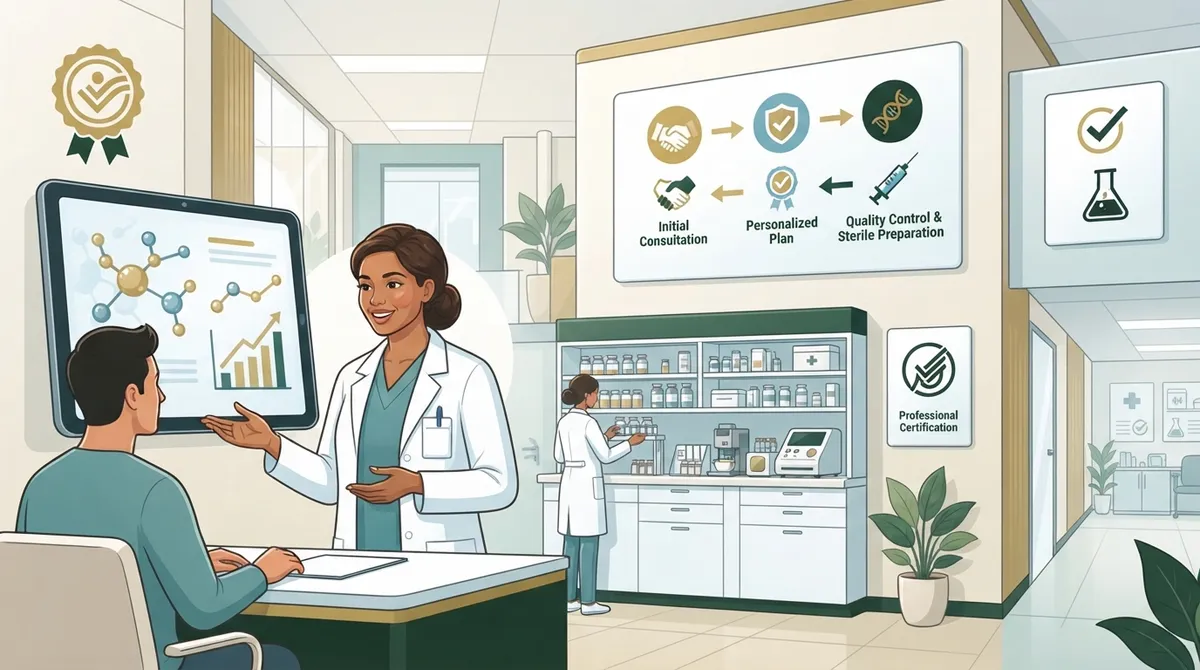
9 Signs You Have Found a Legitimate Peptide Therapy Clinic
1. They Require a Real Medical Evaluation
A trustworthy clinic starts with your health story. A licensed prescriber should review your medical history, current medications, possible contraindications, and your goals before recommending anything.
If a site lets you add peptides to a cart with no questions asked, walk away. No evaluation means no real medical care. A solid intake usually includes:
- A detailed health history and symptom review
- A list of all medications and supplements
- A talk about your goals and realistic expectations
- Informed consent that covers risks and alternatives
2. They Use Licensed, Verifiable Providers
You should be able to find out who is prescribing your treatment. Look for a named clinician, such as a physician, nurse practitioner, or physician assistant, who is licensed in your state.
You can double-check any clinician through your state licensing board. It takes about two minutes and gives real peace of mind. Our guide on why a family nurse practitioner can guide peptide care explains how these providers fit into modern telehealth.
2. They Name the Exact Medication and Its Regulatory Status
Here is a big one. A legitimate clinic will tell you the exact peptide, the intended use, and whether it is FDA-approved or compounded.
FDA approval applies to a specific drug, formulation, indication, and label. It does not apply to peptides as a whole class. So a clinic should never say “it’s FDA-approved” about a compounded product. For a deeper comparison, read FDA-Approved vs. Compounded Peptides: What Wins?
| Type | What It Means | What a Clinic Should Tell You |
|---|---|---|
| FDA-approved peptide drug | Approved for a specific condition and formulation | The brand, the approved use, and whether your use is on-label or off-label |
| Compounded peptide | Made by a pharmacy for a patient; not FDA-approved | That it is compounded, who makes it, and the legal basis |
| Investigational or “research use only” | Not intended for human use | Nothing, because a legitimate clinic should not offer it for injection |
4. They Can Explain the Legal Basis for Compounding
Compounded drugs are not FDA-approved. Under federal law, compounding follows specific rules. Section 503A compounding is generally patient-specific and done by a licensed pharmacist or physician. Section 503B outsourcing facilities follow separate requirements and FDA oversight.
A legitimate clinic should be able to explain which pathway applies and why a given peptide can be compounded. According to FDA compounding policy guidance, 503B facilities may generally use bulk substances only if they appear on the applicable 503B bulks list or the drug is on the FDA shortage list. If a clinic shrugs at these questions, that tells you a lot. You can learn more in 503A vs. 503B: Which Peptide Compounding Wins?
5. They Tell You Which Pharmacy Fills Your Prescription
Transparency about the pharmacy is a major green flag. Ask which pharmacy supplies your medication, whether it is state-licensed, and whether it is an FDA-registered 503B outsourcing facility when that applies.
One important note: FDA registration or the phrase “pharmaceutical grade” does not make a compounded drug FDA-approved. It simply describes the facility or marketing, not the approval status of the product.
Also ask how the medication is labeled, stored, and shipped. Our article on how peptide medications ship safely from telehealth clinics covers what good handling looks like.
6. They Use Lab Work to Guide Your Plan
Data-driven care is a hallmark of quality. A legitimate clinic uses blood work to understand your baseline and shape your plan, rather than guessing. This is especially appealing to biohackers and health optimizers who like to track progress.
Labs also help your provider spot safety issues early and adjust over time. Learn more in 5 Blood Work Analysis Steps Before Peptides in 2026.
7. They Offer Monitoring and Follow-Up
Starting treatment is only the first step. A legitimate peptide therapy clinic builds in check-ins so your provider can review how you feel, update your labs, and tweak your plan.
Look for a clear schedule of follow-ups and an easy way to reach your care team with questions. Not sure what to expect? See 4 Timelines That Show When Peptide Therapy Works (2026) for realistic expectations.
8. They Are Honest About Evidence and Risks
Good clinics do not oversell. They explain what is well studied, what is early-stage, and what is unknown. For example, BPC-157 is not FDA-approved for human use, and a trustworthy provider will say so plainly. Our overview 9 BPC-157 Peptide Facts to Know Before You Start digs into this.
The research base also varies a lot by peptide. A clear-eyed provider will point you to credible sources such as the National Library of Medicine and be upfront about side effects and alternatives.
9. They Never Promise Guaranteed Results
Bodies are different. Age, genetics, sleep, stress, and nutrition all play a role. Any clinic promising guaranteed fat loss, instant youth, or overnight muscle gain is selling hype, not healthcare.
A legitimate clinic will set honest timelines and measure progress with real markers. If you are curious how timing works, see How Long for Peptide Therapy Results? A Real Timeline.
Red Flags vs. Green Flags at a Glance
Need a quick cheat sheet? This table puts the biggest differences side by side.
| Topic | Green Flag | Red Flag |
|---|---|---|
| Prescribing | Licensed clinician reviews your history | No evaluation or prescription needed |
| Product labeling | Made for human use by a licensed pharmacy | “Research use only” peptides sold for injection |
| Regulatory claims | Clear about approved vs. compounded | Claims compounding makes a peptide FDA-approved |
| Pharmacy | Names the pharmacy and licensing | Hides the source of the product |
| Results | Honest, measured expectations | Guaranteed outcomes |
| Follow-up | Scheduled labs and check-ins | One-and-done sales |
Questions to Ask Before You Start
Bring a short list to your first visit. Clear, confident answers are a great sign. Hesitation or vague replies are not. Try these:
- Which exact peptide are you recommending, and why?
- Is it FDA-approved, or is it compounded?
- Which pharmacy will fill my prescription, and is it state-licensed?
- What are the known risks, side effects, and alternatives?
- What labs will you order, and how often will we recheck them?
- Who do I contact if I have a problem?
For an even longer prep list, check out 15 Peptide Consultation Questions to Ask in 2026.
Can a Telehealth Clinic Be Legitimate?
Absolutely. Telehealth can be a safe, convenient way to get peptide care, especially if you have a packed schedule or live far from a specialty office. The key is that the same standards apply: real evaluation, licensed prescribers, transparent sourcing, and follow-up.
Not sure whether to go local or virtual? Local Clinic vs. Telehealth: Best Peptide Therapy Near You? breaks down the tradeoffs. You can also read How Do You Know Online Peptide Therapy Is Safe?
Also remember that state rules matter. A provider must be licensed where you live. Allura Longevity, for example, is licensed in Florida, Georgia, Texas, Connecticut, Indiana, Maryland, New York, and California.
How Allura Longevity Approaches Legitimate Care
At Allura Longevity, care starts with a $50 virtual consultation. From there, you complete blood work through LabCorp, and your licensed provider builds a customized six-month plan. Your medication is delivered to your door, and your team keeps monitoring and adjusting along the way. Our care is led by Ashley, a board-certified Family Nurse Practitioner.
We offer a range of personalized options, including peptides for women and peptides for men, plus GLP-1 weight loss support, BPC-157 for injury recovery, and testosterone replacement. If you want a step-by-step look at getting started, see How to Start Peptide Therapy Safely and See Real Results.
Final Thoughts: Trust, But Verify
A legitimate peptide therapy clinic is open, careful, and proud to show its work. It names the medication, explains the regulatory status, identifies the pharmacy, orders labs, and follows up. It does not hide behind buzzwords or big promises.
You deserve care that is personalized, transparent, and built around your goals. New client spots are limited each month, so if you are ready to talk with a licensed provider, request a consultation today or call (813) 510-6277. For more background on the basics, the what are peptides overview is a helpful read. Your future self will thank you for asking the right questions now.
FAQs
Q: How can I tell whether a peptide therapy clinic is legitimate?
A: Look for a licensed prescriber who reviews your history, names the exact medication, and explains whether it is FDA-approved or compounded. A legitimate clinic also tells you which pharmacy fills your order and plans lab work and follow-ups. If any of that feels fuzzy, keep shopping.
Q: Are peptide therapies FDA-approved?
A: Some peptide medicines are FDA-approved for specific conditions, but “peptide therapy” as a whole is not an approved category. Approval applies to a particular drug, formulation, and use. Compounded peptides are not FDA-approved, so your clinic should be clear about which type you are getting.
Q: Is BPC-157 FDA-approved for human use?
A: No, BPC-157 is not FDA-approved for human use. A trustworthy clinic will say that plainly and explain the limited human evidence and the risks. Be wary of anyone who presents it as proven or approved.
Q: What are the red flags of an unsafe peptide clinic?
A: Big warning signs include selling “research use only” peptides for injection, skipping a medical evaluation, hiding the pharmacy source, and promising guaranteed results. Another red flag is claiming that compounding makes a peptide FDA-approved. When you spot any of these, it is wise to look elsewhere.
Q: Can a telehealth clinic offer legitimate peptide therapy?
A: Yes! Telehealth can be a safe and convenient option when the clinic uses licensed providers, requires a real evaluation and labs, and is transparent about its pharmacy. Just make sure your provider is licensed in your state and offers ongoing monitoring.





