
Key Takeaways
-
The three routes of peptide use—topical serums, oral supplements, and injectable therapy—have different evidence bases and results from one route cannot be applied to another, making this distinction critical to avoid wasted money.
-
Topical GHK-Cu (copper tripeptide-1) shows promise in small, limited human studies with reported wrinkle reductions, but no robust evidence supports injectable GHK-Cu for skin rejuvenation and compounded peptides lack FDA approval.
-
When evaluating peptide products, verify the exact peptide name, look for studies on the specific formula (not just ingredients), check study size and length, and confirm regulatory status before purchasing or injecting.
-
Oral collagen peptides show mixed but encouraging results for hydration and elasticity in some studies, but multi-ingredient formulas make it impossible to credit collagen alone for the results.
-
Retinoids remain the dermatology gold standard with deeper research support; peptides should be viewed as a gentle add-on rather than a replacement for proven treatments like retinoids.
-
Unregulated online peptides marketed for 'biohacking' and injectable peptides without medical prescription carry safety risks, so always consult a licensed provider before trying systemic or injectable peptide therapies.
If you have ever stood in front of the mirror wondering whether a peptide serum, a collagen powder, or a medical peptide plan could really turn back the clock, you are in good company. Peptides are one of the hottest words in skin care right now, and the marketing can get pretty loud.
Here is the friendly truth: clinical skin rejuvenation peptides is a phrase that means different things to different people. It can describe a cosmetic serum, a collagen supplement you drink, or a peptide prescribed by a licensed provider. Each of those is a different route with a different evidence base. Mixing them up is where a lot of confusion (and wasted money) starts.
In this guide, we will walk through what the science says, what it does not say, and how to make smart choices. We will keep it simple, honest, and a little fun. Whether you are a busy professional, a data-loving biohacker, or someone who just wants to feel good in your skin, you will leave with a clear plan. For a broader primer, you can read 8 Facts That Explain What Are Peptides in 2026.

What Are Clinical Skin Rejuvenation Peptides?
Peptides are short chains of amino acids, the building blocks of proteins. Your skin is full of them. If you want the basics, what are peptides is a good place to start.
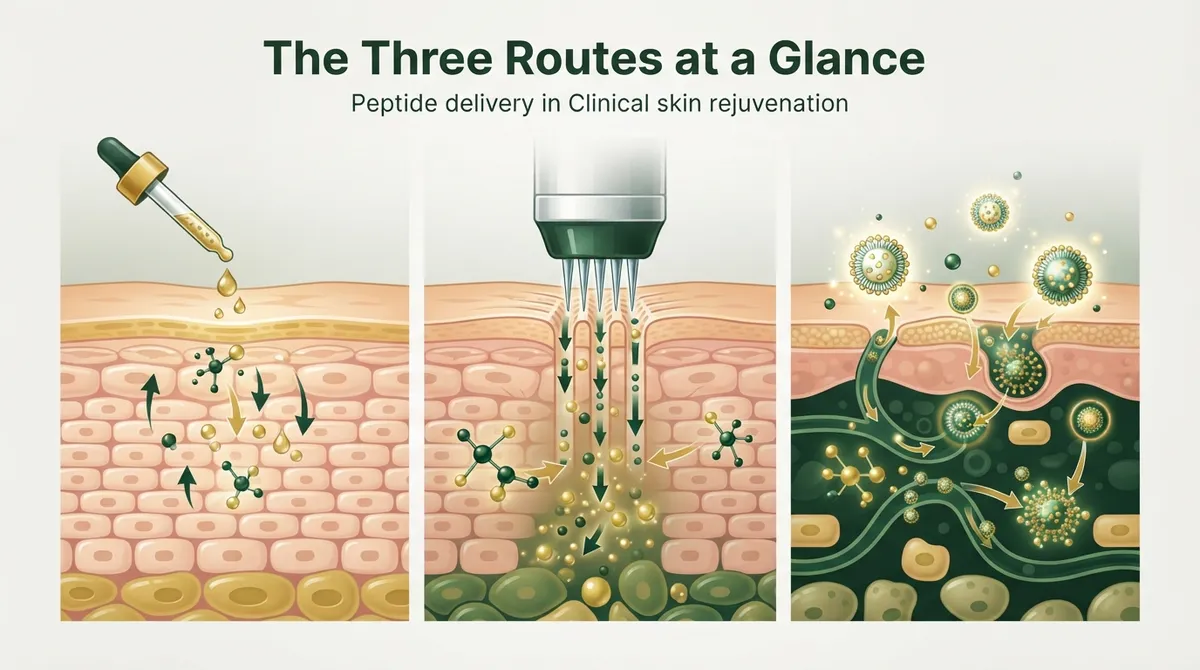
When people say clinical skin rejuvenation peptides, they usually mean one of three things:
- Topical cosmetic peptides: Serums and creams you apply to the skin.
- Oral collagen peptides: Powders or capsules you swallow.
- Peptides given as medical therapy: Prescribed by a licensed provider, often by injection.
These are not interchangeable. A result from a face cream study does not prove that an injection works. A result from a collagen drink does not prove that a serum works. Keep that in mind as we go, because it is the most important idea in this whole article.
The Three Routes at a Glance
| Route | How It Is Used | Evidence Level for Skin | Key Caution |
|---|---|---|---|
| Topical cosmetic peptides | Applied to skin as serum or cream | Small, mostly short studies; product-specific | Penetration and formulation vary widely |
| Oral collagen peptides | Swallowed as powder, drink, or capsule | Some studies show hydration or elasticity gains | Results differ by product; many are multi-ingredient |
| Systemic or injectable peptides | Prescribed and administered under medical care | No robust human evidence for skin rejuvenation found | Compounded drugs are not FDA-approved |
GHK-Cu: The Star of the Show
If peptides had a celebrity, it might be GHK-Cu, also called copper tripeptide-1. It is the peptide most often discussed for skin remodeling.
In the lab, GHK-Cu has shown plausible effects on collagen and other parts of the skin’s support structure. That sounds exciting, and it is a reasonable reason for researchers to keep studying it. But lab and animal findings do not automatically mean benefits in real people. Think of it like a great movie trailer: promising, but you still need to watch the whole film.
What Human Studies Actually Show
Human research on topical GHK-Cu exists, but it is limited. Most studies are small, short, or use products with many ingredients. Here is a quick look at what has been reported:
- A 2018 review describes older 12-week studies, including a facial-cream study with 71 women and an eye-cream study with 41 women.
- The same review summarizes a thigh-skin study where collagen production was reported in 70% of women using a copper-peptide cream, versus 50% with a vitamin C cream and 40% with retinoic acid.
- A small 2016 report on a topical GHK-Cu serum described reductions of 55.8% in wrinkle volume and 32.8% in wrinkle depth after eight weeks, compared with a control serum.
These numbers are interesting, but please read them with a gentle dose of caution. They come from small or older studies, and they are specific to the products tested. They are not a promise that every copper peptide product will deliver the same results. You can explore the research yourself through the National Library of Medicine.
Other Topical Peptides You Will See on Labels
GHK-Cu is not the only name you will meet. Many cosmetic products use signal peptides, which are designed to nudge skin cells, and neurotransmitter-modulating peptides, which are marketed as smoothing expression lines.
One example: a 2024 review of cosmeceuticals in photoaging noted a study where 10% Argireline was associated with reduced wrinkle depth after 30 days. That is a finding for one ingredient in one study, not a green light for peptides in general.
Here is what really matters when you shop:
- The exact ingredient: Peptide names are not all alike.
- The concentration: A trace amount at the bottom of the ingredient list may not do much.
- The formulation: How well a peptide gets into the skin depends on the product design.
- Product-specific testing: Look for studies on the actual formula, not just the ingredient.
Oral Collagen Peptides: A Different Story
Collagen peptides you drink or swallow have their own research path. Reviews and clinical studies report possible improvements in skin hydration and elasticity, but results vary by product and study.
A 2024 clinical study of a supplement with collagen peptides, hyaluronic acid, and micronutrients reported improvements in wrinkle and elasticity measures after three months in healthy women. That sounds great, yet the mix of ingredients means we cannot credit collagen peptides alone.
The takeaway? Oral collagen may be a reasonable part of a skin-supportive routine for some people. But it does not show that injectable peptide therapy rejuvenates skin. They are separate conversations. If you want to go deeper, see Collagen Peptides vs. BPC-157: Arthritis Relief Truth for a helpful comparison of what each type can and cannot do.
What About Injectable Peptides for Skin?
This is where honesty matters most. In the research we reviewed, no robust human clinical evidence establishes injectable or systemic GHK-Cu as an effective skin-rejuvenation treatment. Evidence for topical use should never be stretched to imply that injections are safe or effective for the same purpose.
In the United States, FDA approval is specific to a product and an indication. Compounded drugs are not FDA-approved. The FDA has also flagged safety concerns about certain peptide bulk substances, including BPC-157. So a peptide sold by a clinic or website is not automatically approved, proven, or quality-checked.
This does not mean peptide therapy has no place in wellness. It means you deserve clear information about what a peptide is being used for, and what evidence backs that use. To learn how to separate approved options from compounded ones, read FDA-Approved vs. Compounded Peptides: What Wins? and Is Peptide Therapy Safe? What You Really Need to Know.
Topical vs. Injectable GHK-Cu
| Question | Topical GHK-Cu | Injectable GHK-Cu |
|---|---|---|
| Human skin studies available? | Yes, but small and limited | No robust evidence found for skin rejuvenation |
| Main use studied | Wrinkles, collagen, skin texture | Not established for skin |
| FDA-approved for skin rejuvenation? | Sold as cosmetics, not as approved drugs | No |
| Can one route’s results apply to the other? | No | No |
How Do Peptides Compare With Retinoids?
Retinoids are among the most established tools in dermatology, and they have a deep research record. Peptides can be a gentle add-on for some people, especially those whose skin gets irritated easily. But current evidence does not show that cosmetic peptides replace retinoids or other proven treatments.
A friendly way to think about it: retinoids are the seasoned veteran, and peptides are the promising newcomer still building a track record. Many people use both. A licensed provider or dermatologist can help you build a routine that fits your skin and your goals.
7 Steps to Evaluate Any Peptide Skin Product
Want a simple checklist? Here is how to judge a peptide product without getting swept up in the hype:
- Identify the route. Is it a topical, an oral supplement, or a prescribed therapy?
- Name the exact peptide. Vague claims like “peptide complex” tell you very little.
- Look for studies on the real product. Ingredient studies do not prove a specific formula works.
- Check study size and length. Bigger, longer, independently replicated studies carry more weight.
- Watch for multi-ingredient results. If five ingredients were tested together, you cannot credit just one.
- Confirm regulatory status. Ask whether it is an approved drug, a cosmetic, or a compounded preparation.
- Talk to a licensed provider. Especially before trying anything injectable.
Where Personalized Peptide Care Fits In
Skin is a reflection of your whole body. Sleep, stress, hormones, nutrition, and metabolism all show up on your face eventually. That is why many people exploring skin goals also look at the bigger picture of aging and wellness.
Allura Longevity offers personalized, medically supervised peptide therapy through telehealth. The process starts with a $50 virtual consultation, followed by blood work through LabCorp, and then a customized six-month plan shipped to your home. Licensed providers, led by board-certified Family Nurse Practitioner Ashley, monitor your progress and adjust as needed. Their services focus on areas like energy, sleep, mental clarity, muscle recovery, metabolism, and skin support, and your provider will be upfront about what the evidence does and does not show for each goal.
If skin is your main focus, these reads are helpful next steps:
- 12 Peptide Skin Rejuvenation Facts Worth Knowing (2026)
- How to Evaluate GHK-Cu Peptide Safely in 2026
- How to Trigger Collagen Stimulation With Peptides
Many people also find it useful to look at their overall plan, including how to pick the best peptides for aging and peptides for women or peptides for men.
Realistic Expectations: What to Hope For
Let us keep this real. Skin changes take time, and no peptide is magic. With topical products, studies generally look at timelines of several weeks to a few months. Oral collagen studies often run around three months. Anything promising dramatic overnight change deserves a raised eyebrow.
Good habits still do the heavy lifting: daily sunscreen, gentle cleansing, enough sleep, balanced nutrition, and not smoking. Peptides, when used wisely, may be a supporting player rather than the whole show.
Safety Tips Worth Keeping in Mind
- Patch test any new topical before using it on your whole face.
- Be extra careful with unregulated peptides sold online or marketed for “biohacking.”
- Never inject anything that was not prescribed and supplied through a licensed medical process.
- Tell your provider about all supplements, medications, and health conditions.
- Choose clinics that are transparent about sourcing, evidence, and monitoring.
The Bottom Line
Clinical skin rejuvenation peptides are an exciting area, but the smartest approach is an informed one. Topical GHK-Cu has interesting lab support and a small human research record. Oral collagen peptides have their own mixed but encouraging findings. Injectable peptides for skin rejuvenation lack strong human evidence, and each route should be judged on its own merits.
You do not have to figure it all out alone. If you are curious about a personalized, lab-guided approach to longevity and wellness, we would love to help. Spots for new clients are limited each month, so request a consultation today, or call (813) 510-6277 to talk with the team. Allura Longevity serves clients in Florida, Georgia, Texas, Connecticut, Indiana, Maryland, New York, and California.
FAQs
Q: What are skin rejuvenation peptides, and how are they different from peptide therapy injections?
A: Skin rejuvenation peptides usually mean topical serums, oral collagen supplements, or medically prescribed peptides. They are different routes with different evidence, so results from a cream do not prove that an injection works for skin. A licensed provider can help you understand which option, if any, fits your goals.
Q: Does topical GHK-Cu actually improve wrinkles or collagen?
A: Some small and older human studies suggest topical GHK-Cu may help with wrinkles and collagen, including an eight-week serum study that reported reduced wrinkle volume and depth. Still, the studies are limited, so results should be read with caution and may not apply to every product.
Q: Is injectable GHK-Cu FDA-approved for skin rejuvenation?
A: No. Injectable GHK-Cu is not FDA-approved for skin rejuvenation, and robust human evidence for that use has not been found. Compounded drugs in general are not FDA-approved, so it is wise to ask any provider about sourcing, safety, and evidence.
Q: Are oral collagen peptides effective for skin hydration and elasticity?
A: Some studies report possible gains in skin hydration and elasticity, but results vary by product and many studies test multi-ingredient formulas. Oral collagen may be a helpful add-on for some people, though it does not show that injectable peptides rejuvenate skin.
Q: How can I tell whether a peptide skin-care product has real clinical evidence?
A: Look for studies on the exact product, not just a single ingredient. Check the study size, length, and whether other ingredients were tested at the same time. If the claims feel too big or the evidence is vague, a licensed provider or dermatologist can help you sort it out.





