
Key Takeaways
-
Both peptide therapy and bioidentical hormone replacement require a prescription from a licensed provider in the U.S.—there is no legal 'natural' hormone therapy path that skips medical oversight, regardless of supplement marketing claims.
-
Peptides stimulate your body to produce its own hormones via messenger signals, while bioidentical hormones directly replace missing hormones; peptides work with your existing systems rather than overriding them, making them fundamentally different approaches.
-
Most compounded bioidentical hormones and many peptide protocols used for hormone optimization are not FDA-approved as custom formulations, meaning consistent provider oversight and quality sourcing from reputable pharmacies are essential for safety.
-
Different peptides target different hormone systems: growth hormone peptides like sermorelin and CJC-1295 boost GH/IGF-1, while gonadorelin specifically supports natural testosterone production through LH and FSH release.
-
Choose peptide therapy if your labs show mild deficiencies and you want gradual whole-body optimization; choose direct hormone replacement if labs show significant deficiency or you need faster symptom relief—decision should be based on blood work, not assumptions.
-
Baseline blood work, provider consultation, treatment initiation with monitoring checkpoints, and reassessment every few months removes guesswork and ensures your hormone plan adapts as your body and labs change over time.
If you’ve spent any time reading about hormone health, you’ve probably seen the phrase “natural hormone therapy” tossed around a lot. Maybe you’re wondering if it means something different from a prescription treatment, or if “natural” just means safer. Here’s the truth: in the world of peptide therapy, the line between natural and prescription is not always what people expect, and understanding it can help you make smarter choices for your body.
Whether you’re a busy professional trying to fix your energy crash by 2 p.m., a biohacker who tracks every lab number, or someone simply looking to feel like yourself again, this guide breaks it all down. We’ll cover how peptides differ from bioidentical hormones, what actually requires a prescription, and which options might fit your goals. By the end, you’ll know exactly what questions to ask before starting any hormone or peptide plan.
1. Understand What “Natural” Really Means in Hormone Therapy
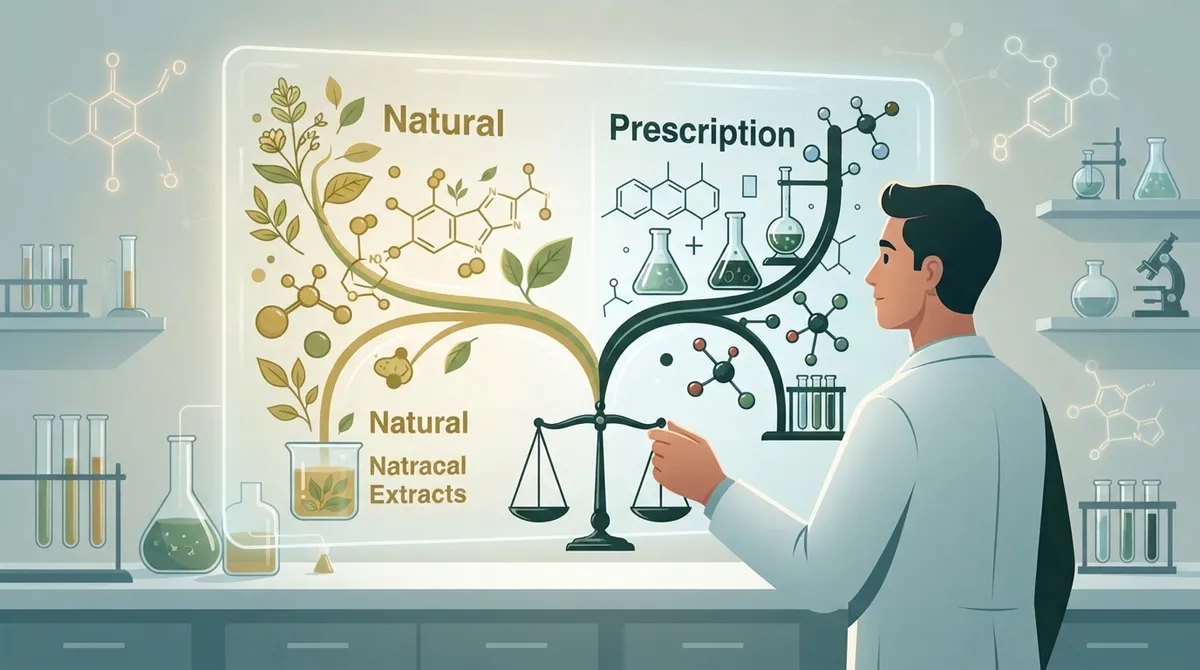
The word “natural” gets used loosely in wellness marketing. In reality, it usually refers to one of two things: treatments that mimic your body’s own hormone structure, or treatments that stimulate your body to make more of its own hormones. Neither one is automatically safer or unregulated just because it’s called natural.
Peptide therapy falls into the second category. Peptides are short chains of amino acids that act like messengers, telling your body to produce or regulate hormones on its own, rather than replacing them directly, according to what are peptides. This is a key distinction, because it means peptides work with your body’s existing systems instead of overriding them.
- Peptides signal the body to produce hormones naturally
- Bioidentical hormone therapy (BHRT) replaces hormones directly
- Both approaches typically require a prescription in the U.S.
- “Natural” does not mean unsupervised or risk-free
2. Know the Real Difference Between Peptides and Bioidentical Hormones
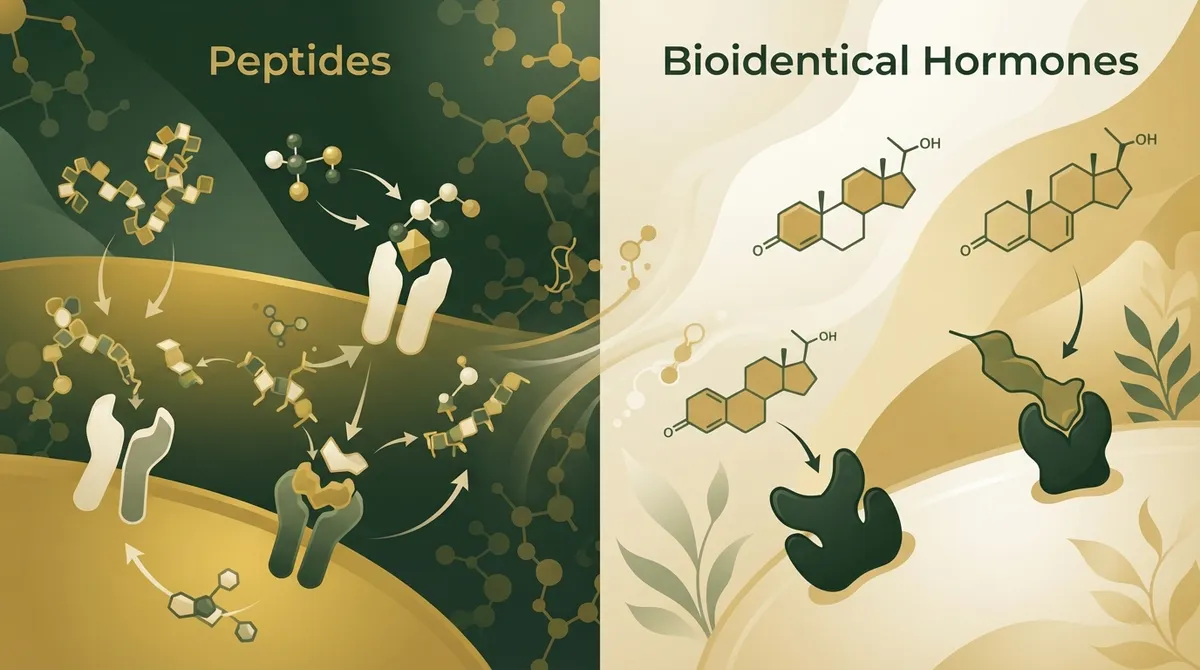
This is where a lot of confusion happens. Peptide therapy and bioidentical hormone replacement therapy (BHRT) are often talked about in the same breath, but they work in very different ways.
Bioidentical hormones supply your body with estrogen, progesterone, testosterone, or DHEA to directly replace what’s missing. Peptides, on the other hand, stimulate your pituitary gland or other systems to ramp up natural hormone production. If you want the deep dive on this, our guide on how to choose between bioidentical hormones and peptides walks through it step by step.
Quick Comparison Table
| Feature | Peptide Therapy | Bioidentical Hormone Therapy (BHRT) |
|---|---|---|
| How it works | Signals the body to produce hormones | Directly replaces hormone levels |
| Common examples | Sermorelin, Ipamorelin, CJC-1295, Gonadorelin | Estrogen, progesterone, testosterone, DHEA |
| Prescription required | Yes | Yes |
| FDA status | Some approved, many compounded/off-label | Compounded versions not FDA-approved |
| Typical goal | Boost growth hormone, recovery, metabolism | Restore specific hormone levels directly |
Both paths require guidance from a licensed provider, and both can be part of a well-rounded plan depending on your blood work and goals.
3. Learn Which Peptides Support Natural Hormone Production
Not all peptides do the same job. Some focus on growth hormone, while others tap into the reproductive hormone axis. Knowing the difference helps you set realistic expectations.
Growth Hormone Peptides
Peptides like sermorelin, ipamorelin, and CJC-1295 are commonly used to stimulate growth hormone and IGF-1 production. They are not designed to raise testosterone directly. If you’re curious how these work at a deeper level, check out our breakdown of growth hormone peptides and how they work.
Reproductive Axis Peptides
Gonadorelin is one peptide that acts differently. It prompts the release of LH and FSH, hormones that can support your body’s own testosterone production in appropriate cases. This is a great example of “natural” stimulation rather than direct replacement.
- Sermorelin – stimulates growth hormone release
- Ipamorelin – supports growth hormone with minimal side effects
- CJC-1295 – extends growth hormone pulses for longer effect
- Gonadorelin – supports natural testosterone via LH and FSH release
- BPC-157 – supports tissue repair and recovery
- Thymosin Alpha-1 – supports immune function
For a more complete list of options and how they’re used for muscle, energy, and recovery, take a look at our guide on 14 peptides for muscle gain worth knowing and how to pick peptides for energy that actually work.
4. Confirm the Prescription Reality for Both Options
Here’s a fact worth repeating: in the U.S., both bioidentical hormones and prescription peptides require a valid prescription from a licensed healthcare provider. There is no legal path to “natural” hormone therapy that skips medical oversight, no matter what a supplement label claims.
A 2026 clinical education source confirms that peptide therapy and testosterone replacement therapy (TRT) are both prescription-only treatments that require baseline assessment and ongoing monitoring. This matters because self-treating with unregulated products can be risky, and it removes the safety net of lab-based dosing.
- Prescription peptides require provider evaluation and blood work
- Compounded peptides come from 503A or 503B pharmacies under prescription
- Bioidentical hormones also require a prescription, even in cream or pellet form
- Neither option is legally sold as an over-the-counter “natural” product
According to the National Library of Medicine, roughly 100 peptides have been authorized by the FDA for various applications since insulin’s introduction in 1921. However, a 2024 review notes the FDA has approved only about ten natural peptides since 1923, spanning categories like diabetes care, growth hormone–releasing hormones, and alpha-MSH analogues. Many peptide protocols used for hormone optimization today are compounded or prescribed off-label, which is why working with an experienced provider matters so much.
5. Weigh the FDA Status of Common Treatments
This is one of the most misunderstood parts of the natural vs. prescription conversation. People often assume “bioidentical” means FDA-approved, but that’s not always true.
What’s Actually Approved
Compounded bioidentical hormones are not FDA-approved as custom mixtures, even when their individual ingredients are chemically identical to hormones your body makes. Some standardized bioidentical products do have FDA approval, but custom compounded versions do not go through that same review process.
Peptide FDA Status
Some peptide treatments are FDA-approved for specific medical uses, like certain diabetes medications. But many peptide protocols used specifically for hormone optimization, recovery, or anti-aging purposes are compounded or prescribed off-label. This doesn’t mean they’re unsafe, but it does mean provider oversight and quality sourcing are essential. Our article on FDA-approved vs. compounded peptides covers this in more detail.
| Treatment Type | FDA Status | Typical Use |
|---|---|---|
| Standardized bioidentical hormones | Some FDA-approved | Menopause, low testosterone |
| Compounded bioidentical hormones | Not FDA-approved as custom mix | Personalized hormone dosing |
| Select peptides (e.g., certain GLP-1s) | FDA-approved for specific indications | Diabetes, weight management |
| Growth hormone peptides (Sermorelin, CJC-1295) | Often compounded/off-label | Recovery, growth hormone support |
6. Choose the Approach That Fits Your Goals
So how do you actually decide between natural hormone stimulation and direct prescription hormone replacement? It comes down to your labs, symptoms, and what you’re hoping to achieve.
Signs Peptide Therapy Might Fit You
- You want to support your body’s own hormone production
- Your labs show mild deficiencies rather than severe drops
- You’re interested in recovery, sleep, or metabolism support
- You want a gradual, whole-body optimization approach
Signs Direct Hormone Replacement Might Fit You
- Your labs show significant hormone deficiency
- You need faster symptom relief
- Your provider recommends direct replacement based on your health history
- You’ve already tried natural stimulation without enough improvement
The best way to know for sure is through blood work and a conversation with a licensed provider. This is exactly the process we use at Allura Longevity: a $50 virtual consultation, LabCorp blood work, and a custom six-month plan built around your actual numbers, not guesswork. If you’re ready to find out where you stand, you can request a consultation and get started with real answers instead of assumptions.
Common Questions People Ask Before Starting
Before wrapping up, let’s touch on a few things people often want clarity on. If you’re still building your treatment plan, our guide on how to start peptide therapy safely and see real results is a helpful next stop. And if cost is on your mind, take a look at 6 hormone therapy cost mistakes that drain your wallet before committing to any program.
What This Means for Long-Term Health
Some hormone clinics report peptide protocols are used every four to six months in pellet-based hormone programs, though this varies by practice and is not a universal standard. What matters more than the schedule is consistent monitoring. Your body changes, your labs change, and your plan should change with them.
- Get baseline blood work through a trusted lab
- Review results with a licensed provider
- Choose peptides, bioidentical hormones, or a combination
- Start treatment with clear monitoring checkpoints
- Adjust dosing based on follow-up labs
- Reassess goals every few months
This step-by-step approach removes the guesswork and keeps your plan grounded in real data, not trends you saw online. Learn more about what to expect in our piece on 12 things to expect from peptide therapy in 2026.
Bringing It All Together
Choosing between natural hormone stimulation and prescription hormone replacement doesn’t have to feel overwhelming. Both paths are legitimate, both require medical supervision, and both can help you feel more like yourself again when guided by the right provider. The real win is working with someone who looks at your actual labs and builds a plan around your body, not a generic protocol.
At Allura Longevity, licensed providers led by Ashley, a board-certified Family Nurse Practitioner, create personalized six-month plans based on your blood work, delivered right to your door. Whether you’re exploring peptides for energy, recovery, weight loss, or hormone support, you deserve a plan built just for you. Spots are limited each month, so if you’re ready to take the next step, schedule your consultation today and start your journey with real support behind you.
FAQs
Q: What is the difference between peptide therapy and hormone replacement therapy?
A: Peptide therapy uses small protein signals to encourage your body to make more of its own hormones, while hormone replacement therapy supplies the hormones directly. Think of peptides as a gentle nudge and hormone replacement as a direct refill. Both can work well, and the right choice depends on your lab results and goals.
Q: Is peptide therapy considered natural hormone therapy?
A: In many ways, yes. Peptides work by stimulating your body’s own hormone production instead of replacing hormones from an outside source. That said, peptide therapy still requires a prescription and medical supervision, so “natural” doesn’t mean unregulated.
Q: Do peptides require a prescription?
A: Yes, in the U.S. prescription peptides require a valid prescription from a licensed healthcare provider. This is true whether the peptide is FDA-approved for a specific use or prescribed off-label through a compounding pharmacy.
Q: Are compounded bioidentical hormones FDA-approved?
A: Not as custom mixtures. Even when the individual hormones are bioidentical to what your body naturally produces, the compounded blend itself does not go through FDA approval. Some standardized bioidentical products are FDA-approved, but personalized compounded versions are not.
Q: Can peptide therapy increase testosterone naturally?
A: Certain peptides, like gonadorelin, can prompt your body to release LH and FSH, which may support natural testosterone production in appropriate cases. This is different from growth hormone peptides like sermorelin or ipamorelin, which target growth hormone and IGF-1 instead.





