
Key Takeaways
-
Oral hydrolyzed collagen peptides have the strongest human trial evidence for aging skin, mainly improving hydration, with wrinkle and elasticity results being less consistent across products.
-
Topical copper peptides (GHK-Cu) and signal peptides show promise for texture and fine lines, but current studies are small and often product-specific.
-
Injectable peptides are not established for reversing skin aging, so be cautious of providers making dramatic skin claims without supporting data.
-
Expect modest, gradual changes; many collagen studies measure results around 8 to 12 weeks, and early weeks often show little visible change.
-
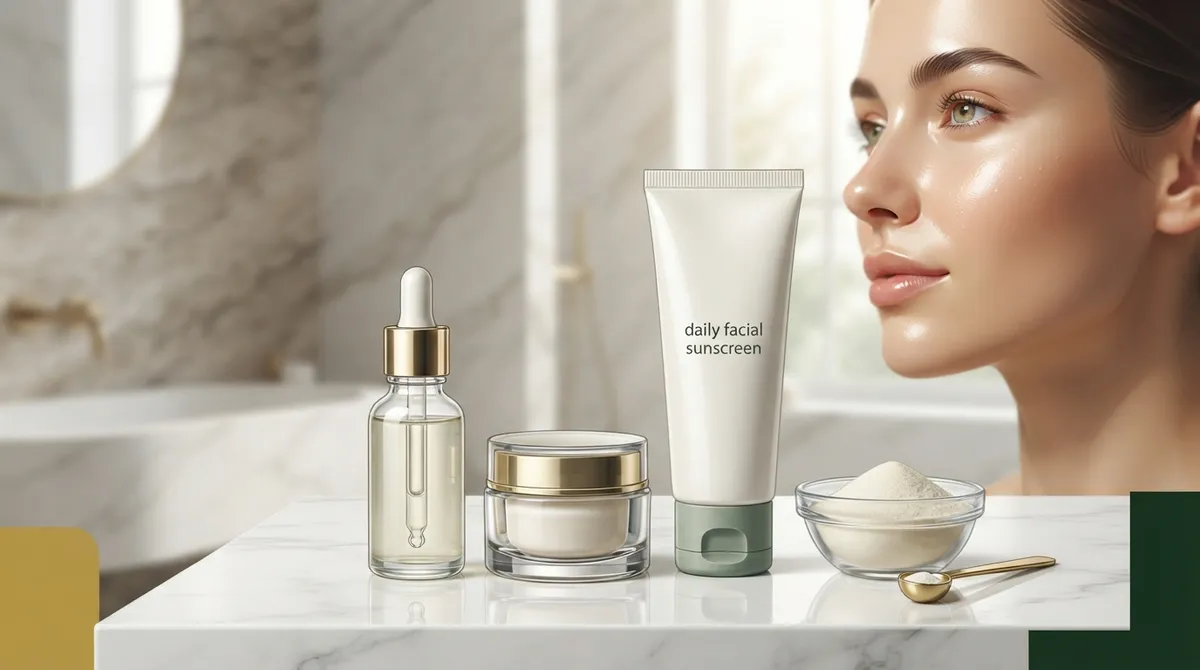
Daily broad-spectrum sunscreen remains the biggest factor in visible skin aging, so peptides work best alongside sun protection and healthy habits.
-
Peptide skincare products are sold as cosmetics and are not FDA-approved to treat wrinkles, so keep expectations grounded and consult a dermatologist for skin concerns.
If you have ever stared at the mirror and wondered where your glow went, you are not alone. Skin changes with age. It gets drier, thinner, and a bit less bouncy. So it makes sense to ask, what peptides help with aging skin, and which ones are worth your time and money?
Here is the honest answer. “Peptides” is a big umbrella term, not one single treatment. Some are in a collagen powder you drink. Some are in a serum you rub on your face. Others are prescription-only options that a licensed provider must oversee. Each has a different level of evidence behind it, and the results are usually modest, not magic.
In this friendly guide, we break down seven peptide options people talk about for aging skin. We will tell you what the research says, where it falls short, and how to think about it safely. If you want a refresher first, check out 8 Facts That Explain What Are Peptides in 2026. Ready? Let’s dive in.

First, Know the Three Peptide Categories
Before we get to the list, it helps to sort peptides into three buckets. Mixing them up is the most common mistake people make.
- Oral collagen peptides: Powders, capsules, or drinks you swallow. These have the most human trial data for skin.
- Topical cosmetic peptides: Serums and creams you apply to the skin. The research is promising but limited.
- Injectable or systemic peptides: Prescription products given under medical supervision. Evidence for skin aging specifically is not as strong as for the other two.
Findings from one bucket do not automatically apply to another. A good result from a collagen drink does not prove an injection will do the same thing. Keep that in mind as you read.
The 7 Peptides and Peptide Approaches for Aging Skin
1. Hydrolyzed Collagen Peptides (Oral)
This is the best-studied option. Hydrolyzed collagen is collagen that has been broken into small pieces so your body can absorb it. A 2023 meta-analysis of 26 randomized controlled trials with 1,721 participants found statistically significant improvements in skin hydration and elasticity compared with placebo.
That sounds great, but there is a catch. Results vary by product, dose, and how long people took it. Wrinkle results are less consistent than hydration results. In one triple-blind, placebo-controlled trial, a specific product was linked to a 35% drop in wrinkle score after 12 weeks. That is product-specific, so please do not assume every collagen powder will deliver the same thing.
If you want to go deeper, our post on how to trigger collagen stimulation with peptides covers more of the science.
2. Copper Peptides (GHK-Cu, Topical)
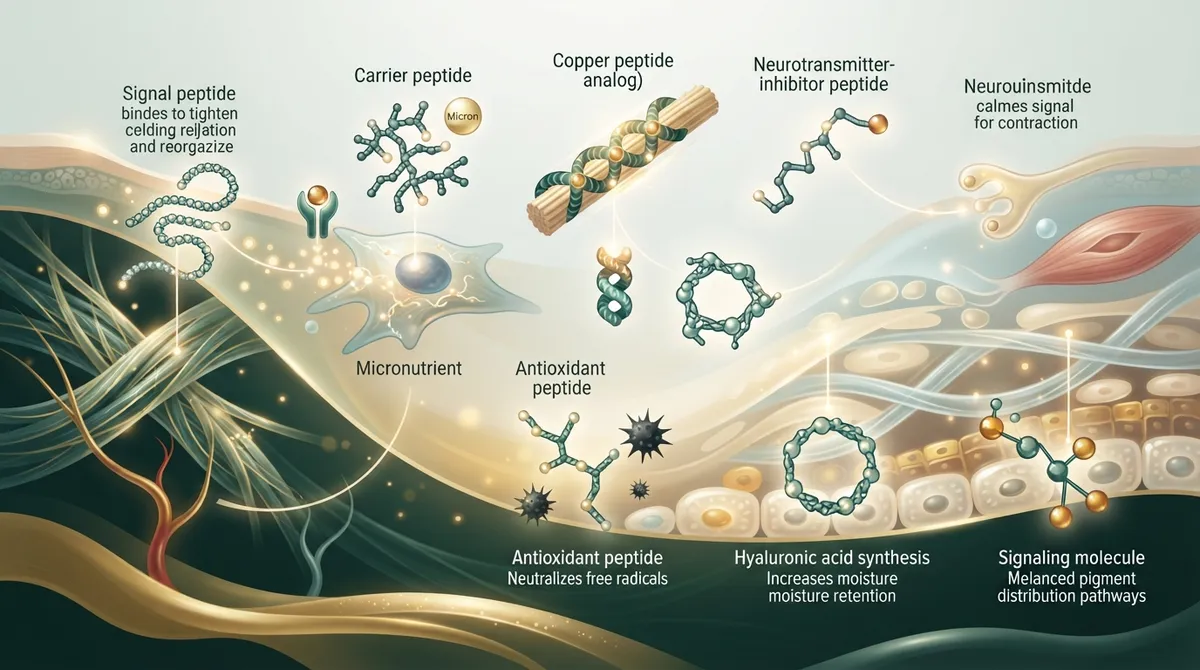
Copper peptides, often written as GHK-Cu, are popular in skincare. They are thought to play a role in skin repair and collagen-related processes. People often use them in serums for texture, firmness, and overall look.
The evidence is early. Most studies are small, and many test one specific formula. Think of copper peptides as a promising cosmetic ingredient, not a proven wrinkle eraser. For a deeper look, see how to evaluate GHK-Cu peptide safely in 2026.
3. Signal Peptides (Topical)
Signal peptides are short chains designed to “signal” skin cells to behave in a more youthful way, such as supporting collagen-related activity. You will see names like palmitoyl pentapeptide on ingredient lists.
A 2024 systematic review of topical exosome and peptide therapies found nine articles on topical peptides. The authors called the findings promising but stressed that the evidence base is limited. One small, uncontrolled study of a specific peptide serum in 20 women aged 40 to 65 reported a 19% improvement in fine wrinkles after twice-daily use. Small and open-label means we should treat that number with caution.
4. Carrier and Neurotransmitter-Affecting Peptides (Topical)
Two other topical types come up often. Carrier peptides help deliver trace minerals to skin. Neurotransmitter-affecting peptides are marketed as helping soften expression lines. Both are cosmetic claims, and how well they work depends a lot on the formula and how deeply the ingredient can actually get into the skin.
That is a key point. Topical peptides can be large molecules, and penetration varies. A fancy label does not guarantee results.
5. Collagen-Support Peptide Blends in Personalized Plans
Some wellness providers build personalized plans that pair nutrition, skincare habits, and lab-guided care. In a telehealth setting, the goal is to look at the whole picture: sleep, stress, hormones, nutrition, and skin goals. Peptides may be one small part of that picture, not the whole plan.
At Allura Longevity, licensed providers review your blood work and goals before suggesting anything. You can read how that process works in How to Start Peptide Therapy Safely and See Real Results.
6. Injectable Peptides Marketed for Skin Rejuvenation
This is where we need to be extra careful. Some injectable peptides are discussed in wellness circles for general recovery, repair, or vitality. But the research does not show that injectable peptide therapy safely or effectively reverses skin aging. The evidence is simply not on the same level as oral collagen or topical products.
If a provider promises dramatic skin results from injections, ask for the data. A responsible provider will talk about uncertainty and will not make broad treatment claims. Our guide on whether peptide therapy is safe is a helpful read here.
7. Peptides Plus Hormone and Lifestyle Support
Skin is closely tied to your overall health. Hormone shifts, poor sleep, and high stress can all show up on your face. For many people, the smartest move is to look at the root causes alongside any peptide choice. Learn more in How to Pick the Best Peptides for Aging in 2026 and What Peptides Do for Skin: A Real-World Guide for 2026.
Quick Comparison: How the Options Stack Up
| Option | How You Use It | Strength of Evidence | Best Known For |
|---|---|---|---|
| Oral hydrolyzed collagen | Swallow daily | Strongest human trial data | Hydration, some elasticity |
| Copper peptides (GHK-Cu) | Apply to skin | Early, limited | Texture and firmness |
| Signal peptides | Apply to skin | Promising, small studies | Fine lines |
| Carrier/neuro-type peptides | Apply to skin | Limited, formula-dependent | Cosmetic smoothing |
| Injectable peptides | Medical supervision | Not established for skin aging | General wellness goals |
What Results Can You Realistically Expect?
Let’s keep it real. Peptides for skin tend to offer modest, gradual changes. Think better hydration and a slightly smoother look over weeks to months, not a face that looks twenty years younger overnight.
Here is a simple way to set expectations:
- Weeks 1 to 4: You may notice little to no change. Skin cells turn over slowly.
- Weeks 8 to 12: Many studies of oral collagen measure results around this window. Some people notice better hydration.
- Month 3 and beyond: Any change in elasticity or fine lines tends to be gradual, and it varies a lot from person to person.
These are cosmetic appearance outcomes. They are not treatments for a skin disease, and peptides do not replace dermatology care. For more on timing, see how long until peptides improve skin.
Don’t Skip the Basics
Here is the friendly truth no serum can dodge. Peptides work best on top of good habits. No peptide replaces sun protection, and sun damage is the biggest driver of visible skin aging.
- Wear broad-spectrum sunscreen every day.
- Sleep well and manage stress when you can.
- Eat enough protein and a variety of colorful foods.
- Do not smoke, and go easy on alcohol.
- See a dermatologist for skin concerns or changes in moles.
Peptide serums are generally used alongside other skincare like sunscreen, vitamin C, or retinol. If you are layering several actives, introduce one at a time and ask a professional about your routine, especially if your skin is sensitive.
How to Choose Wisely: Red Flags and Green Flags
The peptide market is crowded, and marketing can get loud. Here is a quick table to help you spot the difference.
| Green Flags | Red Flags |
|---|---|
| Honest language about modest, uncertain results | Promises to “reverse aging” or erase wrinkles |
| Licensed provider who reviews your health history | No medical review or lab work |
| Clear product ingredients and dosing | Vague “proprietary blends” |
| Separates cosmetic goals from medical treatment | Claims to cure disease or replace dermatology |
Also remember that peptide skincare products are generally sold as cosmetics, which means they are not FDA-approved to treat wrinkles. That is one more reason to keep expectations grounded. For general background, the what are peptides overview from WebMD is a handy primer, and the National Library of Medicine hosts peer-reviewed research you can explore yourself.
Where Peptide Therapy Fits In
So where does a telehealth peptide clinic come in? Think of it as the personalized, big-picture layer. Skin changes are often linked to energy, sleep, hormones, and recovery. A provider can look at your labs and goals, then build a plan that makes sense for you.
Allura Longevity offers personalized, medically supervised peptide therapy through telehealth. Clients start with a $50 virtual consultation, complete blood work through LabCorp, and receive a customized six-month plan delivered to their home. Care is led by Ashley, a board-certified Family Nurse Practitioner, with ongoing monitoring and adjustments. We are licensed in Florida, Georgia, Texas, Connecticut, Indiana, Maryland, New York, and California.
We will always be upfront: your provider will talk through what is well supported and what is still uncertain, so you can make a confident choice. Curious about options for peptides for women or peptides for men? Both are available.
Final Thoughts
So, what peptides help with aging skin? Oral hydrolyzed collagen has the most human evidence, mainly for hydration and, less consistently, elasticity and wrinkles. Topical peptides like copper and signal peptides show early promise. Injectable options are not proven for skin aging. Across the board, expect modest results and pair them with daily sunscreen and healthy habits.
Want a plan built around your own labs and goals? Request a consultation with Allura Longevity or call (813) 510-6277. Spots for new clients are limited each month, so reach out while there is room. Your skin has a story, and we would love to help you write the next chapter, safely and honestly.
FAQs
Q: What peptides are best for aging skin?
A: Oral hydrolyzed collagen peptides have the most human trial evidence, mainly for skin hydration and sometimes elasticity. Topical options like copper and signal peptides show early promise, but the research is smaller. Results are usually modest and vary by product.
Q: How long does it take for collagen peptides to affect skin?
A: Many studies look at around 8 to 12 weeks, so patience is key. Some people notice better hydration in that window, while changes in elasticity or wrinkles tend to be slower and less consistent. Everyone’s skin responds a little differently.
Q: Are topical peptides or oral collagen peptides more effective?
A: Oral collagen has more human trial data right now, while topical peptide evidence is promising but limited and often product-specific. Neither is a miracle fix. Many people use a mix of both alongside daily sunscreen.
Q: Do injectable peptides help with skin aging, and are they safe?
A: The current evidence does not show that injectable peptide therapy safely or effectively reverses skin aging. Any injectable peptide should be prescribed and monitored by a licensed provider after a proper health review. Ask lots of questions and be wary of big promises.
Q: Are peptide skin-care products FDA-approved to treat wrinkles?
A: No. Peptide skincare products are generally sold as cosmetics, which means they are not FDA-approved to treat wrinkles or disease. They may improve how skin looks, but they are not a medical treatment or a replacement for dermatology care.





