

Key Takeaways
-
A legitimate home-delivery peptide program requires a licensed clinician's medical evaluation, a valid prescription when required, and a licensed dispensing pharmacy; if any is missing, keep looking.
-
Home delivery is only a delivery method; it does not make a peptide safe, effective, or FDA-approved, so put the medical evaluation before the shipping convenience.
-
Always ask whether a medication is FDA-approved or compounded, and ask why a compounded option is recommended instead of an approved alternative.
-
Avoid 'research use only' or 'not for human consumption' peptide vials, since their identity, purity, potency, and sterility are uncertain and no clinician guides dosing.
-
Insist on baseline lab work and ongoing follow-up, since blood work lets your provider personalize the plan and track progress over time.
-
Treat guaranteed results, unnamed pharmacies, no real medical assessment, and pressure to decide quickly as red flags that warrant pausing before you commit.
You’re busy. Between work, family, workouts, and everything else, a trip to a clinic can feel like one more thing on a very long list. So it makes sense that peptide therapy with home delivery sounds like a dream. A licensed provider, a personalized plan, and a package at your front door? Sign me up!
But here’s the honest truth: the best peptide therapy with home delivery isn’t a single product or a trophy title. It’s a care pathway. The best option depends on your health goals, the evidence behind each treatment, and whether a qualified clinician decides it’s right for you.
Home delivery is simply how your medicine arrives. It doesn’t make a product safe, effective, or FDA-approved on its own. In this guide, we’ll walk through what a legitimate program looks like, how to tell approved medicines from compounded ones, which red flags to dodge, and what questions to ask before you start. Think of this as a friendly checklist from someone who wants you to feel confident, not confused.

What Does “Best Peptide Therapy With Home Delivery” Really Mean?
Let’s clear up a common mix-up. “Best” is not an official quality rating. No agency stamps a program as the top choice. Instead, the best programs share a few solid traits that protect you and support real results.
First, a licensed clinician reviews your health history. Second, a prescription is written when one is required. Third, a properly licensed pharmacy prepares and ships your medication. If any of those three pieces is missing, keep looking.
If you’re brand new to this world, our guide to peptide therapy basics every beginner should know is a great place to build your foundation. You can also read a plain-language overview from WebMD on what are peptides.
Convenience Is a Perk, Not Proof
Fast shipping is nice. But a shiny website and a speedy courier don’t tell you whether the treatment is appropriate for your body. Always put the medical evaluation first and the delivery second.
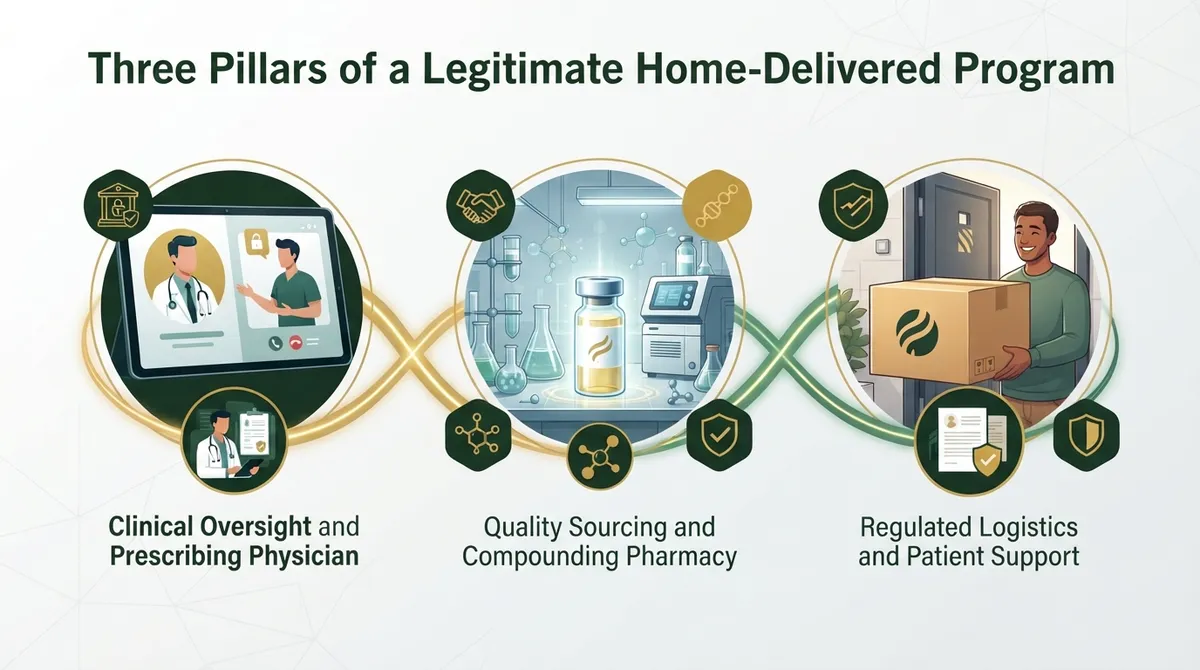
The Three Pillars of a Legitimate Home-Delivered Program
Whether you’re a health optimizer, a biohacker, or a busy professional, these three pillars should be non-negotiable.
- A real medical assessment. A licensed provider reviews your symptoms, history, goals, and ideally your lab results before recommending anything.
- A valid prescription pathway. When a medication requires a prescription, it should come from that clinician after a meaningful evaluation.
- A licensed dispensing pharmacy. The pharmacy should be clearly identified and credentialed in the relevant state.
That’s it. Simple, but powerful. If a company skips the first step and jumps straight to checkout, that’s your cue to pause. Our article on how a telehealth prescription works for peptides breaks down what a proper visit looks like.
FDA-Approved vs. Compounded Peptides: Know the Difference
This is the part many people skip, and it matters a lot. Not all peptide products are created equal, and the label on the box tells only part of the story.
| Feature | FDA-Approved Peptide Medicine | Compounded Peptide Product |
|---|---|---|
| FDA review before marketing | Yes, for safety, effectiveness, and quality | No, not reviewed by FDA before marketing |
| Typical use | Specific approved conditions | Limited cases when an approved drug can’t meet a patient’s needs |
| Prescription needed | Usually yes | Yes, from a licensed clinician |
| Key question to ask | Is it right for my condition? | Why is this recommended instead of an approved option? |
Compounding can be appropriate in limited situations under the law. But compounded drugs are not FDA-approved, so you deserve a clear explanation of why one is being suggested. For a deeper look, read our comparison of FDA-approved vs. compounded peptides.
Regulatory Status Can Change
The FDA has flagged safety concerns for certain substances proposed for compounding, including risks like immunogenicity and peptide-related impurities. Because rules can shift, it’s smart to check the FDA’s current compounding information for any specific substance your provider mentions.
Why “Research Use Only” Products Are Not the Answer
You’ve probably seen them online: vials labeled “for research use only” or “not for human consumption.” They can look tempting, especially for biohackers who love to experiment. But please, steer clear.
These products are not legitimate substitutes for prescribed medicines. Their identity, purity, potency, sterility, and storage conditions may be uncertain. Self-injecting an unknown substance can carry serious risks.
- No guarantee the vial contains what the label says
- No clinician guiding dose or safety
- No pharmacist oversight or accountability
- Unclear sterility and handling
A well-run program replaces guesswork with data and supervision. That’s the whole point of medical care.
How to Vet a Home-Delivery Peptide Provider
Ready to compare options? Use this simple table as your cheat sheet. You can screenshot it and keep it handy.
| What to Check | What Good Looks Like | Red Flag |
|---|---|---|
| Clinician licensure | Licensed in your state, easy to verify | No names or credentials listed |
| Pharmacy source | Clearly named, properly licensed | Hidden or vague product source |
| Medical evaluation | Health history and labs reviewed | Checkout with no real assessment |
| Product transparency | Tells you if it’s approved or compounded | Avoids the question |
| Results promises | Honest about uncertainty | Guaranteed results |
| Follow-up care | Ongoing monitoring and adjustments | Ship it and forget it |
For an even deeper checklist, see our guide on how to choose a peptide therapy clinic you trust, and review these 5 signs longevity medicine telehealth is legit.
Questions to Ask Before You Start
Don’t be shy. A great provider welcomes your questions. Bring this list to your first visit:
- Is this medication FDA-approved or compounded?
- Why are you recommending it for me specifically?
- What evidence supports this use?
- Which pharmacy will prepare and ship it?
- What side effects should I watch for, and who do I call?
- How often will you check in and adjust my plan?
- Is there an FDA-approved alternative for my goal?
That last question is a big one. Sometimes an approved medicine fits your needs better than anything else. A trustworthy clinician will tell you so. We also suggest reading 15 peptide consultation questions to ask in 2026 and avoiding the 3 peptide consultation mistakes that waste your first visit.
How Peptides Should Be Shipped and Stored
Your medication’s journey matters. Some peptide medicines need cool storage, and a sloppy shipment can compromise them. Here’s what a quality shipment should include.
- Secure, protective packaging
- Temperature control when the medication requires it
- Clear storage and handling instructions
- A label you can read and understand
- A way to reach a pharmacist with questions
Here’s a rule worth memorizing: do not use a shipment that arrives damaged, improperly stored, or with unclear labeling. Contact the pharmacy right away instead. To learn more, check out how peptide medications ship safely from telehealth clinics and what to expect from home-delivered peptides.
Why Lab Work Is the Secret Ingredient
Here’s something that separates thoughtful care from guesswork: blood work. Your labs act like a roadmap. They help your provider understand where your body is today so your plan fits you, not a generic template.
For data-loving biohackers and wellness seekers, this is where things get exciting. Baseline numbers let you and your provider track progress over time and make smart adjustments. You can learn more about lab work for peptide therapy and what to test, plus 7 reasons lab work matters before peptide therapy.
Personalized Beats One-Size-Fits-All
Two people can want the same outcome and need very different plans. That’s why personalized peptide therapy plans consistently make more sense than cookie-cutter bundles.
Red Flags That Should Make You Hit Pause
We want you to feel protected, so here’s a quick scan list of warning signs. If you spot even one, take a breath and ask more questions.
- Promises of guaranteed results
- Prescribing with no meaningful medical assessment
- A hidden or unnamed dispensing pharmacy
- Pushing unapproved products without explaining the uncertainty and risks
- Pressure tactics that rush your decision
Good care never needs to rush you. And it never hides the ball. Before you commit, it’s also worth reading about how to weigh the risks of peptide therapy safely and the 7 peptide therapy side effects you should know.
A Realistic Look at Evidence and Results
Let’s keep it real. Research on peptides varies widely by the specific peptide and the condition being treated. Some peptide medicines have strong approval and data behind them. Others have far less human research.
It’s also worth noting that we didn’t find a reliable, broadly applicable statistic comparing outcomes or safety across home-delivery providers. So be cautious of any company throwing around big numbers or provider-reported success rates as if they were clinical proof.
The National Library of Medicine hosts peer-reviewed research you can explore yourself, including this National Library of Medicine article on therapeutic peptides. Reading the science helps you become a sharper, more confident patient.
Where Allura Longevity Fits In
If you’re looking for a supervised, convenient path, Allura Longevity offers personalized peptide therapy through telehealth. Here’s how it works:
- Start with a $50 virtual consultation with a licensed provider.
- Complete blood work through LabCorp.
- Receive a customized six-month treatment plan based on your results and goals.
- Get your medication delivered right to your home.
- Enjoy ongoing monitoring and adjustments from your care team.
Care is led by Ashley, a board-certified Family Nurse Practitioner. Services focus on energy, sleep, mental clarity, skin rejuvenation, muscle recovery, metabolism, and sexual wellness, along with GLP-1 weight loss support, BPC-157 for injury recovery, and testosterone replacement when appropriate. Allura is licensed in Florida, Georgia, Texas, Connecticut, Indiana, Maryland, New York, and California.
Curious how this style of care compares to visiting in person? Read local clinic vs. telehealth peptide therapy and see how peptide therapy delivered to your home works.
Your Simple Game Plan
Feeling a little overwhelmed? Totally normal. Here’s the short version you can follow without stress.
- Pick a provider that puts evaluation before shipping.
- Ask whether your medication is approved or compounded.
- Verify clinician and pharmacy credentials.
- Insist on lab work and follow-up care.
- Skip research-use products entirely.
Do those five things, and you’ll already be ahead of most people shopping for peptides online.
Ready to Take the Next Step?
The best peptide therapy with home delivery is the one built around you: a real medical evaluation, a transparent medication source, honest conversations about evidence, and caring follow-up. Convenience is wonderful, but safety and personalization come first.
If you’d like to talk it through with a licensed team, we’d love to help. Spots for new clients are limited each month, so don’t wait too long. Request a consultation today, or call (813) 510-6277 to get started. You deserve care that fits your life and your goals.
FAQs
Q: What is the safest way to get peptide therapy delivered to my home?
A: The safest route is a licensed clinician who evaluates you first, writes a prescription when required, and sends it through a properly licensed pharmacy. Ask where the medication comes from and whether it’s FDA-approved or compounded. If a company skips the medical assessment, keep shopping.
Q: Are compounded peptides FDA-approved?
A: No. Compounded drugs are not FDA-approved and aren’t reviewed by the FDA for safety, effectiveness, or quality before they’re marketed. They may be appropriate in limited cases when an approved drug can’t meet your needs, so ask your provider why one is being recommended.
Q: Are peptides sold for research use safe for people?
A: Products labeled “research use only” or “not for human consumption” aren’t legitimate substitutes for prescribed medicine. Their purity, potency, and sterility can be uncertain, and self-injecting them can be risky. Stick with supervised care and a licensed pharmacy.
Q: How should peptide medications be shipped and stored?
A: Look for protective packaging, temperature control when needed, and clear storage instructions. You should also have a way to reach a pharmacist with questions. If a shipment shows up damaged, stored incorrectly, or poorly labeled, don’t use it and contact the pharmacy right away.
Q: How can I verify an online peptide clinic?
A: Check that the clinician is licensed in your state, the dispensing pharmacy is named and credentialed, and the team explains the evidence behind your plan. Also look for lab work, follow-up care, and honest talk about risks. Guaranteed results and hidden product sources are big red flags.





