

Key Takeaways
-
Peptides are short chains of amino acids that act as signals in the body, and some are well-studied FDA-approved medicines, such as semaglutide and tirzepatide.
-
"Peptide therapy" is a broad umbrella term, so evidence is product-specific: whether it works depends on which peptide, the purpose, and the dose.
-
Compounded peptides are made by a pharmacy for an individual patient and are not FDA-approved or reviewed for safety, effectiveness, or quality before reaching patients.
-
The FDA has raised concerns about compounded peptides, including impurities, aggregation, and immune reactions that can range from rashes to rare anaphylaxis.
-
Popular wellness peptides like BPC-157 and TB-500 often lack human efficacy, established dosing, and long-term safety data, and "research use only" products are not approved for people.
-
Good peptide care starts with a licensed provider reviewing your history, goals, and blood work, and red flags include skipping labs or promising miracle results.
If you have scrolled social media lately, you have probably seen peptides everywhere. Podcasts, gym chats, and wellness feeds all seem to be buzzing about them. Maybe you are curious, a little confused, and wondering where to even start. Good news: you are in the right place.
This is the best intro to peptide therapy basics we can offer. We will keep it simple, honest, and friendly. Peptide therapy is a big, broad topic, and not every product you see online is proven or approved. Some peptides are well-studied prescription medicines. Others are marketed with big promises and very little human research.
Whether you are a busy professional, a data-loving biohacker, or someone who just wants to feel good as the years go by, these ten basics will help you ask smarter questions. Let’s dive in, one easy step at a time.
1. Peptides Are Short Chains of Amino Acids
Let’s start at the very beginning. Peptides are short chains of amino acids, which are the same building blocks that make up proteins. Think of amino acids as beads, and a peptide as a short string of those beads.
Your body already makes peptides on its own. Some act as hormones or signaling molecules. They tell your cells what to do, like when to release insulin or when to feel full. If you want a deeper walkthrough, our guide on 8 Facts That Explain What Are Peptides in 2026 covers it nicely. You can also read this plain-language explainer on what are peptides.
Medical peptide treatments are designed to mimic, adjust, or block these natural signals. That is the heart of the idea.
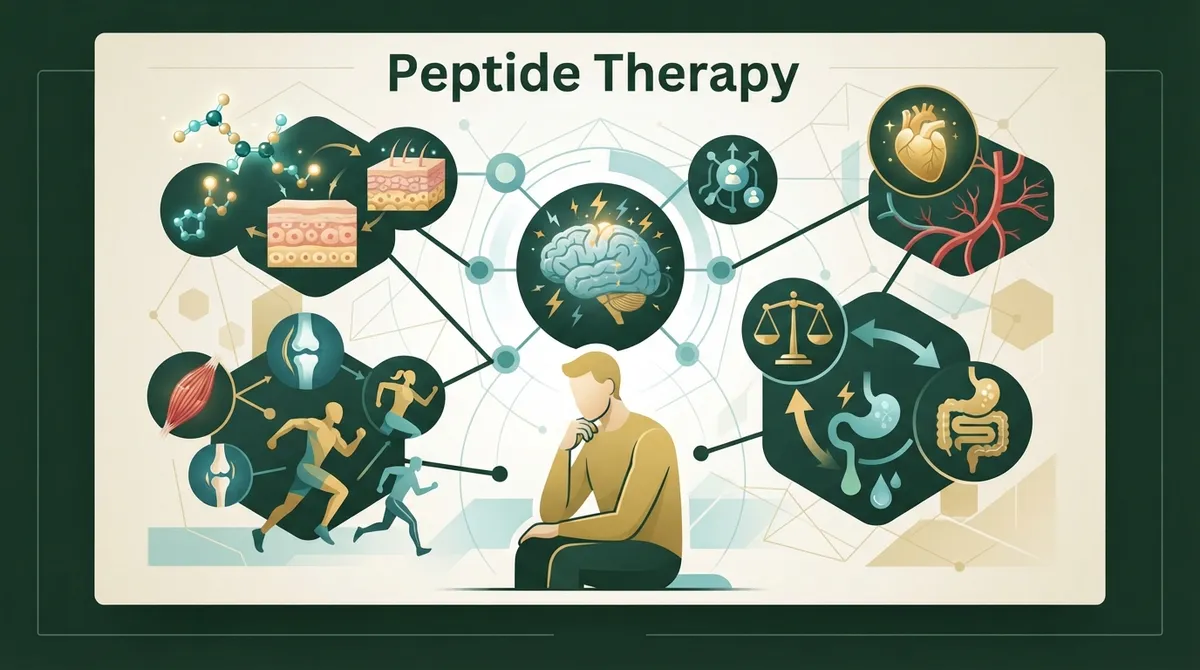
2. “Peptide Therapy” Is a Broad Term, Not One Treatment
Here is something many beginners miss. Peptide therapy is not a single, standardized treatment. It is a wide umbrella term. Under it, you will find proven prescription medicines and also unapproved products sold for wellness or performance.
That is why one person’s experience can look totally different from another’s. Two people can both say they are “on peptides” and be taking very different things, for very different reasons.
So when someone asks, “Does peptide therapy work?” the honest answer is: it depends on which peptide, for which purpose, and at what dose. Evidence is product-specific. That single idea will save you a lot of confusion.
3. Approved Peptide Medicines Are Different From Wellness Peptides
This is the most important line to understand. Some peptide medicines are FDA-approved. They have defined uses, dosing, and safety information backed by clinical review.
Other peptides are promoted for recovery, anti-aging, or performance, but they lack strong human efficacy and safety data. Marketing can sound confident even when the science is thin.
Research backs up how big this field is. A 2025 review reported that more than 80 peptide drugs had been approved worldwide as of 2023, with over 200 more in clinical development. Counts vary depending on how “peptide drug” is defined. The takeaway: real peptide medicine exists, but it is not the same as every product you see online.
| Category | What It Means | Evidence Level |
|---|---|---|
| FDA-approved peptide medicines | Reviewed for a specific use, dose, and safety | Strong, product-specific |
| Compounded peptides | Made for an individual patient; no FDA premarket review | Varies widely |
| “Research use only” peptides | Not approved for human use | Limited or none in humans |
4. GLP-1 Medicines Are the Best-Known Peptide Examples
If you want a real-world example of peptide medicine, look at GLP-1 therapies. Semaglutide and tirzepatide are peptide-based medicines approved for certain diabetes and weight-management uses.
They work by mimicking natural gut hormones that help regulate appetite and blood sugar. That is why so many people are talking about them. If this interests you, try How to Understand GLP-1 Peptide Therapy in 2026 and How to Lose Weight With Peptide Therapy in 2026.
One important note, though. Approval is specific to a product and a use. A medicine being approved does not prove that other peptides, or other versions, work the same way. Keep that in your back pocket.
5. Compounded Does Not Mean FDA-Approved
You will often hear the word “compounded.” Let’s make it clear. Compounded drugs are made by a pharmacy for an individual patient. They are not FDA-approved, and they do not go through FDA premarket review for safety, effectiveness, or quality.
Compounding can be appropriate in certain cases when legal requirements are met and an approved drug cannot meet a patient’s medical need. It is a legitimate part of medicine when done properly. But it is a different thing than an approved medicine, and you should know which one you are getting.
Want to dig in further? Check out FDA-Approved vs. Compounded Peptides: What Wins? and 503A vs. 503B: Which Peptide Compounding Wins?.
6. Safety Starts With Understanding the Risks
Let’s be honest and kind about this part. Peptides are not risk-free, and injectables deserve respect. The FDA has raised concerns about certain compounded peptides, including impurities, clumping (called aggregation), and poor characterization.
Injected peptides can also trigger the immune system. FDA materials on peptide immunogenicity (2024) note that severe reactions, including anaphylaxis, are possible. That does not mean peptides are scary. It means quality, sourcing, and medical oversight really matter.
- Impurities or contaminants in poorly made products
- Immune reactions, from mild rashes to rare severe responses
- Unknown long-term effects for many wellness peptides
- Drug interactions and conditions that make a peptide a poor fit
For a closer look, read Is Peptide Therapy Safe? What You Really Need to Know.
7. Popular “Regenerative” Peptides Often Lack Human Data
Names like BPC-157 and TB-500 pop up constantly in wellness circles. They are marketed for healing, recovery, and tissue repair. They sound exciting.
Here is the grounded truth. For many of these peptides, human evidence, established dosing, and long-term safety data are limited or missing. Products sold as “research use only” are not approved medicines for people.
That does not mean you should never be curious. It means you should treat bold claims with a healthy dose of skepticism and talk with a licensed clinician first. Learn more in Is BPC-157 Safe? What the Research Really Shows and What Are Regenerative Medicine Peptides, and Do They Work?.
8. Labs and a Licensed Provider Make a Real Difference
Here is where personalized care shines. Good peptide care does not start with a trend. It starts with you: your symptoms, your history, your goals, and your blood work.
Labs help a provider see what is actually going on inside your body. Then they can decide whether a peptide is even a good idea, and if so, which one. That is the opposite of guessing.
- Share your health history and goals honestly.
- Complete blood work so your provider has real data.
- Review options, risks, and alternatives together.
- Start a plan with clear dosing and follow-up.
- Recheck and adjust over time.
If you like a step-by-step view, see How to Start Peptide Therapy Safely and See Real Results.
9. Know How to Spot a Legitimate Peptide Source
With so many sellers online, how do you tell who is trustworthy? A few simple checks go a long way.
| Green Flag | Red Flag |
|---|---|
| Licensed clinician reviews your history | No medical questions asked |
| Lab work is part of the process | Skips labs entirely |
| Clear about approved vs. compounded | Vague about what is in the vial |
| Honest about limits of the evidence | Promises of miracle results |
| Ongoing monitoring and follow-up | “Research use only” products sold for self-injection |
A trustworthy provider will welcome your questions. If you are comparing options, you may like How to Get Prescription Peptides Safely in 2026 and 15 Peptide Consultation Questions to Ask in 2026. For broader background, the National Library of Medicine hosts research on peptide therapeutics.
10. Telehealth Can Make Peptide Care Simple and Personal
Life is busy. Driving to a clinic, sitting in a waiting room, and rescheduling around meetings is a lot. That is where telehealth comes in.
With a telehealth model, you can talk to a licensed provider from home, complete lab work locally, and have your plan delivered right to your door. For busy professionals and anyone who values convenience, that is a big win. We break down the pros and cons in Local Clinic vs. Telehealth: Best Peptide Therapy Near You?.
Allura Longevity offers exactly this kind of personalized, medically supervised care. Clients start with a $50 virtual consultation, complete blood work through LabCorp, and receive a customized six-month plan delivered at home. Licensed providers, led by Ashley, a board-certified Family Nurse Practitioner, monitor progress and adjust your plan along the way.
Quick Cheat Sheet: Peptide Therapy Basics at a Glance
- Peptides are short amino acid chains that act as signals in your body.
- “Peptide therapy” is a broad label, not one treatment.
- Approved medicines and wellness peptides are very different things.
- Compounded does not mean FDA-approved.
- Risks are real, especially with low-quality or unverified sources.
- Many trending peptides lack solid human data.
- Labs and a licensed provider make care safer and more personal.
Who Might Be a Good Fit?
Peptide therapy conversations tend to resonate with a few groups. Health optimizers want better energy, sleep, and recovery. Aging adults hope to keep vitality strong. Biohackers love tracking data. Busy professionals want convenient care, and wellness seekers want to go a step beyond supplements.
Any of those sound like you? Then the next best step is a real conversation with a clinician who can look at your labs and goals. Not sure you qualify? Read Who Is a Candidate for Peptide Therapy in 2026?. Women can explore peptides for women, and men can explore peptides for men.
Ready to Take the Next Step?
Learning the basics is a wonderful first move, and you just did it. You now know that peptide therapy is broad, that evidence is product-specific, and that safety comes from quality sourcing and medical guidance.
Allura Longevity is a telehealth option built around personalized plans and licensed providers, available in Florida, Georgia, Texas, Connecticut, Indiana, Maryland, New York, and California. New client spots are limited each month, so do not wait too long. Request a consultation today, or call (813) 510-6277 to chat with the team. Your future self will thank you.
FAQs
Q: What is peptide therapy, and how does it work?
A: Peptide therapy is a broad term for treatments that use peptides, which are short chains of amino acids that act as signals in your body. Some are approved prescription medicines, while others are marketed for wellness without strong human evidence. How it works depends on the specific peptide and its purpose, so always check with a licensed clinician.
Q: Are peptide injections safe?
A: Safety depends on the product, the quality, and the medical oversight behind it. Injectable peptides can cause immune reactions, and poorly made products may contain impurities, so sourcing really matters. A licensed provider can review your health history and help you weigh the risks.
Q: What is the difference between an FDA-approved peptide and a compounded one?
A: FDA-approved peptide medicines are reviewed for a specific use, dose, and safety profile. Compounded peptides are made by a pharmacy for an individual patient and do not go through FDA premarket review. Both can have a place in medicine, but they are not the same thing, so ask your provider which one you are getting.
Q: Are BPC-157 and TB-500 proven to work?
A: For many wellness peptides like these, human studies, established dosing, and long-term safety data are limited. Products labeled “research use only” are not approved medicines for people. It is wise to stay curious but cautious and talk with a licensed clinician before trying anything.
Q: How do I know if a peptide provider is legitimate?
A: Look for a licensed clinician, lab work as part of the process, and clear honesty about what is approved versus compounded. A good provider also offers ongoing monitoring and welcomes your questions. Be wary of anyone who skips medical review or promises miracle results.





