

Key Takeaways
-
"Physician guided" is a marketing phrase, not a medical standard; it does not guarantee a product is FDA-approved, proven, or safe. Ask for specifics instead.
-
A responsible provider should name the exact drug, the diagnosis or treatment goal, and how progress will be tracked. Vague "optimization" promises are a red flag.
-
Peptides fall into different regulatory categories: FDA-approved, compounded (no premarket review), and research-use-only (not for human use). Approval for one use does not prove benefit for others.
-
CJC-1295 and ipamorelin are not FDA-approved to treat any condition, and robust clinical evidence for general aging or low-energy claims is lacking.
-
A proper evaluation includes medical history, medication review, exam, baseline blood work, informed consent, and follow-up monitoring, not just a quick online checkout.
-
Before starting, verify the pharmacy's licensing and ask about regulatory status, human evidence, alternatives, and monitoring plans; be wary of guaranteed results or pressure to buy quickly.
If you have typed “looking for physician guided hormone peptides” into a search bar, you are in good company. More people than ever are curious about peptides for energy, sleep, recovery, and healthy aging. And you are smart to ask for a doctor’s help instead of ordering something random online.
But here is a little secret: “physician guided” is a marketing phrase, not a medical standard. It does not promise a product is FDA-approved, proven, or even safe. It simply suggests a clinician is involved. The details behind that word are what matter.
In this friendly guide, we will walk through what physician guided hormone peptides actually are, what the evidence says in 2026, and how to spot a trustworthy program. Whether you are a data-driven biohacker, a busy professional, or someone who just wants to feel like yourself again, you will leave knowing exactly which questions to ask. Let’s dig in.

What Does “Physician Guided Hormone Peptides” Actually Mean?
Peptides are short chains of amino acids, the building blocks of proteins. Your body makes many of them naturally, and several act as chemical messengers. If you want a quick refresher, our guide 8 Facts That Explain What Are Peptides in 2026 covers the basics, and WebMD has a helpful overview of what are peptides.
“Hormone peptides” usually means peptides meant to influence hormone signaling. Most often, that points to the growth hormone axis. The phrase covers a wide range of very different products, and that is where people get tripped up.
A responsible program should start with a specific diagnosis and a clear treatment goal. It should name the exact drug, the reason for using it, and how progress will be tracked. If a provider cannot do that, the “physician guided” label is just decoration.
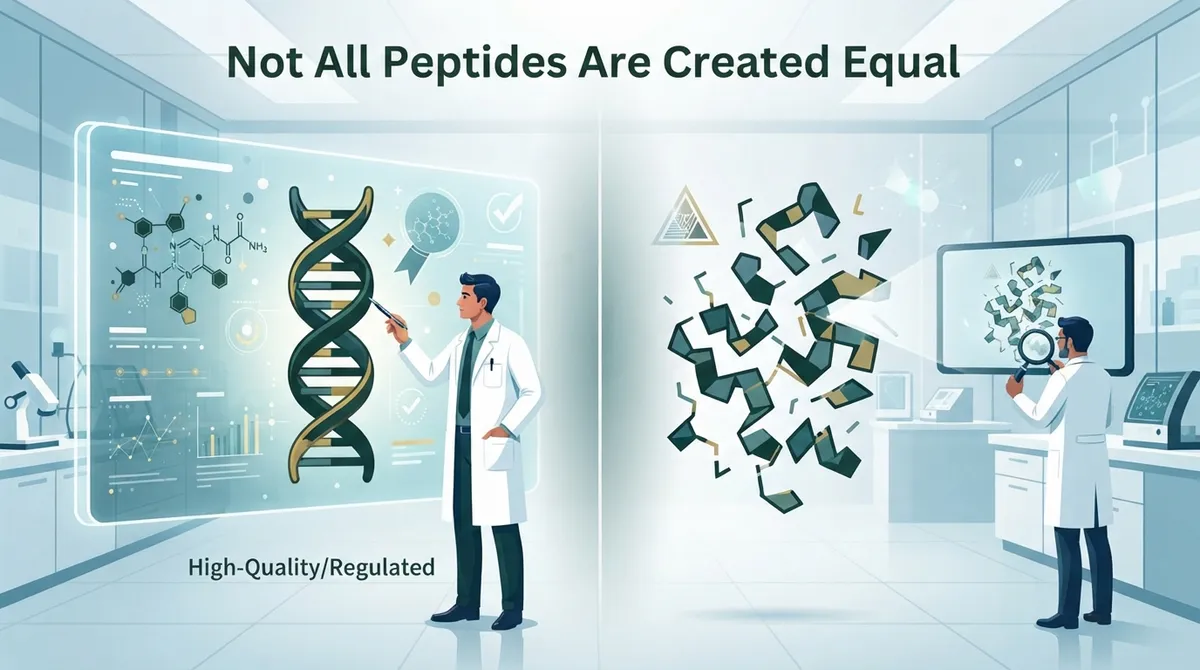
Not All Peptides Are Created Equal
Here is the most important idea in this whole article: peptides fall into very different regulatory buckets. Approval for one use does not prove benefit for unrelated wellness, anti-aging, weight-loss, or recovery claims.
| Category | What It Means | Key Point to Remember |
|---|---|---|
| FDA-approved peptide medicines | Reviewed for safety and effectiveness for specific conditions and doses | Approval applies only to the studied use |
| Compounded peptides | Prepared by a pharmacy for an individual patient under legal rules | Not FDA-approved and no premarket review of safety, effectiveness, or quality |
| Research-use-only peptides | Sold for lab purposes, not for people | Not intended for human use at all |
Knowing which bucket a product sits in is step one. For a deeper comparison, see FDA-Approved vs. Compounded Peptides: What Wins?
Growth Hormone vs. Growth Hormone-Releasing Peptides
These two are often lumped together, but they are not interchangeable. Prescription growth hormone is used for defined, diagnosed medical indications. Growth-hormone-releasing peptides, such as CJC-1295 and ipamorelin, work differently. They signal the body to release its own growth hormone.
Here is the honest part. Claims that these peptides safely treat general aging or low energy are not backed by robust clinical evidence. They are not FDA-approved to treat any condition. That does not mean a conversation with a qualified clinician is pointless. It means you deserve straight talk about what is known and what is not.
If you want to learn how this class works, our explainer Growth Hormone Peptides: What They Are & How They Work goes step by step. You can also read about Ipamorelin Peptide Therapy: Benefits, Dosing & Safety.
What the Evidence Really Says in 2026
The peptide world is moving fast, and 2026 has been a big year for regulation. Let’s look at what recent reporting tells us.
- Limited human data: FDA staff briefing materials for a 2026 Pharmacy Compounding Advisory Committee review reportedly found little or no controlled human evidence for several nominated peptides. For four of seven substances, no known clinical studies assessed safety by any route.
- Advisory, not approval: News reports say the committee voted in July 2026 to recommend six of seven peptides for possible inclusion on the 503A bulk drug substances list, while FDA staff scientists recommended against inclusion. That vote is advisory. It is not FDA approval or a finding of safety and effectiveness.
- Immune concerns: FDA reviewers raised concerns about immunogenicity for six of seven peptides considered. Reactions can range from a drug simply not working to a severe allergic response.
- Mostly early research: A 2026 review reported that about 67% of peptide publications it assessed were preclinical, meaning lab or animal studies rather than human trials. This is a secondary-source figure, so treat it as a rough guide.
The takeaway? Excitement is high, but human evidence for many wellness peptides is still thin. A trustworthy provider will say so out loud. The National Library of Medicine hosts peer-reviewed research on peptide therapeutics if you like reading the science yourself.
The Real Risks of Compounded Peptide Injections
Compounding is not automatically bad. It can be appropriate for an individual patient when legal requirements are met and an FDA-approved medicine cannot meet a medical need. But compounded drugs skip FDA premarket review, so quality and consistency depend heavily on the pharmacy.
FDA has flagged several concerns about certain bulk substances used in compounded peptides:
- Possible immune reactions (immunogenicity)
- Impurities or poorly characterized ingredients
- Limited human safety data
- Contamination or dosing errors with injectables
This is why sourcing matters so much. To understand how pharmacies are classified, check out 503A vs. 503B: Which Peptide Compounding Wins? And if you are weighing safety overall, Is Peptide Therapy Safe? What You Really Need to Know is a great next read.
What a Good Medical Evaluation Looks Like
A real physician-guided process is not a quick checkout form. It should feel like medicine. Here is what a responsible evaluation generally includes:
- Medical history: Your symptoms, goals, past conditions, and family history.
- Medication and supplement review: To catch interactions or reasons to avoid certain products.
- Exam and appropriate lab testing: Blood work gives a baseline instead of guesswork.
- Clear diagnosis or goal: A defined reason for any therapy, not a vague “optimization” promise.
- Informed consent: You understand the regulatory status, evidence, and risks.
- Follow-up monitoring: Check-ins to assess response and watch for side effects.
Labs are the backbone of this process. If you are a biohacker who loves numbers, you will appreciate Lab Work for Peptide Therapy: What to Test and Why. And our 15 Peptide Consultation Questions to Ask in 2026 can go in your pocket for your first visit.
Questions to Ask Before You Start
Do not rely on the phrase “physician guided.” Ask for specifics. A confident, ethical provider will welcome these questions.
| Question | What a Good Answer Sounds Like |
|---|---|
| What exact drug and indication are you recommending? | A named product tied to a documented reason |
| What is its regulatory status? | Clear explanation: approved, compounded, or neither |
| What is the evidence in humans? | Honest discussion, including limits and unknowns |
| Which pharmacy supplies it? | A licensed pharmacy you can verify |
| How will you monitor me? | Scheduled labs and follow-ups |
| What are the alternatives? | Lifestyle, approved medicines, or other options |
Red flags include guaranteed results, no lab work, pressure to buy right now, or vague answers about where the product comes from. For more on spotting safe providers, read How to Find Legal Peptide Therapy You Can Trust and How to Get Prescription Peptides Safely in 2026.
Why Telehealth Can Work Well (When Done Right)
If you are a busy professional, telehealth can be a real gift. You skip the waiting room, complete labs at a local lab, and meet with a licensed provider from your couch. The key is that convenience should never replace medical rigor.
Good telehealth care still includes a real evaluation, real blood work, a named plan, and real follow-up. If you are curious how the two models compare, see Local Clinic vs. Telehealth: Best Peptide Therapy Near You?
At Allura Longevity, care begins with a $50 virtual consultation. You complete blood work through LabCorp, and licensed providers, led by Ashley, a board-certified Family Nurse Practitioner, design a customized six-month plan based on your labs and goals. Treatments are delivered to your home, with ongoing monitoring and adjustments. Telehealth care is available in Florida, Georgia, Texas, Connecticut, Indiana, Maryland, New York, and California. You can read more about peptides for women or explore peptides for men to see how personalization works.
Matching Your Goals to the Right Conversation
Different readers come to this topic with different goals. Here is how to think about it:
- Health optimizers and wellness seekers: Start with sleep, nutrition, and movement basics, then discuss whether peptides add anything for you.
- Aging adults: Ask whether bioidentical hormones, approved medicines, or peptides best fit your labs. See How to Choose Between Bioidentical Hormones and Peptides.
- Biohackers: Insist on baseline labs, a tracking plan, and a clear stop rule if a protocol is not helping.
- Busy professionals: Look for streamlined telehealth with real clinical oversight, not just fast shipping.
Remember, hormone care and peptide care are not the same thing. If you are comparing paths, Hormone Therapy vs. Peptide Therapy: Which Wins? can help you sort it out.
Setting Realistic Expectations
No reliable statistic proves that “hormone peptide therapy” as a whole category works or is safe. Evidence differs by drug, condition, formulation, and dose. That is why a personalized plan beats a one-size-fits-all bundle every time.
Results, when they happen, also take time. For a realistic picture, read How Long for Peptide Therapy Results? A Real Timeline. Patience and good tracking are your best friends here.
Final Thoughts: Look Past the Label
Searching for physician guided hormone peptides is a healthy first step. It shows you care about doing this the right way. The next step is looking past the label and asking for specifics: the exact drug, the diagnosis, the evidence, the pharmacy, and the monitoring plan.
Choose a provider who explains the limits as clearly as the potential. That honesty is the best sign of quality care. If you want a personalized, lab-based approach with licensed providers guiding every step, we would love to hear from you. Request a consultation with Allura Longevity today. Spots for new clients are limited each month, and you can also call (813) 510-6277 with any questions. Your future self will thank you for asking the smart questions now.
FAQs
Q: What does physician guided hormone peptide therapy mean?
A: It is a broad marketing phrase, not a standardized medical treatment. It should mean a licensed clinician evaluates you, names a specific drug and goal, and monitors your progress, but it does not guarantee a product is FDA-approved, effective, or safe.
Q: Are CJC-1295 or ipamorelin FDA-approved for low growth hormone or anti-aging?
A: No. CJC-1295 and ipamorelin are not FDA-approved to treat any condition, and robust clinical evidence for general aging or low-energy claims is lacking. A good provider will be upfront about that and discuss it with you.
Q: How can I tell whether a peptide clinic and its pharmacy are legitimate?
A: Look for licensed providers, required lab work, and a named, verifiable pharmacy. Ask about the exact drug, its regulatory status, the evidence, and the monitoring plan, and be cautious of guaranteed results or pressure to buy fast.
Q: What tests should happen before starting peptide treatment?
A: A responsible evaluation includes a medical history, medication review, an exam, and appropriate blood work. Follow-up visits should then check how you are responding and watch for side effects.
Q: How are FDA-approved peptides different from compounded or research peptides?
A: FDA-approved peptides are reviewed for safety and effectiveness for specific uses. Compounded peptides skip that premarket review, and research-use-only peptides are not intended for human use at all.





