

Key Takeaways
-
"Lean body peptide therapy" is a marketing phrase, not a formal treatment; it usually means prescription semaglutide or tirzepatide, or other peptides promoted for fat loss with weaker evidence.
-
Weight loss from semaglutide and tirzepatide can include lean muscle, not just fat, and the major trials did not prove these medicines build or protect muscle.
-
Protect lean mass by eating enough protein, doing regular resistance training, avoiding very low calorie intake, sleeping well, and tracking strength and labs, not just the scale.
-
Ask whether a product is FDA-approved or compounded: compounded versions are not reviewed by the FDA for safety, effectiveness, or quality before marketing.
If you’ve been searching for “lean body peptide therapy,” you’re not alone. Lots of people want to drop stubborn weight, keep their muscle, and feel strong and energized in 2026. It’s a great goal, and you deserve clear answers.
Here’s the honest truth up front: “lean body peptide therapy” is a marketing phrase, not a formal medical treatment. In real life, it usually points to one of two things. The first is prescription weight-management medicines like semaglutide and tirzepatide. The second is a mix of other peptides that clinics promote for fat loss or body composition.
In this friendly guide, we’ll compare the two best-studied options, semaglutide and tirzepatide. We’ll look at what the research shows, what it doesn’t show about muscle, and how to protect your lean mass along the way. Whether you’re a busy professional, a data-loving biohacker, or simply someone who wants to feel great as you age, you’ll leave with a clear plan.
What Does Lean Body Peptide Therapy Actually Mean?
Let’s clear up the confusion first. There is no single FDA-approved therapy called “lean body peptide therapy.” The phrase is used loosely. Some clinics use it to describe weight-loss injections. Others use it for peptides that are said to help burn fat or build muscle.
Not all of these options have the same level of proof. The strongest evidence we have is for two FDA-approved incretin medicines used for chronic weight management in eligible adults. They work best alongside healthy eating and regular movement.
If you’re new to the topic, our guide on what peptides are in 2026 is a helpful starting point. You can also read a plain-language overview from WebMD on what are peptides.
Two Main Meanings You’ll See
- Approved weight-management medicines: Semaglutide and tirzepatide, which have large clinical trials behind them.
- Other promoted peptides: Growth-hormone-releasing peptides and similar products marketed for body composition, often without strong weight-loss proof.
Knowing which bucket a product falls into is the smartest first step you can take.
How Semaglutide and Tirzepatide Work
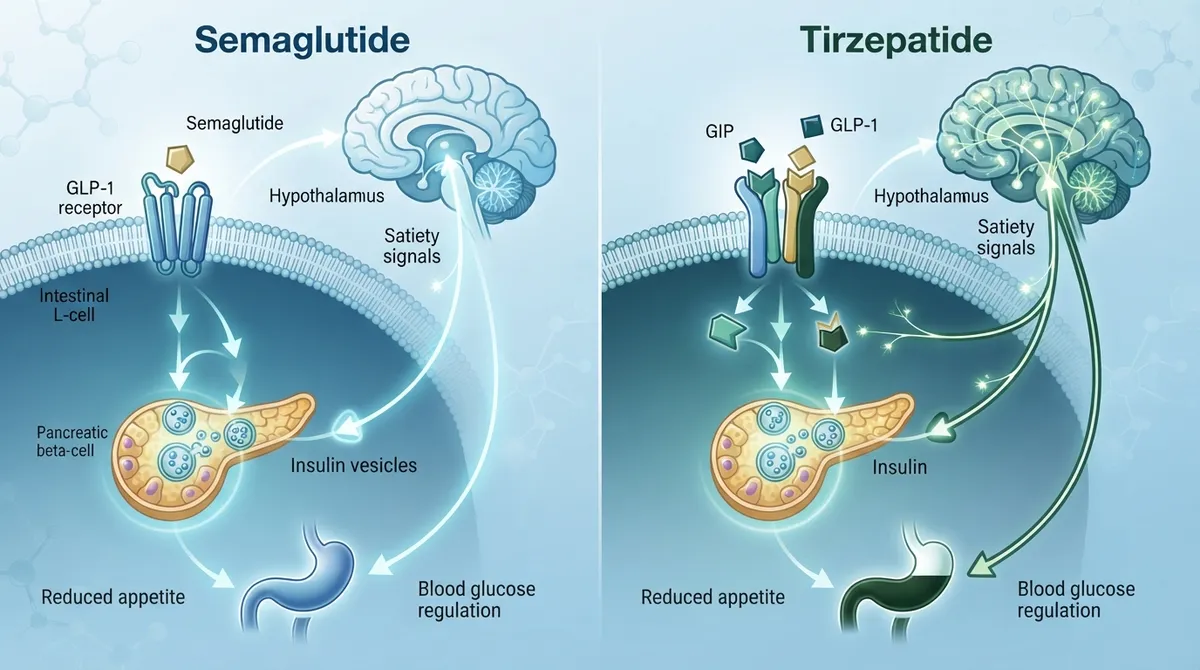
Both medicines are peptide-based. They mimic natural gut hormones that help control appetite and blood sugar. In simple terms, they help you feel full sooner and stay full longer.
Semaglutide is a GLP-1 receptor agonist. Tirzepatide activates two receptors: GIP and GLP-1. That dual action is why people often compare the two so closely.
If you’d like a deeper dive, check out how to understand GLP-1 peptide therapy in 2026. And for a broader look at the whole category, see GLP-1 vs. dual-agonist peptides.
Semaglutide vs. Tirzepatide: What the Trials Show
Let’s look at the numbers from two major studies. Remember, results vary from person to person based on dose, adherence, and lifestyle.
| Feature | Semaglutide (2.4 mg weekly) | Tirzepatide (5, 10, 15 mg weekly) |
|---|---|---|
| How it works | GLP-1 receptor agonist | Dual GIP and GLP-1 agonist |
| Key trial | STEP 1 (68 weeks) | SURMOUNT-1 (72 weeks) |
| Average weight change | -14.9% (vs. -2.4% placebo) | -15.0%, -19.5%, -20.9% (vs. -3.1% placebo) |
| Lost at least 5% of weight | 86.4% (vs. 31.5% placebo) | 85%, 89%, 91% (vs. 35% placebo) |
On average, tirzepatide showed larger weight changes at higher doses in its trial. But these were two separate studies with different designs, so it’s not a perfect head-to-head comparison. The “better” choice depends on your health history, goals, and how your body responds.
Curious about this exact matchup? We break it down further in GLP-1 semaglutide vs. tirzepatide: which loses more? You can also see how tirzepatide works in how tirzepatide therapy really works.
The Big Question: What Happens to Your Muscle?
Here’s where “lean body” really matters. Weight loss is not the same as selective fat loss. When you lose weight with these medicines, some of it can come from lean mass, not only fat.
The major weight-loss trials above were designed to measure total weight change. They do not prove that these medicines build muscle or protect it. That’s an important point, and a lot of marketing skips over it.
The good news? You have real control here. A smart plan can help you hold on to strength while the scale moves.
Simple Habits That Support Lean Mass
- Eat enough protein. Ask your clinician about the right daily target for your body and health.
- Lift weights or do resistance training. Aim for a few sessions each week, built up gradually.
- Don’t under-eat. Very low calories can make muscle loss more likely.
- Get good sleep. Recovery is when your body repairs and rebuilds.
- Track your progress. Look at strength, measurements, and labs, not only the scale.
For more on this topic, explore 12 body composition facts peptide users need in 2026 and 7 muscle loss recovery facts that actually matter.
What About Other Peptides for a Lean Body?
You’ve probably seen other peptides promoted for fat loss or muscle gain. These often include growth-hormone-releasing peptides and similar products. It’s natural to feel curious, especially if you’re a biohacker who loves testing new tools.
Here’s the careful take. These products should not be presented as proven or FDA-approved weight-loss treatments unless there’s evidence for that specific product and use. Always check the regulatory status and the research, not just the clinic’s sales page.
If you want to explore these topics with a clear eye, try 13 peptides for fat loss that really work in 2026, peptides for muscle building: what really works in 2026, and how GHRP peptides really work in your body.
Approved vs. Compounded: Why It Matters
This is one of the most important parts of the whole conversation. FDA-approved products go through agency review for safety, effectiveness, and quality. Compounded versions do not get that same review before they’re marketed.
Compounding can be appropriate when a patient has a specific medical need. But it isn’t a general substitute for an approved product. The FDA has also raised concerns about dosing errors and has received adverse-event reports. As of May 31, 2026, the agency reported 990 reports tied to compounded semaglutide and more than 730 tied to compounded tirzepatide. Those are reports, not proof of cause or rates, and the numbers change over time, so always check the latest FDA page.
| Question | FDA-Approved Product | Compounded Product |
|---|---|---|
| Reviewed by FDA for safety and effectiveness? | Yes | No |
| Reviewed for quality before marketing? | Yes | No |
| Best used for | Eligible patients per label | Specific, patient-based medical needs |
| Key concern | Side effects and fit | Dosing errors and quality questions |
To learn more, read FDA-approved vs. compounded peptides and how to evaluate compounded GLP-1 medication safely. The National Library of Medicine also hosts helpful research, such as this peer-reviewed article on peptide therapeutics.
Side Effects and Safety: What to Expect
Like any medicine, these come with trade-offs. The most common side effects are stomach-related. They often show up as your body adjusts.
- Nausea
- Vomiting
- Diarrhea
- Constipation
- Abdominal pain
Each product also has its own warnings, contraindications, and precautions. That’s why a licensed clinician should review your history before you start. Many people find that small habit changes ease symptoms. Learn more in what causes GLP-1 side effects and how to manage them and why GLP-1 therapy causes constipation.
How to Choose Your Path: A Simple Checklist
So, which one is right for you? There’s no one-size-fits-all answer. Here’s a friendly way to think it through.
- Get your baseline. Blood work gives you real data on metabolic health and hormones.
- Define your goal. Is it fat loss, keeping muscle, energy, or all three?
- Talk to a licensed provider. They’ll check if you’re a fit for an approved medicine.
- Ask about the product. Is it FDA-approved or compounded? Why?
- Plan for muscle. Build in protein, strength training, and follow-ups.
- Reassess often. Doses and plans should change as you progress.
If you’d like a roadmap, try how to lose weight with peptide therapy in 2026 and how to start peptide therapy safely.
Why Personalization Makes the Difference
Two people can take the same medicine and get very different results. Age, hormones, sleep, stress, and training all play a part. That’s why a customized plan beats a generic one every time.
At Allura Longevity, our licensed telehealth providers build treatment plans around your blood work and your goals. Care is led by Ashley, a board-certified Family Nurse Practitioner. You start with a $50 virtual consultation, complete lab work through LabCorp, and receive a customized six-month plan delivered to your home. Your team keeps monitoring and adjusting along the way.
We serve clients in Florida, Georgia, Texas, Connecticut, Indiana, Maryland, New York, and California. Whether you’re looking for peptides for women or peptides for men, you’ll get support from real clinicians who care about your progress. Want to compare options first? See local clinic vs. telehealth.
Final Thoughts: Aim for Lean, Strong, and Healthy
“Lean body peptide therapy” isn’t a magic formula. But with the right guidance, approved medicines like semaglutide and tirzepatide can be powerful tools for eligible adults. Pair them with protein, strength training, and smart monitoring, and you give yourself the best shot at a stronger, leaner you.
Remember to ask the tough questions about product type, safety, and muscle protection. A trustworthy provider will welcome them. You’ve got this, and you don’t have to figure it out alone.
Ready to see what a personalized plan could look like for you? Request a consultation with Allura Longevity today. Spots for new clients are limited each month, so reach out soon, or call (813) 510-6277.
FAQs
Q: What does lean body peptide therapy mean?
A: It’s a marketing phrase, not a formal medical treatment. It usually refers to prescription weight-management medicines like semaglutide or tirzepatide, or to other peptides promoted for fat loss or body composition. Always ask which specific product is being used and what evidence supports it.
Q: Do weight-loss peptide medications reduce muscle as well as fat?
A: They can. Weight loss from these medicines may include lean mass, and the major trials don’t show that they selectively build or preserve muscle. Eating enough protein, lifting weights, and working with a clinician can help you protect your strength.
Q: Is semaglutide or tirzepatide better for weight management?
A: In their separate trials, tirzepatide showed larger average weight changes at higher doses (up to -20.9%) versus semaglutide (-14.9%). But the best choice depends on your health history, goals, and how you respond, so a licensed clinician should guide the decision.
Q: Are compounded semaglutide or tirzepatide injections FDA-approved?
A: No. The FDA says compounded versions aren’t reviewed for safety, effectiveness, or quality before marketing. Compounding can fit a specific patient need, but it isn’t a general swap for an approved product, so ask your provider why they recommend it.
Q: Can peptides build lean muscle or target belly fat?
A: The strongest weight-loss evidence is for semaglutide and tirzepatide, and those don’t target belly fat or build muscle on their own. Other peptides promoted for physique goals shouldn’t be treated as proven or approved for weight loss without product-specific evidence.





