
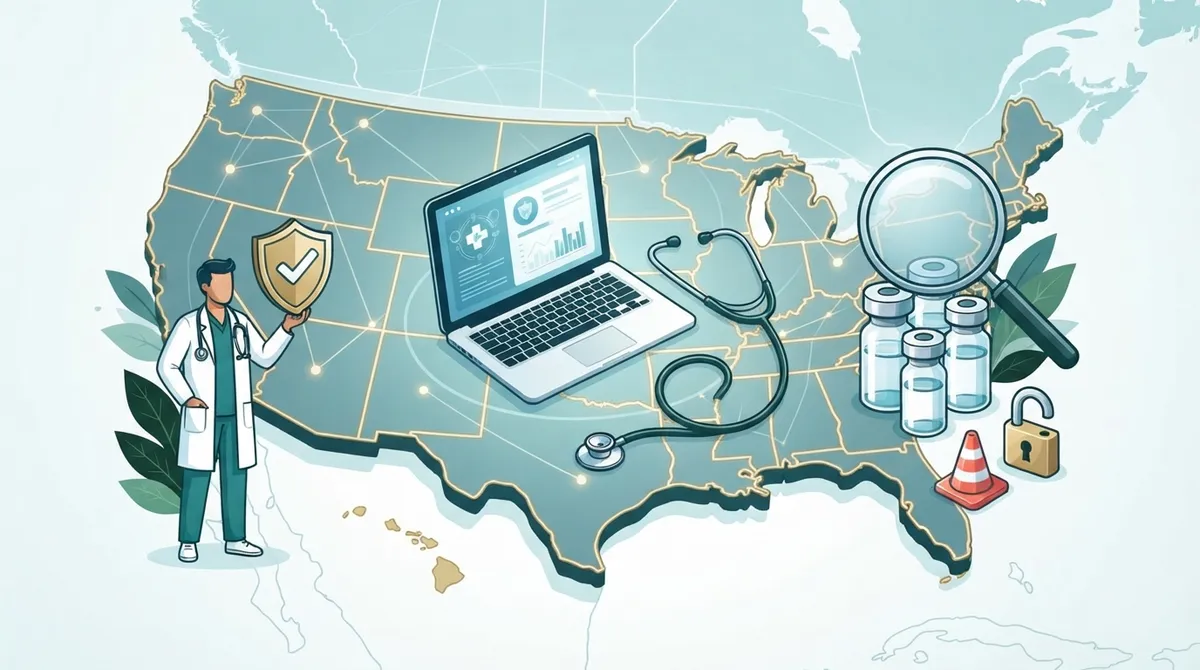
Key Takeaways
-
"Nationwide" does not mean no rules: clinicians generally must be licensed in the state where the patient lives, and prescribing and pharmacy rules vary by state, so ask which states providers are licensed in.
-
Telehealth is only a delivery method; it does not make a medication FDA-approved or prove it works, and FDA-approved peptides apply only to specific labeled uses.
-
Compounded peptides are not FDA-approved and are not reviewed for safety, effectiveness, or quality before sale, so ask whether each substance is currently allowed and which pharmacy makes it.
-
Check the FDA's current status for any substance before starting, since the agency has flagged safety concerns for some bulk peptides such as GHRP-2 and semax.
-
Avoid any product labeled "for research use only," guaranteed results, pressure to buy large bundles, or clinics that prescribe without named providers or lab work.
-
A quality clinic follows a clear process: virtual consultation, blood work, clinical review that includes unproven aspects, a personalized plan, pharmacy fulfillment, and ongoing monitoring.
Picture this: it’s a Tuesday night, you’re finally off your laptop, and you’re wondering if there’s a smarter way to feel more energized, sleep better, and bounce back faster. You’ve heard about peptides. Maybe a friend mentioned them, or a podcast did. Then you search online and find dozens of websites all promising the same thing. Which ones are real? Which ones are just good at marketing?
That’s exactly why a nationwide online peptide clinic deserves a closer look. These clinics use telehealth to connect you with licensed clinicians, review your health history and labs, and, when appropriate, coordinate treatment through a pharmacy. It’s care that fits into a busy life.
But here’s the friendly truth: not every online clinic is built the same way. “Nationwide” does not mean “no rules.” State licensing, prescribing laws, and FDA policies all still apply. In this guide, we’ll walk through how these clinics work, what to ask before you sign up, and how to spot the good ones. Let’s dive in!

What Is a Nationwide Online Peptide Clinic?
A nationwide online peptide clinic is a telehealth practice that evaluates patients remotely and, when it makes clinical sense, coordinates peptide-related treatment. You meet with a licensed provider by video or phone. Prescriptions, when appropriate, are filled by a pharmacy and shipped to your door.
Think of it as a doctor’s visit without the waiting room. You get the same kind of careful review, just from your couch.
If you’re brand new to the topic, our guide on 8 Facts That Explain What Are Peptides in 2026 is a great starting point. For a general overview, what are peptides is also explained clearly by WebMD.
Telehealth Is a Delivery Method, Not a Drug Approval
This point matters. Telehealth is simply a way to deliver care. It does not make a medication FDA-approved, and it does not prove a treatment works. A good clinic will say this out loud. A pushy one will skip right past it.

How “Nationwide” Really Works
Here’s where many people get tripped up. A clinic can serve patients in many states, but each clinician generally must be authorized to practice in the state where you are located. Prescribing and pharmacy rules also vary from state to state.
So when you see “nationwide,” it’s smart to ask: Is a provider licensed in my state?
Allura Longevity, for example, offers telehealth peptide therapy in Florida, Georgia, Texas, Connecticut, Indiana, Maryland, New York, and California. Being upfront about where licensed providers can practice is a good sign of a trustworthy clinic. If you want to learn more about this, see Which States Allow Telehealth Peptide Prescriptions?
| What You See | What It Should Mean | What to Ask |
|---|---|---|
| “Serving all 50 states” | Clinicians are licensed where patients live | Which states are you licensed in? |
| “Prescription delivered to your door” | A licensed pharmacy fills and ships your order | Which pharmacy will dispense my medication? |
| “Personalized plan” | Plan is based on your history and labs | What tests will you review before prescribing? |
| “Doctor-supervised” | A licensed clinician oversees care | Who exactly is my provider? |
FDA-Approved vs. Compounded Peptides
This is the biggest topic to understand before you start. Not all peptide medications are the same in the eyes of the FDA.
FDA-approved peptide medicines exist for specific uses. Semaglutide products, for example, are approved for certain diabetes or weight-management uses. Approval applies to the specific product, the specific use, and its labeling. It does not mean other peptides are approved or proven.
Compounded drugs are different. They are not FDA-approved. The FDA does not review them for safety, effectiveness, or quality before they are sold the way it reviews approved drugs. Compounding can be appropriate for an individual patient when legal conditions are met, but it is not a general substitute for an approved drug.
Want the deeper comparison? Check out FDA-Approved vs. Compounded Peptides: What Wins? and 503A vs. 503B: Which Peptide Compounding Wins?
| Feature | FDA-Approved Peptide Drug | Compounded Peptide |
|---|---|---|
| FDA premarket review | Yes, for the labeled use | No |
| Made for | General patient population | An individual patient when legal conditions are met |
| Evidence base | Clinical trials for specific indications | Varies widely by substance |
| Key question to ask | Is this my labeled use? | Is this substance currently allowed, and which pharmacy makes it? |
A Word About Safety Flags
The FDA has identified safety concerns for certain bulk peptide substances proposed for compounding. These concerns include impurities, aggregation, and possible immune reactions. The agency has specifically pointed to substances like GHRP-2 and semax. The FDA also notes that serious adverse event reports exist for some, while saying cause has not been established.
FDA lists and policies can change. That means both clinics and patients should check the current FDA page for any substance before starting. Also, just because a substance was discussed by an advisory committee or moved off a risk list does not mean it is FDA-approved. Only the FDA decides what may be used under the compounding rules.
One more tip: steer clear of anything labeled “for research use only.” Those products are not intended for human treatment.
What Happens at a Good Online Peptide Clinic?
A quality clinic follows a careful process. It should feel more like a medical visit and less like online shopping. Here is what a typical path looks like:
- Virtual consultation. You talk with a licensed provider about your goals, symptoms, medications, and medical history.
- Blood work. Labs help guide decisions. Many clinics use a national lab network so you can get tested close to home.
- Clinical review. The provider weighs your results, risks, and alternatives. They should explain the evidence honestly, including what is not yet proven.
- Personalized plan. If treatment makes sense, you get a plan matched to you, not a one-size-fits-all bundle.
- Pharmacy fulfillment. A pharmacy prepares and ships your medication, often right to your home.
- Ongoing monitoring. Follow-ups and lab checks help adjust the plan and catch side effects early.
For a closer look at that first step, read What Really Happens During a Peptide Telehealth Visit? and 5 Blood Work Analysis Steps Before Peptides in 2026.
Who Tends to Look Into Online Peptide Care?
Online peptide clinics appeal to a wide mix of people. See if you recognize yourself here:
- Busy professionals who want expert care without sitting in a waiting room.
- Health optimizers chasing better energy, sleep, and recovery.
- Biohackers who love labs, tracking, and data-driven adjustments.
- Aging adults who want to stay strong, sharp, and active.
- Wellness seekers already investing in supplements and prevention who want to go a step further.
Whatever your goal, the best results come from a plan built around you. It also helps to understand the full picture. Our article Who Is a Candidate for Peptide Therapy in 2026? breaks it down.
Common Goals People Bring to Telehealth Peptide Care
Clients often come in with a few key goals. A responsible provider will talk through what the evidence does and does not support for each one.
- Weight management: Some people ask about GLP-1 medications. See How to Understand GLP-1 Peptide Therapy in 2026.
- Injury and muscle recovery: Many ask about BPC-157. Read 9 BPC-157 Peptide Facts to Know Before You Start for a careful look.
- Energy and sleep: Explore How to Pick Peptides for Energy That Actually Work.
- Hormone support: Some people pair peptides with testosterone care. Learn more in TRT vs. Peptides: Which Hormone Fix Wins for Men?
Notice that a good clinic will never promise a specific outcome. Results vary from person to person, and honest providers say so.
How to Check If an Online Clinic Is Legit
Here’s your friendly cheat sheet. Before you hand over your card number, run through these questions.
- Who is my provider, and where are they licensed? You should be able to find a name and credentials.
- Is this medication FDA-approved or compounded? The answer should be clear and direct.
- Which pharmacy will dispense it? Look for a licensed pharmacy, not a mystery supplier.
- What evidence supports this use for me? A good provider shares both benefits and limits.
- What monitoring is planned? Expect labs and follow-ups.
- How are side effects handled? There should be a clear plan and easy contact.
- Is anything labeled “for research use only”? If yes, walk away.
For more on this topic, see How Do You Know Online Peptide Therapy Is Safe? and How to Get Prescription Peptides Safely in 2026. The National Library of Medicine also offers peer-reviewed research on peptide therapeutics if you like to dig into the science.
Red Flags to Watch For
Trust your gut. If something feels off, it probably is. Here are common warning signs:
- Guaranteed results or “miracle” language
- No named provider or no way to confirm a license
- No lab work or health review before prescribing
- Implying that online availability equals FDA approval
- Selling products labeled “for research use only”
- Pressure to buy large bundles right away
A little caution goes a long way. Your health is worth the extra five minutes of checking.
Online Care vs. Visiting a Local Clinic
Both options can work well. It often comes down to your schedule and comfort level.
| Factor | Online Clinic | Local In-Person Clinic |
|---|---|---|
| Convenience | Visits from home, medication shipped | Travel and office hours required |
| Access | Available where providers are licensed | Limited to your area |
| Hands-on exam | Limited, labs done separately | In-person exam possible |
| Scheduling | Often flexible | Depends on availability |
Not sure which fits you? Our comparison Local Clinic vs. Telehealth: Best Peptide Therapy Near You? can help you decide.
A Note on Controlled Substances
You might see headlines about telehealth prescribing rules. According to the HHS telehealth policy page, DEA and HHS flexibilities for prescribing controlled medications through telemedicine were extended through December 31, 2026. That only matters if a proposed medication is a controlled substance. It does not mean a peptide is approved or allowed for compounding. Always check the status of each specific medication.
Why People Choose Allura Longevity
If you want a clear, step-by-step experience, Allura Longevity was built for exactly that. Care starts with a $50 virtual consultation. Then you complete blood work through LabCorp. From there, you get a customized six-month plan, shipped to your home, with ongoing monitoring and adjustments by licensed providers.
The team is led by Ashley, a board-certified Family Nurse Practitioner. Services focus on energy, sleep, mental clarity, immune support, skin rejuvenation, muscle recovery, metabolism, sexual wellness, GLP-1 weight loss, BPC-157 for injury recovery, and testosterone replacement. You can explore options for peptides for women or peptides for men.
Every plan is built around your labs and goals, not a script. That personal touch is what many clients love most.
Ready to Take the Next Step?
A nationwide online peptide clinic can make expert care easier to reach, especially when life is packed. The key is choosing one that is honest about licensing, clear about FDA status, and serious about lab-based monitoring. Ask the tough questions. Expect real answers. You deserve nothing less.
If you’re in one of our licensed states and want a plan built around your own labs and goals, we’d love to meet you. Request a consultation today, or call (813) 510-6277. Spots for new clients are limited each month, so don’t wait too long to reserve yours.
FAQs
Q: What is a nationwide online peptide clinic?
A: It’s a telehealth practice where licensed clinicians evaluate you remotely and, when appropriate, coordinate peptide-related treatment filled by a pharmacy. Think of it as a regular medical visit that happens from home, with medication shipped to your door.
Q: Can an online peptide clinic prescribe in every state?
A: Not automatically. Clinicians generally must be authorized to practice in the state where you’re located, and prescribing and pharmacy rules vary by state. Always ask which states the clinic is licensed in before you book.
Q: Are peptide therapies FDA-approved?
A: Some are, for specific uses. For example, certain semaglutide products are approved for diabetes or weight management. Many other peptides, especially compounded ones, are not FDA-approved, so it’s smart to ask your provider about the status of each medication.
Q: What should I ask before starting peptide therapy through telehealth?
A: Ask who your provider is and where they’re licensed, whether the drug is FDA-approved or compounded, and which pharmacy will fill it. Also ask what evidence supports the use, what monitoring is planned, and how side effects are handled.
Q: How do I know if an online peptide clinic is legitimate?
A: Look for named, licensed providers, required lab work, clear answers about FDA status, and a licensed pharmacy. Be cautious of guaranteed results, pressure to buy bundles, or products labeled “for research use only.”





