
Key Takeaways
-
Oral hydrolyzed collagen peptides have the most human trial evidence, with a 2023 meta-analysis of 26 randomized trials showing improvements in skin hydration and elasticity.
-
Route matters: oral, topical, and injectable peptides have very different evidence bases, so always identify which route a product uses before judging its claims.
-
Topical peptide evidence is still preliminary, limited by few randomized trials and by the skin barrier restricting how much ingredient gets through.
-
Injectable peptides are not established as a proven treatment for rejuvenating healthy skin, and compounded products are not FDA-reviewed for safety, effectiveness, or quality.
-
Peptides are a complement, not a replacement: daily sunscreen and retinoids have stronger track records, and results typically take weeks to months to appear.
-
Judge any product by checking for a named ingredient, a stated route, human trial data matching your goal, and realistic outcome measures, and avoid research-use products.
You look in the mirror and notice it. Skin that feels a little drier, a little looser, and a little less bouncy than it used to. Then you scroll online and see bold promises about visible skin rejuvenation peptides that sound almost too good to be true. Sound familiar? You are not alone, and your curiosity is completely valid.
Here is the friendly truth: the word “peptides” covers a lot of ground. Some peptide products have decent human research behind them. Others have very little. The route matters too, because a cream, a powder you drink, and an injection are not the same thing at all.
This guide walks you through the evidence in plain language. You will learn which peptides have the best support, what results are realistic, how to judge a product, and how to talk to a licensed provider. No hype, no pressure, just clear steps so you can choose with confidence.

What Are Peptides, and Why Do They Matter for Skin?
Peptides are short chains of amino acids, the building blocks of proteins. If you want a deeper primer, our guide on 8 Facts That Explain What Are Peptides in 2026 covers the basics, and what are peptides is a helpful plain-language overview from WebMD.
Your skin is rich in collagen, elastin, and other proteins. As we age, collagen breaks down faster than the body rebuilds it. That is one reason skin can lose firmness and hydration over time. The idea behind visible skin rejuvenation peptides is to support those structures in some way.
But here is the key point. “Peptides” is a broad label. What a peptide does depends on the exact peptide, the dose, the form, and how it gets into your body. Results from one type should never be assumed for another.
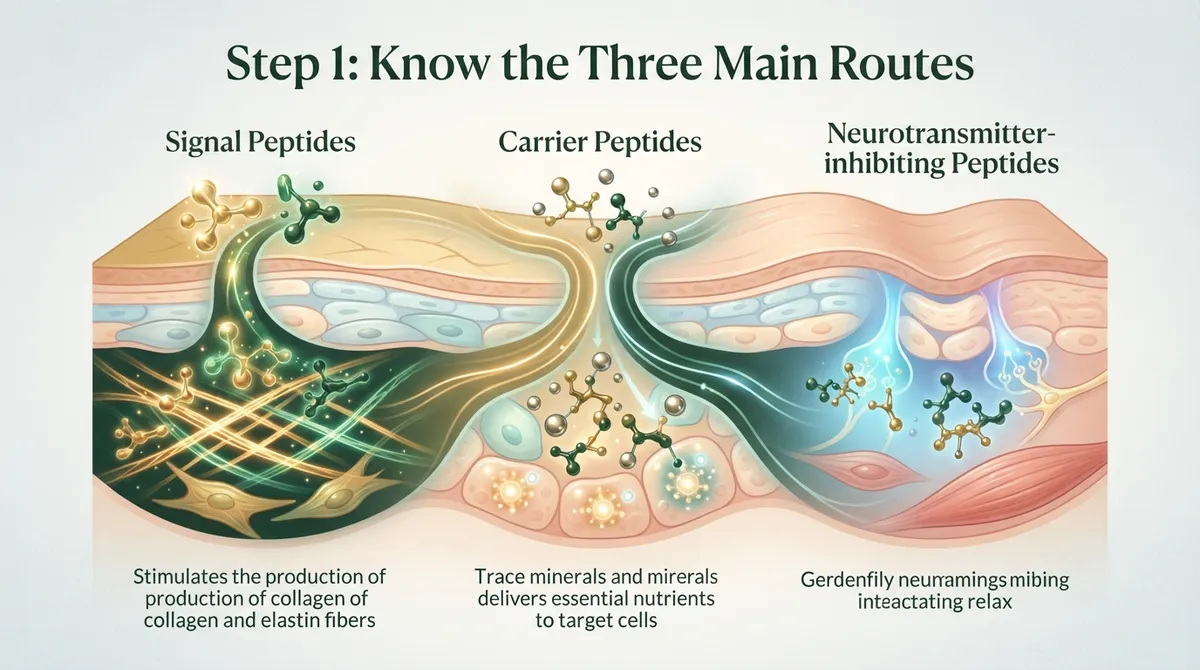
Step 1: Know the Three Main Routes
Before you buy or start anything, figure out which route you are dealing with. The evidence is very different for each one.
| Route | Common Example | Strength of Human Evidence | Main Limitation |
|---|---|---|---|
| Oral | Hydrolyzed collagen peptides | Most developed of the three | Study methods and products vary |
| Topical | Peptide serums and creams | Preliminary | Skin barrier limits penetration; few randomized trials |
| Injectable | Prescribed or compounded peptides | Not established for healthy-skin rejuvenation | Reviews do not prove a cosmetic benefit |
Think of this table as your map. Whenever you read a claim, ask yourself which row it belongs to. That one habit will save you time and money.
Step 2: Understand the Oral Collagen Evidence
Oral hydrolyzed collagen peptides have the most human research among peptide products marketed for skin appearance. A 2023 meta-analysis of 26 randomized trials with 1,721 participants found statistically significant improvements in skin hydration and elasticity.
That sounds exciting, and it is a good sign. Still, let us keep our feet on the ground. Studies used different products, doses, and ways of measuring results. And these findings do not tell us anything about injectable or topical peptides.
So what can you reasonably expect? Possible gains in hydration and elasticity, and modest changes at best. A National Library of Medicine resource is a good place to explore the research behind collagen and skin if you like reading the science yourself.
A 2026 systematic review search result described 19 randomized trials with 1,341 participants for oral and topical peptides. It reported a modest pooled wrinkle effect and inconsistent findings for elasticity and density. This is a very recent finding, so treat it as promising but worth confirming as more reviewers weigh in.
Quick Takeaways on Oral Collagen
- Best-supported benefit: hydration and elasticity
- Wrinkle effects: possible but modest
- Time frame: studies often run several weeks to months, so patience matters
- Not a replacement for sunscreen or a good daily routine
If you want to explore the topic further, our post on how to trigger collagen stimulation with peptides goes deeper on how collagen support works.
Step 3: Set Realistic Expectations for Topical Peptides
Topical peptides are the ones you see in serums and creams. They are popular, easy to use, and generally low risk for most people. But the research is still early.
A 2024 systematic review of topical exosome and peptide studies included nine articles on topical peptides. It found preliminary reports of better fine lines, elasticity, texture, and skin thickness. However, the authors noted that the evidence base is limited and randomized trials are scarce.
There is also a delivery challenge. Your skin’s outer layer is built to keep things out. That barrier can limit how much of an ingredient actually gets through. A promising result for one peptide or delivery system does not prove another product works.
What About Growth-Factor Products?
You may see growth-factor serums marketed alongside peptides. They are related, but they are not the same thing. A 2023 review of 33 studies with 1,180 participants found generally modest improvements. Investigator-rated median improvements from baseline were under 50% for texture, under 35% for fine lines and wrinkles, and under 20% for overall facial appearance. Whether results last beyond six months was unknown.
These numbers are not peptide-specific, but they show a useful pattern. Even in studies, results tend to be modest and vary a lot by product.
Step 4: Be Careful With Injectable Claims
This is where a little extra caution goes a long way. The reviews we looked at do not establish injectable peptides as a proven treatment for rejuvenating otherwise healthy skin. Claims about injectable or compounded products should be kept separate from the evidence on oral supplements and topical cosmetics.
It is also worth knowing how regulation works. In the United States, compounded drugs are not FDA-approved. The FDA does not review them for safety, effectiveness, or quality before they are marketed. That does not make every compounded product unsafe, but it does mean your sourcing and your provider really matter.
Research-use products are a firm no. They are not made for human use and should not be treated as proven cosmetic therapies. To learn more, read FDA-Approved vs. Compounded Peptides: What Wins? and How to Get Prescription Peptides Safely in 2026.
Step 5: Use a Simple Checklist to Judge Any Peptide Product
Marketing can be loud. This quick checklist helps you stay grounded.
- Name the exact ingredient. “Proprietary peptide blend” tells you very little. Look for specific, named peptides.
- Identify the route. Oral, topical, or injectable? Match the claim to the right evidence.
- Look for human trials. Animal or lab results do not guarantee results on your face.
- Check the outcome measured. Hydration and elasticity are different from wrinkle depth.
- Watch for big promises. Any product claiming to reverse aging deserves a raised eyebrow.
- Confirm the source. Buy from reputable sellers and work with a licensed clinician for anything prescribed.
Keep this list handy. It works for serums, supplements, and anything a provider recommends.
Step 6: Compare Peptides With Proven Basics
Here is something many people find reassuring. Peptides are one tool, not the whole toolbox. Daily sunscreen, retinoids, good sleep, and gentle skin care have long track records. Peptides may add a little extra support on top of that foundation, but they are not a substitute for it.
| Approach | What It Does Best | Where Peptides Fit |
|---|---|---|
| Daily sunscreen | Helps protect against sun-related aging | Peptides do not replace it |
| Retinoids | Well-studied for texture and fine lines | Peptides may complement, not replace |
| Hydration and sleep | Supports overall skin health | Foundation for any plan |
| Oral collagen peptides | May support hydration and elasticity | Best-studied peptide option |
If you are a data-minded person who likes to track results, this is great news. You can build a simple routine, add one new thing at a time, and watch how your skin responds. For ideas on what the evidence says across the board, see What Peptides Do for Skin: A Real-World Guide for 2026.
Step 7: Talk to a Licensed Provider Before You Start
If you are curious about prescribed peptide therapy, the smartest first move is a real conversation with a licensed clinician. Skin rejuvenation is rarely just about skin. Hormones, sleep, nutrition, stress, and overall health all play a part.
A good provider will ask about your goals, your history, and your current routine. They will also be honest about what the evidence does and does not show. That honesty is a green flag. If someone promises dramatic, guaranteed results, it is okay to walk away.
At Allura Longevity, personalized peptide therapy is delivered through telehealth, with licensed providers who build plans around your blood work and health goals. It is a convenient fit for busy professionals who want expert guidance without sitting in a waiting room. You can learn more about how this works in How to Start Peptide Therapy Safely and See Real Results.
Questions Worth Asking Your Provider
- Which exact peptide are you recommending, and by what route?
- What human evidence supports it for my goal?
- Is the product FDA-approved, or is it compounded?
- What risks or side effects should I know about?
- How will we track my progress, and when will we reassess?
Prefer to compare care models? Our guide to local clinic vs. telehealth peptide therapy can help you decide what fits your life.
Step 8: Plan Your Timeline and Track Your Progress
Skin changes slowly. Skin cells turn over over weeks, and collagen remodeling takes even longer. So if you start a new product and see nothing after a few days, that is normal.
Here is a simple way to track without stress:
- Take baseline photos. Use the same lighting, angle, and no makeup.
- Change one thing at a time. This makes it easier to see what is actually helping.
- Check in every four to six weeks. Compare photos and how your skin feels.
- Give it a fair trial. Many studies run for weeks to months.
- Reassess honestly. If nothing changes after a fair trial, it is fine to move on.
For more on pacing, see How Long Until Peptides Improve Skin? A 2026 Timeline.
Common Mistakes to Avoid
- Assuming all peptides are the same. They are not, and results do not transfer between types.
- Buying research-use products. These are not made for human use.
- Skipping sunscreen. No peptide can make up for sun damage.
- Expecting overnight change. Visible shifts take time and are often subtle.
- Starting several new products at once. You will not know what is working.
Being aware of these pitfalls puts you ahead of most people. And remember, it is completely okay to be curious and cautious at the same time.
Your Next Step Toward Healthier-Looking Skin
Visible skin rejuvenation peptides can be part of a thoughtful routine, but the best results come from matching the right product to the right route and keeping expectations grounded. Oral collagen peptides have the strongest human evidence for hydration and elasticity. Topical peptides show early promise. Injectable options have not been proven as a cosmetic skin treatment, so they call for extra care and a licensed clinician.
If you would like personalized guidance, we would love to help you sort through the options. Request a consultation with Allura Longevity to talk through your goals with a licensed provider. Spots for new clients are limited each month, and you can reach the team at (813) 510-6277. Telehealth is available in Florida, Georgia, Texas, Connecticut, Indiana, Maryland, New York, and California.
FAQs
Q: Which peptides have clinical evidence for improving skin appearance?
A: Oral hydrolyzed collagen peptides have the most human trial evidence, with possible improvements in skin hydration and elasticity. Topical peptide evidence is still preliminary, and injectable peptides are not established as a proven treatment for rejuvenating healthy skin.
Q: Do oral collagen peptides reduce wrinkles or mainly improve hydration and elasticity?
A: The strongest findings point to hydration and elasticity. Reviews suggest a possible but modest effect on wrinkles, and results can vary a lot depending on the product, dose, and study design.
Q: Are injectable peptides proven or FDA-approved for skin rejuvenation?
A: The reviews we looked at do not establish injectable peptides as a proven skin-rejuvenation treatment. Compounded products are also not FDA-approved or reviewed for safety, effectiveness, or quality before marketing, so it is best to discuss risks and sourcing with a licensed clinician.
Q: How can I evaluate a peptide product’s evidence, quality, and safety?
A: Look for a named ingredient, a clear route (oral, topical, or injectable), and human trial data that matches your goal. Buy from reputable sources, avoid research-use products, and check in with a licensed provider before starting anything new.
Q: How do peptides compare with sunscreen and retinoids?
A: Sunscreen and retinoids have long, well-established track records for protecting and improving skin. Peptides may add modest extra support, but they are best viewed as a complement to those basics rather than a replacement.





