

Key Takeaways
-
CBT-I (cognitive behavioral therapy for insomnia) is the guideline-supported, evidence-based first-line treatment for chronic insomnia, while DSIP peptide therapy lacks FDA approval and relies on small, outdated studies with mixed results.
-
Deep sleep peptide therapy is primarily a marketing term, not a standard medical treatment; DSIP and other sleep-marketed peptides have no FDA approval for sleep or insomnia and lack robust modern clinical trials.
-
Compounded or research-use peptide products vary in quality, purity, and dosing consistency, and carry potential risks including possible immune reactions, making them fundamentally different from FDA-approved medicines.
-
Before considering peptides, rule out underlying sleep disorders like sleep apnea, medication side effects, circadian rhythm disorders, and hormone shifts—these common issues must be identified and addressed first.
-
A smart sleep optimization plan should follow this order: establish healthy sleep basics, get clinical evaluation, try CBT-I for persistent insomnia, check relevant labs, and only then discuss peptides with a licensed provider.
-
CJC-1295, ipamorelin, and epitalon are promoted for sleep based on indirect reasoning or preliminary evidence, not robust sleep-specific clinical trials, so using them primarily for deep sleep goes beyond current scientific support.
You’re tired. You’ve tried the blackout curtains, the magnesium, the sleep tracker, and the cold bedroom. Your ring says your deep sleep is low, and now you’ve seen ads claiming that deep sleep peptide therapy could be the missing piece. It’s a tempting idea. Who wouldn’t want a simple shot that unlocks restful, restoring sleep?
Here’s the friendly, honest truth: “deep sleep peptide therapy” is a marketing phrase, not a standard medical treatment. It usually points to a peptide called DSIP, and the research behind it is small and old. Meanwhile, a non-drug option called CBT-I has strong guideline support for chronic insomnia.
In this guide, we’ll put the two side by side so you can see what each one really offers. We’ll cover what the science says, what the risks are, and how to build a smart plan. If you’re a busy professional, a data-driven biohacker, or someone in midlife who just wants better rest, you’ll leave with a clear, realistic picture. Let’s dig in.

What Is Deep Sleep Peptide Therapy?
Deep sleep, also called slow-wave sleep, is the stage when your body does a lot of its repair work. Muscles recover, memories settle, and you wake up feeling restored. Many people want more of it, and that’s where peptides enter the conversation.
In simple terms, deep sleep peptide therapy refers to using peptides that are claimed to affect sleep, especially slow-wave sleep. It is not one standardized treatment. The term is mostly used in marketing, and no peptide discussed here is FDA-approved to treat insomnia or boost deep sleep.
If you’re new to the basics, our guide on what peptides are is a good starting point. You can also read the general overview from what are peptides on WebMD.
The Peptides People Talk About Most
- DSIP (delta sleep-inducing peptide): The most common name tied to deep sleep claims. It is also called emideltide.
- CJC-1295 and ipamorelin: Growth-hormone secretagogues. Sleep claims here come from indirect reasoning, not sleep-specific trials.
- Epitalon: Sometimes marketed for sleep or circadian effects, but the evidence is preliminary.
We’ll look at each of these more closely below. First, let’s meet the other contender in this matchup.
What Is CBT-I?
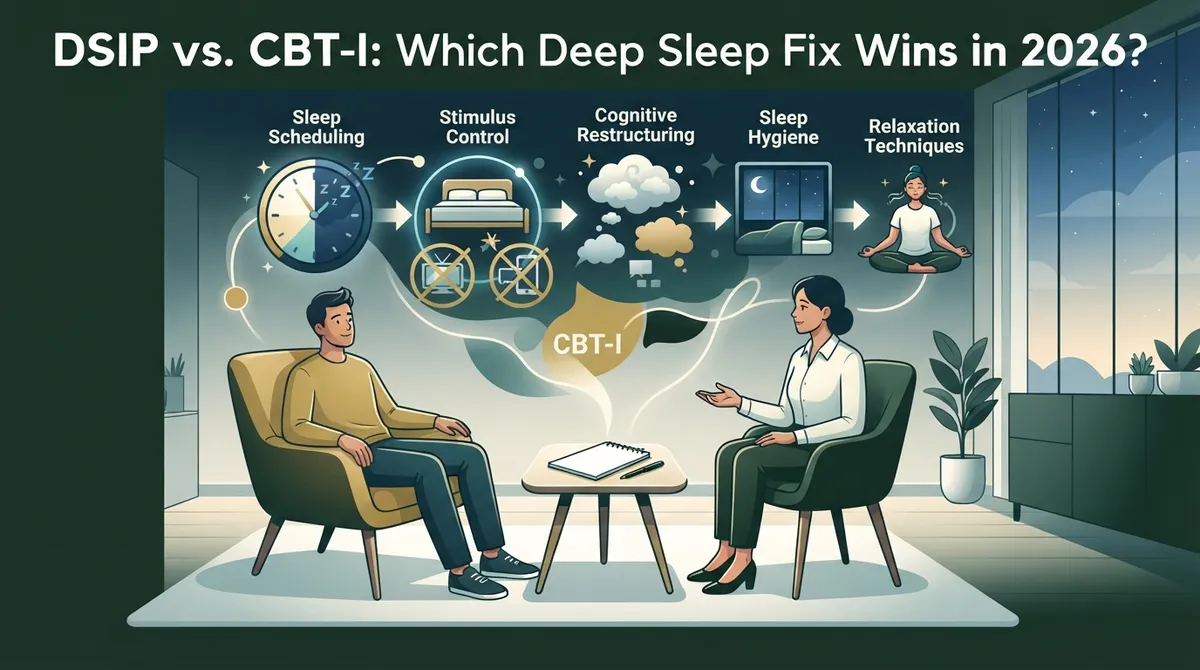
CBT-I stands for cognitive behavioral therapy for insomnia. It’s a structured program that helps you change the habits and thoughts that keep you awake. There are no injections and no pills. It’s guided training for your sleep system.
CBT-I is a guideline-supported treatment for chronic insomnia. That means major clinical groups point to it as a first-line approach. It usually includes a few core pieces:
- Sleep scheduling: Setting a steady bedtime and wake time to strengthen your body clock.
- Stimulus control: Training your brain to link the bed with sleep, not scrolling or worrying.
- Cognitive work: Calming the racing thoughts that show up at 2 a.m.
- Relaxation skills: Simple breathing and wind-down routines.
CBT-I takes effort and a few weeks of practice. But it targets the root habits behind poor sleep, and it doesn’t carry the product-quality questions that come with unapproved peptides.
DSIP vs. CBT-I: A Side-by-Side Look
Let’s compare the two on the things that matter most when you’re deciding where to put your time, energy, and money.
| Factor | DSIP (Peptide) | CBT-I |
|---|---|---|
| Regulatory status | Not FDA-approved for sleep or insomnia | Guideline-supported for chronic insomnia |
| Human evidence | Small, older, mixed studies | Strong clinical support |
| How it works | Proposed effect on sleep signaling | Changes sleep habits and thought patterns |
| Product quality | Compounded or research-use products can vary | Not applicable |
| Time to benefit | Unclear and inconsistent | Often builds over several weeks |
| Effort required | Low (injections) | Moderate (daily habit work) |
The takeaway is simple. CBT-I has the stronger track record. DSIP is more of a “maybe” that still needs better proof.
What Does the Research Say About DSIP?
DSIP has been studied in animals and in a handful of older human trials. Most of the human work comes from the 1980s and 1990s. The results are mixed, the studies are small, and no modern large trial has confirmed that it works for deep sleep.
One often-cited example is a 1992 double-blind study in 16 people with chronic insomnia. It reported some objective sleep improvements, including sleep efficiency and how quickly people fell asleep. But it did not show a consistent benefit in how people felt about their sleep. With only 16 participants and a short study period, we can’t draw big conclusions.
Why the Evidence Falls Short
- The human studies are small and brief.
- Results were mixed rather than clear-cut.
- There is no modern Phase 2 or Phase 3 trial proving efficacy for deep sleep.
- Promotional claims about big jumps in Stage 3 sleep shouldn’t be treated as established fact.
That doesn’t mean DSIP is useless or dangerous. It means we simply don’t have enough solid proof. Being honest about that gap is part of caring for your health.
What About CJC-1295, Ipamorelin, and Epitalon?
You’ll see these names in many “sleep stack” ads. Here’s the realistic view of each.
Growth hormone and slow-wave sleep are linked in the body, so some marketers reason that boosting growth hormone could deepen sleep. That’s indirect logic. The research we reviewed did not find strong, sleep-specific clinical trials showing that CJC-1295 or ipamorelin improve deep sleep.
These peptides do have their own uses in personalized plans for other goals. If you’re curious, you can read about ipamorelin peptide therapy benefits, dosing, and safety or how CJC-1295 is used safely. Just keep in mind that using them mainly for sleep is a stretch beyond what the evidence supports.
Epitalon is also marketed for sleep or body-clock effects. The evidence is preliminary, and large, well-controlled trials in Western clinical settings are lacking.
| Peptide | Common Sleep Claim | Evidence Level for Deep Sleep |
|---|---|---|
| DSIP | Boosts slow-wave sleep | Limited, old, mixed |
| CJC-1295 | Raises growth hormone, deepens sleep | Indirect reasoning only |
| Ipamorelin | Supports recovery and sleep | No robust sleep-specific trials found |
| Epitalon | Supports circadian rhythm | Preliminary |
For a deeper look at the sleep side, see our post on DSIP sleep peptide facts worth knowing and our guide on which peptides actually help you sleep better.
Safety and Quality Concerns You Should Know
This is the part many ads skip, so let’s walk through it together. Compounded or research-use peptide products are not the same as FDA-approved medicines. Quality, dose consistency, and purity can be uncertain, especially if you buy from unvetted online sellers.
The FDA has also raised safety concerns about certain bulk substances proposed for compounding, including possible immunogenicity concerns for injectable peptides. In plain words, the body could react to them in unwanted ways. And limited published safety data should never be read as proof that long-term use is safe.
To learn more about how regulation and sourcing work, check out FDA-approved vs. compounded peptides and is peptide therapy safe. The National Library of Medicine is also a helpful place to read peer-reviewed research.
Smart Safety Habits
- Never buy injectable peptides from unverified “research chemical” sites.
- Work with a licensed medical provider who reviews your history and labs.
- Ask where the product is made and how it is tested.
- Report any unusual reaction to your provider right away.
When Poor Sleep Needs a Bigger Look
Here’s something worth saying loud and clear. If you have ongoing sleep trouble, a peptide is not the first stop. It’s important to find out why you’re sleeping poorly.
Several common issues can wreck deep sleep:
- Chronic insomnia: Often best treated with CBT-I.
- Sleep apnea: Pauses in breathing can fragment your sleep all night.
- Medication effects: Some prescriptions and stimulants interfere with sleep.
- Circadian rhythm disorders: Your body clock may be out of sync with your schedule.
- Hormone shifts: Perimenopause, menopause, and low testosterone can disrupt rest.
That last point matters for many of our readers. Hormones and sleep are tightly connected. You can explore sleep disorder treatment facts and hormone optimization facts for peptide users to see how these pieces fit together.
A Smarter Sleep Plan for Health Optimizers
If you love data and want a clear path, here’s a practical order of operations. It respects both the evidence and your time.
- Check the basics. Keep a steady schedule, limit late caffeine and alcohol, and get morning light. Our list of sleep optimization steps before trying peptides walks through these.
- Get evaluated. Rule out sleep apnea, medication effects, and circadian issues with a clinician.
- Start CBT-I. Use a structured program if insomnia is persistent.
- Look at labs. Blood work can reveal hormone or metabolic factors worth addressing.
- Discuss peptides with a licensed provider. If they fit your goals, make the call together with real data, not hype.
Notice that peptides come last, not first. That ordering protects your health and your wallet.
Where Personalized Peptide Care Fits
So where does a company like Allura Longevity come in? Peptide therapy can play a role in a bigger, personalized wellness plan, especially for energy, recovery, metabolism, and healthy aging. It just shouldn’t be sold as a guaranteed fix for deep sleep.
Allura Longevity is a telehealth clinic that builds medically supervised plans around your blood work and goals. It starts with a $50 virtual consultation, followed by LabCorp blood work and a customized six-month plan delivered to your home. Ashley, a board-certified Family Nurse Practitioner, leads care with ongoing monitoring and adjustments. Telehealth is available in Florida, Georgia, Texas, Connecticut, Indiana, Maryland, New York, and California.
If you want to understand the process, read how to start peptide therapy safely and how to prepare for safe, effective peptide injections. You can also browse options like peptides for women and peptides for men.
So, Which Wins: DSIP or CBT-I?
For chronic insomnia and poor sleep, CBT-I wins on evidence. It has guideline support, it addresses root causes, and it comes without product-quality worries. DSIP remains an interesting but unproven idea, with small and dated human data.
That said, this isn’t about picking a side forever. A smart plan can include healthy sleep habits, CBT-I, proper medical evaluation, and, where appropriate, personalized peptide care for your wider goals. The key is to be honest about what each tool can and can’t do.
Ready for a plan built around your own labs and goals? Request a consultation with Allura Longevity, or call (813) 510-6277. New-client spots are limited each month, so reach out while there’s room. Better rest starts with a clear, honest first step.
FAQs
Q: Do peptides help you get more deep sleep?
A: The evidence is still thin. DSIP has a few small, older human studies with mixed results, and growth-hormone peptides like CJC-1295 and ipamorelin lack strong sleep-specific trials. Right now, no peptide is FDA-approved to boost deep sleep.
Q: What is DSIP, and does it work for sleep?
A: DSIP, or delta sleep-inducing peptide, is a peptide studied for its possible effect on slow-wave sleep. Early research is interesting, but the human studies are small and inconsistent, so we can’t say it reliably works.
Q: Is DSIP FDA-approved for insomnia or deep sleep?
A: No. DSIP is not FDA-approved to treat insomnia or increase deep sleep. Compounded or research-use versions are also not equal to FDA-approved medicines, so quality and dosing can vary.
Q: What are the risks of using compounded or research peptides for sleep?
A: Risks include uncertain product quality, inconsistent dosing, and possible immune reactions to injectable peptides. Limited safety data also means long-term safety isn’t established, so it’s best to work with a licensed provider.
Q: What are evidence-based treatments for chronic insomnia?
A: CBT-I is a guideline-supported first-line treatment for chronic insomnia. It’s also smart to be evaluated for sleep apnea, medication effects, and circadian rhythm issues, since fixing those can improve sleep a lot.





