

Key Takeaways
-
Currently, no established clinical evidence proves that popular wellness peptides like CJC-1295 or ipamorelin treat menopause symptoms or slow menopause-related aging in women.
-
Menopausal hormone therapy (MHT) remains the most effective evidence-based treatment for hot flashes and night sweats, particularly for women under 60 or within 10 years of menopause onset.
-
Online and compounded peptides labeled 'research use only' carry significant risks including uncertain purity, unclear dosing, manufacturing quality issues, and potential injection complications.
-
Peptide therapy may complement a broader healthy aging plan including sleep, nutrition, and exercise when guided by labs and supervised by licensed providers with realistic expectations.
-
Track symptoms for several weeks and obtain baseline blood work before discussing treatment options with a qualified clinician to make informed menopause care decisions.
-
FDA-approved peptide medicines differ from wellness peptides; approval for one condition does not prove benefits for menopause or aging, and each substance requires individual evaluation.
If you are in your 40s, 50s, or beyond, you have probably noticed the changes. Hot flashes hit at the worst times. Sleep gets choppy. Your energy dips, your skin feels different, and the scale seems to have a mind of its own. It is no surprise that many women start searching for answers online, and “peptide therapy” keeps popping up.
So, can peptides help menopause aging symptoms? The honest answer is a little complicated, and we think you deserve the full picture. Peptides are a broad group of compounds, and not all of them are the same. Some are approved medicines. Others are experimental. Right now, there is no established clinical evidence that popular wellness peptides treat menopause symptoms directly.
In this guide, we will walk you through what the research says, what it does not say, which treatments have real evidence, and where personalized peptide care may fit into a healthy aging plan. Think of this as a friendly chat with someone who wants you to feel great, without the hype.
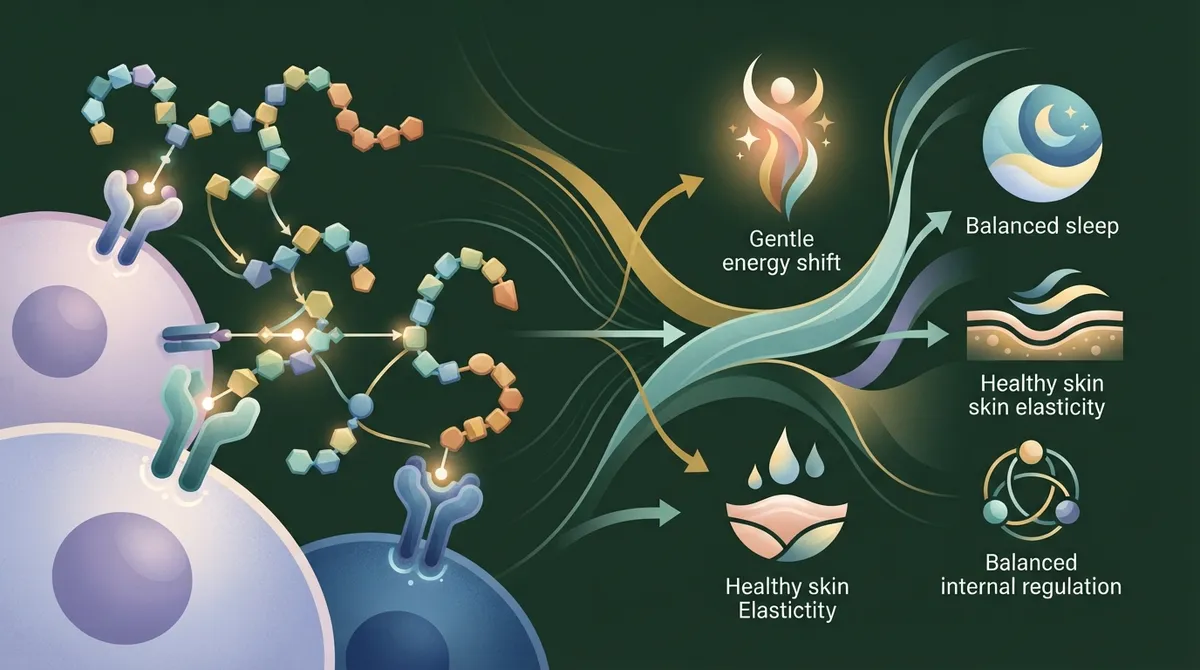
What Are Peptides, and Why Are They Linked to Menopause?
Peptides are short chains of amino acids, the building blocks of proteins. Your body makes thousands of them naturally. They act like tiny messengers, telling cells what to do. If you want a deeper primer, check out 8 Facts That Explain What Are Peptides in 2026 or this overview of what are peptides from WebMD.
Here is the tricky part. “Peptide therapy” is a very broad term. It can mean an FDA-approved peptide-based medicine. It can also mean an experimental product sold for wellness or anti-aging. You cannot assume that a product is proven just because it is a peptide.
Menopause and aging overlap in many ways. As estrogen and progesterone drop, and as growth hormone naturally declines with age, women often notice changes in:
- Sleep quality and night sweats
- Energy and motivation
- Body composition and metabolism
- Skin firmness and hair thickness
- Mood, focus, and “brain fog”
- Recovery after exercise
Because peptides are marketed for many of these goals, people naturally connect the dots. But a connection in marketing is not the same as proof in a clinical trial.

Can Peptides Help Menopause Aging Symptoms? What the Evidence Says
Let us be direct. In the research reviewed for this article, there is no established clinical evidence that commonly marketed wellness peptides, such as CJC-1295, ipamorelin, BPC-157, or epitalon, relieve menopause symptoms or slow menopause-related aging in women. A 2026 literature review also found no relevant randomized controlled trials of non-approved wellness peptide therapies for perimenopause or menopause symptoms.
That does not mean new evidence will never appear. It simply means that claims about hot flashes, sleep, weight, skin, or longevity should not be presented as proven benefits today.
It helps to know the difference between types of research:
| Type of Evidence | What It Tells Us | Strength for Menopause Claims |
|---|---|---|
| Laboratory (cell) studies | How a compound behaves in a dish | Very limited |
| Animal studies | Early signals of possible effects | Limited, may not apply to people |
| Small human studies | Early safety and effect clues | Moderate, but often narrow |
| Randomized controlled trials | Whether a treatment truly works vs. placebo | Strongest, and currently lacking for wellness peptides in menopause |
You can explore the broader scientific landscape through the National Library of Medicine, which hosts many peer-reviewed papers on peptides.
Approved peptide medicines are not the same as wellness peptides
Some approved medicines are peptide-based. That is real and important. But approval for one condition does not prove a benefit for menopause or aging. An approved drug’s indication, risks, and evidence cannot be stretched to other peptides or other uses. Each substance needs to be judged on its own.
What Is Actually Proven for Menopause Symptoms?
Before we talk about where peptides may fit, let us look at what the strongest evidence supports. The North American Menopause Society (NAMS) is a leading authority here.
According to NAMS, frequent hot flashes and night sweats (vasomotor symptoms) last an average of 7 to 9 years, and for about one in three women they can last more than 10 years. That is a long time to feel uncomfortable, so effective options matter.
- Menopausal hormone therapy (MHT): NAMS identifies it as the most effective treatment for hot flashes and genitourinary symptoms, and it helps prevent bone loss and fracture.
- Selected nonhormonal treatments: NAMS also reviews nonhormone options for women who cannot or prefer not to use hormones.
- Lifestyle strategies: Strength training, protein intake, sleep habits, and stress care support overall well-being.
NAMS notes that the benefit-risk balance of hormone therapy is generally more favorable for healthy women younger than 60 or within 10 years of menopause onset who have no contraindications. It becomes less favorable when started later, because the absolute risks of heart disease, stroke, blood clots, and dementia are higher.
If you want to learn more about hormone options, these guides may help: 10 Safest Hormone Therapy Options for Women (2026) and What Menopause Treatment Options Really Work in 2026?
Peptide Therapy vs. Menopausal Hormone Therapy
These two get mixed up a lot, so let us untangle them. They are not the same thing.
| Feature | Menopausal Hormone Therapy | Wellness Peptide Therapy |
|---|---|---|
| What it is | Estrogen, plus a progestogen if you have a uterus | Short amino acid chains used for wellness goals |
| Evidence for hot flashes | Strong (most effective option per NAMS) | No established clinical evidence |
| Protects bone | Yes, helps prevent bone loss and fracture | Not established for these products |
| Needs individualized review | Yes, based on age, timing, history | Yes, and by specific substance |
| Regulatory status | Approved products available | Varies widely by peptide |
For a closer comparison, see MHT vs. Peptides: Which Helps Menopause More? and How to Choose Between Bioidentical Hormones and Peptides.
One more friendly reminder: “natural” or “bioidentical” does not automatically mean safer. Every treatment, hormonal or not, deserves a risk-benefit conversation with a qualified clinician.
Where Peptides May Fit Into Healthy Aging
Now for the hopeful part. Even though peptides are not a proven fix for hot flashes, many women and men explore peptide therapy as part of a broader plan for vitality and healthy aging. Here is how this usually works in a responsible setting.
A licensed provider reviews your symptoms, goals, and lab results. Then, they discuss which options, if any, make sense for you. Peptides may be one piece of a bigger plan that also includes sleep, nutrition, exercise, and, when appropriate, hormone care.
Common goals people explore with peptide care
- Energy and recovery: See How to Pick Peptides for Energy That Actually Work.
- Skin appearance: Read What Peptides Do for Skin: A Real-World Guide for 2026.
- Body composition and weight: Explore Which Weight Loss Peptides Actually Work in 2026?
- Sleep support: Check Which Peptides Actually Help You Sleep Better?
- Brain fog: Learn more in 8 Brain Fog Solutions Backed by Science in 2026.
It is worth saying plainly: these are goals people pursue, not guaranteed outcomes. Results vary, and evidence differs for each substance. A good provider will tell you that up front. For a wider view, read Anti Aging Peptide Treatment: What Really Works in 2026.
The Risks of Online and Unapproved Peptides
This part matters, especially for health optimizers and biohackers who love to experiment. Many peptides sold online are labeled “research use only.” That label does not mean they are safe for humans.
The FDA has raised concerns about certain bulk peptide substances considered for compounding. These include limited human safety data, impurities, and the potential for immune reactions. Compounded medicines are also not FDA-approved for safety and effectiveness, and regulatory status can change over time.
Here are the main risks to keep in mind:
- Uncertain identity and purity: What is on the label may not match what is in the vial.
- Unclear dosing: Too little may do nothing, and too much may cause side effects.
- Manufacturing quality: Unregulated sources may skip important safety steps.
- Injection risks: Self-injecting can lead to infection or dosing errors without training.
- Hidden interactions: Peptides can interact with other medicines or health conditions.
To learn how to stay safe, see FDA-Approved vs. Compounded Peptides: What Wins?, How to Get Prescription Peptides Safely in 2026, and Is Peptide Therapy Safe? What You Really Need to Know.
How to Approach Menopause Care Wisely: A Simple Plan
Feeling overwhelmed? Totally normal. Here is a simple, step-by-step way to move forward with confidence.
- Track your symptoms. Note hot flashes, sleep, mood, energy, and cycle changes for a few weeks.
- Get baseline labs. Blood work gives your provider real data instead of guesses.
- Talk to a qualified clinician. Ask about evidence-based options first, including hormone and nonhormone choices.
- Ask about each peptide by name. Ask what the evidence is, what the regulatory status is, and what the risks are.
- Start with a clear plan. Agree on goals, timelines, and follow-up checks.
- Reassess regularly. Adjust your plan as your body and your symptoms change.
If you want help getting started, our guide on How to Start Peptide Therapy Safely and See Real Results walks through the process, and How to Use Biomarker Testing to Guide Peptide Therapy explains why labs matter so much.
How Allura Longevity Approaches Personalized Care
At Allura Longevity, we believe your care should be honest, personal, and backed by data. We offer personalized, medically supervised peptide therapy through telehealth, so you can get expert guidance without rearranging your busy schedule.
Here is how it works. You start with a $50 virtual consultation. Next, you complete blood work through LabCorp. Then a licensed provider, led by Ashley, a board-certified Family Nurse Practitioner, builds a customized six-month plan based on your labs and goals. Your treatment is delivered to your home, and your team monitors and adjusts your plan along the way.
We are licensed in Florida, Georgia, Texas, Connecticut, Indiana, Maryland, New York, and California. If you are exploring peptides for women, or looking at peptides for men, we will help you separate what is promising from what is just buzz. We will also tell you when a different path, such as hormone therapy, may be a better first step for your symptoms.
Spots for new clients are limited each month, so do not wait too long if you are ready to take the next step.
Conclusion: Be Curious, Stay Informed, and Choose Wisely
So, can peptides help menopause aging symptoms? Right now, the honest answer is that wellness peptides have not been proven to treat menopause symptoms or slow menopause-related aging. Evidence-based options, such as individualized menopausal hormone therapy and selected nonhormonal treatments, remain the standard for bothersome hot flashes and related symptoms.
That said, peptide therapy can still be part of a thoughtful, personalized wellness plan when it is guided by labs, supervised by licensed providers, and discussed with clear, realistic expectations. You deserve care that treats you like a whole person, not a trend.
Ready to talk it through with a team that will give you straight answers? Request a consultation with Allura Longevity today, or call (813) 510-6277. We would love to help you feel your best through every stage of life.
FAQs
Q: Can peptides help with hot flashes or night sweats during menopause?
A: Right now, there is no established clinical evidence that wellness peptides relieve hot flashes or night sweats. For bothersome vasomotor symptoms, NAMS identifies menopausal hormone therapy as the most effective treatment, so it is worth talking with a clinician about whether it fits your health history.
Q: Are CJC-1295 or ipamorelin proven to help menopause symptoms?
A: Not at this time. Studies reviewed so far have not shown that these peptides treat menopause symptoms in women, and no relevant randomized controlled trials were found. A provider can explain what is known about each peptide and whether it makes sense for your goals.
Q: What is the difference between peptide therapy and menopausal hormone therapy?
A: Menopausal hormone therapy uses estrogen, plus a progestogen if you have a uterus, and has strong evidence for hot flashes and bone protection. Peptide therapy is a broad term for amino acid chain products, and evidence and regulatory status vary by substance. They are different tools, and a clinician can help you decide which one fits.
Q: Are online or compounded peptides safe?
A: Not automatically. Products labeled “research use only” are not proven safe for people, and compounded medicines are not FDA-approved for safety and effectiveness. Working with licensed providers who use proper lab testing and quality sources helps lower the risks.
Q: When should I talk to a clinician about menopause treatment?
A: Reach out any time symptoms start affecting your sleep, mood, energy, or daily life. Early conversations help you explore evidence-based options and build a personalized plan, and with Allura Longevity you can start with a simple $50 virtual consultation.





