
Key Takeaways
-
Telehealth longevity clinics, hormone-focused clinics, functional medicine practices, integrative primary care, med spas with medical oversight, and men's or women's health clinics all may offer combined hormone and peptide care.
-
Offering both hormones and peptides does not prove the combination is safe or effective; each treatment needs its own evidence and plan.
-
"Bioidentical" describes molecular structure only, not whether a product is FDA-approved or custom-compounded, so ask which type you are receiving.
-
Endocrine Society states evidence does not show custom-compounded bioidentical hormones are safer or more effective than FDA-approved options, citing inconsistent dose and purity concerns.
-
Many wellness peptides are not FDA-approved for the uses clinics advertise, and the FDA has flagged safety concerns for certain bulk substances such as GHRP-2 and GHRP-6.
-
Vet any provider by checking the clinician's active state license, asking for exact drug names and doses, confirming the pharmacy, and getting the monitoring plan in writing.
So you’ve heard that some clinics offer both bioidentical hormones and peptide therapy, and now you’re wondering who actually does this. You’re not alone. Plenty of people in midlife and beyond want one plan that covers energy, sleep, recovery, and hormone balance. The good news? Lots of options exist. The tricky part? There’s no single national directory, and no one certification that proves a clinic does both well.
That’s why it helps to know what kinds of providers offer these services, what each one tends to do well, and what questions to ask before you say yes. In this guide, we’ll walk through eight provider types, share a simple checklist for vetting any clinic, and clear up a few common mix-ups about the term “bioidentical.”
Whether you’re a biohacker tracking every lab value, a busy professional who needs care from your couch, or a wellness seeker ready to go a step further, you’ll leave with a clear plan. Let’s dive in.
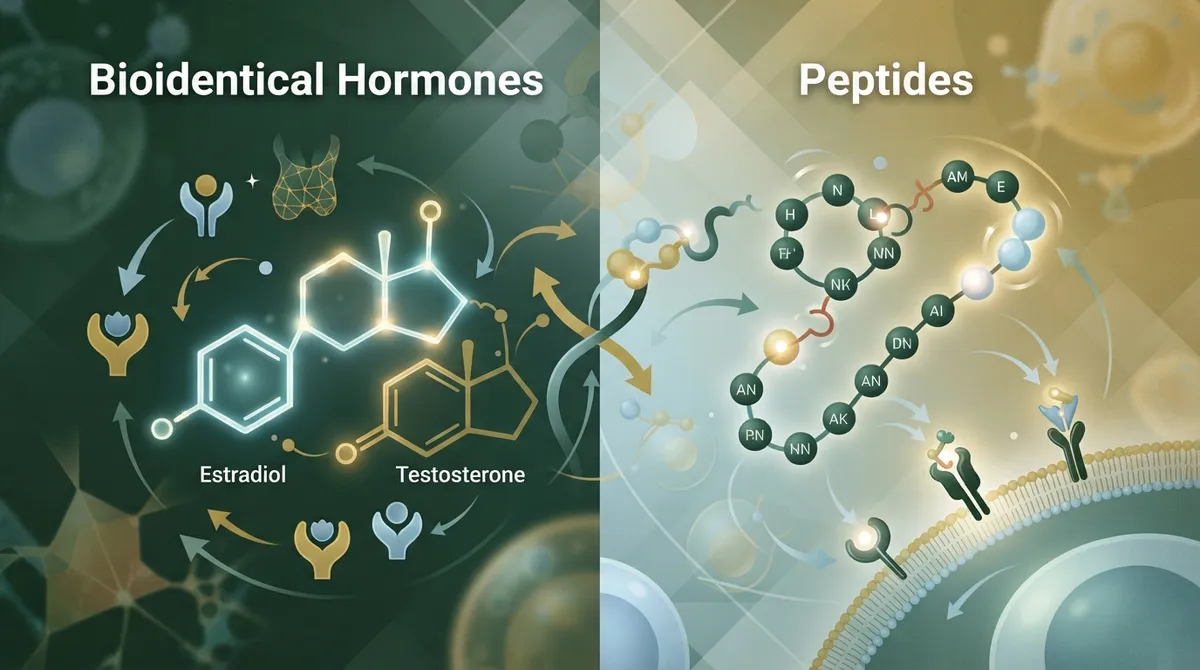
First, What Do We Mean by Bioidentical Hormones Plus Peptides?
Before we look at who provides bioidentical hormones plus peptides, let’s get the terms straight.
“Bioidentical” describes a hormone’s molecular shape. It means the structure matches a hormone your body makes. It does not tell you whether a product is FDA-approved or custom-compounded. Some FDA-approved estradiol and progesterone products are bioidentical. Compounded versions can be too.
Peptides are short chains of amino acids that act as signals in the body. If you want a plain-language primer, what are peptides is a handy place to start. Some peptide-based medicines are FDA-approved for specific uses. Many wellness peptides are not approved for the uses clinics advertise.
Hormones and peptides do different jobs. Hormone therapy replaces or supports a hormone your body is short on. Peptide therapy aims to nudge certain pathways, such as recovery, metabolism, or skin repair. For a deeper look at how the two differ, see How Do Peptides Differ From Hormones? A 2026 Guide.

8 Types of Providers That Offer Both
Here’s a quick look at the main places people find a combined approach in 2026.
| Provider Type | Typical Strength | Watch-Outs |
|---|---|---|
| Telehealth longevity clinics | Convenience, lab-guided plans, home delivery | Check state licensing and pharmacy source |
| Hormone-focused clinics | Deep hormone experience | Peptide menu may be broad and loosely supported |
| Functional medicine practices | Whole-body view, long visits | Wide panels may not guide treatment |
| Integrative primary care | Continuity with your regular doctor | May offer limited peptide options |
| Med spas with medical directors | Skin and aesthetic focus | Oversight can vary a lot |
| Men’s health clinics | Testosterone expertise | Check for women’s care if you need it |
| Women’s health and menopause clinics | Midlife symptom focus | Peptide offerings may be limited |
| Sports medicine and performance clinics | Recovery and training goals | Check anti-doping rules if you compete |
1. Telehealth Longevity Clinics
These clinics run the whole process online. You complete a virtual visit, get lab work at a local draw site, and receive a plan from a licensed provider. Medication then ships to your door. This model fits busy professionals well. It also lets you get care without driving across town. To see how this works in practice, read 5 Things a Nationwide Telehealth Peptide Clinic Does.
2. Hormone-Focused Clinics
These practices built their name on hormone care. Many started with testosterone or menopause treatment and later added peptides. Their hormone experience can be strong. Just ask how they decide which peptides to offer and what evidence supports each one.
3. Functional Medicine Practices
Functional medicine doctors and nurse practitioners often take a whole-body approach. They may spend more time on your history, sleep, stress, and nutrition. Some add bioidentical hormones and peptides to the mix. Be cautious if a plan rests only on a broad wellness panel with no clear link to your symptoms.
4. Integrative Primary Care
Some primary care offices blend standard medicine with hormone and peptide options. A big perk here is continuity. Your clinician already knows your history, your other medicines, and your risk factors.
5. Med Spas With Medical Oversight
Many med spas now list peptides for skin and recovery, and some list hormone therapy too. Ask who the supervising clinician is and how often they review patients. A prescriber should evaluate you, not just a front-desk consult.
6. Men’s Health Clinics
Men’s clinics tend to know testosterone well. Many pair it with peptides for recovery, body composition, or sexual wellness. If that’s your lane, you may also like Why Does Testosterone Injection Therapy Get Paired With Peptides?
7. Women’s Health and Menopause Clinics
These clinics focus on perimenopause, menopause, and the years around them. They often lead with hormone therapy and add peptides for skin, sleep, or energy. For a closer look, try How to Navigate Perimenopause With BHRT and Peptides.
8. Sports Medicine and Performance Clinics
Athletes and weekend warriors sometimes find combined care here. The focus is recovery, strength, and training load. If you compete in tested sports, check the rules first, since some peptides are banned.
A Reality Check: Offering Both Does Not Prove Safety
Here’s the part we’d tell a friend over coffee. A clinic that sells both treatments has not proven that the combo is safe, effective, or right for you. Each treatment needs its own evidence and its own plan.
On the hormone side, the Endocrine Society says the evidence does not show that custom-compounded bioidentical hormones are safer or more effective than FDA-approved options. It also cites concerns about inconsistent dose, purity, and quality. In plain terms, if an approved product fits your needs, it’s worth a real conversation.
On the peptide side, the picture is mixed. Some peptide medicines are FDA-approved for specific conditions. Many peptides promoted by wellness clinics are not approved for the uses advertised, and human evidence can be thin. The FDA has also flagged safety concerns for certain bulk substances proposed for compounding, including GHRP-2 and GHRP-6. The agency has cited possible immunogenicity and impurity concerns. For GHRP-2, it notes reports of serious adverse events, though it has not established that the peptide caused them.
None of this means peptides or compounded hormones are off the table. It means you should treat each product on its own merits. For a balanced look, see Approved Peptides vs. Wellness Peptides: What Works? and How to Weigh the Risks of Peptide Therapy Safely in 2026.
How to Vet Any Provider in 6 Steps
Use this simple list before you book anything.
- Check the license. Look up the treating clinician’s active license on your state’s board website. Confirm they can prescribe in the state where you live.
- Ask who evaluates and follows you. You should know the name and credentials of the person reviewing your labs and adjusting your plan.
- Request exact drug names. “Hormone blend” or “peptide stack” is not enough. Ask for each product, the dose, and the reason it was chosen.
- Ask if each product is FDA-approved or compounded. Both can be valid choices, but you deserve to know which one you’re getting.
- Confirm the pharmacy. Ask where products are made and shipped from, and whether the pharmacy is licensed.
- Get the monitoring plan in writing. You need follow-up labs and check-ins, not a one-and-done prescription.
If you want a longer list, 15 Peptide Consultation Questions to Ask in 2026 covers a lot of ground.
Red Flags to Watch For
A few warning signs show up again and again. Be wary of:
- Guaranteed results or promises of “reversing” age
- Claims that compounded products are automatically safer than approved ones
- Plans built only on a broad wellness panel with no link to your symptoms
- No clear clinician name, or no way to reach one after you buy
- Pressure to prepay for long packages before your labs come back
- Vague answers about where products come from
A good provider welcomes tough questions. If you feel rushed or brushed off, that tells you something. Our guide on 5 Mistakes to Avoid When Picking Hormone Practitioners digs into this further.
Local Clinic or Telehealth: Which Fits You?
Both can work. The right pick depends on how you like to receive care.
| Factor | Local Clinic | Telehealth |
|---|---|---|
| Convenience | Travel and waiting rooms | Visits from home, products shipped |
| Hands-on exams | Easy to arrange | Limited; labs done at a draw site |
| Scheduling | Office hours | Often more flexible |
| Reach | Only nearby options | Providers licensed in your state |
| Follow-up | In-person visits | Video or message check-ins |
If your schedule is packed, telehealth can make it much easier to stick with a plan. If you’d like a deeper comparison, read Local Clinic vs. Telehealth: Best Peptide Therapy Near You?
Why Labs Come First
Whichever provider you pick, your plan should start with your own numbers. Hormones and peptides are not one-size-fits-all. Blood work helps a clinician see where you are today, spot reasons to wait or skip a treatment, and set a baseline for follow-up.
Data-driven folks tend to love this part. You get a starting point, a plan, and a way to measure change over time. Learn more in Lab Work for Peptide Therapy: What to Test and Why and How to Build a Bloodwork-Based BHRT Peptide Plan in 2026.
For the science of how peptides fit into care, the National Library of Medicine hosts peer-reviewed research worth browsing with your clinician.
Where Allura Longevity Fits In
Allura Longevity is a telehealth wellness clinic built around personalized, medically supervised peptide therapy. New clients start with a $50 virtual consultation, complete blood work through LabCorp, and receive a customized six-month plan shipped to their home. Licensed providers, led by Ashley, a board-certified Family Nurse Practitioner, monitor progress and adjust the plan as needed. Services include support for energy, sleep, skin, recovery, metabolism, GLP-1 weight loss, BPC-157 for injury recovery, and testosterone replacement.
Allura Longevity is licensed in Florida, Georgia, Texas, Connecticut, Indiana, Maryland, New York, and California. If you’re on the hunt for a lab-guided plan with real clinician oversight and a clear follow-up schedule, it’s a strong option to explore. You can also learn more about peptides for women and peptides for men.
Who Is This Combined Approach Best For?
A combined plan may be worth discussing if you:
- Have symptoms that overlap, like low energy, poor sleep, and slow recovery
- Already have recent labs and want a clinician to interpret them
- Prefer a single care team instead of juggling several offices
- Want convenient telehealth care that fits a full calendar
- Are ready to track progress and adjust over time
It may not be the right move if you have certain health conditions, take medicines that interact, or are pregnant or trying to conceive. That’s exactly why a real medical evaluation matters. A good starting point is How to Know If You Need Hormone Therapy in 2026.
Wrapping Up
The short answer to who provides bioidentical hormones plus peptides is this: a mix of telehealth longevity clinics, hormone clinics, functional and integrative practices, men’s and women’s health clinics, and some med spas and sports medicine offices. No single type is automatically best. What matters is the clinician, the evidence behind each product, the pharmacy, and the follow-up.
Take your time, ask for specifics, and choose someone who treats your plan as a living, lab-guided process. When you’re ready to talk through your goals with a licensed team, request a consultation with Allura Longevity. New client spots are limited each month, and you can reach the team at (813) 510-6277.
FAQs
Q: Which clinics offer both bioidentical hormone therapy and peptide therapy?
A: You’ll find both offered at some telehealth longevity clinics, hormone-focused practices, functional and integrative medicine offices, and men’s or women’s health clinics. There’s no single national directory, so it’s smart to check each provider’s license, product sources, and follow-up plan before you commit.
Q: Are bioidentical hormones FDA-approved?
A: Some are! Certain estradiol and progesterone products that match human hormones are FDA-approved. Custom-compounded bioidentical products are not FDA-approved, so it helps to ask your clinician which type you’re being offered and why.
Q: Are peptides from wellness clinics FDA-approved?
A: Some peptide medicines are FDA-approved for specific conditions, but many peptides promoted for wellness are not approved for the uses advertised. Ask your provider for the exact product name, the evidence behind it, and whether it’s approved or compounded.
Q: Can hormone therapy and peptide therapy be used together safely?
A: It depends on you, your labs, and the specific products. Offering both doesn’t prove a combo is safe or effective, so a licensed clinician should review your history, set a monitoring plan, and adjust as you go.
Q: How can I check whether a hormone or peptide provider is licensed?
A: Look up the treating clinician on your state’s licensing board website and confirm the license is active and valid in your state. You can also ask who reviews your labs, which pharmacy fills your prescriptions, and how follow-up care works.