

Key Takeaways
-
Lab results support clinical decisions but cannot diagnose you or set your dose alone; treatment should be based on symptoms, history, risks, and how you respond over time.
-
Saliva and urine hormone tests are considered unreliable for setting hormone doses by the North American Menopause Society, so be cautious of providers who rely on them.
-
BHRT and peptides are different tools with different evidence bases and regulations; using labs does not make a peptide safe or effective.
-
"Bioidentical" means chemically identical to hormones your body makes, not that a product is compounded; compounded hormones are not FDA-approved as finished drugs, so ask which type you are getting.
-
Many wellness peptides such as BPC-157, CJC-1295, ipamorelin, and TB-500 lack strong human evidence for commonly advertised uses, so verify current FDA status and ask about unknowns.
-
Before starting, ask who treats you, why each lab is ordered, whether a product is FDA-approved or compounded, what the risks are, how you will be monitored, and how to stop if needed.
If you are looking for lab guided BHRT and peptides, you are probably tired of guessing. Maybe your energy dipped, your sleep got choppy, or your body just doesn’t feel like yours anymore. You want a plan built around real data, not a one-size-fits-all pitch. That is a smart instinct, and we are glad you are here.
But here is the part many clinics skip: lab results are a helpful tool, not a magic answer. Labs can guide a clinical decision. They cannot diagnose you on their own, set your dose for you, or prove a therapy is safe and effective. Bioidentical hormone therapy (BHRT) and peptides are also two very different things, with different evidence and different rules.
In 2026, more people than ever are exploring both. This guide walks you through five things to understand before you start, so you can ask better questions and choose care you can trust. Think of it as a friendly checklist from someone who wants you to feel confident, not confused.

1. What “Lab Guided” Really Means (and What It Doesn’t)
“Lab guided” sounds impressive, but it should mean something specific. Good lab guided care starts with your symptoms and medical history. Then a licensed provider orders tests that answer a real clinical question. Afterward, they use follow-up testing to check how your body responds.
It should not mean a giant panel that gets used to sell you a product. Testing is a stepping stone, not the destination.
A Healthy Way to Think About Testing
- Symptoms come first. Your story matters as much as your numbers.
- Tests answer questions. Each test should have a clear reason.
- Results are one piece. Your history, risks, and medications count too.
- Follow-up is key. Monitoring shows how your body is doing over time.
If you want to see how this works in practice, our guide on lab work for peptide therapy breaks down what to test and why. You can also read 7 reasons lab work matters before peptide therapy for the bigger picture.
Which Tests Are Actually Useful?
Not every test fits every person. Here is a simple overview of how testing is commonly viewed.
| Test Type | Common Use | What to Know |
|---|---|---|
| Serum (blood) hormone tests | Evaluating symptoms, monitoring when clinically indicated | Often needed for some people, but rarely required for routine menopausal hormone therapy |
| Salivary hormone tests | Often marketed in wellness settings | The North American Menopause Society (NAMS) calls these unreliable for setting hormone doses |
| Urine hormone tests | Often marketed in wellness settings | Also considered unreliable for dosing by NAMS |
| Metabolic and safety labs | Checking overall health, cholesterol, liver, and blood counts | Helps a provider spot risks and watch for side effects |
The takeaway? A provider who leans hard on saliva or urine testing to set your dose is worth a second look. The 2022 NAMS position statement is clear that treatment decisions are generally based on symptoms, history, risks, and how you respond. If you want to dig deeper, how to know what labs are required before peptides is a handy read.
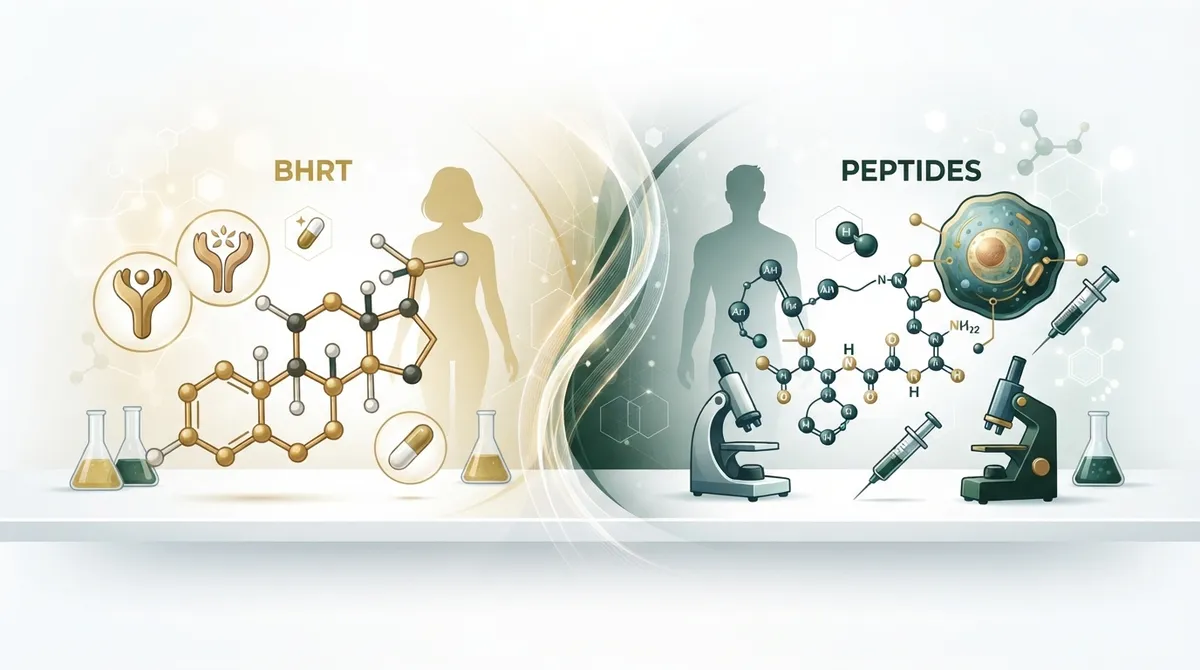
2. BHRT and Peptides Are Not the Same Thing
This is the biggest mix-up we hear. People often lump BHRT and peptides into one bucket. They are actually two different tools.
Hormone therapy replaces or adjusts specific hormones, such as estrogen, progesterone, or testosterone, for defined clinical reasons. Peptides are a wide group of molecules. Some are FDA-approved medicines, and others are investigational or used in wellness settings with limited human evidence. Each peptide has its own target, its own research, and its own risks.
Using labs does not make a peptide safe or effective. It just means your provider is paying attention to your body. If you are new to this world, our what are peptides reference is a good starting point, and how peptides differ from hormones goes deeper.
Side-by-Side Comparison
| Feature | BHRT / Hormone Therapy | Peptide Therapy |
|---|---|---|
| What it does | Replaces or modulates specific hormones | Varies widely by peptide and target |
| Evidence base | Larger body of research for defined uses, such as menopause symptoms | Mixed; some approved, many with limited human data |
| Regulatory status | Includes FDA-approved products and compounded versions | Varies by peptide; always verify the current status |
| Role of labs | Helps with history, safety, and monitoring | Helps with baseline health and safety checks |
Can they be used in the same plan? In some cases, yes, under careful clinical supervision. We explore that in how to choose between peptide therapy vs hormone therapy and 12 facts about BHRT with adjunct peptide therapy.
3. “Bioidentical” Doesn’t Automatically Mean “Compounded”
Here is a word that gets tossed around a lot. “Bioidentical” simply means a hormone is chemically identical to one your body makes. That is it. It does not tell you whether a product is custom-made in a pharmacy.
Some FDA-approved hormone products are bioidentical. Compounded bioidentical hormone therapy (cBHT), on the other hand, is custom-prepared and is not FDA-approved as a finished drug. That difference matters.
What NAMS Says About Compounded Hormones
The North American Menopause Society has voiced several concerns about compounded hormone products. These include:
- Limited government oversight
- Possible over- or under-dosing
- Risk of impurities or sterility problems
- Not enough safety and effectiveness research
- No standard risk labeling
NAMS generally favors approved products when they fit your needs. Compounding may make sense for specific reasons, like an ingredient allergy or a dose that is not commercially available. A good provider will explain these tradeoffs clearly and offer approved options first when they are suitable.
For a plain-language overview, check out 7 facts about bioidentical hormone therapy in 2026 and our bioidentical hormone replacement guide. If you are weighing treatment styles, approved hormone therapy vs. wellness peptides is worth a look.
4. Be Honest About Peptide Evidence and Safety
Now for the part we think every reader deserves to hear plainly. Many peptides promoted by wellness clinics, including BPC-157, CJC-1295, ipamorelin, and TB-500, do not have strong human evidence for the uses commonly advertised. That does not mean they are useless or unsafe for everyone. It means the research is thin, and you deserve to know that.
FDA materials also flag safety questions for certain peptides proposed for compounding. These include limited human data, concerns about impurities or poor characterization, and the chance of immune reactions. Regulatory status can change, so it is wise to verify the current FDA position on any specific product.
Red Flags to Watch For
- Promises of guaranteed anti-aging, healing, or muscle gain
- Products labeled “for research use only” that are sold for human use
- Claims that a peptide is safe simply because labs were drawn
- No clear explanation of side effects or uncertainty
- No licensed clinician reviewing your history and medications
We want to be real with you: no clinic can promise that a peptide will give you a specific result. What a good clinic can do is evaluate you carefully, explain what is known and unknown, and monitor how you do. For balanced reading, see approved peptides vs. wellness peptides, how to weigh the risks of peptide therapy safely, and is peptide therapy safe. You can also look at research summaries from the National Library of Medicine to see what the science actually says.
5. How to Find a Provider Who Does This Right
So what does good care look like? Whether you are a busy professional squeezing in appointments or a data-loving biohacker, the same basics apply. Your provider should treat you like a person, not a product pipeline.
Questions to Ask Before You Start
- Who will be treating me? Ask about their license, training, and role in your care.
- What is my diagnosis or goal? Treatment should connect to a clear clinical reason.
- Why are these specific labs being ordered? Each test should have a purpose.
- Is this product FDA-approved or compounded? You deserve a straight answer.
- What are the risks and unknowns? Honest providers share them.
- How will you monitor me? Expect follow-up labs and check-ins.
- What if I want to stop? A good plan leaves you in control.
Need more prompts? Try our list of 15 peptide consultation questions to ask in 2026, and avoid the pitfalls in 3 peptide consultation mistakes that waste your first visit. For safety clues, see 7 signs telehealth hormone therapy is legit.
How Allura Longevity Approaches It
At Allura Longevity, care starts with a $50 virtual consultation. From there, you complete blood work through LabCorp, and a licensed provider reviews your results alongside your symptoms and goals. Ashley, a board-certified Family Nurse Practitioner, leads care, and your plan includes ongoing monitoring and adjustments. Treatment is delivered to your home, which is a big win if your calendar is already packed. Telehealth care is available in Florida, Georgia, Texas, Connecticut, Indiana, Maryland, New York, and California.
Curious how a plan comes together? Read 15 ways a peptide therapy plan gets personalized or how to build a bloodwork-based BHRT peptide plan. If you are in perimenopause, how to navigate perimenopause with BHRT and peptides may feel especially helpful.
How Monitoring Should Work
Good monitoring is simple and steady. It usually looks like this:
- Baseline labs and a full review of your history
- A clear starting plan with the reasons explained
- Check-ins to track how you feel and any side effects
- Follow-up labs when your provider decides they are needed
- Adjustments or pauses based on your response
That loop of testing, treating, and rechecking is what “lab guided” should really look like. It is calm, steady, and focused on your safety.
Ready to Take the Next Step?
Looking for lab guided BHRT and peptides does not have to feel overwhelming. Remember the five big ideas: labs support decisions but do not make them; BHRT and peptides are different tools; “bioidentical” is not the same as “compounded”; peptide evidence deserves honest scrutiny; and the right provider will explain, monitor, and respect your choices.
You deserve care that is thoughtful, personal, and upfront about what is known and unknown. If that sounds like what you have been searching for, request a consultation with Allura Longevity and start with a conversation. New client spots are limited each month, so reach out soon, or call (813) 510-6277. We would love to help you feel like yourself again.
FAQs
Q: What does lab guided BHRT mean, and which tests are actually useful?
A: Lab guided BHRT means your provider looks at your symptoms and medical history first, then uses tests that answer a real clinical question. Blood tests can help with safety and monitoring, but they are rarely needed for routine menopausal hormone therapy. Your provider decides which tests make sense for you.
Q: Are saliva or urine hormone tests reliable for choosing BHRT doses?
A: Not really. The North American Menopause Society’s 2022 position statement says salivary and urine hormone tests are unreliable for determining hormone therapy doses. Treatment decisions are generally based on your symptoms, history, risks, and how you respond over time.
Q: Are bioidentical hormones the same as compounded hormones?
A: No, and it’s a common mix-up. “Bioidentical” means the hormone is chemically identical to one your body makes, and some FDA-approved products fit that description. Compounded hormones are custom-prepared and are not FDA-approved as finished drugs, so it’s worth asking exactly which type you’re being offered.
Q: Are peptides like BPC-157, CJC-1295, or ipamorelin FDA-approved or backed by human studies?
A: These peptides generally lack robust human evidence for the uses often advertised, and regulatory status can change. Because of that, it’s smart to verify the current FDA position on any specific product and talk openly with a licensed clinician about the risks and unknowns before starting.
Q: Can BHRT and peptide therapy be used together?
A: In some cases, yes, but they are not interchangeable and should only be combined under careful clinical supervision. A licensed provider should review your history, medications, and goals, explain approved alternatives, and monitor your progress and any side effects.





