

Key Takeaways
-
"Natural peptide therapy" is a marketing phrase, not a medical category, so "natural" does not guarantee safety, FDA approval, or effectiveness for women.
-
Every peptide product falls into one of four buckets (FDA-approved, off-label by a clinician, compounded, or unapproved/research-use-only); knowing the bucket tells you how much trust to give it.
-
No peptide is FDA-approved to treat menopause itself, and peptides like BPC-157, CJC-1295, ipamorelin, and sermorelin lack established clinical evidence for menopause symptoms.
-
Bremelanotide (Vyleesi) is FDA-approved only for acquired, generalized hypoactive sexual desire disorder in premenopausal women, not for postmenopausal women or general sexual performance.
-
Compounded peptides are not reviewed by the FDA for safety, effectiveness, or quality before marketing, so ask providers about sourcing, quality, and approval status before buying.
-
Red flags include no prescriber, no labs, vials labeled "research use only," and promises to fix menopause, aging, and weight at once; look for a licensed provider, baseline bloodwork, and ongoing follow-up.
If you have searched for natural peptide therapy for women lately, you have probably seen big promises. Better energy. Smoother skin. Balanced hormones. Glowing confidence. It all sounds wonderful, and it makes sense that you are curious.
Here is the honest truth, said with a warm hug: “natural peptide therapy” is a marketing phrase, not a medical category. It does not tell you whether a product is safe, approved, or likely to work for you. The good news? Once you know how to sort the real options from the buzzwords, you can make smart, calm choices about your health.
In this guide, we will walk through what peptides actually are, what the word “natural” does and does not mean, and which peptide medicines have real evidence for women. You will also get a simple step-by-step checklist, plus a look at how a licensed telehealth provider can help. Grab a cup of tea, and let’s make this easy.

What Does Natural Peptide Therapy for Women Actually Mean?
Let’s start with the basics. What are peptides? They are short chains of amino acids, the small building blocks that make up proteins. Your body already makes thousands of them. Some help control hunger, some send signals between cells, and some play a role in how your skin and muscles repair themselves.
So when people say natural peptide therapy for women, they usually mean one of three things:
- Peptides your body already makes, which may be copied in a lab to act like the real thing.
- Peptide medicines that are made or changed in a lab to act on specific receptors.
- Supplements and creams that contain peptides or collagen pieces.
Notice that last point. A peptide can occur in the body and still be made in a lab. That is normal in medicine. Insulin is a great example. It is a peptide hormone, and the insulin used in treatment is made in a lab.
Why “Natural” Is Not a Safety Guarantee
This part matters. The word “natural” does not mean a product is safe, effective, FDA-approved, or right for women. Poison ivy is natural, too! What counts is the specific peptide, how it is made, the dose, how you take it, and what you are using it for.
If you want to explore this idea further, our guide on whether peptide therapy is natural and what the label really means breaks it down in plain language.
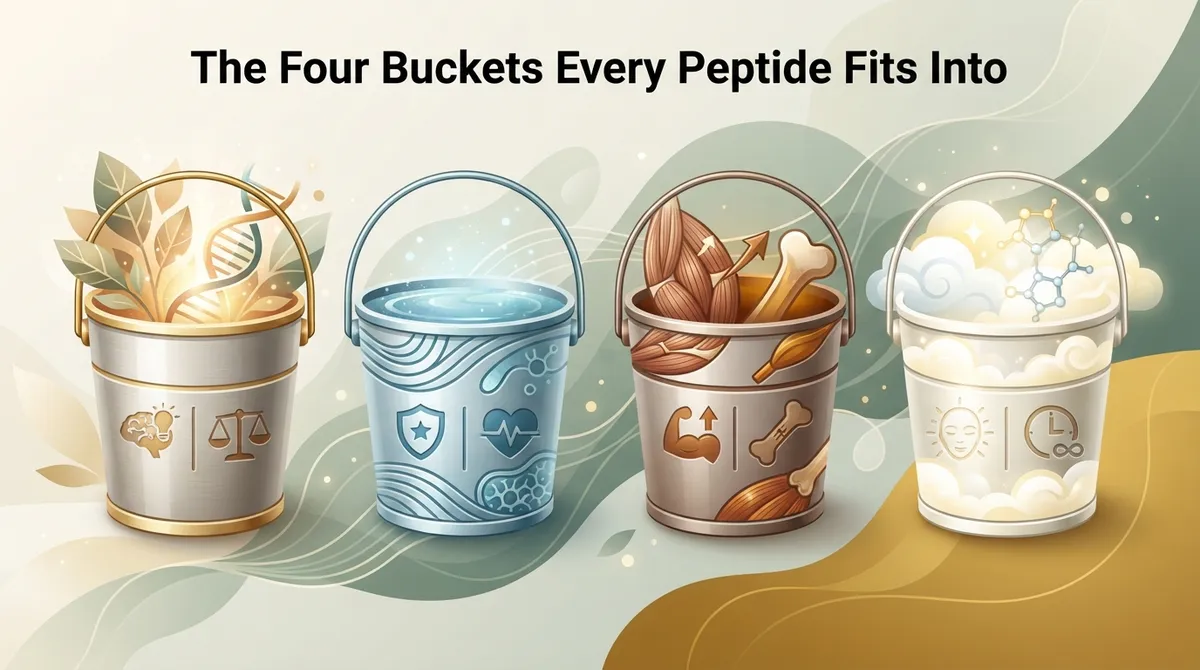
The Four Buckets Every Peptide Fits Into
Here is the single most helpful tool for judging any peptide product. Every peptide you will ever see offered falls into one of four buckets. Knowing the bucket tells you how much trust to give it.
| Bucket | What It Means | Oversight Level | Example |
|---|---|---|---|
| FDA-approved medicine | Reviewed by the FDA for a specific use, dose, and group of patients | High | Bremelanotide (Vyleesi) for a type of low desire in premenopausal women |
| Off-label use by a clinician | An approved drug used for a different purpose, guided by a licensed provider | Medium to high | A prescriber adjusting an approved medicine for a patient’s specific situation |
| Compounded preparation | Mixed by a pharmacy for an individual patient; not reviewed by the FDA for safety, effectiveness, or quality before marketing | Medium | Custom-prepared peptide formulations |
| Unapproved or online-sold product | Sold with no medical review, often labeled “research use only” | Low or none | Vials from websites with no prescriber |
The first bucket has the most proof behind it. The last has the least. Most of the confusion online happens when products from bucket four are marketed with the language of bucket one.
What Evidence Actually Exists for Women?
Let’s be fair and clear. Some peptide medicines have real, narrow, well-studied uses. Others are still being explored. Here is where things stand in 2026.
Bremelanotide for Low Desire
Bremelanotide (Vyleesi) is FDA-approved for acquired, generalized hypoactive sexual desire disorder (HSDD) in premenopausal women. That is a very specific condition. It is not approved for postmenopausal women, and it is not approved as a general boost for sexual performance. If this topic interests you, read about bremelanotide versus wellness peptides and what each can realistically do.
GLP-1 Medicines for Weight Management
Medicines such as semaglutide and tirzepatide have specific weight-management approvals. That is a real, evidence-based use. But it does not mean they treat menopause or other unrelated symptoms. If weight is your goal, see how you qualify for GLP-1 medication in 2026.
Peptides in Fertility Care
Certain peptide-based medicines have legitimate roles in fertility treatment when guided by a specialist. That is a very different world from wellness or anti-aging programs, and the two should never be mixed up. The use, the approval status, and the safety questions all differ by drug and treatment plan.
What About Menopause?
This one surprises many women. No peptide is FDA-approved to treat menopause itself. Peptides often promoted for menopause symptoms, such as BPC-157, CJC-1295, ipamorelin, and sermorelin, lack established clinical evidence for that purpose. If menopause is your concern, a clinician can talk with you about options that do have a long track record. Our article on menopause hormone therapy versus peptides offers a clear side-by-side look.
Meanwhile, a 2022 review indexed by the National Library of Medicine is a helpful place to see how researchers describe the broader promise and the limits of therapeutic peptides.
How to Judge Natural Peptide Therapy for Women: A Step-by-Step Checklist
Ready for the practical part? Use these seven steps any time you see a peptide offer that sounds exciting. Think of it as your friendly safety net.
- Name the exact peptide. “Peptide blend” or “natural women’s formula” is not good enough. You should know the exact compound, dose, and form.
- Ask which bucket it fits. Is it FDA-approved, off-label, compounded, or unapproved? A trustworthy provider will answer plainly.
- Match the use to the evidence. If a product claims to “balance hormones” or “reverse aging,” ask for the study. Claims should match what has actually been tested in women.
- Look for a licensed prescriber. A real clinician should review your history, medicines, and goals before anything is prescribed.
- Ask about labs. Good care starts with bloodwork, not guesses. See lab work for peptide therapy: what to test and why for what to expect.
- Check the source and quality. Ask where the product is made and how it is shipped and stored. Our guide to how peptide medications ship safely explains what good handling looks like.
- Plan follow-up. Ongoing monitoring is a sign of quality care. One-and-done sales are a red flag.
Red Flags vs. Green Flags
Sometimes a quick comparison makes things click. Here is a simple table you can screenshot and keep.
| Red Flags | Green Flags |
|---|---|
| “All-natural miracle peptide for every woman” | Specific peptide, specific purpose, specific dose |
| No prescriber, no questions, no labs | Licensed provider and baseline bloodwork |
| Vials labeled “research use only” | Clear explanation of approval or compounding status |
| Promises of fixing menopause, aging, and weight at once | Honest talk about what is known and what is not |
| No follow-up after you buy | Ongoing monitoring and plan adjustments |
Safety Notes Every Woman Should Know
Safety is the heart of this whole topic, so let’s slow down here.
The FDA states that compounded drugs are not FDA-approved and are not reviewed by the agency for safety, effectiveness, or quality before marketing. The FDA has also flagged potential concerns with certain bulk peptide substances proposed for compounding, including impurities and immune reactions. Its page on this topic was updated in April 2026, so the guidance is current.
That does not mean every compounded product is unsafe. It means quality and oversight matter a great deal, and you deserve a provider who is open about both.
Special Situations to Discuss With a Clinician First
- Pregnancy or trying to conceive. Many peptides have not been studied in pregnancy.
- Breastfeeding. Safety data is often limited or missing.
- Existing conditions or medicines. Some peptides can interact with other treatments.
- Past reactions to injections or medicines. Your history shapes which options may fit.
For a deeper look at risk and who should pause, see how to spot peptide therapy contraindications safely and how to weigh the risks of peptide therapy safely.
Where Personalized Telehealth Care Fits In
So, can peptide therapy still be a smart choice for women who want to feel their best? Yes, when it is done the right way. Personalized, medically supervised care looks very different from buying a mystery vial online.
At Allura Longevity, care begins with a $50 virtual consultation. From there, you complete blood work through LabCorp, and a licensed provider designs a customized six-month plan based on your labs and your goals. Your treatment is delivered to your door, and your team monitors progress and adjusts the plan along the way. Care is led by Ashley, a board-certified Family Nurse Practitioner, and telehealth is available in Florida, Georgia, Texas, Connecticut, Indiana, Maryland, New York, and California.
This approach is especially helpful for busy professionals who cannot spend hours in waiting rooms, and for data-minded health optimizers who want their plan guided by real numbers. If you like to see how a plan is built, read about how a peptide therapy plan gets personalized and what to know about an online peptide clinic for women.
Setting Realistic Expectations
Let’s keep it real and kind. Even with the right plan, peptide therapy is not magic. Results vary from person to person, and timelines matter. Here is a rough way to think about progress, always guided by your own provider.
| Phase | What Usually Happens |
|---|---|
| Before you start | Consultation, health history review, and baseline labs |
| First weeks | Getting comfortable with your routine; early check-ins on how you feel |
| Months 2 to 4 | Many people start noticing changes; your provider reviews progress and tweaks the plan |
| Months 5 to 6 | Full plan review, updated labs, and decisions about next steps |
For a closer look at timing, see a realistic peptide therapy timeline in 2026. And remember, lifestyle basics such as sleep, protein, movement, and stress care still matter a lot. Peptides work best as part of a bigger picture, not as a replacement for it.
Common Mistakes to Skip
You are already ahead by reading this far. Here are a few common slips to avoid:
- Buying peptides online without a prescriber.
- Assuming “natural” means “gentle” or “risk-free.”
- Skipping bloodwork because it feels like extra work.
- Mixing several peptides at once without medical guidance.
- Expecting one peptide to fix menopause, weight, skin, and mood.
Want a head start on your first visit? Check out 15 peptide consultation questions to ask so you walk in confident.
Your Next Step
Natural peptide therapy for women is not one single thing. It is a wide label that can cover approved medicines, carefully supervised plans, and products with little oversight. The smartest move is to look past the word “natural” and focus on the details: the exact peptide, the evidence, the prescriber, the labs, and the follow-up.
When you ask those questions, you protect your health and your wallet, and you give yourself the best shot at real results. You do not have to figure it out alone, either. If you are ready for a personalized, medically supervised plan delivered to your home, request a consultation with Allura Longevity or call (813) 510-6277. Spots for new clients are limited each month, so reach out while there is room. You deserve care that is thoughtful, honest, and built around you.
FAQs
Q: What does “natural peptide therapy” mean for women?
A: It is not a standard medical term. Peptides are short chains of amino acids, and some occur naturally in your body, while peptide medicines may be made or modified in a lab. The word “natural” does not tell you whether a product is safe, approved, or effective, so always look at the exact peptide and its intended use.
Q: Is there a peptide treatment for menopause symptoms?
A: No peptide is FDA-approved to treat menopause itself. Peptides often promoted for this purpose, such as BPC-157, CJC-1295, ipamorelin, and sermorelin, lack established clinical evidence for menopause. A licensed clinician can walk you through options that do have a strong track record.
Q: Are compounded peptides safe and FDA-approved?
A: Compounded drugs are not FDA-approved, and the FDA does not review them for safety, effectiveness, or quality before they are marketed. The FDA has also raised concerns about impurities and immune reactions with certain bulk peptide substances. That is why working with a licensed provider who is open about sourcing and quality matters so much.
Q: Who can use bremelanotide (Vyleesi)?
A: Bremelanotide is FDA-approved for acquired, generalized hypoactive sexual desire disorder (HSDD) in premenopausal women. It is not approved for postmenopausal women or for general sexual-performance enhancement. A clinician can tell you whether it fits your situation.
Q: Can I use peptide therapy while pregnant, breastfeeding, or trying to conceive?
A: Please talk with a licensed clinician first. Many peptides have not been well studied in pregnancy or breastfeeding, and some can affect fertility treatment. Your provider can help you decide what is safest for your plans.





