
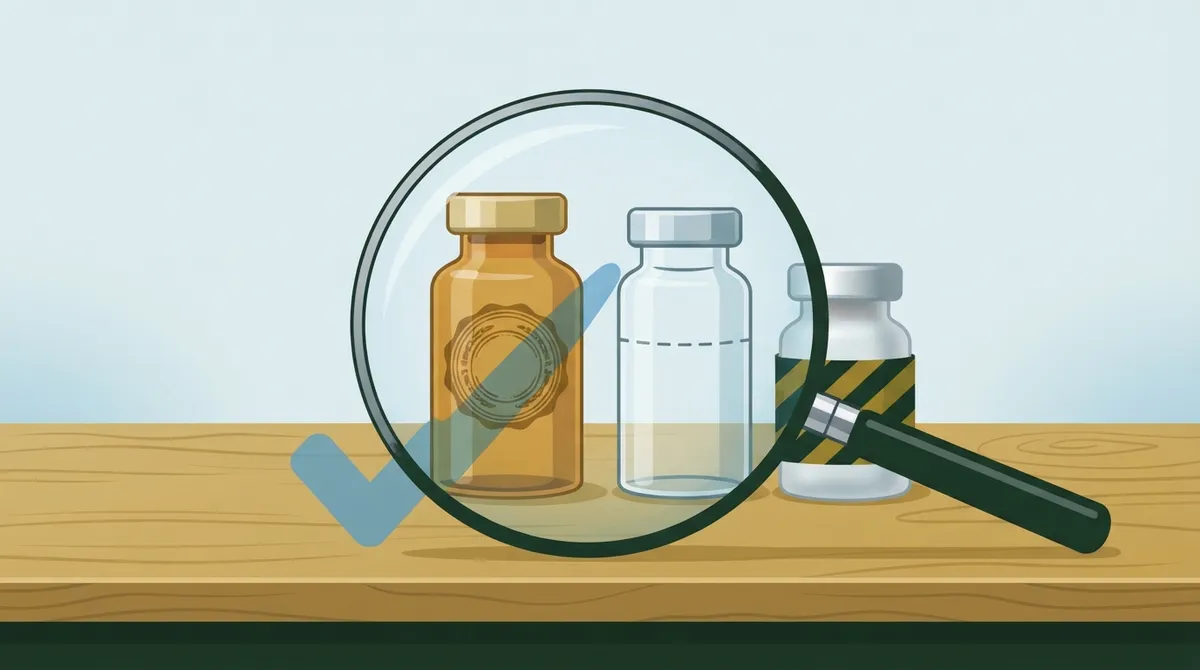
Key Takeaways
-
The phrase "FDA recognized peptide therapy" is a marketing term, not an official FDA category. The FDA approves specific drugs for specific uses, not peptide therapy as a whole.
-
Peptides fall into three groups: FDA-approved drugs (like insulin, semaglutide, tirzepatide, teriparatide), compounded drugs (not reviewed by FDA for safety or quality), and "research use only" products (not approved for human use).
-
Verify any peptide by searching the exact product name in the FDA's Drugs@FDA database, then check whether your goal matches the labeled approved use.
-
BPC-157, TB-500, CJC-1295, and ipamorelin should not be described as FDA-approved; the FDA has raised concerns about limited human evidence, impurities, and possible immune reactions.
-
An FDA advisory committee recommendation is not approval and does not by itself authorize routine compounding; check current FDA records because rules can change.
-
Red flags include claims of "FDA approved" clinics, no blood work before treatment, guaranteed fast results, and no prescriber or pharmacy information; green flags include lab testing, licensed providers, and ongoing monitoring.
You have probably seen the phrase “FDA recognized peptide therapy” on a clinic website or in a social media ad. It sounds reassuring, right? Here is the catch: the FDA does not hand out a badge called “recognized peptide therapy.” It is a marketing phrase, not an official category.
That does not mean you are stuck guessing. Some peptide medicines are fully FDA-approved. Others are compounded by pharmacies. Still others are sold online with little oversight at all. Knowing the difference helps you ask smarter questions and protect your health.
If you are a health optimizer, a busy professional, or someone who loves data and labs, this guide is for you. We will walk through what the phrase really means, how to check any peptide yourself, and which red flags to watch for. Think of it as a friendly checklist you can use before you commit to any plan. If you want a refresher first, start with 8 Facts That Explain What Are Peptides in 2026.

What Does “FDA Recognized Peptide Therapy” Really Mean?
The short answer: nothing official. The FDA approves specific drugs for specific uses. It does not approve a whole wellness category called peptide therapy. When a website uses the phrase fda recognized peptide therapy, it may be stretching the truth.
Approval is narrow. It applies to one product, made a certain way, for a certain labeled use. A clinic cannot borrow that approval for every peptide it offers.
Approved, compounded, and research-only: three different worlds
Most peptide products fall into one of three groups. Each one has a very different level of review.
| Category | FDA Review | Typical Example | What It Means for You |
|---|---|---|---|
| FDA-approved drug | Reviewed for safety, effectiveness, manufacturing, and labeling for a specific use | Insulin, semaglutide, tirzepatide, teriparatide | Strongest evidence for the labeled use |
| Compounded drug | Not reviewed for safety, effectiveness, or quality before it is sold | Custom-prepared peptide from a pharmacy | Prescribed for one patient’s need; quality depends on the pharmacy |
| “Research use only” product | Not approved for human use | Vials sold online with no prescriber | No assurance of safety, purity, or legality for people |
Notice how the phrase “recognized” does not appear anywhere in that table. That is the point.

Which Peptide Medicines Are Actually FDA-Approved?
Plenty of peptide-based medicines are approved. They are just approved for specific conditions. Here are some well-known examples.
| Peptide Medicine | General Approved Area |
|---|---|
| Insulin products | Blood sugar control in diabetes |
| Semaglutide | Type 2 diabetes and chronic weight management (by product) |
| Tirzepatide | Type 2 diabetes and chronic weight management (by product) |
| Teriparatide | Osteoporosis treatment |
| Oxytocin | Labor and delivery uses |
| Desmopressin | Certain urinary and bleeding conditions |
Each product has its own label. Approval for diabetes does not equal approval for every wellness goal. If you are curious how these drugs work, see How to Understand GLP-1 Peptide Therapy in 2026.
What approval does and does not tell you
FDA approval generally means the agency reviewed evidence of safety and effectiveness for the approved use. It also looks at how the drug is made and labeled. That is a strong foundation.
But approval does not mean a drug is right for every person. It also does not cover off-label wellness claims. Your provider still needs to look at your labs, history, and goals.
What About BPC-157, TB-500, CJC-1295, and Ipamorelin?
These are popular names in the wellness world. Here is the honest picture: they should not be described as FDA-approved therapies. Being talked about a lot online is not the same as being approved.
The FDA has raised concerns about certain bulk substances considered for compounding. These include limited human evidence, trouble fully characterizing the peptide, impurities, and possible immune reactions. These concerns are specific to each substance, so you cannot paint them all with one brush.
Want the details on each? These guides can help: Is BPC-157 Safe? What the Research Really Shows, 13 Facts About TB-500 Peptide You Need in 2026, and Ipamorelin Peptide Therapy: Benefits, Dosing & Safety.
The advisory committee trap
Here is a point that trips up a lot of people. In July 2026, reports say the FDA’s Pharmacy Compounding Advisory Committee considered seven peptide groups. It reportedly recommended six for possible inclusion on a compounding list and rejected emideltide.
That is an advisory recommendation. It is not FDA approval. It also does not, by itself, authorize routine compounding. The FDA must take the next regulatory step. Rules can change, so always check current FDA records before you trust a claim.
There is also news that federal health leaders are moving to allow temporary sale of some unapproved peptides. Even then, “allowed to be sold” is not the same as “approved.” Keep those two ideas separate in your mind.
How to Verify FDA Recognized Peptide Therapy: A Step-by-Step Checklist
Ready to play detective? You do not need a medical degree. Follow these steps for any peptide you are considering.
- Get the exact name. Ask for the full product name, not just a nickname or a stack name.
- Search Drugs@FDA. Look up the name on the FDA’s Drugs@FDA database. If it is approved, you will see the label and approved uses.
- Read the approved use. Does your goal match the labeled indication? If not, the use is off-label.
- Ask if it is compounded. If it is not an approved product, ask which pharmacy prepares it and under what rules.
- Confirm a licensed prescriber. A real clinic uses a licensed provider who reviews your history and labs.
- Look for monitoring. Good care includes follow-ups, not just a vial in the mail.
- Get claims in writing. If a site says “FDA recognized,” ask exactly what that means and what record supports it.
For a deeper look at the approved versus compounded debate, read FDA-Approved vs. Compounded Peptides: What Wins? and How to Verify FDA Approval Before Peptide Therapy.
Can a Compounding Pharmacy Make Non-Approved Peptides?
Compounding is allowed under specific federal and state rules. It is generally meant to meet an individual patient’s medical need when an approved drug cannot do so. It is not a free-for-all.
The FDA does not review each compounded preparation for safety, effectiveness, or quality before it is marketed. That puts extra weight on the pharmacy and the prescriber. You can learn the difference between pharmacy types in 503A vs. 503B: Which Peptide Compounding Wins?, and get more background in 4 Compounded Peptides Facts You Need in 2026.
A quick word on “research use only”
Products labeled “research use only” are not approved or shown to be safe for human use. A label like that is a legal shield for the seller, not a green light for you. Avoid them, and be cautious with any seller who skips the prescriber step.
Red Flags and Green Flags to Watch For
Use this simple list to size up any peptide provider fast.
Red flags:
- Claims like “FDA approved clinic” or “FDA endorsed protocol”
- No blood work or health history before treatment
- Promises of fast, guaranteed results
- Products with no prescriber, label, or pharmacy information
- Pressure to buy stacks of peptides on day one
Green flags:
- Clear language about what is approved and what is compounded
- Licensed providers who explain risks and limits
- Lab testing before and during treatment
- Ongoing check-ins and dose adjustments
- Willingness to say “the evidence is limited here”
For more safety signals, see How Do You Know Online Peptide Therapy Is Safe? and How to Find Legal Peptide Therapy You Can Trust.
What Good Peptide Care Looks Like in Practice
Safe peptide care follows a pattern. First comes a conversation about your goals, like energy, sleep, recovery, or weight. Next come labs, so your plan is built on data and not guesses. Then a licensed provider designs a plan and checks in as you go.
This is the model Allura Longevity uses. It is a telehealth clinic offering personalized, medically supervised peptide therapy. Clients start with a $50 virtual consultation, complete blood work through LabCorp, and receive a customized six-month plan delivered to their home. Ongoing monitoring and adjustments come from licensed providers, led by Ashley, a board-certified Family Nurse Practitioner.
Notice what that does not say. It does not claim every peptide is FDA-approved. A trustworthy clinic is upfront about what is approved, what is compounded, and why a plan fits you. You can read more about the process in How to Start Peptide Therapy Safely and See Real Results and How to Get Prescription Peptides Safely in 2026.
Questions to Ask Before You Start
Bring this short list to your consult. A good provider will welcome it.
- Is this exact product FDA-approved, and for what use?
- If it is compounded, which pharmacy makes it and how is quality checked?
- What does the evidence say about my specific goal?
- What labs will you run, and how often?
- What side effects should I watch for, and who do I call?
Want a longer list? Check out 15 Peptide Consultation Questions to Ask in 2026. And if you like to see how real research is weighed, the National Library of Medicine is a solid place to read studies, while what are peptides offers a plain-language overview.
For another trustworthy data source, you can search official drug records directly at Drugs@FDA. It is free, and it takes about two minutes.
Final Thoughts: Be Curious, Not Confused
The phrase fda recognized peptide therapy sounds official, but it is not. What matters is the specific product, its approved use, and the quality of the care wrapped around it. Ask for names, check the FDA database, and choose providers who are honest about the gray areas.
You deserve clear answers and a plan built around your own labs and goals. If you are ready to talk it through with licensed providers who will explain exactly what is approved, what is compounded, and what fits you, request a consultation with Allura Longevity or call (813) 510-6277. Allura is licensed in Florida, Georgia, Texas, Connecticut, Indiana, Maryland, New York, and California, and spots for new clients are limited each month.
FAQs
Q: What does “FDA recognized peptide therapy” mean?
A: It is a marketing phrase, not a formal FDA category. The FDA approves specific drugs for specific uses, not peptide therapy as a whole. If you see the phrase, ask which exact product is approved and look it up yourself.
Q: Are BPC-157, TB-500, CJC-1295, or ipamorelin FDA-approved?
A: No, they should not be described as FDA-approved therapies. The FDA has raised concerns about certain bulk substances, including limited human evidence, impurities, and possible immune reactions. Always talk with a licensed provider about the evidence for your goal.
Q: Does an FDA advisory committee recommendation mean a peptide is approved?
A: Nope! A committee recommendation is advice, not approval, and it does not by itself authorize routine compounding. The FDA still has to take regulatory action, and rules can change, so check current FDA records.
Q: How can I check whether a peptide drug is FDA-approved?
A: Search the exact product name in the Drugs@FDA database. If it is approved, you will see its label and approved uses. If you cannot find it, ask your provider whether it is compounded and how it is made.
Q: Are peptides sold as “research use only” safe for human use?
A: No. That label means the product is not approved or established as safe for people. It is best to skip these and work with a licensed provider who prescribes from a reputable pharmacy.





