
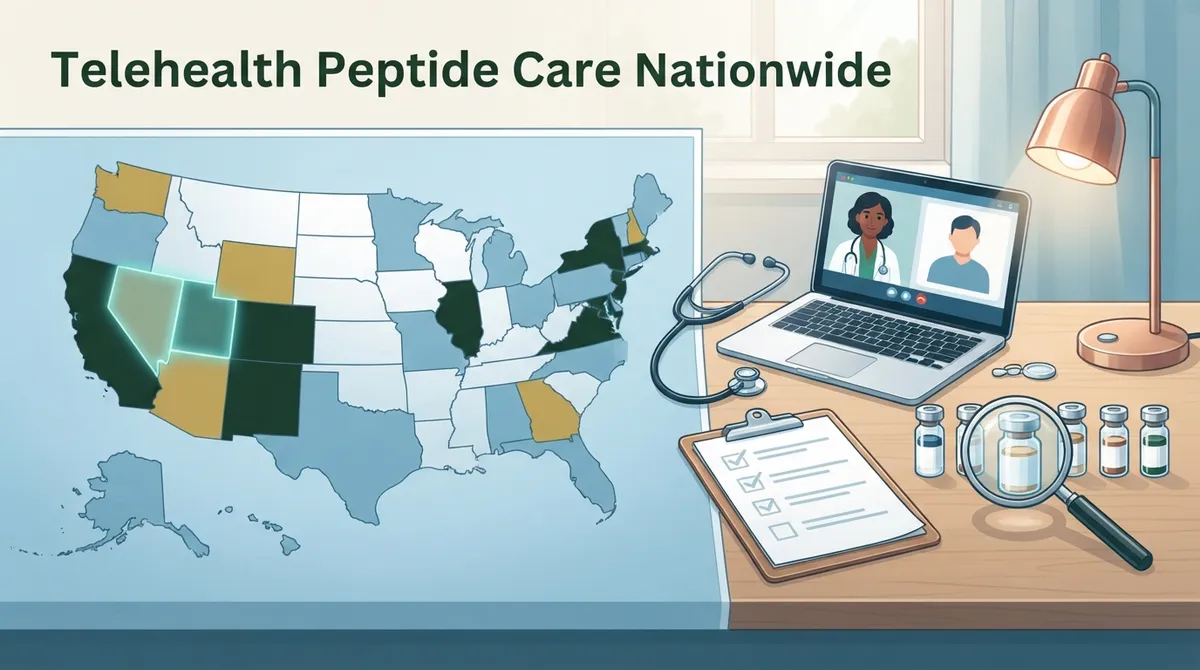
Key Takeaways
-
"Nationwide" usually means many states where a clinic is licensed, not all 50; your provider must be licensed in the state where you are physically located during the visit.
-
Compounded peptides are not FDA-approved, and the FDA does not review them for safety, effectiveness, or quality before they are marketed.
-
A legitimate telehealth visit should include a real clinician-patient relationship: history review, risks and alternatives explained, labs, and a follow-up plan, not just a quiz.
-
The word "peptide" alone doesn't indicate safety or legality; each product and intended use must be checked individually, and the FDA has raised concerns about some bulk peptides like TB-500.
-
Ask the provider which pharmacy prepares your medication, how quality is checked, and whether each product is FDA-approved or compounded before starting.
-
Good peptide care is personalized to lab results and goals and includes ongoing monitoring, with red flags like guaranteed fast results or 'FDA-approved' claims for compounded products.
Imagine getting a peptide therapy plan without sitting in a waiting room. You talk to a licensed provider from your couch, get your labs done nearby, and have your treatment shipped to your front door. That is the promise of telehealth peptide care nationwide, and it sounds pretty great, right?
Here is the catch. The word “nationwide” does not mean what many people think it means. It does not mean one clinician can prescribe to all 50 states. It also does not mean every peptide you see online is approved, safe, or legal to prescribe.
So let’s slow down and sort this out together. Whether you are a busy professional, a biohacker who loves lab data, or someone in midlife who wants to feel like yourself again, this guide will help you spot real care from loud marketing. We will walk through six truths that matter most in 2026. If you want a primer first, check out 8 Facts That Explain What Are Peptides in 2026.
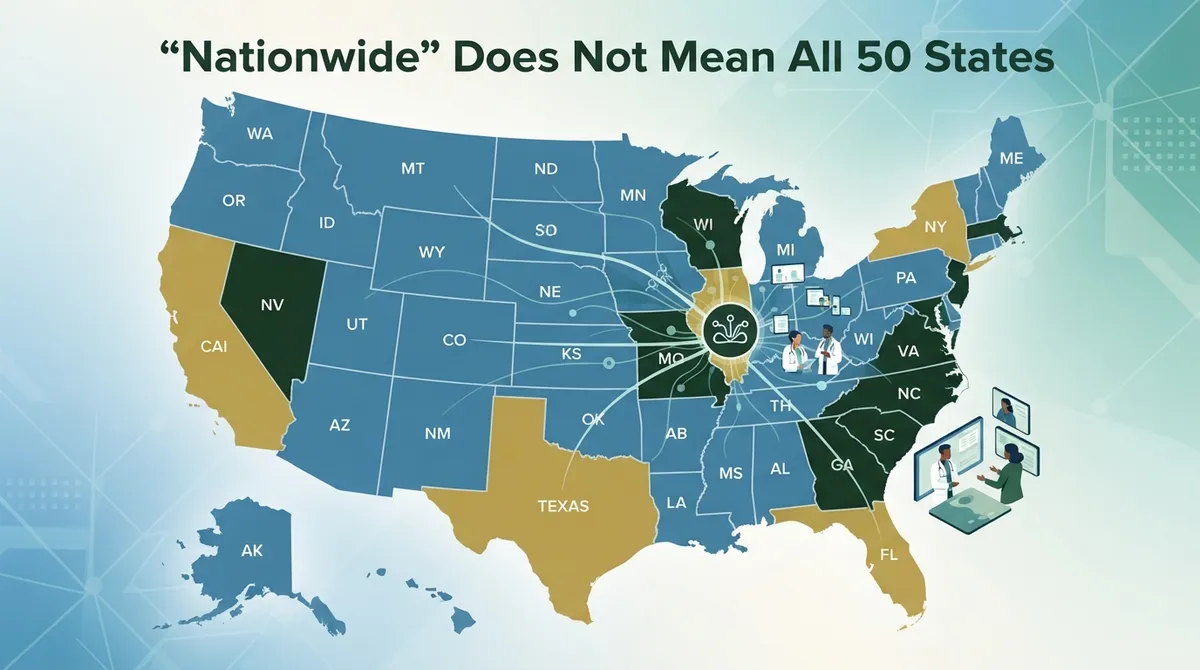
Truth 1: “Nationwide” Does Not Mean All 50 States
When a clinic says it offers telehealth peptide care nationwide, it usually means it serves patients in many U.S. states. It does not mean every provider can treat anyone anywhere.
Telehealth follows a simple rule. A provider generally needs a license or other state authorization where the patient is physically located during the visit. If you are sitting in Texas, your provider needs to be authorized in Texas. A weekend trip to another state can change that, too.
State rules also cover prescribing, standard of care, and follow-up. So “nationwide” is best read as “many states, where we are licensed.” Always ask which states a provider covers before you book.
How to Check Coverage in Your State
Here is a quick way to verify that you are in good hands:
- Ask the clinic for a list of states where it is licensed.
- Confirm your provider holds a license for the state you are in during the visit.
- Look up the provider on your state licensing board website.
- Ask how care works if you travel or move.
For a deeper look at this topic, see Which States Allow Telehealth Peptide Prescriptions?

Truth 2: A Telehealth Visit Is Still Real Medical Care
Some people assume a video visit is a shortcut. It is not. A remote visit does not remove ordinary clinical or prescribing duties.
A legitimate telehealth evaluation should create a real clinician-patient relationship. That means a provider reviews your history, assesses your health, explains risks and alternatives, and sets up a follow-up plan.
Think of it like a regular doctor visit, just without the commute. If a site hands you a peptide after a two-minute quiz, that is a red flag worth noticing.
What a Good Consultation Includes
- A full health and medication history
- A conversation about your goals, like energy, sleep, recovery, or weight
- A review of recent lab work or an order for new labs
- A clear talk about benefits, risks, and other options
- A plan for monitoring and follow-up
Curious what the first appointment feels like? Read What Really Happens During a Peptide Telehealth Visit?
Truth 3: “Peptide” Is Not One Single Treatment
Peptides are short chains of amino acids. That is a broad family, not a single product. Some are FDA-approved medicines with specific uses. Others are sold online as wellness, anti-aging, recovery, or performance products without approval for those uses.
This is where many people get tripped up. The word “peptide” does not tell you whether something is approved, studied, or even lawful to prescribe. You have to look at each specific product and each specific use. You can read a plain-language overview on what are peptides from WebMD.
| Category | What It Means | What to Ask |
|---|---|---|
| FDA-approved peptide medicines | Approved for specific uses with official prescribing information | Is it approved for my condition? |
| Compounded peptides | Made by a pharmacy for an individual prescription; not FDA-approved | Which pharmacy, and how is quality checked? |
| Online “research” or wellness peptides | Often limited human safety data and unclear legal status | Is a licensed clinician involved at all? |
To go deeper, see FDA-Approved vs. Compounded Peptides: What Wins?
Truth 4: Compounded Does Not Mean FDA-Approved
This one is important, so let’s say it plainly. Compounded drugs are not FDA-approved. The FDA does not review compounded products for safety, effectiveness, or quality before they are marketed.
That does not make every compounded medicine unsafe. Compounding can serve real patient needs when done properly. But it does mean no one should call a compounded product “FDA-approved,” a “generic equivalent,” or proven to work the same as an approved drug.
The FDA has also warned telehealth companies about misleading ads. Marketing should never imply FDA approval or suggest that a pharmacy is “FDA-approved” or “FDA-licensed.” If you see language like that, pause and ask more questions.
503A vs. 503B in Plain English
You may hear these two terms when you ask about pharmacy sourcing. Here is a simple breakdown:
| Feature | 503A Pharmacy | 503B Outsourcing Facility |
|---|---|---|
| Basic idea | Compounds for an individual patient with a prescription | Larger facility with separate FDA requirements |
| Oversight | Mainly state pharmacy rules plus federal conditions | Registered with FDA and subject to inspections |
| Important note | Products are not FDA-approved | Registration does not mean products are FDA-approved |
Want the full comparison? Read 503A vs. 503B: Which Peptide Compounding Wins?
Truth 5: Not Every Peptide Online Is Safe or Lawful to Prescribe
Just because a peptide is easy to find does not mean it is safe. The FDA has raised concerns about certain bulk peptides proposed for compounding. For example, it flagged TB-500 because of limited human safety information and possible risks like immune reactions and impurities.
Each substance has its own legal status and its own evidence. You cannot assume BPC-157, TB-500, CJC-1295, or any other peptide is fine just because it appears in an online shop or is described as “compounded.” For more reading, see 13 Facts About TB-500 Peptide You Need in 2026 and Is BPC-157 Safe and Legal for Athletes to Use?
You can also explore the research landscape through the National Library of Medicine, which hosts peer-reviewed studies on peptide therapeutics.
Safety Questions to Ask Before You Start
- Is this specific peptide FDA-approved for my use, or is it compounded?
- What does the human research actually show?
- Which pharmacy prepares it, and how do you verify quality?
- What side effects should I watch for?
- How will you monitor me over time?
Safety is the whole game here. Our guide Is Peptide Therapy Safe? What You Really Need to Know covers the basics in a friendly way.
Truth 6: Personalization, Labs, and Follow-Up Make the Difference
The best telehealth peptide care feels personal. It starts with your numbers, your goals, and your history, not a one-size-fits-all menu.
For biohackers and data lovers, that means lab work guides the plan. For busy professionals, it means a plan that fits your schedule and arrives at your door. For aging adults and wellness seekers, it means a provider who listens, explains, and adjusts as you go.
Good care also keeps going after the first shipment. Ongoing check-ins help your provider spot side effects, track progress, and tweak your plan. Learn more in 5 Blood Work Analysis Steps Before Peptides in 2026 and 14 Telehealth Check-In Mistakes That Slow Peptide Results.
Quick Comparison: Red Flags vs. Green Flags
| Red Flags | Green Flags |
|---|---|
| No provider names or credentials listed | Licensed providers clearly identified |
| Skips labs and medical history | Uses blood work to guide your plan |
| Claims products are “FDA-approved” when compounded | Explains approval status honestly |
| Promises dramatic results fast | Sets realistic expectations and timelines |
| No follow-up plan | Ongoing monitoring and adjustments |
How to Verify a Telehealth Peptide Provider
Ready to do your homework? Here is a simple checklist you can use with any provider:
- Confirm licensure. Check that the clinician is licensed in your state.
- Ask about credentials. Look for board-certified or licensed medical providers.
- Ask about the pharmacy. Find out where products are prepared and how quality is checked.
- Request clear status info. Ask whether each product is FDA-approved or compounded.
- Review the plan. Make sure labs, risks, alternatives, and follow-up are all covered.
For more ideas, our article 6 Ways to Spot a Licensed Telehealth Peptide Provider goes step by step. And if you are comparing options, Local Clinic vs. Telehealth: Best Peptide Therapy Near You? can help.
Where Allura Longevity Fits In
Allura Longevity is a telehealth wellness clinic that offers personalized, medically supervised peptide therapy. The team is led by Ashley, a board-certified Family Nurse Practitioner, and care is built around your goals and your lab results.
Here is how it works. You start with a $50 virtual consultation. Next, you complete blood work through LabCorp. Then your licensed provider builds a customized six-month plan, and your treatment is delivered to your home. Ongoing monitoring and adjustments keep your plan on track.
Allura Longevity is licensed in Florida, Georgia, Texas, Connecticut, Indiana, Maryland, New York, and California. Services focus on energy, sleep, mental clarity, immune support, skin rejuvenation, muscle recovery, metabolism, sexual wellness, GLP-1 weight loss, BPC-157 for injury recovery, and testosterone replacement. You can explore options like peptides for women and peptides for men.
New client spots are limited each month, so if you are curious, it helps to ask early.
Final Thoughts: Choose Care You Can Trust
Telehealth peptide care nationwide can be a wonderful way to get expert guidance without rearranging your whole life. The key is knowing what to look for. Check state licensing, ask about each peptide’s approval status, understand compounding, and look for real labs and real follow-up.
You deserve clear answers and honest care. If you are ready to see whether a personalized plan fits your goals, request a consultation with Allura Longevity or call (813) 510-6277. We would love to help you take the next step with confidence.
FAQs
Q: Can I get peptide therapy through telehealth in my state?
A: Maybe! It depends on whether a provider is licensed in the state where you are physically located during your visit. Ask any clinic for its list of licensed states before you book. Allura Longevity is licensed in Florida, Georgia, Texas, Connecticut, Indiana, Maryland, New York, and California.
Q: Are compounded peptides FDA-approved?
A: No, compounded drugs are not FDA-approved, and the FDA does not review them for safety, effectiveness, or quality before marketing. That is why it is smart to ask your provider which pharmacy prepares your medication and how quality is checked.
Q: What should a telehealth peptide consultation include?
A: A good visit covers your medical history, goals, current medications, and lab results. Your provider should also explain risks, benefits, and alternatives, then set up a follow-up plan so you are never left guessing.
Q: How do I verify a telehealth peptide provider?
A: Start by checking that the clinician is licensed in your state and has real credentials. Then ask which pharmacy supplies your medication and whether each product is FDA-approved or compounded. A trustworthy provider will happily answer these questions.
Q: Are peptides like BPC-157, TB-500, or CJC-1295 approved for human use?
A: Each peptide has its own legal and evidence status, and many are not FDA-approved for the uses promoted online. The FDA has raised safety concerns about some, including TB-500. Always ask your provider to explain the status and research behind any specific peptide.





