

Key Takeaways
-
Your provider reviews your full health history, medications, supplements, and goals before any testing or treatment decision, so share every medication and supplement, even over-the-counter ones.
-
Baseline labs should be ordered for a clinical reason, not as a standard panel; common tests include blood counts, metabolic and glucose measures, lipids, and hormone-related markers.
-
Do not start unprescribed peptide products, including 'research chemicals,' while waiting for results; your lab data should guide your plan.
-
Compounded peptides are not FDA-approved; ask exactly what drug you are getting, whether it is FDA-approved for your goal, and how it is sourced.
-
A 'not yet' or 'not this one' from your provider is a sign of careful care; treatment may be delayed, adjusted, or replaced with another approach.
-
Report injection-site redness, swelling, or pain that worsens, allergic signs like hives or trouble breathing, and any concerning symptoms; seek urgent care for severe or sudden problems.
You booked the consultation. You answered the questions. You talked through your goals with a licensed provider. Now what? If you are wondering what happens after a peptide consultation, you are in good company. Most people walk away feeling hopeful but a little unsure about the next steps.
Here is the good news: the process is more straightforward than it looks. It usually moves from a consultation to testing, then to a results review, then to a treatment decision, and finally to follow-up. There is no single universal protocol, and the exact path depends on you, the medication being considered, and the clinic.
This guide walks through each stage in plain language. Whether you are a busy professional squeezing care into a packed week, a data-driven biohacker who loves a good lab report, or someone simply looking to feel more energized as you age, you will know what to expect. You will also learn which questions to ask so you stay in the driver’s seat the whole way.
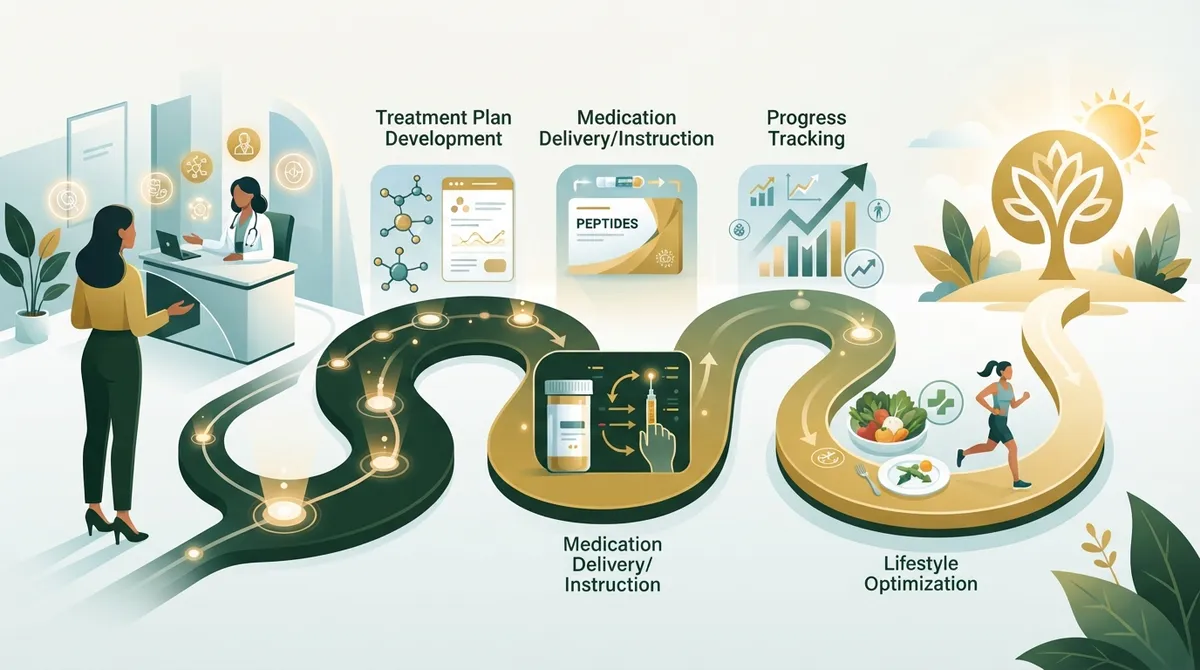
The Short Answer: Your Post-Consultation Roadmap
After a peptide consultation, the clinician reviews your history and the conversation, decides what tests make sense, reviews results with you, and only then decides whether treatment is appropriate. If it is, you get a prescription, clear instructions, and a monitoring plan.
Think of it as a series of checkpoints, not a single leap. Each one exists to keep you safe and to make sure any plan fits you personally.
| Stage | What Usually Happens | What You Do |
|---|---|---|
| 1. Review | Provider reviews your history, goals, and any exam findings | Share complete health details |
| 2. Testing | Provider orders or reviews baseline labs, if clinically useful | Complete blood work |
| 3. Results discussion | Provider explains findings and whether treatment fits | Ask questions |
| 4. Treatment decision | Provider prescribes, adjusts, or recommends against | Review risks and alternatives |
| 5. Start and monitor | You begin and check in on a schedule that fits your plan | Report symptoms and side effects |

Step 1: Your Provider Reviews Your Health Picture
Right after your consultation, your clinician pulls together everything you shared. That includes your medical history, current medications, supplements, symptoms, and goals.
This review matters because peptides are not one-size-fits-all. Some people want better recovery. Others want help with sleep, skin, metabolism, or sexual wellness. A good provider looks at the whole picture before choosing a direction.
This is also where a clinician may decide that more information is needed. Or that a particular approach is not a good fit. Hearing “not yet” or “not this one” is a sign of careful care, not a setback.
What Helps You Get the Most Out of This Step
- Share every medication and supplement you take, even over-the-counter ones
- Mention past reactions to injections or medications
- Be honest about your goals and your timeline
- Tell your provider about any chronic conditions or family history
Step 2: Baseline Testing Comes Next
Many peptide programs include baseline lab work. Testing should be chosen for a clinical reason, not run as a standard panel for everyone. In some cases, recent results you already have may be useful.
Commonly discussed tests can include blood counts, metabolic and glucose measures, lipids, and hormone-related markers. Which ones apply to you depends on your goals and the treatment being considered.
For the data lovers out there, this is the fun part. Labs give you a starting line, so you can see how things change over time. If you want a deeper look at why this matters, check out lab work for peptide therapy: what to test and why.
| Test Category | Why It May Be Ordered |
|---|---|
| Complete blood count | Gives a general view of blood health |
| Metabolic and glucose measures | Helps assess metabolic health and safety |
| Lipids | Provides a heart and metabolic health snapshot |
| Hormone-related tests | Used when hormone balance is part of your goals |
At Allura Longevity, clients complete blood work through LabCorp, which keeps things simple and consistent. You can read more about the process in 5 blood work analysis steps before peptides in 2026.
Step 3: How Long Do Lab Results Take?
This is one of the most common questions, and the honest answer is: it varies. Turnaround depends on the lab, the specific tests, and your clinic. There is no reliable, universal timeline.
While you wait, here are a few things you can do:
- Follow any fasting or prep instructions closely so your results are accurate
- Keep a simple journal of your energy, sleep, and mood
- Write down questions for your results appointment
- Avoid starting any unprescribed peptide products on your own
That last point is important. Buying peptides sold as “research chemicals” or without a valid prescription is risky. Your results should guide your plan, not the other way around.
Step 4: The Results Review Appointment
If your provider needs more information, the next step is often a results review before any treatment decision. This is your chance to see what the numbers say and ask what they mean.
A responsible plan should explain several things clearly:
- The intended medication and why it was chosen
- What the evidence shows, and where the evidence is limited
- Possible risks and side effects
- Alternatives to consider
- How progress will be monitored
- When to seek medical help
If anyone rushes past those points, pause and ask for more detail. You deserve a full conversation. A helpful resource to prepare is 15 peptide consultation questions to ask in 2026.
Step 5: The Treatment Decision
Now comes the big moment. Based on your history, labs, and goals, your provider decides whether peptide therapy is appropriate. There are a few possible outcomes:
- Treatment moves forward with a prescription and instructions
- More testing or time is needed before deciding
- A different approach is recommended, such as lifestyle changes or another therapy
Any of these can be the right answer. The goal is a plan that is safe and fits you, not a prescription at all costs.
FDA-Approved vs. Compounded: Know the Difference
This part deserves your attention. FDA-approved peptide medicines and compounded preparations are not interchangeable. Compounding is not FDA approval. Compounded drugs do not go through FDA premarket review for safety, effectiveness, and quality in the same way approved drugs do.
In addition, many peptides marketed by wellness or online clinics are not FDA-approved for the uses being advertised, and some have limited human evidence. The FDA has also flagged potential safety concerns for certain peptide substances, including immune reactions tied to impurities or aggregation.
So ask your provider directly: What exact drug is this? Is it FDA-approved for my purpose? How is it sourced? You can learn more in FDA-approved vs. compounded peptides: what wins? and how to verify FDA approval before peptide therapy.
For general background on peptides, the what are peptides overview is a helpful starting point, and the National Library of Medicine hosts peer-reviewed research you can explore.
Step 6: Getting Your Prescription and Starting Treatment
If treatment is appropriate, your clinician issues a prescription and explains how to obtain and use the medication. With telehealth, medication can be delivered right to your door, which is a big win for busy schedules.
Your plan should include clear instructions on:
- How to store the medication
- How and when to administer it
- How to handle injectable supplies safely
- What side effects to watch for
- Who to contact with questions
Injectable products need particular care around sterility, quality, and handling. If you are new to this, how to prepare for safe, effective peptide injections walks you through it. For delivery details, see how peptide medications ship safely from telehealth clinics.
Step 7: Follow-Up and Monitoring
Starting treatment is not the finish line. It is the beginning of an ongoing conversation with your provider.
Follow-up should be tailored to your medication and your health. It may include checking symptoms, side effects, how well you are sticking with the plan, and relevant lab measures. If something is not working or causes problems, your provider can change or stop treatment.
There is no evidence-based universal follow-up schedule for all peptides. So rather than expecting a set calendar, expect a plan that fits your situation. Ask early on how often you will check in and how to reach your care team between visits.
| What to Track | Why It Helps |
|---|---|
| Energy and sleep | Shows day-to-day impact |
| Side effects | Helps your provider adjust safely |
| Adherence | Reveals whether the plan fits your routine |
| Lab changes | Gives objective data over time |
Curious about timing? Results vary a lot from person to person. How long for peptide therapy results? A real timeline sets realistic expectations.
Warning Signs to Report to Your Provider
Reach out to your clinician promptly if you notice anything unusual after starting treatment. For anything severe or sudden, seek urgent medical care.
- Redness, swelling, or pain at an injection site that worsens
- Signs of an allergic reaction, such as hives or trouble breathing
- New or worsening symptoms that concern you
- Anything that feels off compared to what you were told to expect
Reporting early helps your provider keep you safe. It also helps them decide whether to adjust your plan. For a broader safety overview, read is peptide therapy safe? What you really need to know.
How Allura Longevity Handles the Post-Consultation Journey
At Allura Longevity, the process starts with a $50 virtual consultation. From there, clients complete blood work through LabCorp and receive a customized six-month treatment plan designed by licensed medical providers, led by Ashley, a board-certified Family Nurse Practitioner.
Medication is delivered to your home, and care includes ongoing monitoring and adjustments as you go. Telehealth care is available in Florida, Georgia, Texas, Connecticut, Indiana, Maryland, New York, and California. Whether you are exploring peptides for women or peptides for men, the approach stays personal and lab-guided.
If you want to see what the visit itself looks like, check out what really happens during a peptide telehealth visit. And if you are thinking about the bigger picture, how to start peptide therapy safely and see real results is a great companion read.
Smart Questions to Ask Before You Say Yes
You are allowed to take your time. Before agreeing to any plan, consider asking:
- What is the exact medication, and is it FDA-approved for my goal?
- Is this product compounded, and where is it made?
- What are the risks, and what is the evidence behind it?
- What alternatives could I consider?
- How will you monitor me, and how often?
- What happens if I want to pause or stop?
A trustworthy provider welcomes these questions. If you want a deeper checklist, how to get prescription peptides safely in 2026 covers what to look for.
Ready for Your Next Step?
Now you know what happens after a peptide consultation: a careful review, targeted testing, a results discussion, a thoughtful treatment decision, and personalized follow-up. Each step is designed to keep you informed and safe while you work toward your goals.
If you are ready to start the conversation, you can request a consultation with the Allura Longevity team. Spots for new clients are limited each month, so reach out while there is availability. You can also call (813) 510-6277 to talk it through. Your future self will thank you for taking that first step.
FAQs
Q: What tests might a clinician order after a peptide consultation?
A: It depends on your goals and the medication being considered. Common options include blood counts, metabolic and glucose measures, lipids, and hormone-related tests. Your provider should choose tests for a clinical reason, and sometimes recent results you already have can be used.
Q: Do I start peptide therapy right after the consultation?
A: Usually not right away. Most clinics review your history, check labs, and discuss results before deciding on treatment. That extra step helps make sure any plan is safe and a good fit for you.
Q: Are compounded peptides FDA-approved?
A: No. Compounding is not FDA approval, and compounded drugs do not go through FDA premarket review for safety, effectiveness, and quality the way approved drugs do. Ask your provider exactly which product you are getting and how it is sourced.
Q: How often should I follow up after starting a peptide medication?
A: There is no single schedule that fits every peptide or every person. Follow-up is individualized and may include checking symptoms, side effects, adherence, and relevant labs. Ask your provider upfront how often you will check in and how to reach them between visits.
Q: What side effects or warning signs should I report?
A: Report worsening redness, swelling, or pain at an injection site, signs of an allergic reaction like hives or trouble breathing, and any new or concerning symptoms. For anything severe or sudden, seek urgent medical care right away. Early reporting helps your provider keep you safe.





