

Key Takeaways
-
Prescription fat loss peptides like semaglutide (Wegovy) and tirzepatide (Zepbound) should be prescribed and monitored by a licensed clinician, as they are real medications with real precautions.
-
"Fat loss peptides" is a marketing term, not a regulated category, so products range from FDA-approved drugs to compounded versions to unapproved "research" peptides sold online.
-
Compounded semaglutide and tirzepatide are not FDA-approved and are not reviewed for safety, effectiveness, or quality, and the FDA has flagged dosing errors and hospitalizations linked to them.
-
Retatrutide and cagrilintide are not FDA-approved for weight loss, and "research peptides" sold online have no one verifying purity, strength, or sterility for human use.
-
A supervised plan screens for contraindications such as a personal or family history of medullary thyroid carcinoma or MEN 2 before any treatment begins.
-
Look for a real consultation, lab work, a clear dosing plan, licensed-pharmacy sourcing, ongoing check-ins, and easy access to your care team.
Let’s be honest: scrolling through social media these days, it feels like everyone has a “magic peptide” for fat loss. Maybe a friend swears by one. Maybe an online store promises results in weeks. It’s tempting, and it’s totally normal to wonder if you can just skip the doctor and order something yourself.
So, do fat loss peptides require medical supervision? In most cases, yes. The prescription peptide medicines used for weight management should be prescribed and monitored by a qualified clinician. That’s the short answer.
The longer answer is where it gets interesting. “Fat loss peptides” is a catch-all marketing phrase, not one regulated category. Some products are FDA-approved. Others are compounded. And some are sold as “research chemicals” that were never meant for people at all.
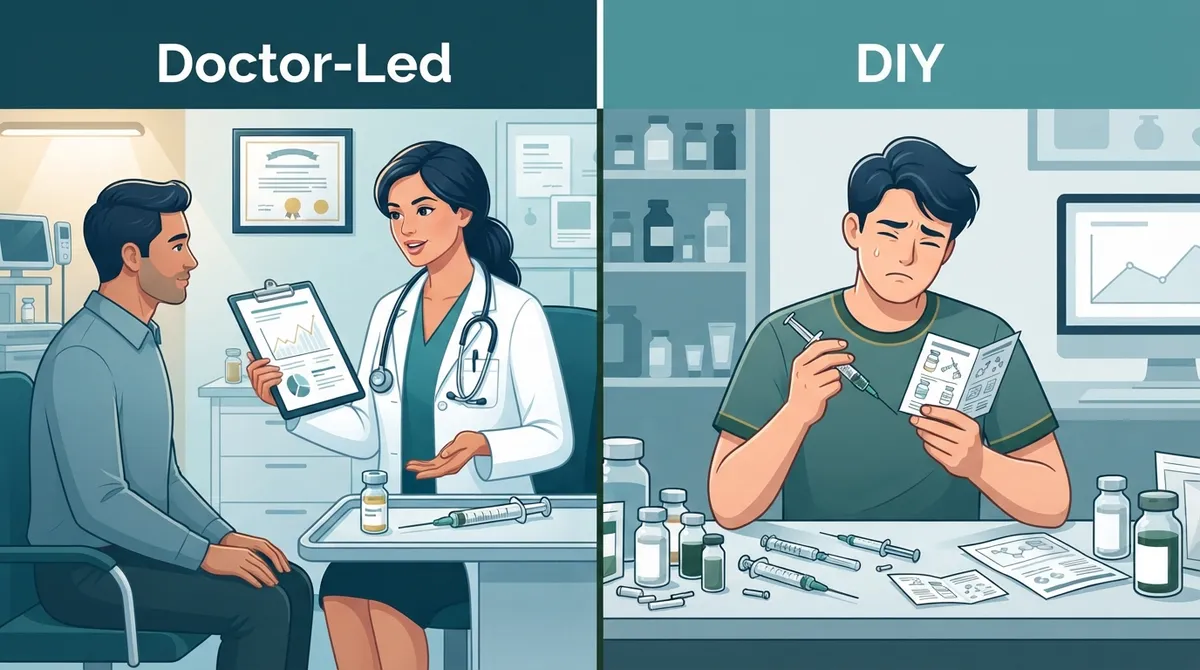
In this guide, we’ll compare two paths side by side: doctor-led care and do-it-yourself (DIY) use. You’ll learn what each really involves, where the risks hide, and how to pick the safer route. This is general information, not individual medical advice.

What Are Fat Loss Peptides, Really?
Peptides are short chains of amino acids. Your body makes thousands of them, and they act like tiny messengers. If you want a quick refresher, our guide on 8 Facts That Explain What Are Peptides in 2026 covers the basics, and what are peptides from WebMD gives a clear overview.
When people say “fat loss peptides,” they usually mean one of three things:
- FDA-approved peptide medicines such as semaglutide (Wegovy) and tirzepatide (Zepbound), which are approved for weight management.
- Compounded versions of those drugs, made by pharmacies and not reviewed by the FDA.
- “Research” peptides sold online, which are not approved for weight loss and may not be safe for human use.
That mix is exactly why supervision matters. The word “peptide” tells you very little about safety. The specific product, its source, and how it’s used tell you a lot more.
For a deeper look at which options have real evidence behind them, check out Which Weight Loss Peptides Actually Work in 2026?
Doctor-Led vs. DIY: A Side-by-Side Look
Think of it like this. Doctor-led care is a guided hike with a map and a trained guide. DIY is wandering into the woods because a stranger said the view is great. Both might end at the same spot. Only one has a safety plan.
| Factor | Doctor-Led Care | DIY Use |
|---|---|---|
| Eligibility check | Clinician reviews history, goals, and labs | Self-assessed, often guesswork |
| Product source | Prescribed through licensed pharmacies | Often unverified online sellers |
| Dosing | Set and adjusted by a provider | Self-measured, higher error risk |
| Monitoring | Regular check-ins and lab review | None, or relies on forums |
| Side effect response | Clear plan and provider access | You are on your own |
| Drug interactions | Reviewed against your medicines | Rarely considered |
The gap is biggest in three areas: who checks if it’s right for you, who verifies what’s in the vial, and who helps if something goes wrong.
Why Supervision Matters for Prescription Weight-Loss Peptides
Medicines like semaglutide and tirzepatide work well for many people, but they are real medications with real precautions. Here’s what a clinician helps you handle.
Checking Whether Treatment Is Appropriate
FDA-approved weight-management medicines are generally intended for people with obesity, or overweight with a weight-related health condition. They’re used along with lifestyle changes like nutrition and movement. A clinician confirms whether you fit the product’s criteria.
The National Institute of Diabetes and Digestive and Kidney Diseases (NIDDK) lists six FDA-approved medicines for long-term weight management: orlistat, phentermine-topiramate, naltrexone-bupropion, liraglutide, semaglutide, and tirzepatide. A provider can talk through which, if any, fits your situation.
Reviewing Contraindications
Some people should not use certain weight-loss peptides. For example, semaglutide and tirzepatide labeling includes a boxed warning about thyroid C-cell tumors seen in rodents. These medicines are contraindicated for people with a personal or family history of medullary thyroid carcinoma or multiple endocrine neoplasia syndrome type 2.
That’s not something you want to discover after the fact. A quick medical history review can catch it before you start.
Managing Side Effects
GLP-1-based medicines can cause nausea, vomiting, diarrhea, constipation, and abdominal pain. Most of these are manageable, especially with slow dose increases. Serious or persistent symptoms need prompt medical attention.
If you’re curious about what drives these effects and how to handle them, read What Causes GLP-1 Side Effects and How to Manage Them? A supervised plan lets your provider adjust your dose rather than leaving you to tough it out alone.
Monitoring Progress
Supervision isn’t just a one-time prescription. It usually includes tracking:
- Weight response and how you’re feeling
- Tolerability during dose changes
- Hydration and stomach symptoms
- Other health conditions and medicines
This ongoing loop is where most of the safety value lives.
The Compounding Question: What the FDA Says
This is the part many people miss. Compounded semaglutide or tirzepatide is not FDA-approved. The FDA says compounded drugs are not reviewed by the agency for safety, effectiveness, or quality before they’re marketed. They should generally be used only when a patient’s medical needs can’t be met by an approved drug.
The FDA has also flagged a few specific concerns:
- Dosing errors. Problems have been reported when patients measure doses from multidose vials or when doses are miscalculated. Some adverse events required hospitalization, with symptoms like nausea, vomiting, diarrhea, abdominal pain, and constipation.
- Different active ingredients. Semaglutide sodium and semaglutide acetate are different from the semaglutide used in approved medicines.
- Adverse event reports. As of July 31, 2025, the FDA reported 605 adverse-event reports tied to compounded semaglutide and 545 tied to compounded tirzepatide. The agency notes these may be undercounted, since some state-licensed pharmacies aren’t required to report.
None of this means every compounded product is unsafe. It does mean quality, sourcing, and dosing deserve a professional’s eyes. For more on how these two categories differ, see FDA-Approved vs. Compounded Peptides: What Wins?
| Product Type | FDA Status for Weight Loss | Supervision Needed? |
|---|---|---|
| Semaglutide (Wegovy) | Approved | Yes, prescription required |
| Tirzepatide (Zepbound) | Approved | Yes, prescription required |
| Compounded semaglutide or tirzepatide | Not approved | Yes, with extra quality and dosing care |
| Retatrutide, cagrilintide | Not approved | Not for compounding under federal law |
| “Research peptides” sold online | Not approved | Not appropriate for self-use |
The Risks of Going DIY
We get it. DIY sounds cheaper and faster. But the shortcuts come with trade-offs that don’t show up on a product page.
Unapproved and “Research” Peptides
Retatrutide and cagrilintide are not FDA-approved for weight loss. The FDA states they can’t be used in compounding under federal law and haven’t been found safe and effective for any condition. Products sold online as “research peptides” should never be assumed safe for human use. Nobody is checking purity, strength, or sterility for you.
Dosing Mistakes
Injectable peptides need accurate measuring. A small math slip can mean a much bigger dose than intended. That’s one of the exact issues the FDA has warned about.
No Safety Net
If you feel unwell on a DIY plan, who do you call? A forum thread isn’t a care team. With supervision, you have a provider who knows your history and can respond quickly.
If you want a practical walkthrough of the safer path, our article on How to Get Prescription Peptides Safely in 2026 breaks it down step by step.
What Good Medical Supervision Looks Like
Not all supervision is equal. Whether you’re a data-driven biohacker or a busy professional with no time to spare, here’s what a solid program should include.
- A real consultation. A licensed provider reviews your history, goals, and current medicines.
- Lab work. Blood work helps guide safe, personalized choices.
- A clear plan. Your product, dose, and schedule are spelled out.
- Safe sourcing. Medicines come through licensed pharmacies, not mystery websites.
- Ongoing check-ins. Your provider tracks progress and adjusts as needed.
- Easy access. You know exactly how to reach your care team with questions.
That’s the standard to look for. It’s also why many people now choose telehealth, which delivers this kind of structure without the commute. If you’re weighing your options, Local Clinic vs. Telehealth: Best Peptide Therapy Near You? is a helpful comparison.
How Allura Longevity Approaches Supervised Peptide Care
At Allura Longevity, personalized, medically supervised care is the whole point. The process starts with a $50 virtual consultation. From there, you complete blood work through LabCorp, and licensed providers, led by Ashley, a board-certified Family Nurse Practitioner, build a customized six-month plan around your labs and goals.
Your treatment is delivered right to your home, and your provider keeps monitoring and adjusting along the way. For weight loss, that includes GLP-1 options. Telehealth is available in Florida, Georgia, Texas, Connecticut, Indiana, Maryland, New York, and California.
Whether you’re exploring peptides for women or peptides for men, the approach is the same: labs first, plan second, support always. Curious how GLP-1 care fits in? Read How to Understand GLP-1 Peptide Therapy in 2026 for the full picture.
Quick Answers: When Is Supervision Non-Negotiable?
Here’s a simple rule of thumb. Supervision matters most if any of these apply to you:
- You plan to use semaglutide, tirzepatide, or any injectable weight-loss peptide.
- You take other medicines or have a chronic health condition.
- You have a family history of thyroid cancer or related syndromes.
- You’re considering compounded or “research” products.
- You want results you can maintain, not just a quick drop.
If you’re still deciding where to begin, How to Lose Weight With Peptide Therapy in 2026 offers a friendly starting point, and 13 Peptides for Fat Loss That Really Work in 2026 shows what the evidence does and doesn’t support.
The Bottom Line
So, do fat loss peptides require medical supervision? For prescription options like semaglutide and tirzepatide, yes. For compounded products, supervision is even more important because of quality and dosing risks. And for “research” peptides bought online, the safest choice is to skip them entirely.
Doctor-led care gives you screening, safe sourcing, dose guidance, and a team in your corner. DIY gives you uncertainty. When it comes to your health, that’s an easy comparison.
Ready to do it the safe, personalized way? Request a consultation with Allura Longevity today. Spots for new clients are limited each month, so don’t wait. You can also call (813) 510-6277 to talk with our team. For extra reading on peptide research, the National Library of Medicine is a trustworthy place to start.
FAQs
Q: Do I need a prescription for peptides used for weight loss?
A: For FDA-approved options like semaglutide (Wegovy) and tirzepatide (Zepbound), yes. A licensed provider needs to prescribe and manage them. It’s a good thing, too, because it means someone is checking that the treatment fits your health and your goals.
Q: Are compounded semaglutide and tirzepatide safe?
A: They aren’t FDA-approved, and the FDA doesn’t review compounded drugs for safety, effectiveness, or quality before they’re sold. The agency has also warned about dosing errors with injectable compounded products. That’s why working with a licensed provider who can guide sourcing and dosing is so important.
Q: Can I use weight-loss peptides I bought online without medical supervision?
A: We’d gently say no. Products sold online as research peptides, including retatrutide and cagrilintide, are not FDA-approved for weight loss and shouldn’t be assumed safe for human use. A supervised plan through a licensed provider is the safer way to go.
Q: What side effects of GLP-1 weight-loss medicines need medical attention?
A: Nausea, vomiting, diarrhea, constipation, and abdominal pain are the common ones, and mild cases are often manageable with dose adjustments. Severe or lasting symptoms deserve prompt medical attention. Always reach out to your provider if something feels off.
Q: What should a clinician check before prescribing a weight-loss peptide?
A: A good provider reviews your medical history, current medicines, and goals, and often orders labs. They also screen for contraindications, such as a personal or family history of medullary thyroid carcinoma or MEN 2. This groundwork helps keep your plan safe and personal.





