

Key Takeaways
-
“Full spectrum anti aging peptide therapy” is a marketing label, not a standardized or FDA-recognized medical treatment, so providers can define it very differently.
-
Peptides marketed for anti-aging, such as BPC-157, CJC-1295, ipamorelin, and epitalon, are generally not FDA-approved for that purpose; ask whether each one is approved, compounded, or investigational.
-
No reliable human evidence shows that a full-spectrum peptide regimen extends lifespan or prevents age-related disease; biomarker changes like IGF-1 are not proof of better healthspan.
-
Unapproved injectable peptides carry risks including immune reactions, impurities, inaccurate dosing, fluid retention, blood sugar changes, and unknown long-term effects.
-
Before starting, get baseline blood work, confirm the licensed pharmacy and quality testing, verify the supervising clinician’s credentials, and plan for follow-up monitoring.
-
Avoid providers who promise to reverse aging, sell one-size-fits-all stacks without lab work, use ‘for research use only’ products, or pressure you to buy quickly.
If you have spent any time online looking for ways to feel younger, you have probably seen the phrase full spectrum anti aging peptide therapy. It sounds impressive. It also sounds like a one-stop fix for aging. Here is the friendly truth: it is a marketing label, not a standardized medical treatment.
That does not mean peptides have no place in a wellness plan. Some peptide medicines are FDA-approved for specific conditions, and many people work with licensed clinicians to support energy, recovery, sleep, and skin. But “full spectrum” can mean very different things from one provider to the next, and the evidence behind popular anti-aging claims is often limited.
In this guide, we will walk you through how to look past the buzzwords. You will learn what the term really means, which peptides get marketed most, what the research does and does not show, and the exact steps to take before you start. Whether you are a data-driven biohacker, a busy professional, or someone simply curious about healthy aging, you deserve clear answers. Let’s dig in together.

What Does Full Spectrum Anti Aging Peptide Therapy Mean?
There is no official definition. No medical board, and no FDA guidance, describes a “full spectrum” protocol. Providers use the phrase to suggest a broad plan that touches several areas of aging at once.
Most of the time, it points to a mix of peptides promoted for:
- Growth-hormone signaling (often tied to energy, body composition, and sleep)
- Tissue repair (often tied to recovery from injury)
- Skin quality (often tied to firmness and fine lines)
- Metabolism (often tied to weight and blood sugar)
- Sexual wellness (often tied to libido and desire)
Because the ingredients and claims vary so much, the label alone tells you very little. The real questions are: which peptides, at what dose, from which pharmacy, and under whose supervision? If you want a refresher on the basics, our guide 7 Facts That Get Peptide Therapy Explained (2026) is a helpful starting point, and what are peptides is covered nicely by WebMD too.
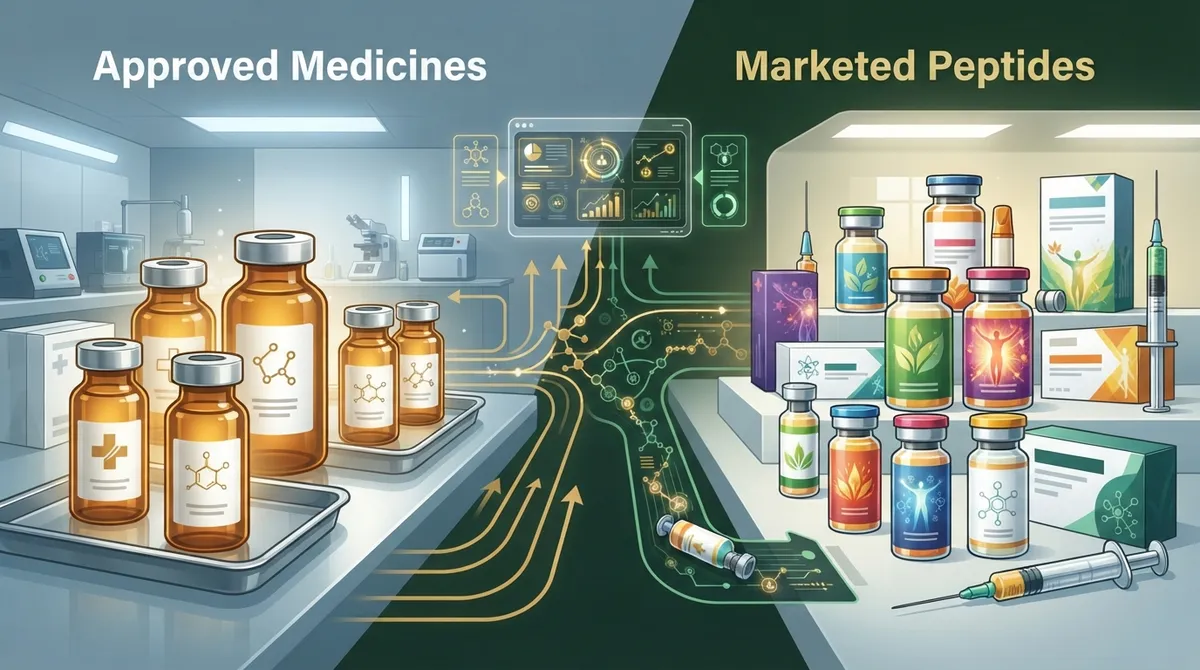
Step 1: Separate Approved Medicines From Marketed Peptides
This is the single most useful skill you can learn. Peptides are a huge family of molecules, and they are not all the same.
Some peptide drugs are FDA-approved for specific conditions, such as certain metabolic medicines. Approval for one use does not mean the drug reverses aging or extends lifespan. It simply means it was tested and approved for its listed purpose.
Many of the peptides marketed for anti-aging are a different story. They are not FDA-approved for anti-aging, and some are offered as compounded or investigational products. If you want to understand the difference, read FDA-Approved vs. Compounded Peptides: What Wins?
| Category | What It Means | Example Question to Ask |
|---|---|---|
| FDA-approved peptide medicine | Reviewed for safety and effectiveness for a specific condition | Is this being used for its approved purpose? |
| Compounded peptide | Prepared by a pharmacy for an individual prescription; not the same as FDA approval | Which licensed pharmacy prepares it? |
| Investigational or research-use product | Not approved for human use for these claims; quality varies widely | Why is this being offered to patients at all? |
Step 2: Know the Peptides People Talk About Most
Here are the names you will see again and again in “full spectrum” programs, along with what they are claimed to do. Remember, claims are not the same as proof.
| Peptide | Commonly Claimed Purpose | Evidence Reality |
|---|---|---|
| CJC-1295 and ipamorelin | Growth-hormone signaling | Can raise growth hormone or IGF-1; a lab change is not proof of better healthspan |
| BPC-157 | Tissue repair and recovery | Much evidence is preclinical; FDA briefing materials cite insufficient clinical safety data |
| TB-500 | Tissue repair | Limited human evidence |
| GHK-Cu | Skin quality | Not approved for anti-aging; evidence varies by use |
| Epitalon | Longevity claims | Limited and not established in humans |
Want more detail on a few of these? We break them down in How to Use CJC-1295 Peptide Safely for Real Results, Ipamorelin Peptide Therapy: Benefits, Dosing & Safety, and 9 BPC-157 Peptide Facts to Know Before You Start.
Step 3: Understand What the Research Actually Shows
Here is where we get honest, because you deserve that. There is no reliable clinical evidence showing that a “full spectrum” peptide regimen increases human lifespan or prevents age-related disease. If a provider promises that, treat it as a red flag.
What does exist is smaller, more specific research. For example, a 2023 review of growth hormone secretagogues looked at studies in older adults:
- A randomized, double-blind study of ibutamoren included 65 adults aged 60 to 81 and followed treatment for up to two years. It increased pulsatile growth-hormone secretion, which returned to baseline after treatment stopped.
- A capromorelin program included 395 adults aged 65 to 84. The review reports increases in lean body mass and IGF-1.
These are interesting findings. But they do not show that these compounds slow aging or extend life. A measurable biomarker change is not the same as living longer or feeling better in the long run. Mechanism studies and animal findings should never be read as proven human benefits.
For a balanced overview, you can also explore Can Peptide Therapy Really Help Slow Aging? and the research roundup at the National Library of Medicine.
Step 4: Weigh the Risks Honestly
Peptides can sound gentle because they are “natural-sounding.” But risk depends on the substance, the dose, the route, and the quality of the product. Reported concerns for unapproved injectable peptides include:
- Immune reactions
- Contamination or impurities
- Inaccurate dosing
- Unknown long-term effects
- Fluid retention and changes in blood sugar regulation with growth-hormone stimulation
FDA advisory committee briefing materials in 2026 describe insufficient clinical safety information for BPC-157 and raise concerns about immunogenicity and peptide-related impurities. A regulatory review or a compounding-list discussion is not the same as FDA approval for safety, effectiveness, or anti-aging use.
This is exactly why self-injecting products bought from random websites is a bad idea. For a deeper look, see Is Peptide Therapy Safe? What You Really Need to Know and How to Spot and Avoid Peptide Therapy Risks.
Step 5: Follow This Checklist Before You Start
Ready to move from curious to careful? Work through these steps in order.
- Get baseline blood work. Good care starts with data, not guesses. Labs help your clinician see what is actually going on in your body.
- Define your goal. Is it better sleep, recovery, skin, energy, or weight? Specific goals lead to specific plans.
- Ask what is FDA-approved and what is not. A trustworthy provider will answer plainly.
- Confirm who prepares the product. Ask about the licensed pharmacy and quality testing.
- Check the provider’s credentials. You want a licensed medical professional who supervises your care.
- Plan for monitoring. Follow-ups and lab rechecks should be part of the plan.
- Set realistic expectations. No honest clinician promises rejuvenation or longevity.
If you want a gentler walkthrough, try How to Start Peptide Therapy Safely and See Real Results and 15 Peptide Consultation Questions to Ask in 2026.
Step 6: Spot the Red Flags
Even friendly marketing can hide shaky practices. Be cautious if you see any of these:
- Promises to “reverse aging” or “add years to your life”
- A one-size-fits-all “full spectrum” stack with no lab work
- No licensed clinician involved
- Products labeled “for research use only”
- Pressure to buy quickly or in bulk
- Vague answers about where the peptides come from
A single peptide is not always better or worse than a stack. What matters is whether the plan fits your labs, goals, and health history. You can compare approaches in Single Peptides vs. Peptide Stacks: Which Wins?
What a Responsible Approach Looks Like
So what does a thoughtful, evidence-aware plan look like? It is personalized, monitored, and honest about what is known and unknown. Instead of chasing a “full spectrum” label, it focuses on the pieces that matter to you and checks progress over time.
Here is how that can compare to a typical marketing-first approach:
| Feature | Marketing-First Program | Clinician-Guided Program |
|---|---|---|
| Starting point | A pre-set stack | Blood work and health history |
| Claims | Broad anti-aging promises | Targeted goals with honest limits |
| Oversight | Minimal or unclear | Licensed provider with follow-ups |
| Adjustments | Rare | Based on labs and how you feel |
This is the philosophy behind peptides for women and peptides for men care at Allura Longevity. As a telehealth clinic, Allura offers medically supervised peptide therapy built around your own lab results. It starts with a $50 virtual consultation, blood work through LabCorp, and a customized six-month plan delivered to your home, with ongoing monitoring by licensed providers led by a board-certified Family Nurse Practitioner. Services are available in Florida, Georgia, Texas, Connecticut, Indiana, Maryland, New York, and California.
Who Might Benefit From a Conversation About Peptides?
Peptide therapy is not for everyone, and that is okay. Many people find a clinician conversation worthwhile if they are:
- Working on sleep, recovery, or energy and want a data-guided plan
- Dealing with injury recovery and looking at options with a professional
- Interested in metabolism or weight support under supervision
- Curious about skin and sexual wellness options
A good provider will tell you when peptides are not the right fit. Sometimes sleep habits, nutrition, strength training, or hormone testing deliver more than any injection. Our guide Who Is a Candidate for Peptide Therapy in 2026? can help you think it through.
Set Realistic Timelines
Another thing that surprises people: results are not instant, and they are not guaranteed. Changes in sleep or recovery may take weeks, while skin and body composition shifts often take longer. Individual response varies a lot. For a grounded look, read How Long for Peptide Therapy Results? A Real Timeline.
Keep a simple log of your sleep, energy, workouts, and lab values. Data keeps everyone honest, including your provider and you.
Final Thoughts: Be Curious and Careful
“Full spectrum anti aging peptide therapy” is an appealing phrase, but the smartest move is to look beneath it. Ask what is approved, what is investigational, what the evidence shows, and who is watching your health along the way. Peptides may play a supportive role for some people, but they are not a proven way to stop aging or extend lifespan.
If you would like a personalized, lab-guided conversation with a licensed team, we would love to help. New client spots are limited each month. Request a consultation with Allura Longevity or call (813) 510-6277 to get started.
FAQs
Q: What does full spectrum anti aging peptide therapy mean?
A: It is a marketing phrase, not a standardized medical treatment or FDA-approved protocol. It usually refers to a combination of peptides promoted for areas like skin, recovery, metabolism, or growth-hormone signaling, and the exact ingredients vary by provider. The best next step is to ask which peptides are included and why.
Q: Are anti-aging peptides FDA-approved?
A: Some peptide medicines are FDA-approved, but only for specific conditions. The peptides most often marketed for anti-aging, like BPC-157, CJC-1295, ipamorelin, and epitalon, are not FDA-approved for that purpose, so it helps to ask your clinician about each one.
Q: Is there clinical evidence that peptide therapy slows aging or extends lifespan?
A: Not yet. Some studies show growth-hormone-related markers or lean body mass can change in older adults, but those findings do not prove longer life or broad healthspan benefits. Be wary of any provider who promises to reverse aging.
Q: What are the risks of injectable peptides?
A: Risks depend on the peptide, dose, and product quality, and can include immune reactions, impurities, inaccurate dosing, and unknown long-term effects. Growth-hormone stimulation may also contribute to fluid retention and blood sugar changes. Working with a licensed clinician and a reputable pharmacy helps lower these risks.
Q: What should I ask a clinician before starting peptide therapy?
A: Ask which peptides are recommended, whether they are FDA-approved or compounded, who prepares them, and what labs and follow-ups are included. Also ask what results are realistic and when you should stop. A trustworthy provider will welcome these questions.





