
Key Takeaways
-
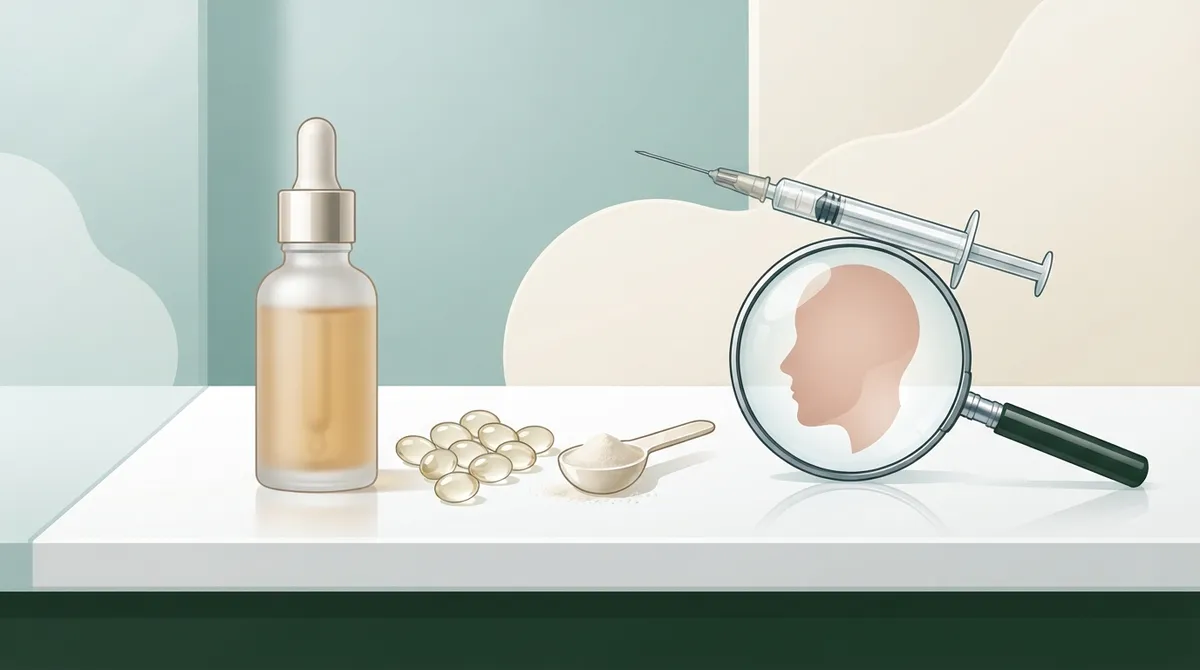
"Peptide facial rejuvenation program" is a marketing label, not a standardized medical treatment; it may mean topical serums, oral collagen, or clinic injections, each with very different evidence and risks.
-
Topical peptide studies are small and product-specific, so results from one serum cannot be assumed for another; they are a helpful routine addition, not a guaranteed wrinkle treatment.
-
Oral collagen peptides show mixed results: some trials improve hydration and elasticity, but a 60-person study found no significant difference in wrinkle reduction versus control.
-
Injectable peptides like GHK-Cu lack robust controlled human trials for facial rejuvenation, and many clinic-sold products are not FDA-approved; promises of wrinkle reversal are red flags.
Let’s be honest: scroll through your feed for five minutes and you’ll see someone promising glowing, youthful skin through peptides. It sounds exciting. It also sounds a little confusing. What does a peptide facial rejuvenation program actually include? Is it a cream, a pill, a shot, or all three?
Here’s the friendly truth. The phrase is a marketing term, not a single standardized medical treatment. Depending on who is selling it, it could mean topical skincare, collagen supplements, or clinic-administered injections. Each one has a very different evidence base and risk profile.
If you’re a health optimizer, a busy professional, or simply someone who wants to age well, you deserve clear answers. In this guide, we walk through six things worth knowing before you invest your time or money. We’ll keep it simple, honest, and useful. For a quick refresher on the basics, you can start with 8 Facts That Explain What Are Peptides in 2026.
1. A Peptide Facial Rejuvenation Program Is a Label, Not a Single Treatment
Peptides are short chains of amino acids. Your body uses them as signals, and many play roles in skin structure and repair. For a plain-English definition, see this overview of what are peptides.
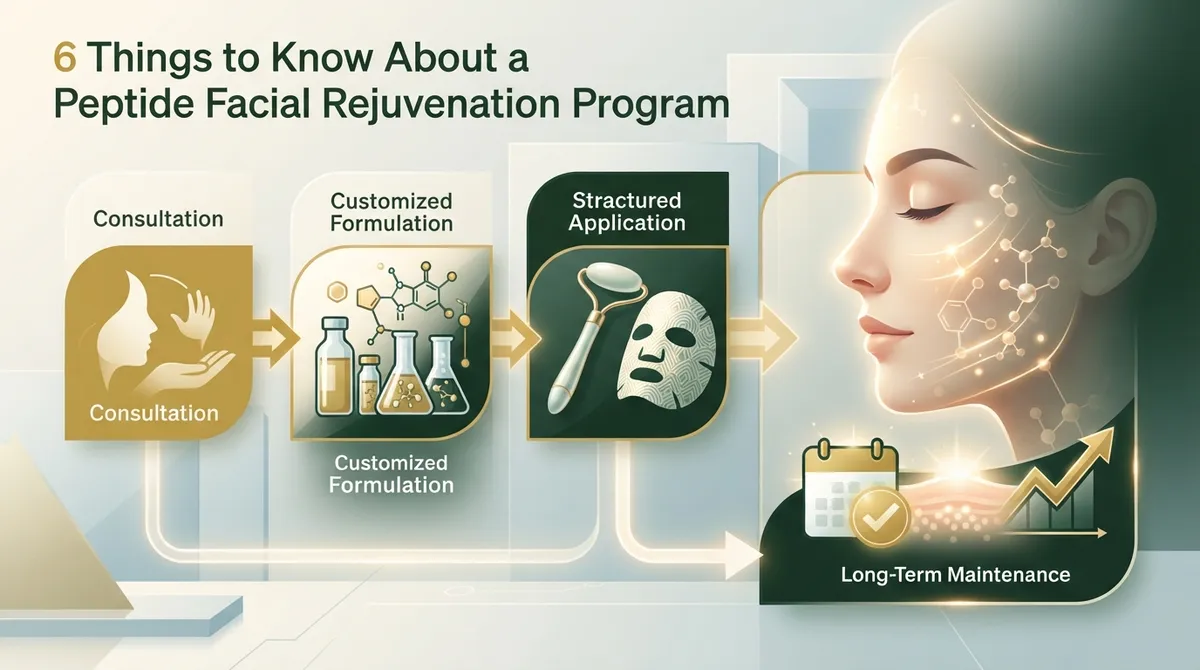
The problem is that no official definition exists for a peptide facial rejuvenation program. One provider may mean a serum routine. Another may mean a supplement stack. A third may mean injections. Comparing them directly is like comparing a salad to a steak because both are “dinner.”
Here is how the three common meanings differ:
| Approach | What It Usually Means | Evidence Level | Main Considerations |
|---|---|---|---|
| Topical peptides | Cosmetic serums and creams applied to skin | Small human studies, mixed designs | Results are product-specific |
| Oral collagen peptides | Daily powders or capsules | Several randomized trials, uneven results | Supplement, not a drug |
| Injectable peptides | Clinic or telehealth-prescribed injections | Limited human data for facial use | Regulatory status varies by product |
Knowing which meaning applies is the first step to judging any program fairly.
2. Topical Peptides Show Promise, but Results Are Product-Specific
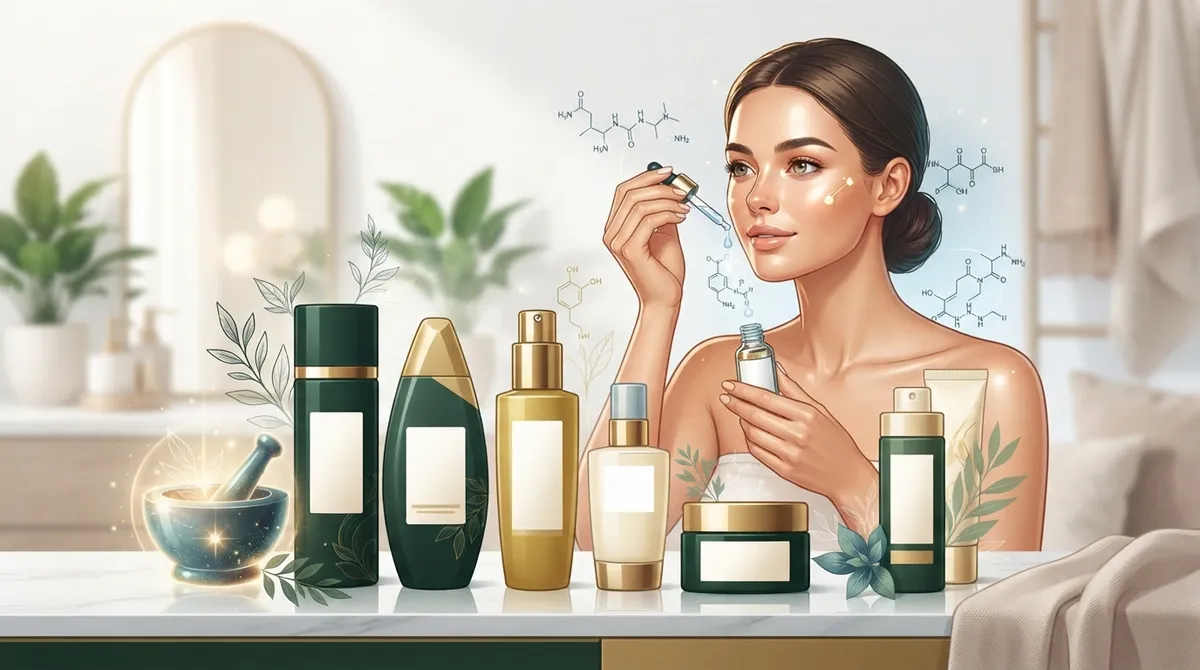
Topical cosmetic peptides are studied for effects on fine lines, texture, hydration, and elasticity. The idea is that certain peptides may signal skin cells involved in collagen and extracellular-matrix turnover.
Some small human studies are encouraging:
- A split-face study of 10 healthy participants used 10% Argireline for 30 days and reported reduced wrinkle depth versus a vehicle.
- A double-blind, placebo-controlled split-face study of 93 participants using palmitoyl pentapeptide-4 reported improved wrinkle measures versus control.
- An evaluation of an SA1-III peptide cosmetic reported, after four weeks, changes from baseline of +43.1% in hydration, −14.3% in skin extensibility, and +5.8% in gross elasticity.
- An open-label evaluation of 20 women aged 40 to 65 using a KP1 peptide serum twice daily reported gains in fine wrinkles (+19%), compactness (+14%), and luminosity (+33%).
Here’s the catch. These are small studies, and they use different ingredients, doses, and measurements. One product’s result can’t be applied to every peptide serum on the shelf. Reviews describe the findings as promising, but they call for stronger, standardized randomized trials. You can explore the broader literature through the National Library of Medicine.
In short, topical peptides may be a nice part of a skincare routine. They are not a guaranteed wrinkle eraser.
3. Oral Collagen Peptides May Help Hydration and Elasticity
Many programs include collagen peptide supplements. These are broken-down collagen proteins you swallow, often mixed into coffee or a smoothie.
Randomized trials have looked at skin hydration and elasticity, and some report improvements. One randomized controlled study of 60 participants taking collagen peptides reported better elasticity and hydration than control. However, it found no significant between-group difference in wrinkle reduction.
That detail matters. Findings are not uniform across studies, and a supplement that helps hydration doesn’t prove a full facial rejuvenation program works. It also says nothing about injectable peptides.
If you’re curious about how collagen-related peptides fit into a bigger picture, our guide on how to trigger collagen stimulation with peptides goes deeper.
4. Injectable Peptides Need Extra Caution
This is where honesty matters most. You may see injectable GHK-Cu and other peptides marketed for youthful skin. But there is a lack of robust controlled human trials establishing the safety and efficacy of systemic GHK-Cu for facial rejuvenation.
So no responsible provider should present injectables as a proven facial rejuvenation treatment. Here are the key points to keep in mind:
- FDA approval is product- and indication-specific.
- Many injectable peptides sold by wellness clinics are not FDA-approved therapies.
- Compounded products are not FDA-approved, and compounding does not establish safety or effectiveness.
- Promises of wrinkle reversal or guaranteed collagen regeneration are red flags.
Want to understand the difference? Read FDA-Approved vs. Compounded Peptides: What Wins? and Is Peptide Therapy Safe? What You Really Need to Know. Both help you ask sharper questions.
5. What a Responsible Program Should Look Like
A good program doesn’t have to promise miracles. It should feel transparent, careful, and personal. Use this checklist when you’re comparing options:
- It separates skincare from medical treatment. You should know exactly which parts are cosmetic and which are prescribed.
- It discloses the evidence limits. Honest providers tell you what is well studied and what is not.
- It starts with your health picture. Blood work and medical history should guide any prescription.
- It uses licensed clinicians. A real provider reviews your goals, risks, and medications.
- It names the product and its source. You should be able to verify regulatory status and where it came from.
- It plans follow-up. Ongoing monitoring and adjustments should be part of the deal.
For a deeper look at screening providers, see 15 Peptide Consultation Questions to Ask in 2026 and How Do You Know Online Peptide Therapy Is Safe?.
6. Skin Is Part of a Bigger Whole-Body Picture
Here’s a perspective many busy professionals and biohackers appreciate. Your face reflects what’s happening inside. Sleep, stress, nutrition, hormones, sun exposure, and recovery all show up in your skin.
That’s why many people pair skin goals with broader wellness work. For example, a personalized plan might look at energy, sleep quality, metabolism, and hormone balance together. Supporting those foundations can matter as much as any serum.
Here’s a quick snapshot of how common goals connect:
| Wellness Goal | Why It Matters for Skin | Where to Learn More |
|---|---|---|
| Better sleep | Skin repairs itself overnight | Which Peptides Actually Help You Sleep Better? |
| Hormone balance | Hormone shifts can change skin texture and firmness | How to Approach Hormone Balance With Peptide Therapy |
| Healthy aging habits | Daily choices add up over years | How to Pick the Best Peptides for Aging in 2026 |
If your main concern is skin, you may also like What Peptides Do for Skin: A Real-World Guide for 2026.
How Allura Longevity Approaches Skin and Wellness
At Allura Longevity, we believe in personalized, medically supervised care. Clients begin with a $50 virtual consultation and complete blood work through LabCorp. A licensed provider, led by Ashley, a board-certified Family Nurse Practitioner, then designs a customized six-month plan delivered to your home.
Our services focus on energy, sleep, mental clarity, immune function, muscle recovery, metabolism, sexual wellness, and skin rejuvenation. We are honest about what the evidence supports, and we tailor every plan to your labs and goals. Telehealth is available nationwide, and we are licensed in Florida, Georgia, Texas, Connecticut, Indiana, Maryland, New York, and California. You can explore options for peptides for women or peptides for men.
Practical Tips Before You Start
Ready to move forward with confidence? Keep these friendly reminders in mind:
- Don’t expect overnight changes. Skin shifts happen gradually, and results vary from person to person.
- Patch test any new topical product before using it on your whole face.
- Tell your provider about every supplement and medication you take.
- Take progress photos in the same lighting so you can judge changes fairly.
- Walk away from anyone who promises guaranteed wrinkle reversal.
Curious about timing? Our guide on how long for peptide therapy results sets realistic expectations.
The Bottom Line
A peptide facial rejuvenation program can be a thoughtful part of a bigger wellness plan, as long as you understand what you’re buying. Topical peptides and oral collagen have some encouraging but limited evidence. Injectable options deserve extra caution and a licensed clinician’s guidance. The best programs are transparent, personalized, and honest about what we do and don’t know.
If you’d like help sorting through your options, we’d love to chat. Spots for new clients are limited each month. Request a consultation with our team, or call (813) 510-6277 to get started on a plan built around you.
FAQs
Q: What is a peptide facial rejuvenation program?
A: It’s a marketing term, not a standardized medical treatment. It may mean topical peptide skincare, oral collagen supplements, or clinic-administered injections, and each has a different evidence and safety profile. Always ask exactly what’s included.
Q: Do peptide creams and serums really reduce wrinkles?
A: Some small human studies report improvements in wrinkle measures, hydration, and elasticity for specific products. But studies are small and vary a lot, so results from one serum can’t be assumed for another. Think of them as a helpful part of your routine, not a guarantee.
Q: Are injectable peptides like GHK-Cu FDA-approved for facial rejuvenation?
A: No. FDA approval is specific to each product and use, and many injectable peptides marketed by wellness clinics aren’t FDA-approved. There also aren’t robust controlled human trials proving systemic GHK-Cu works for facial rejuvenation.
Q: Do oral collagen peptides improve skin?
A: Some randomized trials report better skin hydration and elasticity, though results aren’t consistent. One study of 60 people found no significant difference in wrinkle reduction versus control. They’re a supplement, not proof that a full program will work.
Q: What should I look for in a peptide therapy provider?
A: Look for licensed clinicians, lab-guided plans, clear product sourcing, honest talk about evidence limits, and ongoing follow-up. Be wary of anyone promising wrinkle reversal or guaranteed results.





