

Key Takeaways
-
No peptide is proven or FDA-approved to stop aging or treat menopause, so the 'anti-aging' label is a marketing claim rather than a medical indication.
-
The 2023 Endocrine Society statement found no growth-hormone-raising therapy is approved for anti-aging, and benefits have not been shown to outweigh risks.
-
Growth hormone-related studies in older adults linked treatment to fluid retention, joint pain, carpal tunnel syndrome, and blood sugar problems, including diabetes risk.
-
The FDA has flagged limited safety data, immune reactions, peptide clumping, and impurities in some compounded peptides like ipamorelin, so product source and quality matter.
-
Midlife women can be evaluated for peptide medicines when there is a specific diagnosed condition, with blood work and a clinician guiding the decision.
-
Evidence-based options like approved hormone therapy for menopause symptoms, GLP-1 medicines for eligible patients, and strength training and sleep habits have stronger support.
If you are in your 40s or 50s, you have probably seen the ads. Peptides that promise glowing skin, steady energy, and a body that feels ten years younger. It is easy to wonder, can midlife women use anti aging peptides, or is it all just hype?
Here is the honest, friendly answer: yes, many midlife women can talk with a clinician about peptide therapy. But there is a big catch. In 2026, no peptide is proven or approved to stop aging or treat menopause itself. Some peptide medicines do have real, approved uses for specific health conditions. Others are sold for “wellness” with far less evidence behind them.
In this guide, we walk through three clear truths so you can feel confident, not confused. We will cover what the science says, what the risks are, and how to ask smart questions. You deserve straight talk, and a care plan that fits your body, your labs, and your goals.

Truth 1: The Word “Anti-Aging” Promises More Than the Science Delivers
Let’s start with the part that may surprise you. The Endocrine Society published a 2023 scientific statement on hormones and aging. It concluded that no therapy that raises growth hormone (GH) release or action is approved as an anti-aging treatment. Studies have not shown benefits that outweigh the risks.
That does not mean peptides are useless. It means the label “anti-aging” is a marketing phrase, not a medical diagnosis or an approved use. Think of it like a trendy skincare claim. It sounds great, but it is not the same as a proven treatment.
What Peptides Actually Are
Peptides are short chains of amino acids, the building blocks of proteins. Your body makes many of them naturally. If you want a simple primer, this explainer on what are peptides covers the basics well. Some peptide medicines are well studied and approved for certain conditions. Others are used off-label or compounded, and the evidence is thinner.
Approved vs. Wellness Peptides
This is the most important distinction for midlife women to understand. The table below shows how the two groups differ.
| Feature | Approved, Indication-Specific Peptide Medicines | “Wellness” or Anti-Aging Peptides |
|---|---|---|
| Purpose | Treat a specific diagnosed condition | General vitality or age reversal claims |
| FDA review | Reviewed for safety and effectiveness | Often not reviewed for these uses |
| Evidence | Studied in clinical trials | Limited, small, or short studies |
| Long-term safety | Better understood | Not well established |
| Best for | A medical need confirmed by a clinician | Individual discussion and careful screening |
If you want to go deeper on this split, our guide on approved peptides vs. wellness peptides breaks it down in plain language.
What a Small Study Can and Cannot Tell Us
You may hear about a small study of growth-hormone-releasing hormone in 10 postmenopausal women. It found higher GH and IGF-1 levels and less visceral fat over three months. That sounds exciting! But the study was tiny, short, and had no control group. It cannot prove long-term benefit or safety for anti-aging use. Good news, yes. Proof, no.
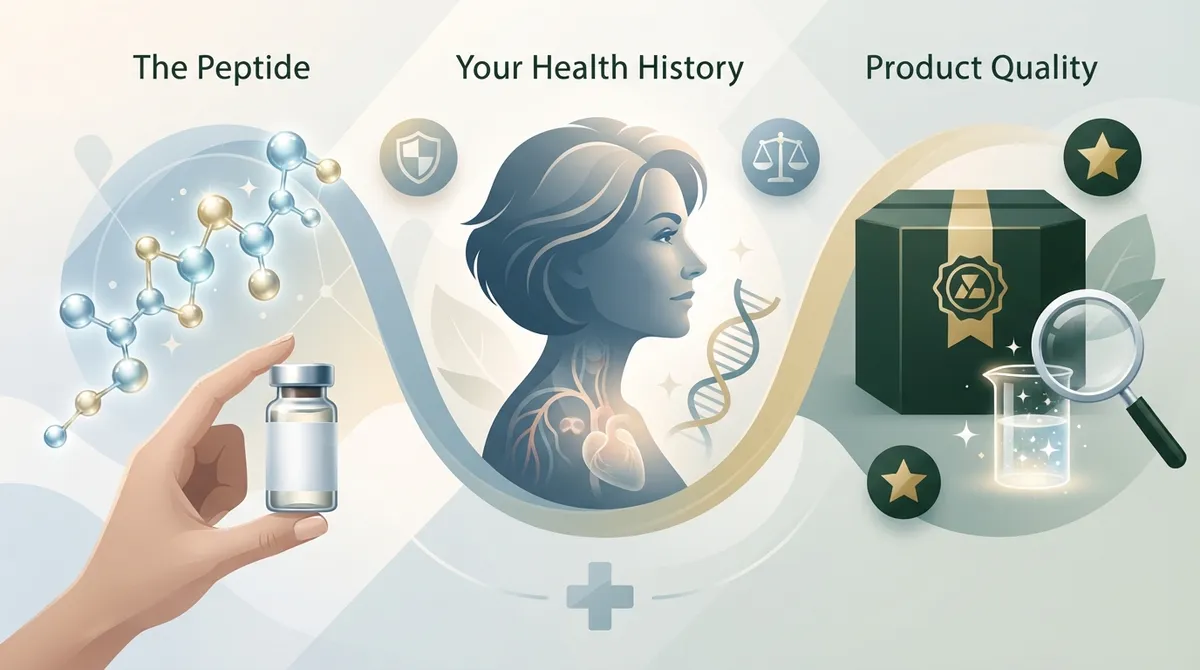
Truth 2: Safety Depends on the Peptide, Your Health History, and Product Quality
Here is where the details matter most. A peptide that is reasonable for one woman may be a poor fit for another. Your history, your labs, and the exact product all play a role.
What We Know About Growth Hormone Risks
Growth-hormone-releasing peptides, often called secretagogues, work on the same system as GH. So it helps to look at what happened in studies of GH in healthy older adults. The 2023 Endocrine Society statement reported average changes of about 2.1 kg less fat mass and 2.1 kg more lean mass. The body-composition effects were bigger in men than in women.
Those results came with a trade-off. Adverse events increased, including:
- Fluid retention (edema)
- Joint pain (arthralgias)
- Carpal tunnel syndrome
- Problems with blood sugar control, including diabetes risk
These findings do not prove every peptide causes the same issues. But they do show why the benefit-risk balance is not clearly in favor of anti-aging use for midlife women. A cautious, individual approach is wise. You can also read how CJC-1295 peptides can be used safely and what to know about ipamorelin benefits, dosing, and safety.
Product Quality and FDA Concerns
Another piece of the puzzle is quality. In 2024, the FDA reviewed ipamorelin-related substances. It noted limited safety and effectiveness data for proposed compounded uses. It also raised concerns about immune reactions, peptide clumping (aggregation), and impurities. The FDA described serious adverse events, including a death, in a study that used intravenous ipamorelin for a different clinical purpose. That does not mean every formulation or route carries the same risk, but it shows why oversight matters.
It is also worth knowing that compounded products are not FDA-approved as a class. A prescription and a licensed compounding pharmacy do not mean a peptide is proven for anti-aging. They simply mean it was prepared under a clinician’s order.
Who Needs Extra Caution
Before considering any therapy that affects the GH and IGF-1 system, tell your clinician about:
- Any history of cancer
- Diabetes or prediabetes
- All medicines and supplements you take
- Joint, swelling, or nerve symptoms
- Pregnancy plans or breastfeeding
Being open here is not a burden. It is how a good clinician keeps you safe. For a broader view, see how to weigh the risks of peptide therapy safely in 2026 and review the common peptide therapy side effects to watch for.
Truth 3: Midlife Women Can Be Evaluated for Peptides When There Is a Clear Medical Reason
So, can midlife women use anti aging peptides? The most accurate answer is this: midlife women can be evaluated for a peptide medicine when there is a specific medical indication and a qualified clinician is guiding care. The decision depends on the drug, the diagnosis, your health history, and your goals.
Separate Symptoms From Conditions
Midlife brings real changes. Hot flashes, poor sleep, weight shifts, low energy, brain fog, and lower desire are common. But they can come from many causes, including perimenopause, thyroid issues, stress, or nutrient gaps. A clinician should sort out which symptoms are tied to normal aging or menopause and which point to a condition with an evidence-based treatment.
For example, menopause symptoms may respond well to approved hormone therapy options. You can learn more in our guide to menopause treatment options that really work in 2026 and how to navigate perimenopause with BHRT and peptides. And if you are weighing the bigger picture, how to judge peptides for women’s healthspan is a helpful read.
Examples of Evidence-Based Alternatives and Add-Ons
Depending on your needs, a clinician may talk with you about options like these:
- Hormone therapy for bothersome menopause symptoms, when it is a good fit for your risk profile.
- Weight management medicines, such as GLP-1 therapy, when you meet medical criteria.
- Lifestyle foundations like strength training, protein intake, sleep habits, and stress care.
- Targeted peptide medicines for specific, clinician-supported goals.
If weight is part of your story, see how you qualify for GLP-1 medication in 2026.
How Peptide Goals Compare: What the Evidence Looks Like
Women often ask whether peptides can help skin, energy, muscle, or weight. The honest answer varies by goal. This table gives a simple snapshot.
| Goal | Evidence Level for “Anti-Aging” Peptides | What to Know |
|---|---|---|
| Skin appearance | Mixed; stronger for topical collagen-supporting ingredients than for injectables | Results vary; ask about the specific product and form |
| Energy and sleep | Limited and uneven | Check labs and rule out thyroid, iron, and sleep issues first |
| Muscle and body composition | Modest changes in GH studies; bigger in men than women | Strength training and protein remain key |
| Weight loss | Strongest for approved GLP-1 medicines in eligible patients | Needs medical screening and monitoring |
| Menopause symptoms | Peptides are not an approved menopause treatment | Hormone therapy has the stronger evidence base |
If skin is your top goal, you may enjoy reading what anti-aging peptide therapy for skin really does and whether midlife women can use skin peptides.
5 Smart Questions to Ask Before You Start
Walking into a consultation with good questions puts you in the driver’s seat. Try these:
- Is this peptide FDA-approved, compounded, or something else? Ask for a clear answer and the pharmacy source.
- What specific condition or goal is it meant to address? A clear target beats a vague promise.
- What labs will you check first, and how often will you recheck? Good care starts with data, not guesses.
- What are the risks for someone with my health history? Mention cancer history, blood sugar issues, and every medicine you take.
- What happens if it is not working? You should know the plan for adjusting or stopping.
Want a head start? Our list of 15 peptide consultation questions to ask in 2026 goes even further, and you can avoid common slip-ups with these 3 peptide consultation mistakes.
Why Labs and Personalization Matter So Much
Midlife women are not all the same. Two women at 48 can have very different hormones, sleep, stress, and metabolic health. That is why blood work is the starting line. It helps a clinician see what is really going on before suggesting anything.
At Allura Longevity, personalized peptide therapy is delivered through telehealth, so you can get care from home. The process starts with a $50 virtual consultation, followed by blood work through LabCorp. From there, licensed providers, led by Ashley, a board-certified Family Nurse Practitioner, build a customized plan and keep monitoring and adjusting it over time. Care is designed around your results and goals, not a one-size-fits-all menu. Learn more about lab work for peptide therapy and what to test, and see 15 ways a peptide therapy plan gets personalized.
Telehealth is available in Florida, Georgia, Texas, Connecticut, Indiana, Maryland, New York, and California. If you want to understand how remote visits work, read what really happens during a peptide telehealth visit.
A Realistic Look at Timelines and Expectations
It is natural to want fast results. But healthy change usually moves at a steady pace. Be wary of anyone who promises dramatic transformation in a few weeks. A better approach is to set small, measurable goals, such as better sleep quality, steadier energy, or improved lab markers, and review them with your provider.
Our guide on a realistic peptide therapy timeline in 2026 can help you set fair expectations. Remember that results can differ from person to person, and some women find that lifestyle changes deliver more than any single peptide.
The Bottom Line for Midlife Women
Let’s bring it all together in a friendly recap. Midlife women can explore peptide therapy, but the phrase “anti-aging” should be treated with healthy skepticism. The science does not show that these peptides reverse aging or treat menopause. Risks like fluid retention, joint pain, and blood sugar changes are real, and product quality matters.
The good news? You have options. With the right clinician, a thoughtful plan, and honest conversations about evidence, you can decide what makes sense for you. Peptides may play a role for some women with a clear medical reason. For others, approved hormone therapy, weight management, and lifestyle changes may be the better path.
Curious whether a personalized plan fits your goals? Request a consultation with Allura Longevity to talk it through with a licensed provider. You can also call (813) 510-6277. Spots for new clients are limited each month, so reach out when you are ready. And if you want to explore more, check out our overview of peptides for women.
For further reading on the research behind peptides and aging, the National Library of Medicine is a trusted place to start. Be curious, ask questions, and choose care that puts your safety first.
FAQs
Q: Can midlife women use peptides for anti-aging?
A: Midlife women can be evaluated for peptide medicines when there is a clear medical reason and a qualified clinician is guiding care. But “anti-aging peptides” are not a proven or approved treatment for aging or menopause, so a personal risk review is key.
Q: Are sermorelin or ipamorelin safe for women in their 40s or 50s?
A: Safety depends on your health history, your labs, and the exact product used. Evidence for anti-aging use is limited, and the FDA has raised concerns about some compounded peptides, so these should only be considered with careful clinical supervision.
Q: Are compounded peptides FDA-approved?
A: No. Compounded products are not FDA-approved as a class for safety, effectiveness, or quality before they are marketed. A prescription and a licensed compounding pharmacy do not mean a peptide is proven for anti-aging.
Q: What should I ask a clinician before starting peptide therapy?
A: Ask whether the peptide is approved or compounded, what condition it targets, which labs you need, and what risks apply to your history. Be sure to share any cancer history, diabetes or prediabetes, and all medicines and supplements you take.
Q: What are evidence-based options for menopause symptoms and age-related changes?
A: Approved hormone therapy, weight management medicines for eligible patients, and lifestyle steps like strength training, good sleep, and balanced nutrition all have stronger evidence. A clinician can help you sort which option fits your symptoms and risk profile.





