

Key Takeaways
-
A legitimate virtual peptide consultation should involve a named, state-licensed clinician who reviews your health history, medications, and goals before recommending any treatment.
-
Compounded peptides are not FDA-approved; the FDA does not review them for safety, effectiveness, or quality before marketing, so providers should never imply otherwise.
-
Bloodwork should be required before any peptide recommendation, and it provides a baseline for tracking progress and adjusting your plan over time.
-
Confirm the provider is licensed in the state where you are physically located during the visit, since telehealth rules depend on your location.
-
Red flags include guaranteed results, countdown-style pressure tactics, no named clinician or pharmacy, and preset protocols that ignore your health history.
-
Ask upfront about the consultation fee, plan price, follow-up costs, and what happens if treatment isn't working or you want to stop.
Picture this: it’s a Tuesday night, you’re scrolling on your phone after a long day, and you land on yet another website promising to transform your energy, sleep, and recovery with peptides. The photos look great. The promises sound even better. But how do you know if it’s actually a good place to start?
You’re not alone in wondering. Interest in peptide care has exploded in 2026, and so have the options. Finding the best virtual peptide therapy consultation takes a little know-how. The good news? You don’t need a medical degree to spot a great one. You just need to know what a quality visit looks like and what red flags to avoid.
In this friendly guide, we’ll walk through what a strong online visit includes, which questions to ask, how to check a provider’s credentials, and how to get the most from your first appointment. Whether you’re a busy professional, a data-loving biohacker, or someone simply ready to feel more like yourself, this roadmap is for you.

What Makes a Virtual Peptide Consultation Truly “Best”?
Let’s clear something up first. The best consultation is not the one that hands you a prescription in five minutes. It’s the one that treats you like a real patient with a real health story.
A top-tier visit is clinician-led, individualized, and honest about what is known and unknown. Telehealth doesn’t lower the medical standard. Your provider should follow the same care standards they would in a clinic, and they must be licensed where you live.
Here’s what separates a great consultation from a so-so one:
- A licensed clinician who reviews your health history, current medications, and goals
- Lab-informed decisions, not a one-size-fits-all protocol
- Plain-language talk about benefits, risks, and uncertainties
- Clear follow-up plans so you’re never left guessing
- No pressure tactics and no guaranteed results
If you want a deeper look at how personalization really works, this guide on 15 ways a peptide therapy plan gets personalized breaks it down nicely.
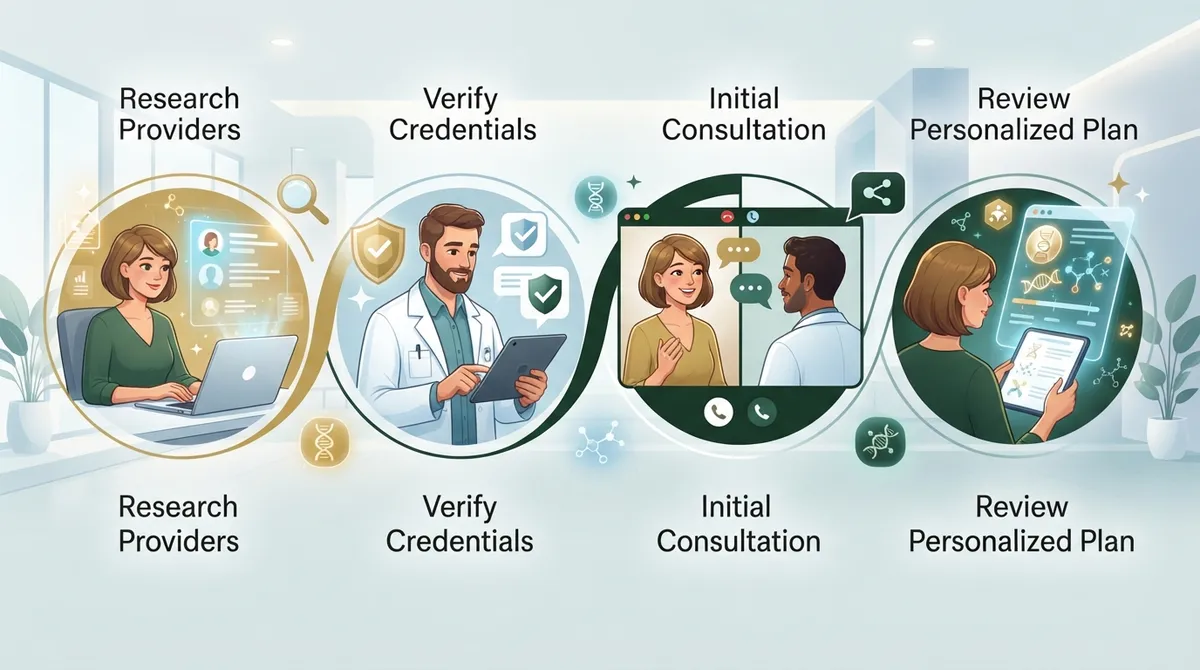
Step-by-Step: How to Choose a Virtual Peptide Consultation
Ready to start your search? Follow these steps in order. They’ll save you time, money, and a lot of second-guessing.
- Confirm the clinician’s credentials. Ask who will be prescribing and what their license is (MD, DO, NP, or PA). Make sure they hold a license in the state where you’ll be during your visit.
- Check where you live. Telehealth rules depend on your location, not the clinic’s. Verify that the provider is licensed in your state.
- Ask about lab work. A responsible provider will want recent bloodwork before recommending anything.
- Request product details. Ask what exactly is being proposed, which pharmacy dispenses it, and how it’s made.
- Understand costs upfront. You should know the consultation fee, the plan price, and what follow-ups cost.
- Look for ongoing monitoring. Great care doesn’t end after the first prescription.
That’s it. Six simple checks that filter out most of the noise.
Credentials and Licensing: Your First Safety Check
Think of licensing as the foundation of the house. Without it, nothing else matters.
A legitimate telehealth provider will openly name their prescribing clinician and the dispensing pharmacy. If you can’t find this information, that’s a gentle nudge to keep looking. We cover more on this topic in 5 signs longevity medicine telehealth is legit.
Here’s a quick comparison to help you sort strong signals from weak ones:
| What to Look For | Strong Signal | Warning Sign |
|---|---|---|
| Clinician identity | Named, board-certified provider | Anonymous “care team” |
| State licensing | Licensed where you live | Vague “nationwide” claims with no detail |
| Pharmacy disclosure | Dispensing pharmacy named | No information about sourcing |
| Lab work | Required before treatment | Optional or skipped entirely |
| Claims | Honest about uncertainty | Guaranteed results |
Understand What You’re Actually Being Offered
This part matters, and a good provider will explain it clearly. Not all peptide products are the same.
Some peptide-related medicines are FDA-approved, such as certain GLP-1 medications for weight management. Others are compounded preparations made by a pharmacy for an individual patient. And some peptides are considered investigational or unapproved.
Here’s the key point: compounded drugs are not FDA-approved. The FDA notes they aren’t reviewed before marketing for safety, effectiveness, or quality. A trustworthy clinic will never imply that a compounded product is FDA-approved or a proven match for an approved drug.
To learn more about the difference, see approved peptides vs. wellness peptides. For general background on the basics, what are peptides is a helpful starting point.
A Quick Word on BPC-157
BPC-157 comes up a lot in conversations about recovery. It’s worth being upfront here. The FDA has raised specific concerns about compounded BPC-157, including limited safety information, possible immune reactions, and peptide-related impurities. The agency also proposed not adding BPC-157 free base or acetate to its 503A Bulks List.
Through December 2025, the FDA’s adverse-event system had three reports tied to injectable BPC-157. The agency cautions that this small number can’t define the full safety picture. In plain English: there’s not enough data to say much with confidence.
A great consultation will walk you through this kind of nuance rather than skip over it. For more detail, read is BPC-157 safe? what the research really shows.
What to Expect During Your Visit
Let’s take the mystery out of the appointment itself. A solid virtual visit usually feels like a friendly, focused conversation.
Expect your clinician to cover these areas:
- Your health history: past conditions, surgeries, family history
- Current medications and supplements: including anything over the counter
- Your goals: energy, recovery, sleep, weight, skin, sexual wellness, or longevity
- Contraindications: reasons a treatment might not be safe for you
- Lab review or ordering: bloodwork to guide decisions
- A clear plan: what’s proposed, why, and what the alternatives are
Want a peek at the flow? Check out what really happens during a peptide telehealth visit.
Mistakes That Waste Your First Visit
Showing up unprepared is the most common one. Have your medication list, recent lab results (if you have them), and your top two or three goals ready. For more on this, see 3 peptide consultation mistakes that waste your first visit.
Questions to Ask Before You Commit
Don’t be shy. A great provider welcomes questions, and honestly, you should bring a list. Here are the ones worth asking:
- Who is my prescribing clinician, and are they licensed in my state?
- Which pharmacy will dispense my treatment?
- Is this product FDA-approved, compounded, or investigational?
- What evidence supports it for my goal, and what’s unknown?
- What labs do I need, and how often will they be repeated?
- What are the possible side effects?
- What does the full cost look like, including follow-ups?
- What happens if it isn’t working or I want to stop?
We’ve gathered even more in 15 peptide consultation questions to ask in 2026.
Why Lab Work Is a Non-Negotiable
Here’s where biohackers and health optimizers tend to nod in agreement. Data beats guesswork.
Bloodwork helps your clinician see your hormone levels, metabolic markers, and other numbers that shape safe decisions. It also gives a baseline, so you can see whether things actually improve over time. Without labs, a peptide plan is little more than an educated guess.
To learn what’s typically checked, read lab work for peptide therapy: what to test and why.
Red Flags That Should Make You Pause
Most online clinics mean well, but some cut corners. Watch for these warning signs:
- Guaranteed outcomes or “miracle” language
- Pressure tactics like countdown timers and “buy today only” offers
- Claims that compounded products are FDA-approved or identical to approved drugs
- No lab work and no real medical review
- No named clinician or pharmacy
- Preset protocols that ignore your health history
If something feels off, trust your gut. The right provider will make you feel informed, not rushed.
A Note on Telehealth Prescribing Rules
Here’s a point that confuses a lot of people. Federal telemedicine rules for controlled substances are a separate topic from peptide therapy in general. HHS reports that temporary federal flexibilities for eligible controlled medications were extended through December 31, 2026.
That doesn’t mean every peptide is a controlled substance, and it doesn’t mean every prescription can be written remotely. State laws and the specific medication still matter. A good clinic will explain what applies to you and your location. Learn more in how does telehealth prescription work for peptides.
Comparing Your Options: Local Clinic vs. Telehealth
Both can be great. It really comes down to your lifestyle.
| Factor | Telehealth | Local Clinic |
|---|---|---|
| Convenience | Visit from home or office | Travel and waiting rooms |
| Scheduling | Flexible, often evenings | Business hours |
| Delivery | Shipped to your door | Pickup or in-office |
| Labs | Often at partner draw sites | Often on site |
| Best for | Busy professionals, remote areas | People who prefer in-person care |
For a fuller comparison, see local clinic vs. telehealth: best peptide therapy near you.
What a Great Consultation Looks Like in Practice
So what does all of this look like when it’s done well? Take Allura Longevity as an example. Their process starts with a $50 virtual consultation. From there, clients complete bloodwork through LabCorp, then receive a customized six-month plan designed by licensed providers, led by Ashley, a board-certified Family Nurse Practitioner.
Treatment is delivered to your home, and your plan is monitored and adjusted over time rather than set and forgotten. Their services span energy, sleep, mental clarity, skin rejuvenation, muscle recovery, metabolism, sexual wellness, weight loss with GLP-1 medications, and testosterone replacement. Care is available in Florida, Georgia, Texas, Connecticut, Indiana, Maryland, New York, and California.
That blend of licensed oversight, lab-guided planning, and ongoing follow-up is the kind of structure that makes a consultation worth your time. If you’re curious about the home-delivery side, take a look at what to expect from home delivered peptides.
How to Prepare So You Get the Most From Your Appointment
A little prep goes a long way. Try this quick checklist before you log on:
- Write down your top three goals in plain words
- List every medication and supplement you take
- Gather any recent lab results
- Note your sleep, energy, and recovery patterns for a week
- Prepare your questions ahead of time
- Find a quiet, private spot with good internet
Think of it like prepping for a great coaching session. The more you bring, the more you get back.
Set Realistic Expectations
Here’s the honest, friendly truth: peptide therapy isn’t magic, and it isn’t instant. Results vary, and timelines depend on your goals, labs, and consistency. A good clinician will be upfront about that rather than overselling.
If you want a realistic picture, read what is a realistic peptide therapy timeline in 2026. And for a broader look at safety, National Library of Medicine research is a helpful place to explore peer-reviewed information.
Final Thoughts: Choose Care That Puts You First
The best virtual peptide therapy consultation comes down to a few simple things: a licensed clinician, a thorough look at your health, honest talk about evidence, and real follow-up. Skip the hype, ask your questions, and choose a provider who welcomes them.
You deserve care that feels personal, clear, and safe. When you’re ready to take the next step, you can request a consultation with Allura Longevity and talk through your goals with a licensed provider who’ll build a plan around you. New client spots are limited each month, so reach out soon, or call (813) 510-6277.
FAQs
Q: What should I expect during a virtual peptide therapy consultation?
A: You can expect a friendly, focused conversation with a licensed clinician about your health history, medications, and goals. They’ll usually review or order bloodwork, explain what’s being proposed and why, and outline follow-up steps. It’s a two-way chat, so come with your questions!
Q: Are compounded peptides FDA-approved?
A: No, compounded drugs aren’t FDA-approved. The FDA notes they aren’t reviewed before marketing for safety, effectiveness, or quality. A trustworthy provider will be upfront about this and explain how it applies to any product they suggest.
Q: Do I need lab tests before starting peptide therapy?
A: A responsible provider will typically want bloodwork first so your plan is based on real data, not guesses. Labs also give you a baseline to track progress over time. Follow-up testing helps your clinician adjust your plan safely.
Q: Can a telehealth clinician prescribe peptides in my state?
A: Only if they’re licensed where you are located during the visit, and rules can vary by medication and state. Always confirm licensing before you book. Allura Longevity is licensed in Florida, Georgia, Texas, Connecticut, Indiana, Maryland, New York, and California.
Q: How can I tell if an online peptide clinic is making misleading claims?
A: Be cautious of guaranteed results, pressure tactics, or any suggestion that a compounded product is FDA-approved. Strong clinics name their clinician and pharmacy, require labs, and speak honestly about uncertainty. If it sounds too good to be true, it probably is.





