

Key Takeaways
-
Collagen peptides are dietary supplements, not the same as prescription peptide therapy; research on one should not be used to support claims about the other.
-
Skin is where collagen has the most support: several trials show modest gains in hydration and elasticity after about 8 to 12 weeks, though results are mixed.
-
Bone research is promising but early: a 12-month trial at 5 g per day showed bone density gains in postmenopausal women, yet studies are small and collagen is not a bone treatment.
-
Joint benefits may occur for some women, but evidence is inconsistent, so collagen should not replace standard care; choose products with third-party testing and doses close to those studied.
If you have ever scrolled past a pretty tub of collagen powder and wondered whether it is worth the money, you are in good company. Collagen is one of the most talked-about supplements for women right now, and the claims can feel huge. Smoother skin! Stronger bones! Happier joints! So, are collagen peptides effective for women, or is it mostly clever marketing?
The honest answer is somewhere in the middle. Some studies show modest, encouraging results for skin and maybe joints. Bone research looks promising, but it is still early. And collagen peptides are very different from the prescription peptide therapy you may have heard about in longevity medicine.
In this friendly guide, we break down five things every woman should know in 2026. We keep it simple, lean on real research, and avoid big promises. Whether you are a busy professional, a wellness seeker, or a data-loving biohacker, you will leave with a clear picture of what collagen can and cannot do.
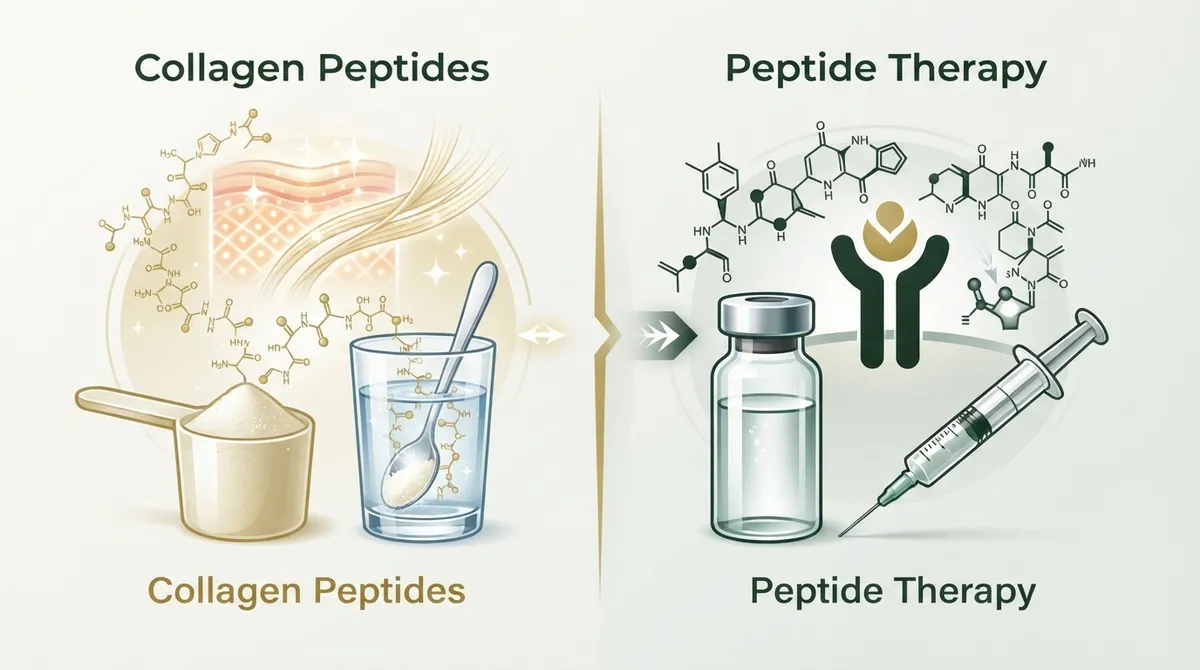
1. Collagen Peptides Are Not the Same as Peptide Therapy
Let’s clear up the biggest mix-up first. The word “peptide” shows up in both worlds, but they are not the same thing.
Collagen peptides are short chains of amino acids made by breaking down collagen. The collagen usually comes from cows, pigs, or fish. You buy them as a powder, capsule, or drink. In the United States, they are sold as dietary supplements.
Peptide therapy is a different story. It uses specific peptides, chosen by a licensed provider, based on your labs and goals. Many are given by injection and require a prescription. If you want the full picture, Collagen Peptides vs. Peptide Therapy: What Women Need goes deeper, and what are peptides is a handy plain-English primer.
| Feature | Collagen Peptides | Medically Supervised Peptide Therapy |
|---|---|---|
| What it is | Dietary supplement | Personalized treatment plan |
| How you take it | Powder, capsule, or drink | Often injection at home |
| Prescription needed | No | Yes, from a licensed provider |
| Based on your labs | No | Yes |
| FDA review for effectiveness | No, supplements are not approved for effectiveness | Varies by medication |
Why does this matter? Because research on collagen supplements should never be used to promote injectable peptides, and the reverse is true too. They are two separate tools with two separate evidence bases.

2. Skin Is Where Collagen Has the Most Support
When women ask, “Are collagen peptides effective?” skin is usually what they mean. And this is the area with the most encouraging data.
Several randomized trials in women report modest gains in skin hydration, elasticity, or wrinkle measures after about 8 to 12 weeks. A 2022 review of collagen for skin aging noted these possible benefits, but it also pointed out that results were mixed. Products, doses, and study designs varied a lot.
What a 2025 Menopause Study Found
A 2025 randomized trial looked at menopausal women. Eighty participants were split into four groups for six months: placebo, calcium plus vitamin D, 5 g per day of fish-derived collagen peptides, or the combination.
Here is what the researchers reported:
- The collagen-only group had a 12.23% within-group improvement in skin elasticity.
- The combination group had a 23% improvement in hydration and an 8.52% improvement in elasticity.
- No significant between-group changes showed up in body composition.
A quick reality check: those numbers are study-specific and within-group. They are not guaranteed results, and they are not necessarily placebo-adjusted. Your skin may respond differently.
If glowing skin is your main goal, collagen can be one small piece of the puzzle next to sunscreen, sleep, and a solid skincare routine. It does not replace them. For a look at what other approaches may do, see 9 Collagen Peptide Wrinkle Mistakes to Avoid in 2026.
3. Bone Health Looks Promising, But the Evidence Is Still Growing
Bone health matters more for women after menopause, when estrogen drops and bone loss can speed up. So it is no surprise that collagen’s bone research gets a lot of attention.
The headline study is a 2018 randomized, double-blind, placebo-controlled trial. It enrolled 131 postmenopausal women. They took 5 g per day of a specific collagen peptide or a placebo for 12 months. The collagen group had significant increases in bone mineral density at the lumbar spine and femoral neck. Twenty-nine participants dropped out, and no adverse events were reported.
That sounds exciting, and it is. But the bigger picture is more cautious:
- A 2025 meta-analysis of 20 studies (17 randomized trials) found improvements in some bone-density outcomes.
- It also found a lot of variation between studies (I² = 80.1%).
- Trials were generally small, with about 39 to 131 people, and lasted only 6 to 12 months.
- The 2025 menopausal-women trial above found no significant changes in the bone-turnover markers it measured.
So is collagen a bone treatment? No. It should not replace calcium, vitamin D, weight-bearing exercise, bone density screening, or medical care for osteoporosis. If bone loss is a concern, a clinician can help you build a real plan. You can also explore 10 Facts on Hormone Therapy Bone Density (2026) for a look at another evidence-based path.
4. Joint Comfort May Improve for Some Women
Many women in midlife notice stiffer knees, achy hips, or slower recovery after workouts. Collagen is a main building block of cartilage, so the idea makes sense. But does the research back it up?
A 2025 review of type I hydrolyzed collagen looked at 36 randomized controlled trials. It found potentially favorable joint outcomes in some studies. It also stressed that differences between studies make firm conclusions hard.
In plain terms:
- Some people with joint discomfort or osteoarthritis report less pain or better function.
- Results depend on the product, the dose, and the group studied.
- Collagen is not a proven arthritis treatment and should not replace standard care.
If your joint pain is steady, getting worse, or limiting your day, talk with a clinician. Supplements are a “maybe helpful extra,” not a diagnosis or a cure.
Quick Evidence Snapshot
| Area | What Studies Suggest | Confidence Level |
|---|---|---|
| Skin hydration and elasticity | Modest improvements in several trials after 8 to 12 weeks | Moderate, but mixed |
| Wrinkles | Some improvement reported; results vary | Low to moderate |
| Bone density (postmenopausal) | Promising in some trials; small, short studies | Low to moderate |
| Joint pain or function | Possible benefit for some people | Low to moderate |
| Body composition | No significant change in a 2025 menopause trial | Low |
5. Safety, Quality, and Smart Shopping Matter
Most clinical studies report few short-term side effects. That is reassuring. But the trials are not enough to prove long-term safety for every product or every person.
Here are a few things to keep in mind:
- Check the source. If you have a fish or shellfish allergy, marine collagen may not be right for you. Bovine and porcine sources have their own considerations.
- Look for independent testing. The FDA does not approve supplements for effectiveness before they hit shelves. Look for third-party quality testing and clear sourcing.
- Match the studied dose. Many of the trials above used about 5 g per day. Mega-doses are not proven to work better.
- Be patient. Skin studies often ran 8 to 12 weeks, and bone studies ran 6 to 12 months.
- Ask your clinician first if you are pregnant, nursing, managing a chronic illness, or taking medications.
Also, be wary of any label that says collagen will treat, cure, or prevent a disease. Supplements cannot make those claims, and honest brands do not try.
Where Medically Supervised Peptide Therapy Fits In
Collagen powder is easy and low-commitment, which is part of its charm. But some women want a more personal, data-driven approach to aging well. That is where telehealth peptide therapy may come in.
At Allura Longevity, licensed providers design customized plans based on your blood work and health goals. It starts with a virtual consultation, labs through LabCorp, and a plan delivered to your door, with ongoing monitoring along the way. If you want to understand how a plan gets built, take a look at 15 Ways a Peptide Therapy Plan Gets Personalized (2026) and What Is Collagen Peptide Therapy for Skin, Really?
It is worth saying again: peptide therapy is not a replacement for good basics, and no one can promise specific results. It is simply a different, clinician-guided option. You can read more from the National Library of Medicine if you like to dig into the science yourself.
The Bottom Line for Women
So, are collagen peptides effective for women? Possibly, in modest ways. The best evidence points to small improvements in skin hydration and elasticity. Bone and joint results are promising but not settled. And collagen is a supplement, not a prescription therapy or a substitute for medical care.
Think of collagen as a “nice to have” rather than a “must have.” Pair it with sleep, protein, strength training, sun protection, and regular checkups for the best shot at feeling your best.
If you are curious about a more personalized path, request a consultation with Allura Longevity to talk through your goals with a licensed provider. Spots for new clients are limited each month, and you can also call (813) 510-6277. Telehealth is available in Florida, Georgia, Texas, Connecticut, Indiana, Maryland, New York, and California. Your future self will thank you for starting with a plan built just for you.
FAQs
Q: Are collagen peptides the same as peptide therapy or injectable peptides?
A: Nope, they are different things! Collagen peptides are dietary supplements you take by mouth, while peptide therapy uses specific peptides chosen and monitored by a licensed provider, often by injection. Research on one should not be used to make claims about the other.
Q: How long does it take for collagen peptides to work, and what dose has been studied?
A: Skin studies often ran about 8 to 12 weeks, while bone studies lasted 6 to 12 months. Many trials used around 5 g per day, though products and designs vary, so results are not guaranteed.
Q: Can collagen peptides help bone density after menopause?
A: Some studies are encouraging. A 12-month trial in postmenopausal women reported higher bone density at the spine and femoral neck with 5 g per day. Still, studies are small and mixed, so collagen should not replace standard bone care or medical advice.
Q: Are collagen peptides safe, and are they FDA-approved?
A: Most short-term studies report few side effects, but long-term safety is not fully proven for every product or person. Collagen is sold as a supplement, so the FDA does not approve it for effectiveness. If you have allergies, are pregnant, or take medications, check with your clinician first.
Q: How do I choose a good collagen peptide supplement?
A: Look for clear sourcing, such as bovine, porcine, or marine, and independent third-party testing. Choose a dose close to what studies used, and skip any product that promises to treat or cure a disease.





