
Key Takeaways
-
Topical peptide serums are cosmetics with limited randomized trial evidence; no FDA-approved topical therapy uses peptides as the main ingredient, so results should be modest and gradual.
-
Oral hydrolyzed collagen peptides have the most human trial data, with a 19-trial meta-analysis reporting improved wrinkles, elasticity, and hydration after about 90 days of daily use.
-
Injectable and compounded peptides lack strong skin-aging evidence, and the FDA does not review compounded products for safety, effectiveness, or quality before marketing.
-
Daily broad-spectrum SPF 30+ sunscreen, a good moisturizer, and dermatologist-discussed options like retinoids remain the best-supported foundation before adding any peptide product.
-
Patch test new peptide products, introduce one at a time, and allow 8 to 12 weeks for topical results, comparing dated photos taken in the same lighting.
-
Before any prescription peptide plan, ask whether the product is FDA-approved or compounded, what human evidence supports your goal, and who will monitor you and how often.
If you’ve looked in the mirror lately and thought, “Where did my glow go?”, you’re in good company. In midlife, skin tends to feel drier, thinner, and a little less bouncy. Fine lines show up. Texture shifts. And suddenly every product promises a “peptide breakthrough.”
Here’s the tricky part. Midlife skin peptide therapy isn’t one single treatment. It can mean a peptide face serum, a collagen peptide powder, or, in some clinics, injectable or compounded peptides. Each one has different evidence, different risks, and different rules.
This guide walks you through how to sort it all out. You’ll learn what each option really does, what the research says in 2026, and how to ask smart questions before you spend a dime. We’ll keep it simple, honest, and friendly. No hype, no magic promises.
If you’re new to the topic, start with 8 Facts That Explain What Are Peptides in 2026 for a quick foundation.

What Midlife Skin Peptide Therapy Really Means
Peptides are short chains of amino acids, the building blocks of proteins. Your skin is full of proteins like collagen and elastin. As we age, especially after our 40s and 50s, collagen production slows down. That’s one reason skin can feel less firm.
So the idea behind midlife skin peptide therapy is simple: give your skin helpful signals or building blocks. But the way you do that matters a lot. For a plain-language overview, what are peptides is a handy read.
Three Very Different Approaches
People often use the same phrase for three different things. Let’s separate them.
- Topical peptides: Creams and serums you apply to your face. These are cosmetics.
- Oral collagen peptides: Powders, drinks, or capsules you swallow. These are supplements.
- Injectable or compounded peptides: Prescription-style products given by injection, usually through a clinic or telehealth provider.
These are not interchangeable. Evidence for one doesn’t prove anything about another. Keep that in mind as we go.
Why Skin Changes in Midlife
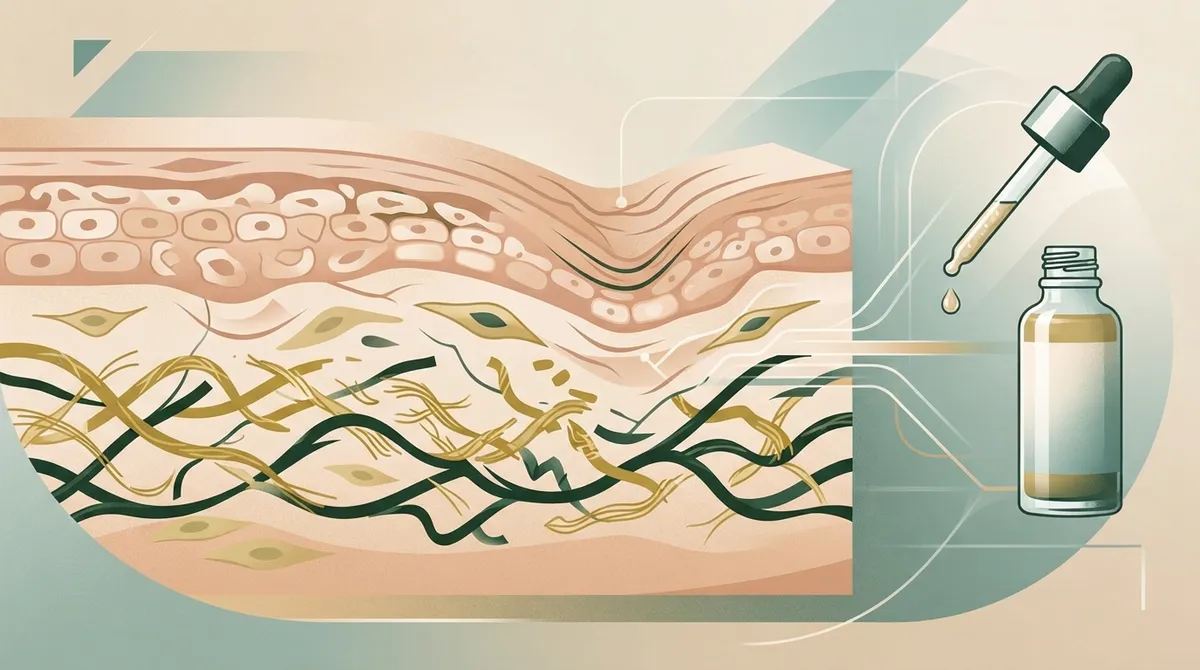
Skin aging has two big drivers. One is natural aging, which includes hormone shifts, especially around perimenopause and menopause. The other is sun exposure over many years, called photoaging.
Common midlife skin changes include:
- Fine lines and wrinkles, especially around the eyes and mouth
- Dryness and a rougher texture
- Less elasticity, so skin doesn’t “snap back” as fast
- Dullness and uneven tone
- Thinner, more delicate-feeling skin
Knowing the cause helps you pick the right tool. Sunscreen and good dermatologic care still do the heavy lifting here. Peptides can be a nice add-on, but they shouldn’t replace the basics.
Step 1: Understand What the Evidence Says
Let’s look at what researchers have found so far. This part matters, because marketing often runs ahead of science.
Topical Peptides: Promising but Not Proven
A 2024 systematic review of topical peptide and exosome therapies included nine peptide studies. Some small human studies reported better fine lines or wrinkles (three studies), elasticity (two studies), and skin texture (three studies). The review also found that none of the participants in those studies had negative side effects.
That sounds great, but there’s a catch. The same review noted that randomized controlled trials were scarce, and the evidence is not conclusive. It also found no FDA-approved topical therapy using peptides or exosomes as the main ingredient. That means a peptide serum is a cosmetic, not a proven medical treatment.
Oral Collagen Peptides: More Human Data
Oral hydrolyzed collagen has more trial data than most peptide skin products. A 2024 review cited a meta-analysis of 19 randomized, placebo-controlled trials with 1,125 participants (95% women). It reported improvements in wrinkle measures, elasticity, and hydration after 90 days.
Another trial of 60 people found better elasticity and hydration with collagen peptides versus a control group, but no significant difference in wrinkle reduction. The researchers cautioned that the study was small and short.
The takeaway? Collagen peptides may help some people, but results vary by product, dose, and study quality. They aren’t guaranteed or permanent. You can read more in the National Library of Medicine database of peer-reviewed research.
Injectable Peptides: Handle With Care
Evidence for topical peptides does not prove that injectable or systemic peptides are safe or effective for skin aging. Many peptides promoted online lack strong human trials and may not be FDA-approved for the advertised use.
For a deeper look at this topic, see FDA-Approved vs. Compounded Peptides: What Wins?
Step 2: Compare Your Options Side by Side
A quick table can make this much clearer. Here’s how the three main routes stack up.
| Type | How You Use It | Evidence Level | Regulatory Status | Main Caution |
|---|---|---|---|---|
| Topical peptides | Apply serum or cream daily | Limited; few randomized trials | Cosmetic, not FDA-approved drug | Results are modest and vary |
| Oral collagen peptides | Powder, drink, or capsule daily | Moderate; more human trials | Dietary supplement | Product quality and dose differ |
| Injectable or compounded peptides | Provider-guided injections | Weak for skin aging specifically | Compounded products are not FDA-approved | Sterility, dosing, and long-term unknowns |
Notice that no option here is a sure thing. That’s okay. The goal is to match your comfort level and goals with the best-supported choice.
Step 3: Build a Smart Skin Routine First
Before adding anything peptide-related, lock in the basics. These have the strongest track record for midlife skin.
- Wear sunscreen daily. Use broad-spectrum SPF 30 or higher, even on cloudy days.
- Moisturize. A good moisturizer helps with dryness and texture.
- Talk to a dermatologist. Ask about established options like retinoids, which have a long research history for photoaging.
- Protect your sleep and nutrition. Skin repairs itself while you rest, and protein intake matters.
- Skip smoking and limit alcohol. Both can speed up visible aging.
Think of peptides as the cherry on top, not the whole sundae. When you’re ready to explore, you can also read What Peptides Do for Skin: A Real-World Guide for 2026.
Step 4: Choose a Topical Peptide Product Wisely
If you want to try a peptide serum, you don’t need the priciest bottle. Look for these signs of a thoughtful product.
- A clear ingredient list, with peptides named (not just “proprietary blend”)
- Fragrance-free or low-irritant formulas, especially if your skin is sensitive
- Realistic claims, such as “supports the look of fine lines” rather than “erases wrinkles”
- Opaque or airless packaging that protects ingredients
- A return policy, so you can stop if your skin reacts
Patch test first. Apply a small amount behind your ear or on your inner arm for a few days. Then add it to your routine slowly, one new product at a time.
How Long Until You’d Notice Anything?
Skin renews slowly. Many people give a topical product at least 8 to 12 weeks before judging it. Take photos in the same lighting every few weeks so you can compare honestly.
Step 5: Consider Oral Collagen Peptides
If you like the idea of supporting skin from the inside, oral collagen is the better-studied route. Here’s how to approach it sensibly.
- Look for hydrolyzed collagen peptides. This form is what most studies used.
- Check for third-party testing. This helps confirm purity and label accuracy.
- Be consistent. The trials that showed benefits ran about 90 days, with daily use.
- Check allergies. Collagen often comes from fish, beef, or eggshell membrane sources.
Keep your expectations realistic. Benefits in studies were modest, and they may fade if you stop. If you want to dig in, How to Choose the Best Collagen Peptides for Women in 2026 is a helpful companion.
Step 6: Know the Risks of Injectable and Compounded Peptides
This is the part where we slow down and get careful. The FDA does not review each compounded product for safety, effectiveness, and quality before it’s marketed. Unapproved injectable products can raise concerns about:
- Sterility and contamination
- Dose accuracy
- Immune reactions
- Unknown long-term effects
And here’s an important point. Injectable peptides should not be presented as a proven skin-rejuvenation treatment. If anyone promises dramatic results, that’s a red flag.
If you’re curious about safe sourcing in general, read How to Get Prescription Peptides Safely in 2026 and Is Peptide Therapy Safe? What You Really Need to Know.
Questions to Ask Any Provider
Before you start any prescription peptide plan, ask:
- Is this product FDA-approved, or is it compounded?
- What human evidence supports it for my specific goal?
- What bloodwork will you review first?
- Which licensed provider will monitor me, and how often?
- What side effects should I watch for, and who do I call?
A trustworthy provider will welcome these questions. A pushy one won’t.
Step 7: Look at Your Whole Health Picture
Skin doesn’t live in a bubble. Hormones, sleep, stress, and nutrition all show up on your face. That’s why many midlife adults, from health optimizers to busy professionals, like a whole-person approach.
A personalized plan starts with data. Bloodwork can reveal things like hormone levels, inflammation markers, and nutrient gaps. That information helps a licensed provider decide what is, and isn’t, appropriate for you.
Allura Longevity offers personalized, medically supervised peptide therapy through telehealth. It starts with a $50 virtual consultation and LabCorp bloodwork, followed by a customized six-month plan delivered to your door and monitored by licensed providers led by Ashley, a board-certified Family Nurse Practitioner. Care is built around your labs and goals, not a one-size-fits-all promise. Clients in Florida, Georgia, Texas, Connecticut, Indiana, Maryland, New York, and California can explore options, and limited spots are available for new clients each month.
You can learn how the process works in How to Start Peptide Therapy Safely and See Real Results, or see how skin fits into the bigger picture in How to Pick the Best Peptides for Aging in 2026.
Step 8: Track Results and Stay Flexible
Good results come from paying attention. Here’s a simple way to track your progress.
- Take baseline photos in natural light before you start.
- Note your routine so you know what changed and when.
- Check in every 4 weeks with new photos and a few notes on hydration and texture.
- Adjust with guidance. If something irritates your skin or you see no change, talk to your provider or dermatologist.
Want a sense of timing? How Long Until Peptides Improve Skin? A 2026 Timeline breaks it down.
Common Mistakes to Avoid
Even smart people trip on these. Watch out for them.
- Buying peptides from random online sellers. Quality and safety can’t be verified.
- Skipping sunscreen. No peptide can undo daily sun damage.
- Starting five products at once. If your skin reacts, you won’t know why.
- Expecting overnight results. Skin changes take weeks, not days.
- Treating marketing claims as proof. “Clinically inspired” is not the same as clinically proven.
A Simple Decision Guide
Not sure where to begin? This table can help you match your situation to a sensible next step.
| If You Want… | A Reasonable First Step |
|---|---|
| A low-risk, low-cost trial | Fragrance-free peptide serum plus daily sunscreen |
| Support for hydration and elasticity | Hydrolyzed collagen peptides for about 90 days |
| Proven prescription skin care | Dermatologist visit to discuss retinoids and other options |
| A personalized, lab-based wellness plan | Telehealth consultation with a licensed peptide provider |
Final Thoughts
Midlife skin peptide therapy can be a helpful part of a bigger plan, as long as you know what you’re buying. Topical peptides and oral collagen have some supportive research, though the evidence is still limited and results vary. Injectable peptides need extra caution, since many lack strong skin-specific data and approval.
The best path is usually the simplest: protect your skin from the sun, build a gentle routine, add one well-chosen product at a time, and work with licensed professionals when you move into prescription territory. Be kind to yourself, too. Aging skin isn’t a problem to fix. It’s a story you’re still writing.
Ready to talk through your goals with a licensed provider who starts with your labs? Request a consultation with Allura Longevity and see whether a personalized peptide plan fits you. You can also call (813) 510-6277. Spots for new clients are limited each month, so reach out when you’re ready.
FAQs
Q: What is peptide therapy for midlife skin?
A: It’s a broad phrase that can mean topical peptide serums, oral collagen peptide supplements, or, in some clinics, injectable or compounded peptides. These options have different evidence, risks, and regulatory status, so it helps to know exactly which one you’re considering.
Q: Do topical peptides actually reduce wrinkles?
A: Some small human studies suggest modest improvements in fine lines, texture, and elasticity. But a 2024 review noted that randomized controlled trials are scarce and the evidence isn’t conclusive, so think of peptide serums as a gentle add-on, not a wrinkle eraser.
Q: Are oral collagen peptides effective for skin after menopause?
A: Oral collagen has more human trial data than most peptide skin products, with studies reporting possible gains in hydration and elasticity after about 90 days. Results vary by product and person, and benefits aren’t guaranteed or permanent.
Q: Are peptide injections approved or proven for skin rejuvenation?
A: Not for skin aging, at least not with strong evidence. Compounded products aren’t FDA-reviewed for safety, effectiveness, or quality before marketing, so it’s smart to ask a licensed provider about approval status and supporting research before you start.
Q: What are the risks of compounded or online peptide products?
A: Concerns include contamination, inaccurate dosing, immune reactions, and unknown long-term effects. Working with a licensed provider who reviews your bloodwork and monitors you over time is a much safer path than buying from random online sellers.





