
Key Takeaways
-
Venous blood draws from mobile phlebotomists are superior to finger-stick tests for hormone therapy monitoring because they provide larger, more reliable samples essential for accurate dosing decisions.
-
At-home blood work is a convenience tool, not a replacement for licensed medical care—a provider must interpret results, connect symptoms, and guide your treatment plan for safety.
-
Hematocrit requires special monitoring during testosterone therapy and should stay below 54%; elevated levels need provider adjustment rather than self-correction through dose skipping.
-
Testing frequency follows medical guidelines: baseline before therapy, every 2-4 weeks initially, roughly every 3 months in year one, then every 6-12 months for maintenance.
-
Peptide therapy monitoring differs from standard hormone panels and requires customized testing (IGF-1 for growth hormone peptides, glucose/A1C for metabolic peptides) matched to the specific peptide.
-
Sample timing consistency matters significantly—collect blood at similar times relative to your last dose, use the same lab, and avoid biotin supplements to ensure valid trend data for treatment adjustments.
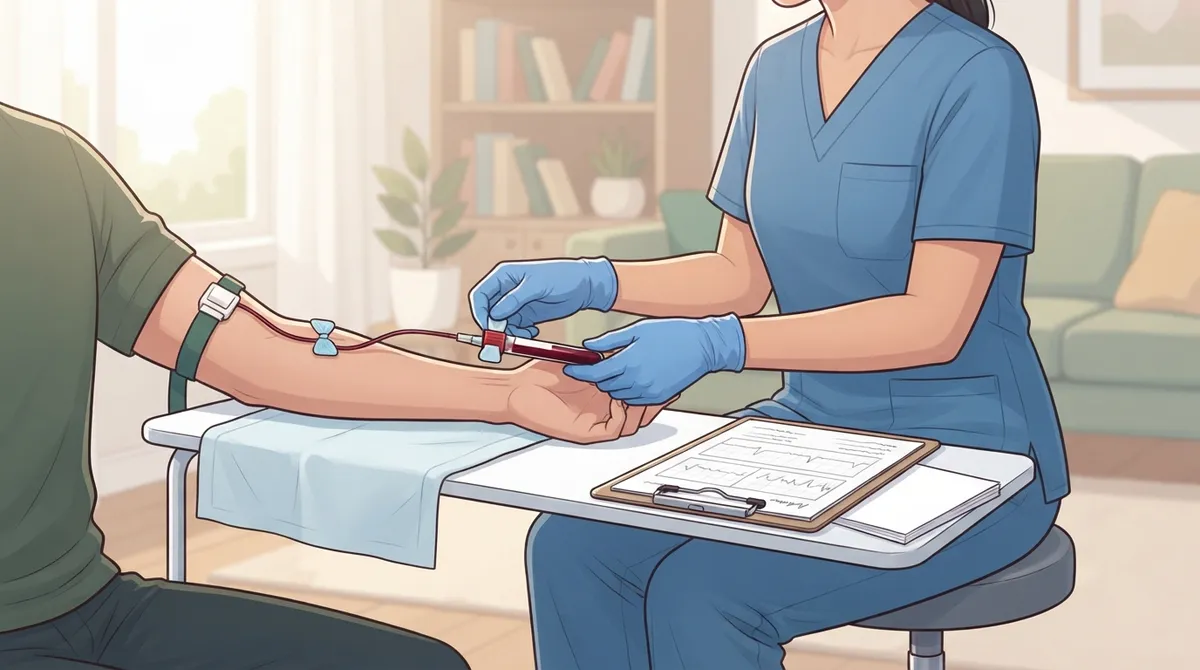
Picture this: you want to start hormone or peptide therapy, but the idea of taking time off work to sit in a waiting room feels exhausting. Good news! At-home blood work has made this so much easier. A friendly mobile phlebotomist can come right to your kitchen table, draw your blood, and send it off to an accredited lab. No traffic, no waiting room magazines from three years ago.
But here’s the thing we want you to know upfront, because we care about your safety and your results: at-home blood work is a wonderful convenience, not a shortcut around real medical care. Your results still need a licensed provider to read them, connect the dots with your symptoms, and guide your treatment plan. Think of at-home testing as the comfy, convenient front door to your care, not the whole house.
In this guide, we’ll walk through how at-home blood work fits into hormone and peptide therapy, what tests actually matter, how often you should test, and how to avoid common mistakes. Whether you’re a busy professional, a dedicated biohacker, or simply someone who wants to feel like yourself again, this one’s for you.
Why At-Home Blood Work Fits So Well With Hormone and Peptide Therapy
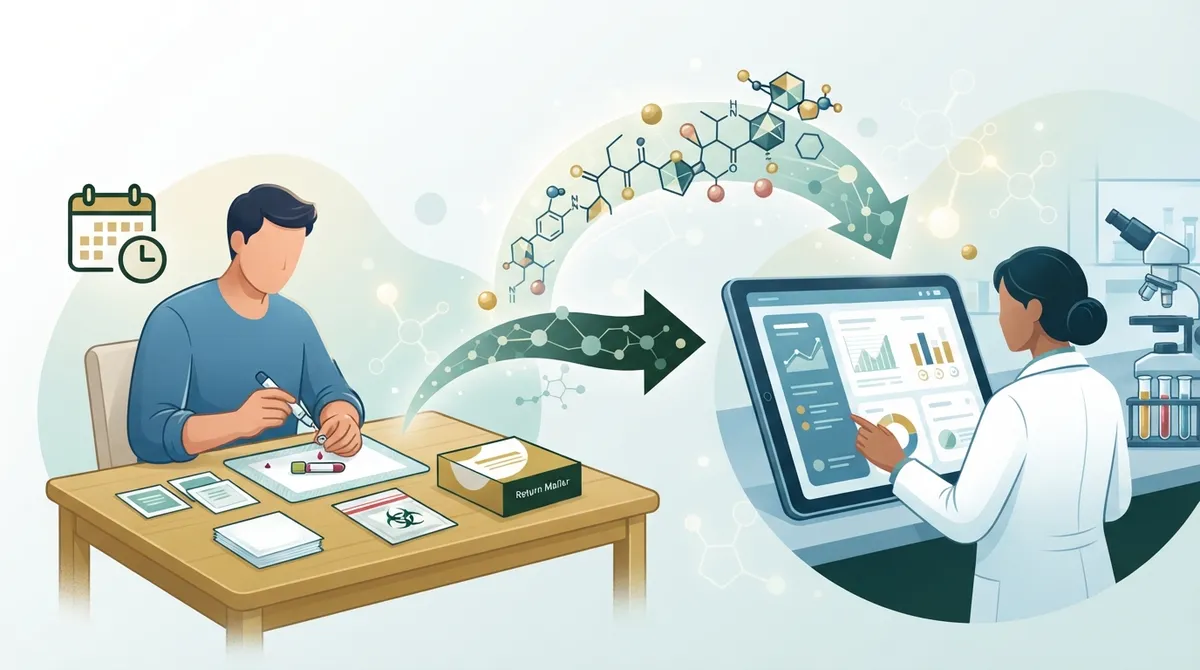
Hormone and peptide therapy both depend on accurate, up-to-date labs. Your provider needs real numbers to build a plan that fits your body, not a generic template. At-home blood draws remove a lot of the friction that keeps people from getting tested regularly.
For busy professionals and parents, this convenience is huge. You can schedule a draw around your calendar instead of rearranging your whole day. For aging adults who may find clinic visits tiring, having a phlebotomist come to you is a genuine relief. And for biohackers who love tracking data over time, at-home testing makes consistent monitoring far more realistic.
Finger-Stick Samples vs. Venous Blood Draws
Not all at-home blood work is the same, so it helps to know the difference.
- Finger-stick dried blood spot tests: A small prick on your finger fills a tiny card with blood. It’s easy and fast, but the sample size is small and results can be less reliable for certain hormones.
- Venous blood draws: A trained mobile phlebotomist draws blood from your arm, just like at a lab. This method usually gives a larger, more reliable sample, especially when several hormones need to be measured at once.
For hormone therapy monitoring, venous draws are generally the better choice. They tend to offer more consistent and complete results, which matters when your provider is making dosing decisions.

What Tests Actually Matter for Hormone Therapy
It’s tempting to think one basic hormone panel covers everything. It doesn’t. The right tests depend on your therapy, your goals, and your health history. Still, there are some common building blocks worth understanding.
| Test Category | What It Checks | Why It Matters |
|---|---|---|
| Total Testosterone | Main androgen hormone level | Guides dosing for testosterone therapy |
| Estradiol | Key estrogen hormone | Balances therapy and reduces side effects |
| SHBG | Protein that binds hormones | Helps calculate “free” hormone levels |
| LH and FSH | Pituitary signaling hormones | Shows how your body is responding to therapy |
| CBC (Hemoglobin/Hematocrit) | Red blood cell counts | Critical safety marker during testosterone therapy |
| Comprehensive Metabolic Panel | Kidney, liver, and electrolyte function | Confirms your body can safely process therapy |
| Lipids and Glucose/A1C | Cholesterol and blood sugar | Tracks metabolic health over time |
| PSA (when appropriate) | Prostate-specific marker | Extra safety check for men on testosterone therapy |
These tests aren’t just boxes to check. They tell a story about how your body is responding, and they help your provider fine-tune your peptide therapy for men or peptide therapy for women plan over time.
Why Hematocrit Deserves Special Attention
If you’re on testosterone therapy, hematocrit is one number you really want to keep an eye on. Testosterone can increase red blood cell production, and too much of a good thing can thicken the blood. The American Urological Association recommends keeping hematocrit below 54%, with regular monitoring along the way.
If your hematocrit climbs too high, that’s not something to fix on your own by skipping doses. It calls for a conversation with your provider, who may adjust your treatment plan based on the full picture.
Peptide Therapy Monitoring Looks a Little Different
Here’s something a lot of people don’t realize: standard hormone panels don’t always tell you much about how a peptide is working. Peptides are a diverse group, and each one interacts with the body in its own way, as explained in this overview of what are peptides and how they function.
Some peptides support growth hormone pathways, some target metabolism, and others focus on tissue repair or immune support. Because of this, monitoring needs to match the specific peptide, not just a generic hormone checklist.
- Growth-hormone-related peptides: May require IGF-1 monitoring to track effect and safety.
- Metabolic peptides (like GLP-1 therapies): Often need glucose or A1C tracking, alongside kidney and liver panels.
- Recovery-focused peptides such as BPC-157: May call for baseline metabolic panels and follow-up as needed, which you can read more about in this guide to BPC-157 peptide facts.
- Amylase or lipase testing: Sometimes added when a peptide could affect the pancreas.
This is exactly why a licensed provider needs to design your testing plan, not a one-size-fits-all wellness package. If you’re curious how this works from the very beginning, this article on how to start peptide therapy safely walks through the process step by step.
How Often Should You Test?
Testing frequency isn’t random. Medical guidelines give us some solid benchmarks to follow.
- Baseline testing: Before starting any hormone or peptide therapy, you’ll want a full baseline panel. This is your starting point.
- Early follow-up: The American Urological Association recommends checking testosterone 2 to 4 weeks after starting therapy, depending on the formulation used.
- First-year monitoring: The Endocrine Society guideline suggests checking hormone levels roughly every 3 months during the first year of hormone therapy.
- Maintenance phase: Once things stabilize, testing typically shifts to once or twice a year, or every 6 to 12 months for testosterone specifically.
Sticking to a testing schedule feels a lot less overwhelming when it’s built into your plan from day one. That kind of structure is part of what makes hormone therapy feel manageable instead of stressful.
Timing Your Blood Draw the Right Way
Here’s a detail that trips people up: when you test matters almost as much as what you test. Testosterone levels can shift a lot depending on your injection schedule, your last dose, and even the time of day.
For consistent, trend-worthy results, try to follow these habits:
- Collect samples at a similar time relative to your last dose each time.
- Use the same lab and testing method for follow-up comparisons whenever possible.
- Avoid biotin supplements for a few days before testing, since biotin can interfere with certain hormone assays.
- Note any recent illness, intense exercise, or fasting changes, since these can all skew results.
Consistency turns your blood work into a useful trend line instead of a confusing, jumpy graph. This matters just as much for those exploring testosterone replacement therapy as it does for anyone tracking peptide progress.
Saliva and Urine Tests: Handle With Caution
You may have seen saliva or urine hormone kits marketed as an easy alternative to blood testing. We get the appeal, but it’s worth pumping the brakes here.
Clinical guidance generally treats salivary sex-hormone testing as investigational, meaning it hasn’t been proven reliable enough for making treatment decisions. A properly drawn blood sample, tested at an accredited lab, remains the gold standard for hormone therapy monitoring.
When accuracy really counts, especially for low testosterone or estradiol levels, labs may use a method called liquid chromatography-tandem mass spectrometry. This approach tends to be more precise than older testing methods at low hormone concentrations, according to research summarized by the National Library of Medicine.
How to Spot a Trustworthy At-Home Testing Service
Not every testing company is created equal. Before you trust your results (and your health decisions) to a service, check for these signs of legitimacy.
| What to Look For | Why It Matters |
|---|---|
| Named, accredited lab | Confirms testing meets quality standards |
| Clear reference ranges | Helps you and your provider interpret results correctly |
| Licensed clinician review | Ensures a real medical professional checks your results |
| Transparent collection instructions | Reduces errors from improper sample handling |
| Established quality systems | Signals the company follows recognized lab standards |
You can also check the FDA’s databases to confirm whether a specific test or device has been cleared or approved. Remember, FDA clearance of a collection device doesn’t automatically mean every bundled panel or recommendation is FDA-approved, so read the fine print.
When At-Home Testing Isn’t Enough
At-home blood work is fantastic for routine monitoring, but it’s not built for emergencies. If you experience any of the following, please seek medical care right away instead of waiting on lab results:
- Chest pain or shortness of breath
- Severe headache or sudden neurological symptoms
- Fainting or severe dizziness
- Intense abdominal pain
- Yellowing of the skin or eyes (jaundice)
These symptoms need prompt evaluation, not a scheduled blood draw. Your safety always comes first.
Turning Results Into a Real Treatment Plan
Getting your blood work done is only half the story. The real value comes from what happens next: a licensed provider reviewing your results alongside your symptoms, medical history, and goals.
This is exactly how Allura Longevity approaches care. After a simple $50 virtual consultation, clients complete blood work through LabCorp, a widely trusted and accredited laboratory. From there, Ashley, a board-certified Family Nurse Practitioner, and the Allura Longevity team build a personalized six-month treatment plan based on your actual numbers, not a generic template. Peptides are then shipped right to your door, with ongoing monitoring and adjustments along the way.
This approach fits beautifully into a busy life. You get the accuracy of clinical-grade testing with the convenience of telehealth, plus a real human checking in on your progress. If you want to explore your options further, this guide on bioidentical hormones and peptides can help you understand what path might fit you best.
A Few Encouraging Final Thoughts
Taking charge of your hormone health is a genuinely empowering step, and we’re proud of you for doing the research. At-home blood work makes the process smoother, more convenient, and less intimidating. Just remember that convenience works best when it’s paired with real medical guidance.
Whether you’re chasing better energy, smoother recovery, or simply want to feel like your best self again, the right testing and the right provider make all the difference. If you’re ready to see what a personalized plan could look like for you, why not request a consultation and take that next step with support from a licensed team? You can also call (813) 510-6277 to ask questions before you commit. Spots for new clients are limited each month, so if you’ve been considering this, now’s a great time to reach out.
FAQs
Q: Can I do blood work at home while taking testosterone or estrogen therapy?
A: Absolutely! Many people on hormone therapy use mobile phlebotomy for convenient at-home blood draws. Just make sure a licensed provider reviews your results and guides any treatment changes.
Q: Are finger-prick hormone tests accurate enough for peptide therapy monitoring?
A: Finger-prick tests can work for some basic screening, but venous blood draws generally give more reliable results, especially for hormones that need precise measurement. Your provider can help decide which method fits your specific therapy.
Q: How often should hormone levels be tested after starting therapy?
A: Most guidelines recommend testing every 2 to 4 weeks after starting testosterone therapy, then roughly every 3 months during the first year. Once things stabilize, testing often shifts to once or twice yearly.
Q: Is at-home saliva testing reliable for hormone therapy monitoring?
A: Not really, at least not yet. Clinical guidance generally considers saliva hormone testing investigational, so a proper blood draw through an accredited lab remains the more trusted option.
Q: Can I change my hormone or peptide dose based on an at-home test result?
A: We’d love for you to hold off on that one! Dose changes should always come from your licensed provider, who can weigh your results alongside your symptoms and overall health picture.





