Key Takeaways
-
Peptide facial rejuvenation spans cosmetic topicals, clinic facials, and prescription-only therapy, and each carries different evidence, safety, and regulatory rules.
-
Board-certified dermatologists are a strong first stop for topical peptides, especially if you have sensitive skin, rosacea, eczema, or acne.
-
Always confirm whether a product is FDA-approved, cosmetic, or compounded, and ask a licensed clinician to verify its regulatory status before starting any injectable.
-
Evidence is encouraging but limited: a 2026 meta-analysis found only a modest wrinkle benefit, and only two of its 19 trials tested topical products.
-
Avoid 'research use only' sellers that ship injectable peptides without a prescription, since their purity and dosing are unknown.
-
Legitimate providers ask about your history and labs, explain risks and realistic timelines, and offer follow-up; guaranteed results or pressure to buy packages are red flags.
You have probably seen the buzz. Peptides are showing up in serums, spa menus, and wellness feeds everywhere. So it is natural to wonder who provides peptide facial rejuvenation, and which of those providers you can actually trust with your face.
Here is the honest truth. The words “peptide facial rejuvenation” can mean very different things. It might be a cosmetic serum you buy at a store. It might be a clinic treatment. Or it might be a medically supervised plan with a prescription. Each route has its own evidence, risks, and rules.
The good news? Once you know the landscape, choosing gets much easier. Think of this guide as a friendly chat with someone who has done the homework for you. We will walk through eight types of providers, what each one really does, and the questions to ask before you say yes. Whether you are a busy professional, a data-loving biohacker, or simply someone who wants to age well, you deserve clear answers. Let’s dive in.

First, What Does Peptide Facial Rejuvenation Really Mean?
Peptides are short chains of amino acids. They act like tiny messengers in your body. If you want a plain-language refresher, this guide on what are peptides is a helpful place to start.
In skin care, “peptide facial rejuvenation” usually falls into two broad buckets:
- Topical peptide skincare: Creams, serums, and in-clinic facials sold as cosmetics.
- Clinician-supervised peptide therapy: Treatments marketed as peptide therapy, sometimes involving prescription or compounded products.
These two paths are not the same. They differ in evidence, safety, and regulation. Do not assume that the word “peptide” means a product is FDA-approved or proven for facial rejuvenation. FDA-approved peptide drugs are a different category from cosmetic peptide products and from unapproved or compounded wellness products.
8 Types of Providers to Know
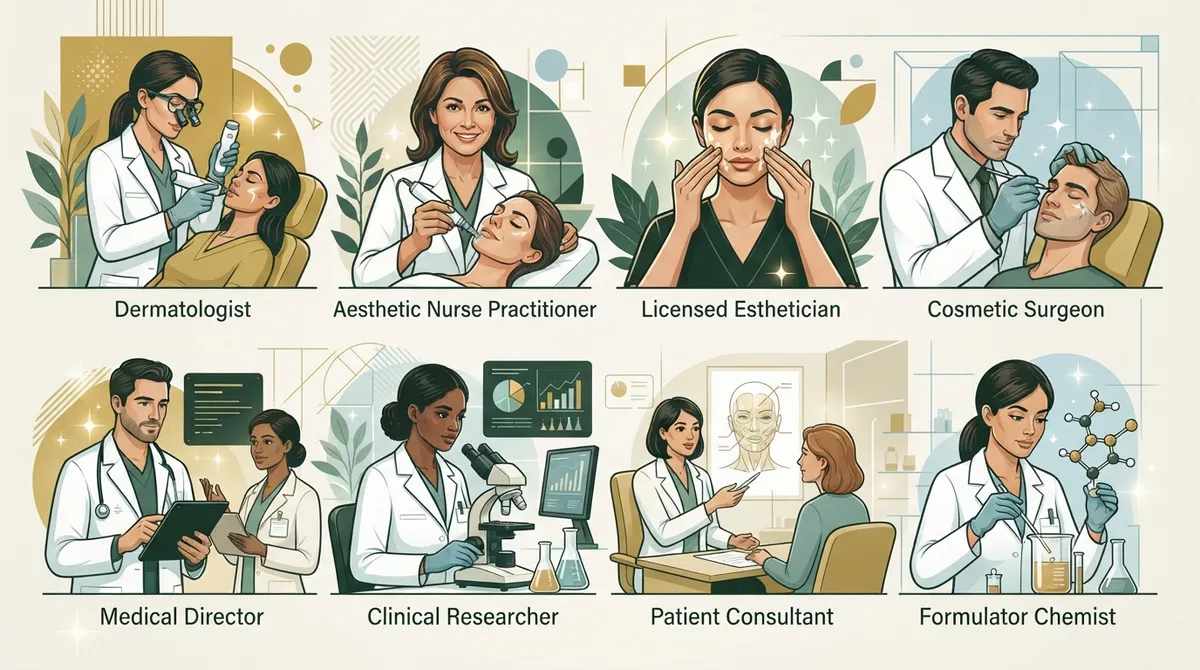
Now for the main question. Here are the eight places people turn to for peptide facial rejuvenation, from the most familiar to the most personalized.
1. Board-Certified Dermatologists
Dermatologists are skin specialists. They can review your skin type, existing conditions, and product ingredients. That matters most if you have sensitive skin, rosacea, eczema, or acne.
A dermatologist is a smart first stop for topical peptides. They can tell you which formulas are worth trying and which are mostly marketing. They also help you avoid ingredient clashes with retinoids, acids, and prescription creams.
2. Licensed Aesthetic Clinics and Estheticians
Many aesthetic clinics offer peptide-based facials and professional-grade serums. These are usually cosmetic services. They can be a nice, low-risk way to try peptides and see how your skin responds.
Ask who designs the treatment and what training they have. A good esthetician will be happy to explain what is in each product and what results are realistic.
3. Medical Spas
Medical spas blend spa comfort with clinical services. Some advertise peptide therapy as part of their menu. The key question is supervision. Who is the medical professional behind the treatments?
For any prescription or injectable service, you should see a licensed clinician who is authorized to prescribe in your state. They should review your medical history, explain risks, and plan follow-up care.
4. Physician-Led Wellness Practices
Some doctors run wellness practices focused on aging, hormones, and vitality. They may offer peptide therapy as part of a bigger plan. This can be a good fit if you want skin support that fits into your overall health picture.
Look for practices that start with a real evaluation. If a provider offers a one-size-fits-all package without asking about your health, that is a red flag.
5. Nurse Practitioners and Physician Assistants
Licensed nurse practitioners often lead modern peptide programs. Many work in telehealth settings where they can spend real time with you. Allura Longevity, for example, is led by Ashley, a board-certified Family Nurse Practitioner.
What matters is the license, the training, and the process. A strong provider asks about your goals, reviews your labs, and adjusts your plan over time.
6. Telehealth Peptide Clinics
Telehealth has changed the game, especially for busy people. You can have a visit from your couch and skip the waiting room. Clinics like Allura Longevity offer personalized peptide therapy by telehealth, with licensed medical providers and treatments delivered to your home.
The Allura process starts with a $50 virtual consultation. You complete blood work through LabCorp. Then your provider builds a customized six-month plan around your results and goals. Ongoing monitoring helps your plan change as you do. Allura is licensed in Florida, Georgia, Texas, Connecticut, Indiana, Maryland, New York, and California.
Curious how this works in real life? Read about how a telehealth prescription works for peptides, or see local clinic vs. telehealth to compare your options.
7. Retail Skincare Brands and Cosmetic Counters
This is the most common way people meet peptides. Cosmetic brands sell serums and creams with ingredients like palmitoyl pentapeptide and acetyl hexapeptide-8. These are sold as cosmetics, not drugs.
They are easy to buy and fairly low-risk for most people. But results depend on the exact product and ingredient. Quality and testing vary widely, so read labels and look for clear ingredient lists.
8. Online “Research Use Only” Sellers (Avoid These)
We have to mention this one because it is out there. Some websites sell peptides labeled “research use only” with no medical oversight. These products are not meant for human use, and their purity and dosing can be unknown.
If a seller will ship injectable peptides without a prescription, step away. Your face is worth more than a gamble. For safer paths, see how to find legal peptide therapy you can trust.
Provider Comparison at a Glance
| Provider Type | Typical Offering | Prescribing Authority | Best For |
|---|---|---|---|
| Dermatologist | Skin assessment, topical advice | Yes | Sensitive or complex skin |
| Aesthetic clinic / esthetician | Peptide facials, serums | No | Low-risk cosmetic care |
| Medical spa | Mixed cosmetic and medical | Depends on supervisor | In-person convenience |
| Physician-led wellness practice | Whole-body aging plans | Yes | Integrated health goals |
| Nurse practitioner / PA | Personalized plans | Yes (state rules apply) | Hands-on guidance |
| Telehealth peptide clinic | Lab-guided plans, home delivery | Yes | Busy, data-driven people |
| Retail brand | Cosmetic creams and serums | No | Easy, affordable starting point |
| “Research use only” seller | Unregulated products | No | Not recommended |
What Does the Research Say?
Let’s keep our feet on the ground. The evidence is encouraging in places, but it is not a blanket promise.
A 2026 systematic review and meta-analysis looked at 19 randomized trials with 1,341 participants across oral and topical peptide studies. It found a modest pooled effect on wrinkle reduction (MD 0.27, p=0.04). But only two of those trials tested topical products. The authors also noted wide differences in peptide types, doses, and outcome measures. You can read the full paper through the National Library of Medicine database and its related research.
Some product-specific findings are interesting:
- A randomized split-face study of 93 women over 12 weeks found improvement in photoaged skin with topical palmitoyl pentapeptide.
- A placebo-controlled study of 60 participants linked topical acetyl hexapeptide-8 to improved periorbital wrinkle measurements after four weeks.
These results apply to specific formulas and studies. They do not prove that every peptide product works. A 2024 review also described the topical-peptide evidence as limited, with a small number of human studies and mixed findings.
For a deeper look, check out how to tell if peptides help with wrinkles and whether peptides for skin regeneration really work.
Topical vs. Injectable: Why It Matters
This difference is the heart of the whole topic. Let’s make it simple.
| Factor | Topical Peptides | Injectable or Compounded Peptides |
|---|---|---|
| Regulatory status | Usually cosmetic | Varies by substance; some are unapproved |
| Who provides it | Retailers, spas, dermatologists | Licensed prescribers only |
| Evidence | Limited, formula-specific | Varies widely; scrutiny needed |
| Main risk | Irritation, wasted money | Side effects, quality concerns |
| Follow-up | Optional | Essential |
Injectable or compounded peptides marketed for cosmetic rejuvenation deserve extra care. FDA rules and compounding limits can differ by substance and can change over time. Always ask your clinician to confirm the regulatory status of any product. To learn more, see topical vs. injectable skin peptides and how to weigh the risks of peptide therapy.
7 Questions to Ask Any Provider
Before you book anything, bring this short list. A good provider will welcome every question.
- Who evaluates and prescribes my treatment? You want a licensed clinician, not a sales rep.
- What exact peptide and route do you propose? Topical, injectable, or oral? Get the name and the method.
- Is the product FDA-approved or compounded? Ask for a straight answer.
- What evidence supports this specific use? Look for product-specific research, not general claims.
- What are the risks and alternatives? Every treatment has both.
- Will you review my labs and history first? Personalization starts here.
- How will you track results and side effects? You deserve a follow-up plan.
For more ideas, browse these 15 peptide consultation questions to ask, and avoid the traps in 3 peptide consultation mistakes that waste your first visit.
Red Flags vs. Green Flags
Here is a quick scan you can use in the moment.
Green Flags
- A licensed clinician reviews your history and labs
- Clear answers about approval status and sourcing
- Honest talk about limits and realistic timelines
- A plan for follow-up and adjustments
Red Flags
- Guaranteed results or “miracle” language
- No medical evaluation before treatment
- Vague product names or “proprietary blends”
- Pressure to buy a big package today
How Personalization Changes the Game
Your face does not exist in a vacuum. Sleep, stress, hormones, nutrition, and sun exposure all show up in your skin. That is why a lab-guided approach can make sense for people who like data and want the full picture.
With a personalized plan, a provider looks at your blood work and goals first. Then they choose a path that fits you, instead of handing you a generic kit. If you are curious about how this works, explore 15 ways a peptide therapy plan gets personalized and what a realistic peptide therapy timeline looks like.
And if your goal is skin that looks healthy and rested, remember the basics still count. Daily sunscreen, good sleep, and steady habits often do more than any single product.
Which Provider Is Right for You?
Here is a simple way to decide.
- Just curious? Start with a dermatologist or a trusted topical product.
- Want a spa-style treat? Try an aesthetic clinic, and confirm who supervises.
- Want a whole-body, data-guided plan? A licensed telehealth peptide clinic may fit best.
- Short on time? Telehealth with home delivery saves hours.
Whatever you choose, take your time. A great provider will never rush you.
Final Thoughts: Choose With Confidence
So, who provides peptide facial rejuvenation? Dermatologists, aesthetic clinics, medical spas, wellness practices, nurse practitioners, telehealth clinics, and retail brands all do, in very different ways. The best choice depends on your goals, your skin, and how much medical guidance you want.
Ask smart questions. Check the license. Be wary of big promises. And remember that real progress usually looks like steady, supported change.
If you would like a personalized, medically supervised path, request a consultation with Allura Longevity. Spots for new clients are limited each month, so reach out soon. You can also call (813) 510-6277. Your future self will thank you.
FAQs
Q: Who provides peptide facial rejuvenation near me?
A: You can find it through dermatologists, aesthetic clinics, medical spas, wellness practices, and telehealth peptide clinics. For prescription treatments, look for a licensed clinician who can prescribe in your state. Telehealth clinics like Allura Longevity can serve you from home if you live in a licensed state.
Q: Can a dermatologist provide peptide therapy for facial rejuvenation?
A: Yes, dermatologists can review your skin and recommend peptide skincare products. Some may also guide medically supervised options, depending on their practice. They are a great pick if you have sensitive skin or a skin condition.
Q: Are injectable peptides approved for facial rejuvenation?
A: Not as a general rule. FDA-approved peptide drugs are separate from cosmetic peptides and from compounded wellness products. Always ask your clinician to confirm the exact regulatory status of any injectable before you start.
Q: How do I check whether a peptide provider is legitimate?
A: Confirm they have a valid license and that a clinician reviews your history and labs. Ask what the product is, where it comes from, and what evidence supports it. Skip any seller offering injectables with no prescription or “research use only” products.
Q: Is there clinical evidence that peptides reduce facial wrinkles?
A: There is some encouraging evidence, but it is product-specific and still limited. A 2026 meta-analysis found a modest wrinkle benefit, though only two of its trials tested topical products. Results from one peptide cannot be applied to all peptide treatments.