

Key Takeaways
-
Peptide therapy can be part of longevity medicine, but only in a limited sense: approved peptide medicines have evidence for specific conditions, while many popular anti-aging peptides remain experimental.
-
Longevity medicine targets healthspan, meaning years of strong, independent living, not a guaranteed extended lifespan or a proven way to stop aging.
-
No reliable human evidence shows that peptide therapy extends lifespan; many wellness peptides like BPC-157 rely mainly on preclinical lab and animal research.
-
FDA-approved peptides such as GLP-1 receptor agonists and insulin have strong evidence for their approved uses, but that does not prove a general anti-aging effect.
-
Compounded peptides and 'research use only' products are not FDA-reviewed for safety, effectiveness, or quality, so they carry real risks like immune reactions and impurities.
-
Before starting any peptide, ask about regulatory status, look for human clinical data, and confirm that a licensed clinician will guide treatment using your lab work.
You’ve probably heard the buzz. Peptides are everywhere right now, from podcasts to social feeds to your gym buddy’s group chat. So it’s fair to ask a simple question: is peptide therapy part of longevity medicine?
The short answer is yes, but with an important catch. “Peptide therapy” covers some very different treatments. A few have strong evidence and clear FDA-approved uses. Many others are popular in anti-aging circles but still experimental. Mixing them up is where people get into trouble.
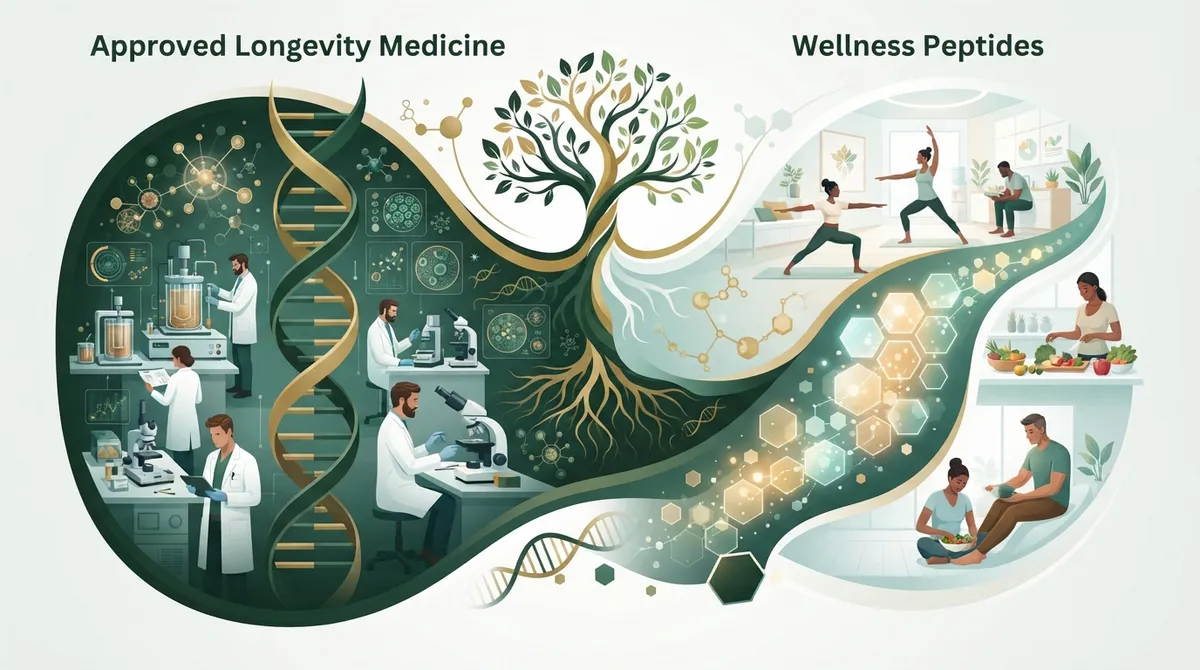
In this guide, we’ll compare the two big groups side by side: approved peptide medicines and wellness-marketed peptides. You’ll learn what longevity medicine actually aims to do, where each group fits, and how to spot a safe, evidence-minded approach. Whether you’re a health optimizer, a busy professional, or just curious about aging well, this will help you cut through the hype with confidence.
Let’s dig in, friend.
What Longevity Medicine Really Means
Longevity medicine is a broad field. At its core, it focuses on preserving health and function as you age. It also aims to lower your risk of age-related disease.
Notice what that does not say. It doesn’t promise to stop aging. It doesn’t guarantee a longer life. It’s about healthspan, which means the years you feel strong, sharp, and independent.
Most longevity care includes a mix of things, such as:
- Lab testing and biomarker tracking
- Sleep, nutrition, and exercise coaching
- Hormone evaluation and support when appropriate
- Metabolic health and weight management
- Targeted medications or therapies chosen by a licensed provider
Peptides can sit inside that toolkit. But being used in longevity medicine is not the same as being proven to slow aging. That’s a distinction worth holding onto. If you want a deeper look at this idea, our article on whether peptide therapy can really help slow aging breaks it down further.

First, What Are Peptides?
Peptides are short chains of amino acids, the building blocks of proteins. Your body makes many of them naturally, and they act like tiny messengers. Some tell your body to release hormones. Others help manage blood sugar, appetite, or tissue repair.
If you want a plain-language primer, this overview of what are peptides is a handy place to start. For a more science-focused look, the National Library of Medicine hosts peer-reviewed research on peptide therapeutics.
Here’s the key idea: because peptides are signals, they can be powerful. That is exactly why quality, dosing, and medical oversight matter so much.
Approved Peptide Medicines vs. Wellness Peptides
Think of peptides as two neighborhoods. In one, the medicines have been reviewed and approved for specific conditions. In the other, the products are popular but have much thinner human evidence.
| Feature | Approved Peptide Medicines | Wellness-Marketed Peptides |
|---|---|---|
| Examples | GLP-1 receptor agonists, insulin | BPC-157, ipamorelin, CJC-1295, TB-500, epitalon |
| FDA approval | Yes, for specific conditions | Generally no approval for longevity claims |
| Human evidence | Established for approved uses | Limited or insufficient in many cases |
| Main research base | Clinical trials | Often preclinical (lab and animal studies) |
| Longevity claim support | Not proof of anti-aging | Not established |
| Safety data | Well characterized for approved uses | Limited, route-specific gaps |
That table tells the story. An approved peptide drug has real evidence for its condition. It does not validate other peptides, and it does not prove a general anti-aging effect.
The Approved Side: Where the Evidence Is Strongest
Approved peptide medicines have earned their place. GLP-1 receptor agonists, for example, are approved for particular uses like type 2 diabetes and weight management. Insulin is another long-standing peptide medicine.
Why does this matter for longevity? Because metabolic health is a huge piece of healthy aging. Carrying excess weight and having poor blood sugar control are linked to many age-related problems. Supporting metabolism can be a smart, evidence-based part of a longevity plan.
Still, be careful with the logic. An approved weight-management drug is great for weight management. That doesn’t mean it extends lifespan on its own. We should respect what the evidence actually shows.
If metabolic goals are on your radar, you may find these helpful:
- How Do You Qualify for GLP-1 Medication in 2026?
- How Does GLP-1 Work for Weight Loss, Really?
- Semaglutide vs. Tirzepatide: Which Peptide Wins in 2026?
The Wellness Side: Popular, but Still Experimental
Now for the other neighborhood. Peptides like BPC-157, ipamorelin, CJC-1295, TB-500, and epitalon get a lot of attention for recovery, sleep, energy, and anti-aging. The excitement is real. The human evidence, honestly, is not there yet.
Here’s what the research picture looks like right now:
- Much of the cited research is preclinical, meaning lab or animal work.
- Robust human trials proving longevity benefits are lacking.
- No reliable, widely accepted statistic shows that peptide therapy extends human lifespan.
That doesn’t mean these peptides are useless or that nothing will ever be proven. It means we should be honest about where the science stands in 2026. Curious readers can explore specifics in our guides on what research supports peptide therapy and what the research really shows about BPC-157.
Safety Questions You Should Ask
Safety is where this comparison gets serious. The FDA has flagged several concerns about certain compounded peptides, including:
- Immunogenicity, which means your immune system may react to the product.
- Peptide-related impurities that can sneak into poorly made batches.
- Trouble characterizing the active ingredient, so you can’t be sure what’s really inside.
- Limited human safety information, especially for certain routes of use.
One example from FDA materials: a published study of intravenous ipamorelin used for gastric motility reported serious adverse events, including death. That finding doesn’t describe every use or every route. But it shows why route-specific safety data matters.
The FDA also notes that safety information for BPC-157 is absent or limited for proposed routes of use. So “popular” and “proven safe” are two very different things.
Compounded Drugs and “Research Use Only” Products
Two more terms trip people up, so let’s clear them.
Compounded drugs are not FDA-approved. They aren’t reviewed by the FDA for safety, effectiveness, and quality before marketing the way approved drugs are. Compounding is also legally restricted. Having a prescription or a pharmacy-prepared product does not mean a peptide is approved or proven for longevity.
“Research use only” products sold online are a bigger red flag. That label does not make something safe for humans. These products often skip the quality controls you’d want for anything you inject.
This is exactly why a licensed clinician matters. If you’re weighing options, our guides on how to find legal peptide therapy you can trust and approved peptides versus wellness peptides are worth a read.
How the Two Approaches Fit Into a Longevity Plan
So where does each group belong? Here’s a simple way to picture it.
| Goal | Evidence-Based Option | Experimental Option |
|---|---|---|
| Metabolic health and weight | Approved GLP-1 medications, when appropriate | Other peptides with limited human data |
| Hormone balance | Lab-guided hormone evaluation and therapy | Growth-hormone-related peptides |
| Recovery | Sleep, training, nutrition, medical guidance | BPC-157, TB-500 |
| Skin and aging | Sun protection, proven skin care, medical advice | Select wellness peptides |
A thoughtful longevity plan leans on the strongest evidence first. It treats experimental options carefully, with informed consent, medical oversight, and honest expectations.
How to Tell if a Peptide Treatment Is Evidence-Based
This is the part biohackers and busy professionals will love. Use this quick checklist before you start anything:
- Ask about regulatory status. Is it FDA-approved, compounded, or sold as “research use only”?
- Ask what it’s intended for. Does the evidence match your actual goal?
- Look for human data. Animal studies are a starting point, not proof.
- Insist on lab work. Treatment should be guided by your bloodwork, not guesswork.
- Confirm a licensed clinician is involved. You should have real monitoring and follow-up.
- Be wary of big promises. Anyone guaranteeing you’ll “reverse aging” deserves a raised eyebrow.
Want to go deeper on this? Try 15 Peptide Consultation Questions to Ask in 2026 and Lab Work for Peptide Therapy: What to Test and Why.
The Role of Personalization and Telehealth
Here’s where modern care shines. Longevity isn’t one-size-fits-all. Your labs, your history, and your goals should shape the plan. That’s why personalized, medically supervised care beats grabbing a random product online.
Telehealth makes this easier for busy people. You can complete a virtual consultation, get blood work done locally, and have treatment delivered to your door. At Allura Longevity, licensed providers design customized treatment plans from your lab results and health goals, then adjust them over time with ongoing monitoring. It’s a practical way to stay consistent without rearranging your calendar.
Curious how this works? Check out what really happens during a peptide telehealth visit and what to expect from home-delivered peptides.
So, Is Peptide Therapy Part of Longevity Medicine?
Let’s wrap the comparison in plain words.
Approved peptide medicines have a clear, evidence-backed role for specific conditions, especially around metabolic health. They can support a longevity plan, but they aren’t magic anti-aging pills.
Wellness-marketed peptides are widely discussed, yet the human evidence is limited, and regulatory and safety questions remain. They belong, if at all, under careful medical guidance with realistic expectations.
So yes, peptide therapy can be part of longevity medicine. The smartest approach is to be curious, stay skeptical of hype, and work with licensed providers who put your safety first. That balance is what separates a real longevity strategy from a trend.
Ready to see what a personalized, lab-guided plan could look like for you? Request a consultation with Allura Longevity. A virtual visit is just $50, and our team, led by board-certified Family Nurse Practitioner Ashley, will walk you through your options. Spots for new clients are limited each month, and you can call (813) 510-6277 with questions. We serve clients in Florida, Georgia, Texas, Connecticut, Indiana, Maryland, New York, and California.
FAQs
Q: Is peptide therapy considered longevity medicine?
A: It can be part of it, yes! Longevity medicine aims to preserve health and function as we age, and some peptide medicines support goals like metabolic health. But the term covers very different treatments, so it’s important to separate approved uses from experimental ones.
Q: Can peptide therapy slow aging or extend lifespan?
A: Right now, there’s no reliable evidence showing that peptide therapy extends human lifespan. Some peptides have solid evidence for specific health conditions, but many popular anti-aging peptides rely mostly on early lab and animal research. Honest expectations are your best friend here.
Q: Are BPC-157, ipamorelin, or CJC-1295 FDA-approved?
A: No, these peptides are not FDA-approved for longevity or anti-aging claims, and human evidence for them is limited. The FDA has also raised safety questions about certain compounded peptides, which is why working with a licensed clinician really matters.
Q: Are compounded peptides safe and legal?
A: Compounded drugs are legal in certain settings but aren’t FDA-approved or reviewed for safety, effectiveness, and quality in the same way as approved medicines. A prescription doesn’t make a peptide proven, so always ask your provider about the product’s regulatory status, risks, and intended use.
Q: How can I tell whether a peptide treatment is evidence-based?
A: Check whether it’s FDA-approved for your goal, look for human clinical data, and make sure treatment is guided by your lab work and a licensed provider. If someone promises dramatic anti-aging results or sells “research use only” products for personal use, treat that as a red flag.





