
Key Takeaways
-
The phrase "peptide facial glow treatment" is a marketing label, not a standard medical procedure, and can mean either a peptide skincare facial or an injectable peptide blend.
-
Topical peptide evidence is early: a 2024 review of nine human studies reported improvements in fine lines, texture, and elasticity in some, but randomized controlled trials are scarce.
-
Good results from a peptide cream do not prove an injectable glow stack works, since the route, dose, and product differ.
-
Injectable glow stacks lack established clinical evidence for safety or effectiveness as a combination, and compounded products are not FDA-reviewed for safety, effectiveness, or quality.
-
Before any injectable peptide treatment, ask what is in the product, whether it is FDA-approved or compounded, where it is made, what the risks are, and how progress will be monitored.
-
Daily broad-spectrum sunscreen, gentle skincare, sleep, and hydration have stronger support for skin appearance than any peptide product, and should be the foundation of any plan.
You have probably seen the phrase “peptide facial glow treatment” all over your feed lately. Maybe it showed up next to a glowing before-and-after photo. Maybe a friend mentioned a “glow stack.” It sounds exciting. It also sounds a little confusing, and that is okay.
Here is the thing. The phrase does not mean just one thing. Some people use it for a spa facial or a serum that contains peptides. Others use it for injectable peptide blends promoted for skin rejuvenation. Those two paths are very different when it comes to evidence, safety, and oversight.
In this friendly guide, we break down 12 facts to help you sort real science from hype in 2026. We will cover what topical peptides can and cannot do, what we do not yet know about injectable “glow” stacks, and how to ask smart questions before you try anything. Whether you are a health optimizer, a busy professional, or simply curious, you deserve clear, honest answers. Let’s dive in.

12 Facts About Peptide Facial Glow Treatment
Each fact below is short and practical. Use them as a checklist as you explore your options.
Fact 1: The Phrase Is Not a Standard Medical Procedure
A peptide facial glow treatment is a marketing label, not a defined medical procedure. It may describe a facial that uses peptide-based products. It may also describe an injectable peptide combination sold in wellness circles. Always ask exactly what is being used and how it is given.
Fact 2: Peptides Are Short Chains of Amino Acids
Peptides are small strings of amino acids, the building blocks of proteins. Your body makes many of them naturally. If you want a simple primer, our guide on 8 Facts That Explain What Are Peptides in 2026 walks through the basics. You can also read this overview of what are peptides from WebMD.
Fact 3: Topical Peptides Are Cosmetic Ingredients
Peptides in creams and serums are used to support the look of skin. Proposed effects include signaling related to collagen and other skin structures. Results depend on the specific peptide, its concentration, the formula, and whether it can reach the right skin layer. In short, not every peptide product is created equal.
Fact 4: The Topical Evidence Is Promising but Early
A 2024 systematic review looked at nine human studies of topical peptides. It reported improvements in fine lines or wrinkles in three studies, skin texture in three, and elasticity in two. One study found no elasticity benefit. The authors noted that randomized controlled trials are scarce, so the findings are preliminary.
Fact 5: Topical Studies Do Not Prove Injectable Glow
This one matters. Good results from a cream do not prove that an injection will make your face glow. Different route, different dose, different product. Evidence for one cannot simply be borrowed for the other.
Fact 6: Injectable “Glow Stacks” Lack Combined Evidence
Injectable “glow” stacks are blends promoted for skin appearance. As a combination, they do not have established clinical evidence for safety or effectiveness. Even if one ingredient has some research, that does not validate the full stack, the dose, or the claimed cosmetic result. We cover this idea more in Single Peptides vs. Peptide Stacks: Which Wins?
Fact 7: Compounded Does Not Mean FDA-Approved
Compounded drugs are not FDA-approved, and the FDA does not review them for safety, effectiveness, or quality before they are marketed. A product being called a “peptide treatment” does not mean it has been shown to treat a medical condition. For a deeper look, see FDA-Approved vs. Compounded Peptides: What Wins?
Fact 8: Where You Buy Matters a Lot
Products from unregulated online sellers may have uncertain identity, strength, purity, or sterility. Injection adds risks like infection and dosing errors. A licensed clinician and a reputable pharmacy source make a real difference. Learn more in How to Get Prescription Peptides Safely in 2026.
Fact 9: “Glow” Is a Cosmetic Word, Not a Medical Result
Radiance, brightness, and “glow” are subjective. They are not clinical outcomes you can measure the same way you measure blood pressure. Be cautious of any provider who promises a guaranteed glow.
Fact 10: Skin Is Shaped by Many Everyday Factors
Sun exposure, sleep, hydration, nutrition, stress, and hormones all influence how skin looks. Sunscreen alone is one of the best-studied tools for protecting skin over time. Peptides should never replace these basics.
Fact 11: Timelines Vary and Should Be Realistic
There is no universal timeline for a peptide facial glow treatment. Topical products are often used consistently for weeks before any change in texture may be noticed, if at all. Be wary of anyone who promises overnight transformation.
Fact 12: A Qualified Clinician Should Guide Injectable Options
If you are considering anything injectable, talk with a licensed medical provider first. Ask about the product source, the evidence, the risks, and the monitoring plan. Personalized care based on your labs and goals is the safest starting point.
Topical vs. Injectable: A Quick Comparison
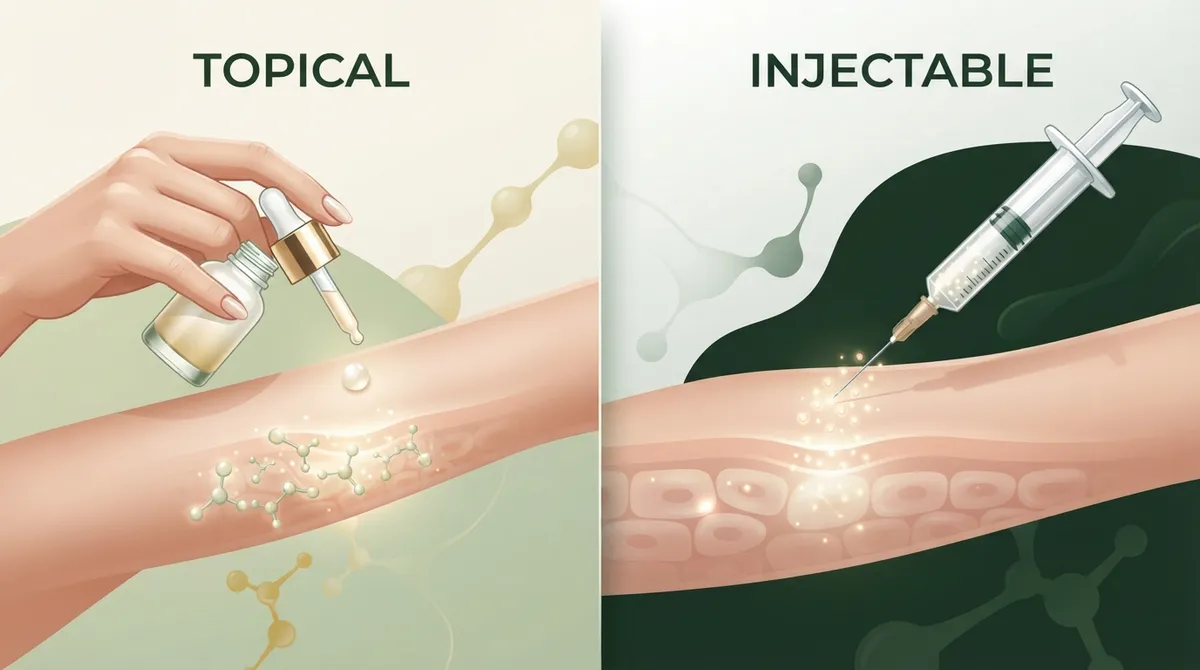
The table below puts the two main meanings of “peptide facial glow treatment” side by side. It is a simple way to see why they should not be treated as the same thing.
| Feature | Topical Peptide Skincare or Facial | Injectable Peptide “Glow” Stacks |
|---|---|---|
| What it is | Serums, creams, or in-spa facials with peptide ingredients | Peptide blends given by injection and promoted for skin appearance |
| Category | Cosmetic | Medical or wellness, often compounded |
| Evidence level | Early, formulation-specific, limited randomized trials | No established evidence for the combination |
| Main risks | Irritation or sensitivity in some people | Infection, dosing errors, uncertain product quality |
| Oversight | Cosmetic product rules | Compounded products are not FDA-reviewed for safety, effectiveness, or quality |
| Who should guide it | Skincare professional or dermatology provider | Licensed medical provider |
What the Research Actually Says
Let’s keep the numbers in perspective. They help us stay honest without losing our enthusiasm for good skincare.
- Nine human studies: The 2024 review of topical peptides looked at nine studies in total.
- Fine lines and wrinkles: Three studies reported improvement.
- Skin texture: Three studies reported improvement.
- Elasticity: Two studies reported improvement, while one found none.
- Side effects: None of the included human studies reported negative side effects, though this does not prove safety for every product or any injectable use.
The authors described the evidence as limited, with few randomized controlled trials. That is why we call the results preliminary. You can explore the research landscape through the National Library of Medicine, which hosts many peer-reviewed studies.
How to Tell Cosmetic Skincare From Medical Peptide Therapy
This is where many people get tripped up. A peptide serum from a skincare shelf and a peptide therapy plan from a licensed provider are not the same thing. Think of it like the difference between a moisturizer and a prescription.
Peptide therapy in a medical setting is built around your health history, goals, and lab results. It is designed and monitored by licensed providers. Skincare peptides, on the other hand, are cosmetic products meant to support how skin looks.
If you want to see how different peptide approaches compare for skin, take a look at What Peptides Do for Skin: A Real-World Guide for 2026 and 12 Peptide Skin Rejuvenation Facts Worth Knowing (2026). They go deeper on realistic expectations.
Questions to Ask Before You Try Any Injectable Peptide Treatment
A great provider will welcome your questions. Use this numbered list as your pre-visit checklist.
- What exactly is in this product? Ask for the ingredient names and amounts.
- Is it FDA-approved or compounded? Make sure you understand which one it is.
- Where is it made? Ask about the pharmacy and quality standards.
- What does the evidence say for this exact use? Listen for honest answers, not guarantees.
- What are the risks and side effects? A good provider will explain them clearly.
- How will you monitor my progress and safety? Look for lab work and follow-up care.
- Who is the licensed clinician guiding my care? Confirm their credentials.
For more ideas, our guide 15 Peptide Consultation Questions to Ask in 2026 has an even longer list, and Is Peptide Therapy Safe? What You Really Need to Know covers the safety side in detail.
Better-Studied Habits for Glowing-Looking Skin
Before you chase a trend, consider the basics that have solid support. They are simple, affordable, and work well alongside any plan you choose.
- Daily sunscreen: Broad-spectrum protection helps guard against sun-related skin aging.
- Consistent gentle cleansing and moisturizing: Healthy barrier support makes skin look calmer and brighter.
- Sleep and stress care: Rest shows up on your face more than any serum can.
- Balanced nutrition and hydration: Skin is part of your whole body.
- Clinician-recommended treatments: A dermatology provider can match proven options to your skin type.
Some people also like to look at the bigger picture of aging and wellness. If that is you, Anti Aging Peptide Treatment: What Really Works in 2026 is a helpful next read.
Matching the Right Approach to Your Goals
Every reader comes to this topic with a different goal. Here is a simple way to think about it.
| Your Profile | What to Focus On First |
|---|---|
| Health optimizers | Evidence-based basics, labs, and a clinician who explains the science |
| Aging adults | Sun protection, gentle skincare, and realistic expectations |
| Biohackers | Verified product sources, tracked results, and honest data |
| Busy professionals | Simple routines and convenient telehealth consultations |
| Wellness seekers | Whole-body support, with skin as one piece of the picture |
How Allura Longevity Fits In
At Allura Longevity, we believe you deserve straight talk. We offer personalized, medically supervised peptide therapy through telehealth, guided by licensed providers and led by Ashley, a board-certified Family Nurse Practitioner. Care starts with a $50 virtual consultation and LabCorp blood work, followed by a customized six-month plan delivered to your home, with ongoing monitoring and adjustments. We serve clients in Florida, Georgia, Texas, Connecticut, Indiana, Maryland, New York, and California.
We will always tell you what is well supported and what is still unproven. If you are curious about peptides for women or peptides for men, we are happy to talk through realistic options. You can also read How to Start Peptide Therapy Safely and See Real Results to learn what a safe start looks like.
Final Thoughts: Glow Smart, Not Fast
A peptide facial glow treatment can mean a lot of things, and now you know how to tell them apart. Topical peptides show early, encouraging signs for fine lines, texture, and elasticity, but the evidence is still limited. Injectable glow stacks do not have established proof for safety or effectiveness as a combination, and compounded products are not FDA-reviewed for quality.
The smartest move is to stay curious, ask good questions, and work with a licensed provider you trust. Glowing skin is a journey, not a shortcut, and you do not have to figure it out alone.
Ready to talk through your goals with a licensed provider? Request a consultation with Allura Longevity today, or call (813) 510-6277. Spots for new clients are limited each month, so reach out while there is room.
FAQs
Q: What is a peptide facial glow treatment?
A: It is a marketing phrase, not a standard medical procedure. It can mean a facial or serum that uses peptide ingredients, or an injectable peptide blend promoted for skin appearance. These two approaches are very different in evidence, risk, and oversight.
Q: Do topical peptides really improve glow, wrinkles, or firmness?
A: Early research is encouraging. A 2024 review of nine human studies reported improvements in fine lines, texture, and elasticity in some of them. But the evidence is limited and results depend on the exact product, so think of it as promising rather than proven.
Q: Are injectable peptide glow treatments FDA-approved?
A: Injectable glow stacks do not have established clinical evidence as a combination. Compounded products are not FDA-approved, and the FDA does not review them for safety, effectiveness, or quality before they are sold. Always ask your provider exactly what you are receiving.
Q: Is a peptide facial the same as peptide therapy?
A: No. A peptide facial is a cosmetic treatment focused on skin appearance. Peptide therapy is a medical approach designed and monitored by a licensed provider based on your health history and labs.
Q: What should I ask a provider before trying an injectable peptide treatment?
A: Ask what is in the product, whether it is FDA-approved or compounded, where it is made, what the evidence says, and what the risks are. Also ask how your progress and safety will be monitored. A trustworthy provider will happily answer every question.





