
Key Takeaways
-
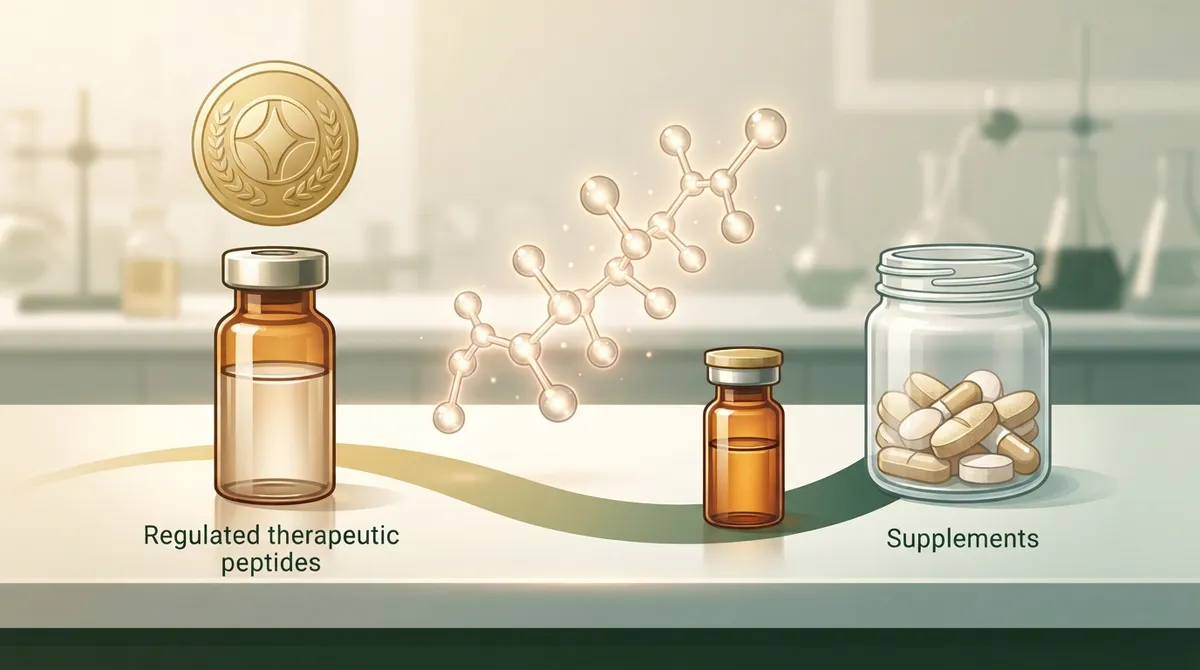
Therapeutic peptides and supplements are different regulatory categories: FDA-approved peptide drugs are reviewed for safety, effectiveness, and quality before sale, while supplements get no premarket approval.
-
The word 'peptide' describes a molecule, not safety or legal status, so always check the exact product name and its FDA status before buying or using it.
-
Supplements cannot legally claim to diagnose, treat, cure, or prevent disease; a product making those claims may be regulated as a drug regardless of its label.
-
FDA approval covers only a specific product and its labeled use, so one approved peptide does not make other peptides or uses approved.
-
Compounded peptides sit between approved drugs and supplements: they are prescribed for individual patients but are not FDA-approved or reviewed for safety, effectiveness, or quality.
You are standing in the wellness aisle, or scrolling online, and you see the word “peptide” everywhere. One bottle promises glowing skin. Another ad promises better recovery. Then a friend tells you about peptide therapy from a medical provider. So here is the big question: are therapeutic peptides the same as supplements?
The short answer is no. They may share a word, but they live in different worlds. One is a medicine category that comes with medical oversight. The other is a food-style product category with lighter rules. Knowing the difference helps you protect your health and your wallet.
In this friendly guide, we will walk you through how to spot the difference, step by step. Whether you are a busy professional, a data-loving biohacker, or someone who already invests in wellness, you will leave with clear tools for choosing wisely in 2026.
The Quick Answer: Why the Word Peptide Is Not Enough
A peptide is simply a short chain of amino acids. Think of it like a tiny string of building blocks. Your body makes thousands of them. If you want a deeper primer, 8 Facts That Explain What Are Peptides in 2026 covers the basics, and this overview of what are peptides is a helpful outside read.
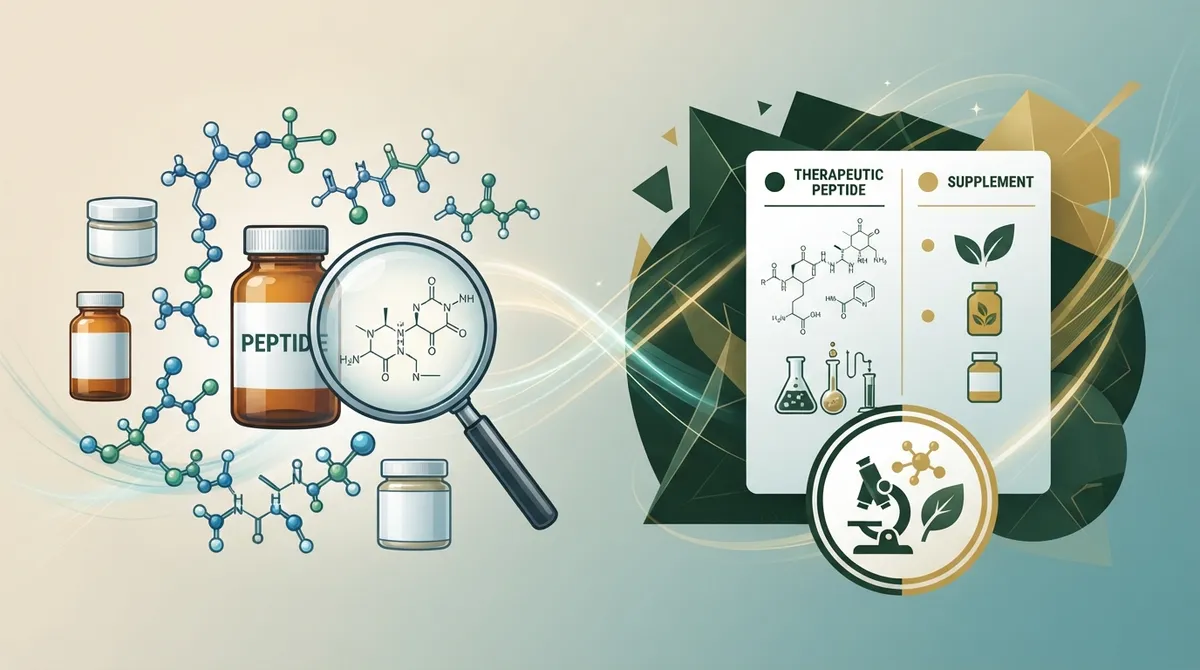
Here is the key point. The word “peptide” describes a type of molecule. It does not tell you if a product is a medicine, a supplement, safe, or effective. A peptide-containing product is not automatically a drug or a supplement. How it is made, how it is marketed, and what it claims all matter.
So when someone asks if therapeutic peptides are the same as supplements, the honest answer is that they are different regulatory categories, even if both involve amino acid chains.
Step 1: Understand the Two Different Rulebooks
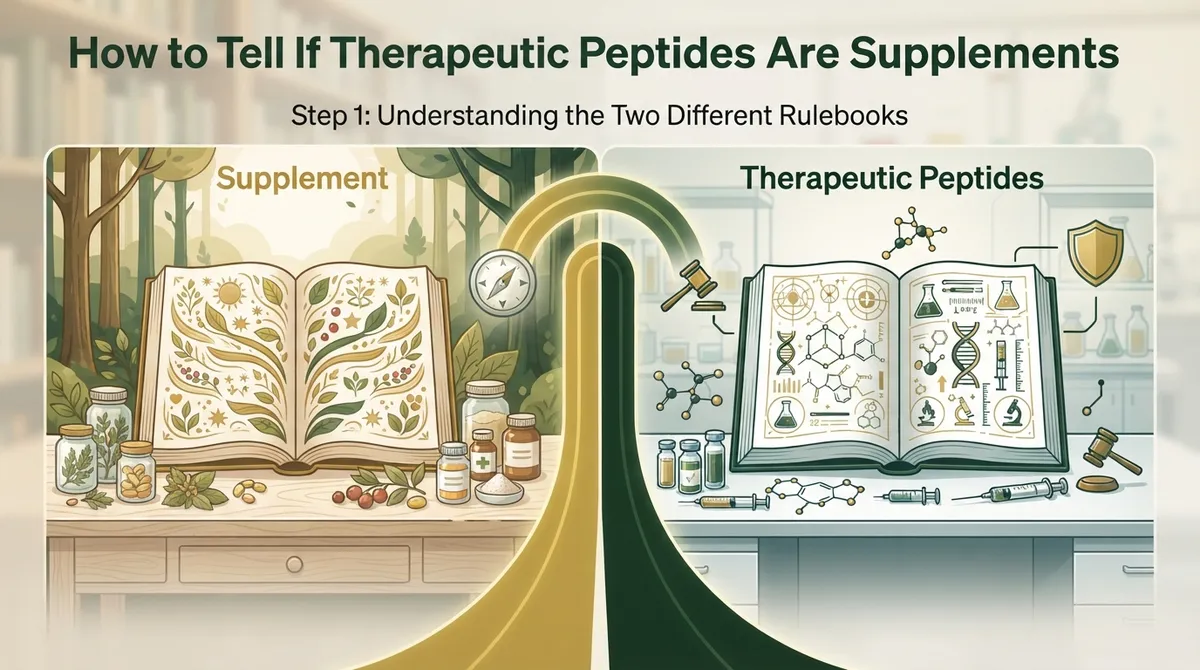
In the United States, medicines and supplements follow different rules. This is the foundation for everything else.
How medicines are regulated
When the FDA approves a peptide drug, it reviews evidence that the product is safe and works for a specific use. It also reviews manufacturing quality. Approval applies to that exact product and its labeled use. It does not mean every peptide, or every use of a peptide, is approved.
How supplements are regulated
Dietary supplements follow a law called the Dietary Supplement Health and Education Act of 1994 (DSHEA). The FDA does not approve supplements for safety or effectiveness before they are sold. Companies are responsible for making safe products and for making truthful, supported claims. The FDA generally steps in after a product is on the market.
| Feature | FDA-Approved Peptide Drug | Dietary Supplement |
|---|---|---|
| Reviewed before sale? | Yes, for safety, effectiveness, and quality | No premarket approval for safety or effectiveness |
| Can claim to treat disease? | Yes, for its approved use | No |
| Who guides use? | Licensed clinician with prescription | Consumer decides |
| Label requirements | Approved labeling and indication | Supplement facts and FDA disclaimer |
Step 2: Check What the Product Claims
Claims are one of the easiest clues. Supplements can make what are called structure/function claims. These describe how a nutrient supports normal body function. A supplement label might say a product “supports joint comfort.”
But a supplement cannot legally claim to diagnose, treat, cure, or prevent a disease. If a product makes those kinds of claims, it can be regulated as a drug, no matter what the label says. For structure/function claims, makers must notify the FDA within 30 days of marketing and include the required FDA disclaimer on the label.
Here are red flags to watch for:
- Promises to cure or reverse a disease
- “Clinically proven” language with no named study
- Claims that sound too good to be true
- No clear ingredient list or amounts
- No licensed clinician involved at any point
Step 3: Learn What Peptide Therapy Actually Means
“Peptide therapy” is a broad marketing term. It is not a single FDA-approved treatment category. It can describe very different things, from an approved medication to a compounded preparation to a wellness product.
That is why you should look at the exact product, not the label “peptide therapy.” Ask what the product is, what its regulatory status is, and what it is meant to do. If you want to know how to avoid common pitfalls, How to Choose the Right Type of Peptide Therapy is a helpful next read.
In a medical setting, peptide therapy usually means a licensed provider reviews your history and labs, then designs a plan around your goals. That is a very different experience from grabbing a bottle off a shelf.
Step 4: Know Where Compounded Peptides Fit
Here is where things get a little tricky, so let’s take it slowly. Between approved drugs and supplements, there is a third group: compounded preparations.
Compounding is when a pharmacy prepares a medication for a specific patient need. It can be appropriate in certain cases. But compounded drugs are not FDA-approved. The FDA does not review them for safety, effectiveness, or quality before they are marketed in the way it reviews approved drugs.
This does not make compounded products automatically bad. It simply means you deserve to know what you are getting and why. For a deeper comparison, see FDA-Approved vs. Compounded Peptides: What Wins? and 503A vs. 503B: Which Peptide Compounding Wins?
| Category | FDA Reviewed Before Sale? | Typical Access | Best Question to Ask |
|---|---|---|---|
| FDA-approved peptide drug | Yes | Prescription | Is this the labeled use? |
| Compounded peptide | No, not like approved drugs | Prescription, from a pharmacy | Why is compounding needed for me? |
| Peptide supplement | No premarket approval | Over the counter | What is the evidence for this claim? |
Step 5: Verify the Exact Product
Now for the practical part. Here is a simple, numbered checklist you can follow before using any peptide product.
- Name the exact product. Get the specific ingredient name, not just “a peptide blend.”
- Look up the FDA status. Search the FDA’s drug databases to see if the product is approved and for what use.
- Read the labeled indication. Approval covers one use. Make sure the way you plan to use it matches.
- Confirm who is prescribing. A real prescription means a licensed clinician reviewed your health picture.
- Ask about the source. For compounded products, ask how and where it is prepared.
- Discuss risks and alternatives. A good provider will happily walk you through both.
If you want to go deeper on this exact skill, How to Verify FDA Approval Before Peptide Therapy breaks it down further. The National Library of Medicine is also a trustworthy place to read peer-reviewed research on peptide therapeutics.
Step 6: Understand How Supplements Reach the Market
Many people are surprised by how supplements get to store shelves. The FDA generally acts after a product is already being sold. There is one important exception. For certain new dietary ingredients, companies generally must send the FDA a safety notification at least 75 days before marketing.
Supplement labels also have to meet certain requirements, such as listing ingredients and including the FDA disclaimer when making structure/function claims. But meeting label rules is not the same as proving a product works.
That is why reading beyond the front of the bottle matters. Look for third-party testing, clear ingredient amounts, and honest claims. And remember that a supplement can be a fine part of a wellness routine. It just plays a different role than a prescribed therapy.
Step 7: Match the Option to Your Goals
Different readers want different things, so here is how to think about it.
- Health optimizers often want measurable change in energy, sleep, and recovery. Lab data and medical guidance help here.
- Aging adults may care most about safety, so verified products and clinician oversight matter most.
- Biohackers love data. Blood work and follow-up tracking turn guesswork into a plan.
- Busy professionals need convenience, which is where telehealth shines.
- Wellness seekers already take supplements and may be ready for something more tailored.
If you are weighing options, Is Peptide Therapy Safe? What You Really Need to Know offers an honest look at safety questions, and How to Get Prescription Peptides Safely in 2026 shows what a safe path looks like.
What Medically Supervised Peptide Care Looks Like
So what is different about care from a licensed provider? In a well-run telehealth program, you typically start with a consultation, complete lab work, and get a plan built around your results and goals. A provider monitors you over time and adjusts as needed.
At Allura Longevity, clients begin with a $50 virtual consultation and complete blood work through LabCorp. Licensed providers, led by Ashley, a board-certified Family Nurse Practitioner, build a customized six-month plan, and medication arrives at your door. Ongoing monitoring means your plan can change as you do. Telehealth care is available in Florida, Georgia, Texas, Connecticut, Indiana, Maryland, New York, and California.
You can explore options designed for peptides for women and peptides for men, depending on your goals. And if you are curious about convenience, Local Clinic vs. Telehealth: Best Peptide Therapy Near You? compares both paths.
Common Mistakes to Avoid
Let’s wrap up the how-to with a few easy-to-make mistakes. Spotting them early can save you time, money, and worry.
- Assuming “peptide” means safe. The word describes a molecule, not a safety record.
- Assuming one approval covers everything. Approval of one peptide does not mean other peptides are approved.
- Skipping the clinician. Going it alone removes your best safety net.
- Falling for disease claims on supplements. Legally, supplements cannot promise to treat disease.
- Ignoring blood work. Without labs, you are guessing about what your body needs.
For more on common missteps, take a look at 9 Peptide Therapy Specialist Mistakes That Cost You Results.
Your Next Step Toward Confident Choices
So, are therapeutic peptides the same as supplements? No. They sit in different regulatory categories, follow different rules, and play different roles in your health. The word “peptide” alone tells you very little. The exact product, its FDA status, its claims, and the clinician guiding you tell you a lot.
The good news is that you do not have to figure this out alone. Asking smart questions is the most powerful move you can make, and you now have the checklist to do it. If you are ready for a personalized, lab-guided plan from licensed providers, request a consultation with Allura Longevity today. Spots for new clients are limited each month, and you can reach the team at (813) 510-6277. Your future self will thank you for starting with clarity.
FAQs
Q: Are therapeutic peptides FDA-approved drugs or dietary supplements?
A: It depends on the exact product, which is why the word “peptide” alone is not enough. Some peptides are FDA-approved drugs for specific uses, some are compounded preparations, and some are sold as supplements. Always check the exact product and its FDA status.
Q: Can a dietary supplement legally claim to treat a disease?
A: No, and that is a handy red flag to remember. Supplements can make limited structure/function claims, but they cannot claim to diagnose, treat, cure, or prevent disease. A product that does may be regulated as a drug instead.
Q: Does FDA approval of one peptide mean other peptide products are approved?
A: Nope! Approval applies to a specific product and its labeled use. One approved peptide does not make other peptides, or other uses, approved.
Q: Are compounded peptides FDA-approved?
A: No. Compounding can be appropriate for particular patient needs, but compounded drugs are not FDA-approved and are not reviewed for safety, effectiveness, or quality the way approved drugs are. Ask your provider why a compounded option makes sense for you.
Q: What should I ask a clinician before starting peptide therapy?
A: Great question to bring to your visit! Ask for the exact product name, its FDA status and labeled use, the source, the possible risks, and any alternatives. A caring provider will welcome these questions and walk you through each answer.





