

Key Takeaways
-
"Hormone balancing with peptides" is a marketing phrase, not a diagnosis; peptides usually target one specific hormone pathway, so no single peptide can balance all hormones at once.
-
Start with symptoms, medical history, and appropriate lab work before any peptide is considered, so treatment addresses a named cause rather than a vague label.
-
Evidence varies widely: tesamorelin is FDA-approved only for reducing excess belly fat in adults with HIV-associated lipodystrophy, while most other popular peptides lack strong proof for general health goals.
-
Peptides can cause side effects such as blood sugar changes, fluid retention, joint pain, injection-site reactions, and shifts in other hormones, and long-term effects are not well established.
-
Compounded peptides are not FDA-reviewed for safety or quality, and "research use only" products are not meant for people and should never be self-injected.
-
Peptides work best as one piece of a plan alongside sleep, strength training, protein, stress management, and regular check-ups, and a trustworthy provider avoids promises like "reverses aging."
You have probably seen the phrase “hormone balancing with peptides” on social media, in clinic ads, or in a friend’s wellness routine. It sounds simple and hopeful. But what does it really mean? And does it actually work?
Here is the honest answer. “Hormone balancing with peptides” is a marketing phrase, not a medical diagnosis or a single standard treatment. Peptides are short chains of amino acids. Some act like hormones. Others nudge the body’s own hormone signals. The effects depend on the specific peptide, the dose, and the person taking it.
If you are a health optimizer, a busy professional, or someone in midlife who wants to feel more like yourself, this guide is for you. We will walk through seven clear truths so you can spot the real science, skip the hype, and ask smarter questions. If you want a quick refresher first, start with 8 Facts That Explain What Are Peptides in 2026.
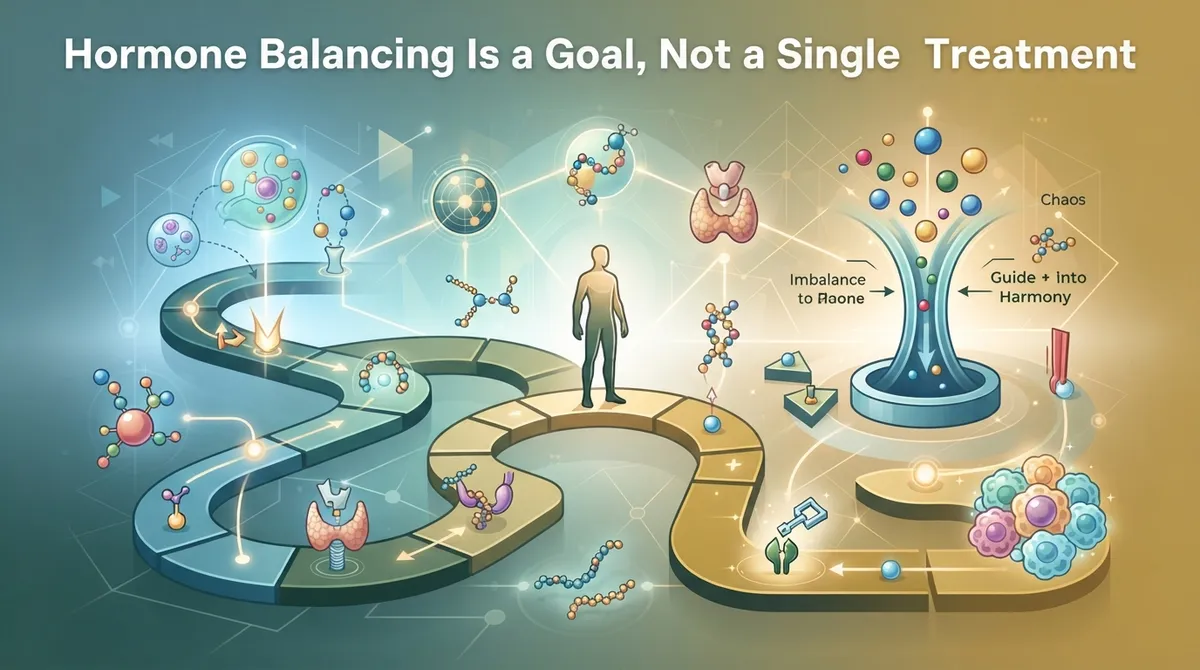
1. “Hormone Balancing” Is a Goal, Not a Single Treatment
Let’s start with the language. Doctors do not diagnose “hormone imbalance” as one condition. They look for specific problems, like low testosterone, thyroid disease, or menopause-related changes. Each one has its own tests and its own treatments.
The same is true for peptides. A peptide that affects growth hormone does not fix your thyroid. A peptide that supports appetite signals does not raise estrogen. So when someone promises to “balance all your hormones” with one product, treat that as a red flag.
A better way to think about it: hormone balancing with peptides means using the right tool, for the right pathway, based on real lab data. That is a much more honest and useful way to look at it. For a deeper look, see How to Approach Hormone Balance With Peptide Therapy.

2. Peptides Work on Specific Pathways, Not Everything at Once
Think of your hormones like a group of radio stations. Each station has its own signal. A peptide usually tunes one station, not the whole dial.
Here are a few examples of how different peptides target different pathways:
- Growth hormone pathway: Peptides like sermorelin, CJC-1295, and ipamorelin signal the pituitary gland to release growth hormone.
- Appetite and metabolic pathways: GLP-1 medications act on hormones that control hunger and blood sugar.
- Sexual response pathways: PT-141 works through the brain’s melanocortin system.
- Reproductive signaling: Gonadorelin and kisspeptin act on the signals that start reproductive hormone release.
A change in one hormone level does not automatically mean you feel better or get healthier. That is why a clinician looks at your symptoms and your labs together, not just one number.
| Peptide Type | Pathway Targeted | What It Does Not Do |
|---|---|---|
| GH secretagogues (CJC-1295, ipamorelin) | Growth hormone and IGF-1 | Does not fix thyroid or sex hormone issues |
| GLP-1 medications | Appetite and blood sugar signals | Does not replace testosterone or estrogen |
| PT-141 | Brain pathways for desire | Does not raise sex hormone levels |
| Gonadorelin | Reproductive signaling | Does not treat growth hormone decline |
3. Evidence and Approval Status Vary a Lot
This is the truth many ads leave out. Not all peptides have the same level of proof behind them.
Some peptides are FDA-approved for specific medical conditions. Tesamorelin is a good example. It is approved for reducing excess belly fat in adults with HIV-associated lipodystrophy. That approval is narrow. It does not prove tesamorelin works for general weight loss, anti-aging, or overall hormone optimization.
Many other peptides sold by clinics and online sellers are not FDA-approved for the uses they are marketed for. For popular growth hormone secretagogues like CJC-1295, ipamorelin, and GHRP-2, much of the research focuses on hormone changes or small, short-term studies. Strong proof of better health, body composition, or quality of life in otherwise healthy people is limited.
A 2026 review of growth hormone and IGF-1 axis peptides reached a similar conclusion. Apart from tesamorelin in its approved use, the evidence for performance or appearance goals is mostly limited, short-term, or based on hormone levels rather than real-world outcomes.
That does not mean peptides are useless. It means you deserve a provider who tells you what is proven, what is promising, and what is still unknown. Learn more in FDA-Approved vs. Compounded Peptides: What Wins?
4. Start With Symptoms and Labs, Not the Peptide
If you take one thing from this article, let it be this: a good plan starts with a question, not a product.
Before any peptide is considered, a qualified clinician should look at the full picture. That means your symptoms, your health history, a physical exam, and appropriate blood work. Hormone levels can change by time of day, stress, sleep, and age, so one number rarely tells the whole story.
Here is a simple step-by-step path that reflects sound practice:
- Track your symptoms. Note energy, sleep, mood, libido, recovery, and weight changes for a few weeks.
- Share your full history. Include medications, supplements, past conditions, and family history.
- Get proper lab work. Your provider chooses tests based on your symptoms and goals.
- Look for a specific cause. The goal is to find a named issue, not just a vague label.
- Choose treatment together. This may or may not include peptides.
- Monitor and adjust. Follow-up labs and check-ins keep the plan safe and useful.
Biohackers, this part will feel familiar. Data first, protocol second. For more on why labs matter, read Why Does Hormone Level Testing Matter for Peptides?
5. Risks Are Real and Depend on the Compound
Peptides are often described as gentle or natural. The truth is more careful than that. Any substance that changes hormone signaling can also cause side effects.
Depending on the peptide, possible risks may include:
- Changes in blood sugar regulation
- Fluid retention and swelling
- Joint or muscle aches
- Shifts in other hormones
- Injection-site reactions
- Immune reactions to the peptide itself
Long-term effects of sustained growth hormone and IGF-1 stimulation are not well established. For context, a review in Endotext found that growth hormone treatment in more than 200 older adults was linked to about 4.6 pounds more lean body mass and a similar fat reduction. But it also came with side effects like swelling, joint pain, carpal tunnel symptoms, and diabetes. That was growth hormone itself, not proof that unapproved peptide plans deliver the same results.
Short-term hormone changes should never be used to claim long-term safety or anti-aging benefits. If you want a plain-language safety overview, see Is Peptide Therapy Safe? What You Really Need to Know.
6. Compounded and “Research Use Only” Peptides Need Extra Caution
Here is where things get serious. Not every vial labeled “peptide” is made or checked the same way.
Compounded drugs are not FDA-approved. The FDA does not review them for safety, effectiveness, or quality before they reach patients. A compounded product should never be described as equivalent to an FDA-approved drug.
The FDA has also raised safety concerns about certain peptides proposed for compounding. These include possible immune reactions and peptide-related impurities. For GHRP-2, the agency notes concerns about aggregation and impurities, and describes reports of serious adverse events, though a direct cause has not been established.
Products sold as “research use only” are even riskier. They are not meant for human use, and quality can vary widely. Please do not self-inject them. Here is a quick comparison to keep in mind:
| Source Type | FDA Review Before Sale? | Clinician Oversight? | Key Concern |
|---|---|---|---|
| FDA-approved peptide medicine | Yes, for a specific use | Yes | Approval applies only to listed use |
| Compounded peptide from a licensed pharmacy | No | Should be | Quality and evidence vary |
| “Research use only” product | No | No | Not intended for people; unknown purity |
To learn how to protect yourself, check out How to Get Prescription Peptides Safely in 2026 and 503A vs. 503B: Which Peptide Compounding Wins?
7. Peptides Are Often One Piece of a Bigger Plan
Here is the good news. When used thoughtfully, peptide therapy can fit into a bigger plan for energy, recovery, metabolism, and healthy aging. But it works best alongside the basics, not instead of them.
Sleep, strength training, protein, stress care, and regular check-ups all shape your hormones. For some people, a diagnosed hormone issue may call for established treatment, like testosterone therapy or menopause hormone therapy. Peptides may be discussed as an add-on in some cases, while in others they may not be the right fit at all.
This is why many people compare options before they decide. You might explore How to Choose Between Bioidentical Hormones and Peptides or look at Hormone Therapy vs. Peptide Therapy: Which Wins? to see how they differ.
Wellness seekers and aging adults often appreciate this balanced view. You do not need a miracle. You need a plan that is personal, monitored, and honest about what it can do. Women exploring this space may also like peptides for women, while men can look at peptides for men.
How to Spot a Trustworthy Peptide Provider
Since the field is full of big claims, it helps to know what good care looks like. Use this checklist when you evaluate any clinic or program:
- They order and review blood work before recommending anything.
- They explain which products are FDA-approved and which are not.
- A licensed clinician reviews your history and monitors your progress.
- They avoid promises like “balances all your hormones” or “reverses aging.”
- They discuss risks and side effects openly.
- They never push “research use only” products for you to inject yourself.
Busy professionals will like that good telehealth care can check these boxes without office visits. Allura Longevity, for example, offers personalized, medically supervised peptide therapy through telehealth. After a virtual consultation and blood work through LabCorp, clients receive a customized plan with ongoing monitoring from licensed providers, with treatment delivered to their home. Care is available in Florida, Georgia, Texas, Connecticut, Indiana, Maryland, New York, and California.
You can also read How to Start Peptide Therapy Safely and See Real Results for a gentle, step-by-step intro. For general background, the what are peptides overview from WebMD and the research collection at the National Library of Medicine are helpful places to keep learning.
Final Thoughts: Be Curious, Stay Careful
Hormone balancing with peptides is not magic, and it is not nonsense either. It is a field with real promise in some areas, limited proof in others, and a lot of marketing noise in between.
The smartest move is simple. Start with your symptoms and labs. Ask which peptide, for which pathway, backed by what evidence. Work with a licensed clinician who monitors you over time. And skip anything that sounds too good to be true.
If you are ready to talk through your goals with a licensed provider, you can request a consultation and see whether a personalized plan makes sense for you. Spots for new clients are limited each month, so reach out when you are ready, or call (813) 510-6277. You deserve care that is thoughtful, personal, and honest.
FAQs
Q: What does hormone balancing with peptides mean?
A: It is a broad marketing phrase, not a medical diagnosis or one standard treatment. Peptides are short amino acid chains, and some influence specific hormone pathways, like growth hormone or appetite signals. What they do depends on the peptide, the dose, and the person.
Q: Can peptides really balance all my hormones?
A: No, and that is a good thing to know up front. Most peptides target one pathway, so they cannot fix every hormone at once. A clinician should use your symptoms and lab results to find a specific issue and choose the right approach.
Q: Which peptides are FDA-approved for hormone-related uses?
A: Tesamorelin is FDA-approved for reducing excess belly fat in adults with HIV-associated lipodystrophy. That approval is very specific and does not cover general weight loss or anti-aging. Many other popular peptides are not FDA-approved for the uses they are marketed for.
Q: What tests should I get before trying peptide therapy?
A: A good starting point is a conversation about your symptoms and history, followed by lab work your provider chooses for your goals. This helps find a real cause instead of guessing. Your clinician will also plan follow-up testing to monitor safety.
Q: Are compounded or research-use-only peptides safe?
A: Compounded peptides are not FDA-approved or reviewed for safety, effectiveness, or quality before sale. Products labeled research use only are not meant for people and should never be self-injected. Working with a licensed clinician is the safest path.





