
Key Takeaways
-
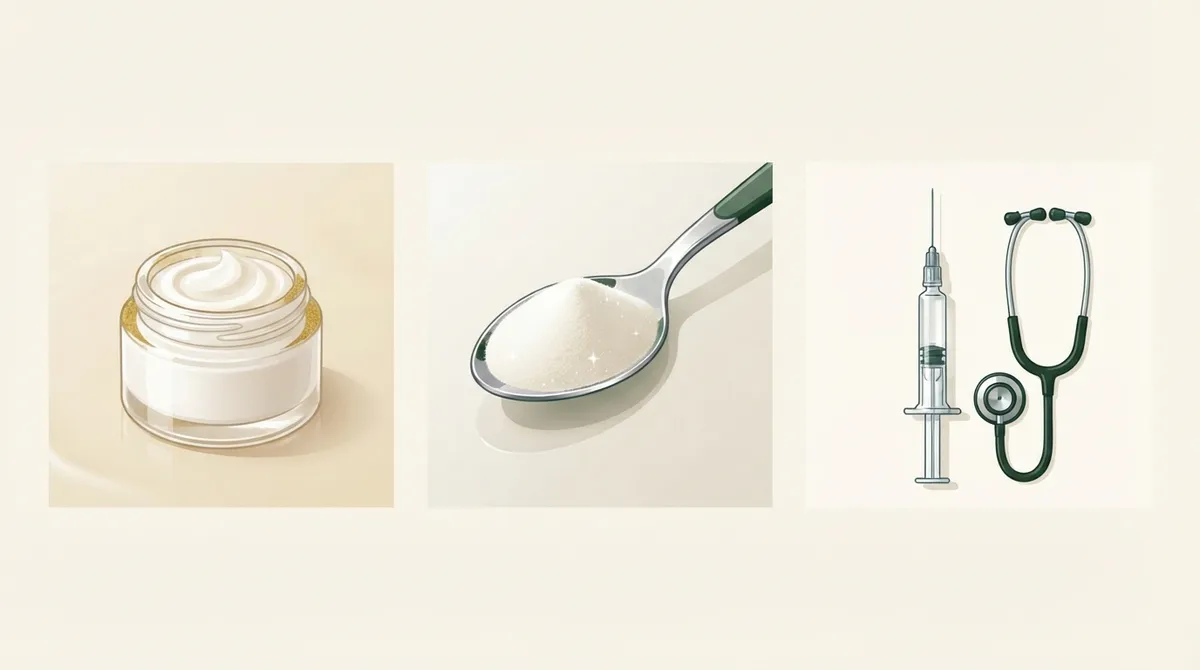
Peptide facial rejuvenation is an umbrella term covering topical creams, oral collagen powders, and injectables, and evidence for one route does not prove anything about the others.
-
Oral collagen peptides have the most consistent human trial data so far; a 2026 trial found 10 g daily for 12 weeks improved wrinkle measures in women aged 35 to 55.
-
Topical peptides look gentle and promising, but a 2024 systematic review found only nine studies and few well-designed randomized trials, so they cannot prove broad benefits.
-
Injectable peptides like GHK-Cu have the weakest facial evidence, relying mostly on lab and animal research, with unanswered questions about dosing and long-term safety.
-
Unapproved or poorly regulated injectables carry risks including contamination, wrong concentration, immune reactions, and infection, so consult a licensed clinician before any injection.
-
Peptides complement proven basics like daily sunscreen and retinoids rather than replacing them, and tracking progress with consistent photos over weeks helps set realistic expectations.
You have probably seen the buzz. Peptide serums, collagen powders, and “glow” injections are all over social media, and each one promises a fresher, firmer face. If you are curious about peptide facial rejuvenation, welcome! You are in good company, and you deserve straight answers.
Here is the catch: “peptide facial rejuvenation” is not one treatment. It is an umbrella term. It can mean a cream you rub on your skin, a powder you stir into your coffee, or a vial that is injected. These are very different things with very different evidence behind them.
In this friendly guide, we will compare the three main routes side by side. We will look at what the research shows in 2026, where the hype runs ahead of the science, and how to make smart choices. Whether you are a busy professional, a data-loving biohacker, or simply someone who wants to age well, you will leave knowing exactly what to ask before spending a dime.

What Does Peptide Facial Rejuvenation Actually Mean?
Peptides are short chains of amino acids, the building blocks of proteins. Your body makes thousands of them, and they act like tiny messengers. If you want a refresher, our guide on 8 Facts That Explain What Are Peptides in 2026 covers the basics, and what are peptides is a handy overview from WebMD.
In skin care, peptide facial rejuvenation usually refers to efforts to improve how the skin looks. People hope for fewer fine lines, better texture, more bounce, and a healthier glow. Notice the word “looks.” These are cosmetic appearance goals, not guaranteed medical outcomes.
The three routes people use are:
- Topical peptides: serums and creams applied to the skin.
- Oral collagen peptides: powders, drinks, or capsules you swallow.
- Injectable peptides: products given by needle, such as GHK-Cu or multi-peptide “glow” blends.
Here is the key rule: evidence for one route does not prove anything about another. A promising cream study says nothing about injections, and vice versa. Keep that in your back pocket as we go.
Topical Peptides: The Cream and Serum Route
Topical peptides are the most familiar option. You will see them labeled as signal peptides or copper-binding peptides such as GHK-Cu. The idea is that they nudge skin cells to support collagen and aid repair.
What the Research Says
A 2024 systematic review looked at nine articles on topical peptides. It reported potential improvements in fine lines, texture, elasticity, and wound healing. That sounds great. But the same review noted that the clinical literature is small and well-designed randomized trials are scarce.
None of those topical studies saw negative side effects in human participants. That is reassuring, yet a small evidence base cannot prove broad or long-term safety. Think of it as a hopeful early chapter, not the whole book.
Who It Fits
Topical peptides are a gentle, low-commitment starting point. They suit wellness seekers who like building a skin routine and want to avoid needles. Just keep expectations realistic. A cream can support your skin’s look, but it is not a facelift in a jar.
Oral Collagen Peptides: The Drink-It Route
Oral collagen peptides have been studied more than many trendy wellness injections. They are broken-down collagen protein that you swallow, often daily.
What the Research Says
A 2026 randomized trial followed 119 women aged 35 to 55 for 12 weeks. They were split into a control group and two groups taking daily oral bioactive collagen peptides at 2.5 g or 10 g. The 10 g group showed statistically significant changes in wrinkle number and length. Both dose groups showed improvement in some hydration or elasticity measures.
That is encouraging, but remember: it describes that specific oral product in that specific trial. It is not proof that every collagen powder works the same way.
A 2026 systematic review and meta-analysis pulled together 19 randomized trials with 1,341 participants across oral and topical peptides. It found a modest pooled effect on wrinkle reduction (MD 0.27, p=0.04), and that result was largely driven by oral polypeptides. Results for elasticity and density were inconsistent. The authors also pointed out that the studies varied a lot, so these findings are preliminary.
For more on this theme, see our article on collagen peptides vs. BPC-157, which shows how different peptide types behave in the body.
Who It Fits
Oral collagen is easy to add to a daily routine. It works well for busy professionals who want a simple habit. Choose products with clear dosing and third-party testing when you can.
Injectable Peptides: The Needle Route
This is where we need to slow down and be extra careful. Injectable peptides promoted for skin, including injectable GHK-Cu and multi-peptide “glow” combinations, are trending. But the evidence is the weakest of the three routes.
What the Research Says
Current claims lean largely on laboratory and animal research. There are not enough high-quality human trials to establish facial benefits, proper dosing, or long-term safety. That is the honest truth, and it matters.
Unapproved or poorly regulated injectables can carry risks. These include contamination, wrong concentration, immune reactions, and injection-related infection or tissue injury. Long-term safety data for many wellness peptides simply do not exist yet.
Not all peptides are alike, either. FDA-approved peptide medicines have product-specific evidence and oversight. That status does not carry over to cosmetic products, compounded preparations, or items sold as “research chemicals.” Our breakdown of FDA-approved vs. compounded peptides explains the difference in plain English.
Who It Fits
If you are drawn to injectables, the safest move is to talk with a qualified clinician first. Ask what the evidence is for your exact goal, where the product comes from, and how it will be monitored. Our guide on how to get prescription peptides safely is a great place to start.
Side-by-Side Comparison
Here is a quick snapshot to help you see the differences at a glance.
| Feature | Topical Peptides | Oral Collagen Peptides | Injectable Peptides |
|---|---|---|---|
| How used | Applied to skin | Swallowed daily | Injected |
| Human evidence | Limited, small studies | More studied, mixed results | Weak, mostly lab and animal data |
| Reported effects | Possible fine line and texture changes | Some hydration, elasticity, and wrinkle changes | Not established for facial benefits |
| Safety data | No side effects seen in small studies | Generally studied in short trials | Long-term data lacking |
| Main risk | Product variability | Product variability | Contamination, dosing errors, infection |
The Verdict: Which Route Wins?
If we are judging by evidence alone, here is the friendly ranking for 2026:
- Oral collagen peptides have the most consistent human trial data, especially for wrinkles and hydration, though results depend on the product.
- Topical peptides show promise and appear gentle, but the studies are small.
- Injectable peptides have the least human evidence for facial results and the most unanswered safety questions.
That does not mean injectables are useless or off limits. It means the proof has not caught up to the marketing. A thoughtful approach respects that gap.
How Peptides Compare With Proven Skin Basics
Here is a gentle reality check. Peptides are not a replacement for the basics that dermatology has long supported. Daily sunscreen, retinoids, and in-office procedures have deep track records for photoaging. Peptides may complement those habits, but they should not replace them.
If you are curious how all the pieces fit together, our article on what peptides do for skin offers a real-world view. You might also enjoy 12 Peptide Skin Rejuvenation Facts Worth Knowing.
Smart Steps Before You Try Anything
Whichever route calls to you, a little homework goes a long way. Here is a simple checklist:
- Name the exact peptide and route. “A peptide glow shot” is too vague. Know what it is and how it is given.
- Separate cosmetic claims from medical claims. Be wary of any promise to “regenerate collagen” or “reverse aging.”
- Check the source. Avoid products sold as research chemicals or with unclear sourcing.
- Get a clinician involved. A licensed provider can review your health history and goals before any injection.
- Track your results. Take photos in the same light and note changes over weeks, not days.
Want a deeper walkthrough? Check out how to start peptide therapy safely and our guide on whether peptide therapy is safe.
Where Personalized Peptide Care Fits In
Healthy-looking skin often reflects what is happening inside your body: sleep, stress, hormones, nutrition, and recovery all play a part. That is why a whole-person approach tends to beat chasing a single miracle product.
Allura Longevity offers personalized, medically supervised peptide therapy through telehealth. It starts with a virtual consultation and blood work through LabCorp, followed by a customized plan reviewed by licensed providers and delivered to your home. The team, led by board-certified Family Nurse Practitioner Ashley, focuses on goals like energy, sleep, recovery, and skin support. Allura does not promise that any peptide will rewrite your face, and you should be cautious of anyone who does. Instead, the goal is thoughtful, monitored care based on your own data.
Telehealth is available nationwide, and Allura is licensed in Florida, Georgia, Texas, Connecticut, Indiana, Maryland, New York, and California. Curious about the experience? Our piece on what really happens during a peptide telehealth visit walks you through it. You can also read the National Library of Medicine for more peer-reviewed background on peptides.
Conclusion: Glow Smart, Not Fast
Peptide facial rejuvenation is exciting, but it works best when you know what you are buying. Oral collagen peptides have the most consistent human data right now. Topical peptides look promising and gentle. Injectables are the newest and least proven for facial goals, so they deserve the most caution and the most professional guidance.
The best skin plans are patient, personalized, and honest about limits. If you want a licensed team to help you sort through the options with real lab data, we would love to chat. Spots for new clients are limited each month, so don’t wait too long. Request a consultation or call (813) 510-6277 to get started.
FAQs
Q: What is peptide facial rejuvenation?
A: It is an umbrella term for topical creams, oral collagen peptides, and injectable peptides marketed to improve how skin looks. Each route is different, and the evidence for one does not apply to the others. It is best viewed as a cosmetic appearance goal, not a guaranteed medical result.
Q: Do peptide creams reduce wrinkles or improve collagen?
A: Some small studies suggest topical peptides may help fine lines, texture, and elasticity. A 2024 review noted, though, that strong randomized trials are limited. So they may help support your skin’s look, but they are not a proven way to rebuild collagen.
Q: Is injectable GHK-Cu proven to rejuvenate facial skin?
A: Not yet. Claims for injectable GHK-Cu and multi-peptide glow blends rely mostly on lab and animal research. High-quality human trials on facial benefits, dosing, and long-term safety are still lacking, so talk with a qualified clinician before considering injections.
Q: Are oral collagen peptides effective for skin aging?
A: They have more human trial data than many injectables. A 2026 trial of 119 women found that 10 g daily for 12 weeks improved wrinkle measures, and a 2026 meta-analysis found a modest wrinkle benefit. Results vary by product and study, so effects are not guaranteed.
Q: What are the risks of peptide injections for skin?
A: Unapproved or poorly regulated injectables can bring risks like contamination, wrong concentration, immune reactions, and infection or tissue injury. Long-term safety data are also missing for many wellness peptides. Working with a licensed provider and a trusted source helps lower these risks.





